8 Ways to Spot a Liar
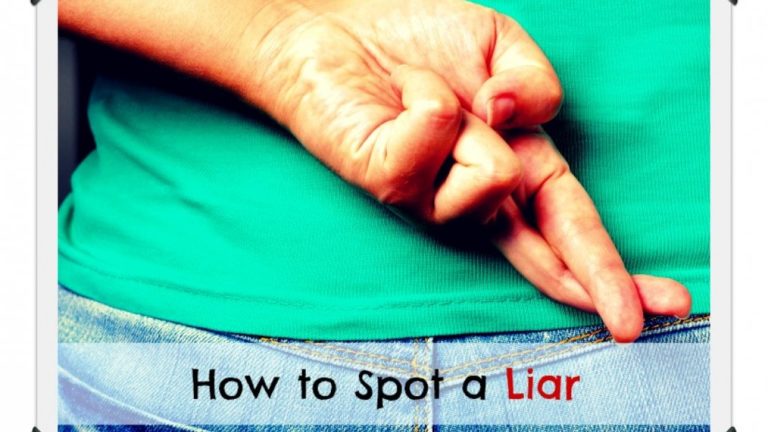
Little white lies, big ol’ whoppers of deception…they’re everywhere in our lives whether we like it or not. While you may not be able to stop them, you might be able to tell when they’re happening and act accordingly. As it turns out, there are several telltale signs that the average liar throws out there, so keep an eye open and detect deception for yourself:
Facial Signs
People may think they can conceal their emotions, but studies have proven they can’t hide everything! Experts advise paying close attention to hard-to-hide micro-expressions; these clues are often so difficult to detect that even trained experts have trouble discerning them. But you may be able to spot the more obvious ones, like reddening on the person’s cheeks, since anxiety can cause people to blush. Other indicators of lying? Flared nostrils, lip nibbling, deep breathing, and rapid blinking, which hint that the brain is working overtime.
Eye Movement
Generally, if people are thinking of visual information to answer a question, their eyes will move up. This is how they retrieve mental pictures. Most right handed people will look up and right when remembering and up and left when creating or visualizing. This is an unconscious habit, but it’s also a reliable one. Looking up and to the left doesn’t necessarily mean that the person is making something up, however. It simply means she’s searching for a mental picture.
The key in reading eye movements is the same as reading other clues. You look for what’s different. Notice when they don’t look up in the same way, or when they look up but perhaps to the other side, or when they maintain eye contact with you when they would normally do otherwise.
This bit last is an interesting point. Most people imagine that we maintain eye contact when we tell the truth and break it when we lie. Not true. The majority of people will maintain eye contact when lying, because they don’t need to retrieve information from their minds and, therefore, don’t need to move their eyes. At another level, they are eager to appear sincere, and so consciously decide to keep looking at you. The eyes are the window!
Body Language
When discerning a person’s truthfulness, it’s important to examine the person’s overall status, as there’s no one feature that’s guaranteed to give her away. Honesty is characterized by features that are in sync with one another—so besides posture, notice the fit between face, body, voice, and speech. Like an animal avoiding detection, a liar may pull his arms and legs inward or keep his movements to a minimum—anything to appear smaller. Liars often shove their hands behind their back because those fidgety fingers might give them away.
Smiles
Is she just happy? Or is she lying? A smile can sometimes mask a person’s true feelings. Pay close attention to how a person smiles as well as other facial movements. You may be able to detect the emotions he or she is trying to hide—such as fear, anger, and disgust. A true smile will incorporate both a person’s lips and eyes.
Voice Pattern Cues
Although a change in voice can be the tip-off to spot a liar, experts say that to be sure, you should also pay attention to a person’s speech rate and breathing pattern—if either speeds up or slows down, chances are you’re not hearing the whole truth.
Word Cues
Liars tend to avoid exclusionary words like “but,” “nor,” “except,” and “whereas,” because they have trouble with complex thought processes. Also, they are less likely to use the words “I,” “me,” and “mine.” In their attempts to distance themselves psychologically from their tall tales, liars will tend to communicate using fewer personal pronouns. Instead, they’ll speak about themselves in the third person (“This is a girl who doesn’t like to commit”) or even truncate their language (“Nice to be here today”)—anything to give themselves psychological distance from the lie.
The Question
It’s normal for someone to look away when asked a difficult question. But when someone avoids your gaze when asked a simple question, you should probably think twice.
Sworn Statements
To sell us on the integrity of their answers, liars often use phrases emphasizing the validity of their statements, like “To tell the truth” and “To be perfectly honest.” Guess what? More often than not, these verbal tip-offs frequently invoke religion. Think of expressions like “I swear on a stack of Bibles” and “As God is my witness.” Most truthful people don’t need to go that far.
About the Author

Top 10 Transformational Videos On Gaia

1. E-Motion
Our western mentality of coping with this is to prescribe drugs and external modalities when we might be missing a solution that’s right in front of us, or rather inside of us. E-motion takes us through the proven methods of doctors and psychologists pioneering practices and tools we can implement to allow our bodies to heal themselves.
Through meditation, intention, and reprogramming, E-motion documents the proven mechanisms from New York Times best-selling authors and spiritual leaders, Dr Joe Dispenza, Nassim Haramein, Neale Donald Walsch, and Sonia Choquette. Their techniques will allow you to clear negative emotions and truly achieve your divine purpose.