Is Rh-Negative Blood Alien In Origin?

For decades, the origin of Rh-negative blood has puzzled scientists. While most humans carry the Rhesus (Rh) factor protein—inherited from a common ancestor—a small percentage of the population does not. This biological anomaly has led to both scientific and metaphysical theories, from evolutionary mutation to ancient alien crossbreeding.
Table of Contents
- What Is Rh-Negative Blood?
- Ancient and Spiritual Theories on Rh-Negative Blood
- Where Is Rh-Negative Blood Most Common?
- Frequently Asked Questions About Rh-Negative Blood
What Is Rh-Negative Blood?
Discovered in 1940, Dr. Karl Landsteiner and Alexander S. Wiener, the Rh factor is a protein on the surface of red blood cells, named after the Rhesus macaque monkey. Blood lacking this protein is called Rh-negative. This is a critical factor in human health, especially during pregnancy.
- Rh Incompatibility: If an Rh-negative woman is pregnant with an Rh-positive baby, her body may produce antibodies that attack the fetus, a condition known as hemolytic disease.
- Medical Solutions: Modern medicine uses Rh-D immunoglobulin to prevent this reaction, ensuring the safety of both mother and baby.
This biological incompatibility between Rh-negative and Rh-positive types is a key point for those who question its evolutionary origin.
Where Is Rh-Negative Blood Most Common?
The highest concentration of Rh-negative blood is found in the Basque region, a small area on the Iberian Peninsula between France and Spain.
- Up to 40% of the Basque population is Rh-negative.
- Basque people speak an indigenous, non-Indo-European language, which is isolated from other European languages.
- One scientific explanation for these distinct traits is that the Basque people became genetically and culturally isolated thousands of years ago, preserving their unique characteristics.
Ancient and Spiritual Theories on Rh-Negative Blood
While science points to a rare genetic mutation, other theories suggest an otherworldly origin.
- Alien Crossbreeding: One theory proposes that an alien species with Rh-negative blood interbred with early humans, creating a hybrid bloodline. Proponents of this idea often compare it to hybrid animals, like the infertile mule (horse and donkey) or liger (lion and tiger), which result from incompatible genetic structures. The incompatibility between Rh-negative mothers and Rh-positive babies is seen as a parallel to these animal hybrids.
- The Nephilim and Anunnaki: Esoteric and spiritual traditions offer their own explanations.
- Nephilim: In biblical lore, the Nephilim were human-angel hybrids created when fallen angels, known as the Watchers, mated with humans. Some believe that survivors of the Great Flood—and their Rh-negative blood—carried on this unique bloodline.
- Anunnaki: Another theory alleges that the Anunnaki, an extraterrestrial race from ancient Mesopotamian texts, engineered or crossbred with humans, resulting in the Rh-negative blood type
While there’s not much grounding evidence for these alleged characteristics, some have pointed to instances of red-haired rulers in ancient civilizations throughout the world as potentially having some connection.
For example, in South America, some of the bizarrely-shaped, oblong Paracas skulls were found to have red hair in an area where that hair color isn’t native. The gene for red hair originates in the Middle East and Europe. Breakaway archeologists, like L.A. Marzulli, have connected these red-haired skulls to the Nephilim. Could the Rh-negative blood type be another connecting factor?
Frequently Asked Questions (FAQ)
- Q: Are there any known physical or mental characteristics of people with Rh-negative blood?
A: According to some unsubstantiated theories, people with Rh-negative blood may have certain traits, such as higher than average IQ, lower body temperature, or a predilection for psychic phenomena. However, scientists question the evidence to support these claims. - Q: Does Gaia have content about ancient human origins and extraterrestrial connections?
A: Yes. Gaia’s original series, such as Ancient Civilizations and Initiation, dive deep into alternative history, cosmic origins, and suppressed knowledge. You can also explore our library of films and documentaries on the Anunnaki, Nephilim, and other ancient mysteries. - Q: Is there a connection between red hair and Rh-negative blood?
A: Some people have pointed to a potential link between red hair and Rh-negative blood, citing instances of red-haired rulers in ancient civilizations and the red-haired Paracas skulls found in South America. While the gene for red hair is most common in the Middle East and Europe, a direct genetic link to the Rh-negative blood type has not been scientifically established.
About the Author

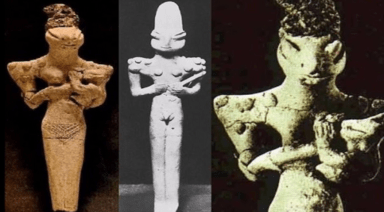
The Ubaid Lizardmen Figurines; Reptilians in Ancient Sumer

By now, the idea of reptilian humanoids sharing this planet with us is nothing new, especially to those in the world of ufology and alien conspiracy. And if we look closer at what is being uncovered at ancient archaeological digs, it has become evident to many that signs of an ancient reptilian race may be right in front of our noses.
A recent discovery at the Al Ubaid archaeological site, where many pre-Sumerian 7,000-year-old artifacts were found, depict humanoid figures with lizard-like characteristics. Now interested parties are left wondering whether these are images of mythical figures or actual beings who still live among us.
Evidence from Sumerian Statues of the Distant Past
The Ubaid period is a prehistoric era particular to Mesopotamia that falls sometime between 5500 and 4000 BCE. The period is much older than historians have accepted as the beginning of civilization associated with ancient Sumer. Sumerians are considered by academics to be the creators of civilization (4500 to 4000 BCE).
The name “Ubaid” comes from Tell al-‘Ubaid, the location of the earliest excavation of ancient material discovered in what is now modern-day Iraq. According to the Metropolitan Museum of Art, the people of the region left behind “baked clay figurines, mainly female, decorated with painted or appliqué ornament and lizardlike heads,” all of which have been found at a number of Ubaid sites.