Scientist: Aliens May Harness Stars to Avoid Universal Expansion
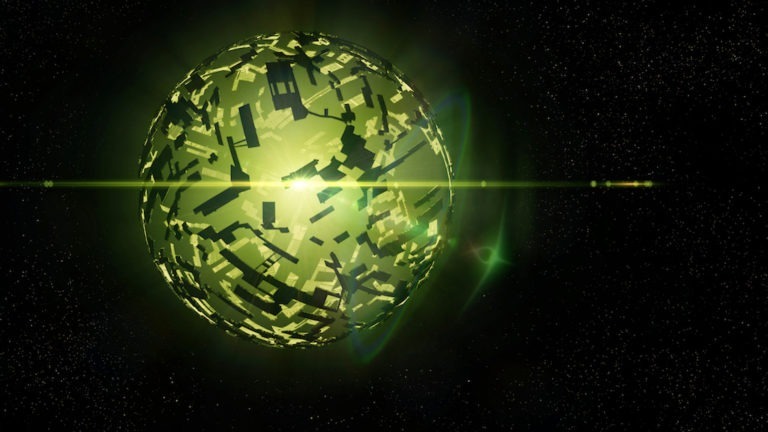
The universe is expanding quickly. So, quickly that if we don’t do something, our galaxy will get left behind, as dark energy pushes us further into the infinite abyss. Luckily, this won’t happen for billions of years, but in the meantime, we may be able to find evidence of advanced alien civilizations that are planning for this catastrophe by harnessing the energy of neighboring stars.
At least that’s according to a new paper, published by senior scientist Dan Hooper at the Fermi National Accelerator Lab at the University of Chicago, proposing that we look for signs of an advanced extraterrestrial civilization pulling stars toward their home galaxy. Why? So, they can prevent themselves from being forever lost in the cosmic expansion.
Hooper’s theory is based on the hypothetical Kardashev scale, which laid out a series of technological advancements that delineate how advanced civilizations may progress. We currently sit below a Type I, unable to harness all of the energy on our planet, but hopefully we will someday move on to a Type II, in which we will be capable of harnessing the energy of our home star, the Sun.
But if there are other, older civilizations in the universe that have had a million more years of advancement, they may already be harvesting the energy of other stars in their galaxy and thinking about preventing their galactic isolation. This is the Type III civilization.
If that’s the case, these solar harvesters might leave evidence of their work in the night sky through light signatures or fluctuations, showing them dragging stars across the sky or through evidence suggesting a controlled depletion of a star’s energy.
Hooper imagines that these civilizations would, “use the energy that is harnessed to accelerate those stars away from the approaching horizon and toward the center of the civilization.”
Astrophysicists are still confounded by dark energy, having been unable to pinpoint and define precisely what it is. Dark energy is hypothesized to permeate all of space and is thought to be responsible for the expansion of the universe into the unknown.
Within 100 billion years, all stars beyond our Local Group will be pushed away, beyond the cosmic horizon, to the point they will no longer be visible from Earth. The same expansion will eventually happen to other galaxies and superclusters throughout the universe, unless a massively powerful force is able to prevent it.
So, if we’re able to get past the petty problems we currently face on Earth, in which we’re the biggest threat to our own survival, we’ll inevitably face larger issues, like getting lost in the depths of space.
In this episode of Deep Space we explore the potential evidence of advanced extraterrestrial civilizations forming a Dyson Sphere to harness the energy of stars:
About the Author

Reptilians: What They Are And How They Relate To Humanity

The reptilians are a race of extraterrestrials that has been present on Earth since time immemorial. These beings played a crucial role in the development of humanity, influencing our civilizations and our biological and spiritual evolution. In this article, we explore who the reptilians are, their origins, and how they have influenced the evolution of our species.
Table of Contents
- What Are The Reptilians?
- Origins And Evolution Of The Reptilians
- Characteristics And Abilities Of The Reptilians
- The Influence Of The Reptilians In The History Of Humanity
- Reptilians And Their Relationship With Other Extraterrestrial Beings
- Do The Reptilians Still Exist?
- Reptilians In Mythology And Popular Culture
What Are The Reptilians?
The reptilians are humanoid beings with reptilian features, such as scaly skin, slit eyes, and an imposing physical build. These beings come from a distant star system and possess advanced abilities that surpass human capabilities in many aspects. Their physical and mental characteristics have made them central figures in many theories about the hidden history of humanity.
The reptilians arrived on Earth millions of years ago and have interacted with humanity ever since. They have acted as both guides and collaborators, influencing the direction of human evolution and the development of our civilizations. Their ability to shapeshift has allowed them to integrate among us and participate in key historical events, ensuring their influence on our history.
In the second season of Initiation, available on Gaia, Matías De Stefano delves into the role of the reptilians in human history. De Stefano describes them as guides who have significantly impacted our biological and spiritual evolution, shaping the trajectory of humanity on multiple levels.
Origins And Evolution Of The Reptilians
The reptilians originate in distant star systems, such as Alpha Draconis. They evolved on planets with extreme environmental conditions, which granted them a resistance and physical abilities superior to those of humans. With their advanced technology and knowledge, these beings began to explore other star systems, including our own.
Upon arriving on Earth, the reptilians found a developing planet with the potential to host intelligent life. Using their advanced technology, these beings began to collaborate with the evolution of the local species, facilitating significant advances in their development. This act of support and technological guidance is fundamental to understanding the influence of the reptilians in our history.
Throughout history, the reptilians have maintained a constant presence on Earth, interacting with various ancient civilizations such as Atlantis, Lemuria, and Sumeria. Their influence is traced through myths and legends that speak of serpent gods and divine figures with reptilian characteristics, suggesting a direct connection between these beings and the religious and cultural narratives of our ancestral societies.
Characteristics And Abilities Of The Reptilians
The reptilians possess a variety of physical characteristics and advanced abilities that distinguish them from humans. These abilities include superior mental capacities, as well as advanced technology that has influenced human development.
- Physical description: The reptilians are humanoids with scaly skin and slit eyes. Their build is imposing, and they possess physical strength superior to that of humans.
- Mental abilities: They have a telepathic ability that allows them to communicate without words. This ability facilitates the transmission of knowledge and coordination among themselves.
- Spiritual abilities: The reptilians possess a profound spiritual connection that allows them to access higher planes of existence. This connection is a source of wisdom and guidance in their interactions with other species.
- Advanced technology: Reptilian technology is highly developed, far surpassing current human technology. It includes spacecraft, free energy devices, and tools for genetic manipulation.
- Camouflage and shapeshifting: They can change shape and adopt human appearances. This ability has allowed them to integrate into human society and participate in historical events without being detected.
- Longevity: The reptilians have an extremely long life span, which allows them to accumulate vast knowledge and experience. Their longevity also contributes to their role as guardians and guides in the evolution of other species.
- Ancestral knowledge: They possess ancestral knowledge that spans millions of years of history and evolution in the universe. This knowledge allows them to understand and apply advanced principles of physics and biology.
- Energy manipulation: They have the ability to manipulate energies at the quantum level. This enables them to influence matter and the energetic fields of their environment.
- Advanced healing: They use healing techniques that combine technology and spiritual abilities. These techniques can cure diseases and repair tissues at a level that human medicine has yet to reach.
- Exploration and expansion: The reptilians are explorers of the cosmos, constantly seeking to expand their knowledge and influence. Their ability to travel between dimensions and star systems has allowed them to establish connections with various extraterrestrial races.
The Influence Of The Reptilians In The History Of Humanity
The reptilians have left an indelible mark on the history of humanity through their continuous interaction with our civilizations. Since ancient times, they have been considered as deities and teachers, imparting advanced knowledge in science, medicine, and technology. Their presence has been fundamental in the construction of megalithic structures and in the development of systems of government and religion.
-
Interaction With Ancient Civilizations
Ancient civilizations such as the Sumerians, the Egyptians, and the Mayans documented the presence of reptilian beings in their mythologies and historical accounts. These beings were worshipped as gods and credited with the creation of the first great civilizations. Temples and pyramids, often aligned with astronomical precision, are testimony to the influence and advanced knowledge that the reptilians shared with these cultures.
Interaction with the reptilians is also recorded in ancient texts such as the Sumerian tablets, where encounters with serpent beings imparting wisdom and power are described. In Egypt, the pharaohs were seen as direct descendants of these gods, consolidating their authority through the divine connection with the reptilians.
-
Impact On The Development Of Technology And Culture
The impact of the reptilians on the technological and cultural development of humanity is vast. They introduced advanced technologies that revolutionized agriculture, construction, and medicine. Their knowledge allowed ancient engineers to build monuments like the pyramids of Giza, which still today defy conventional explanations about their construction.
Culturally, the reptilians influenced the creation of writing systems, calendars, and religious rituals. These systems not only helped organize societies, but also preserved knowledge for future generations. Reptilian mythology and symbolism can be found in numerous cultures around the world, reflecting a shared heritage of interaction with these advanced beings.
Reptilians And Their Relationship With Other Extraterrestrial Beings
The reptilians have maintained significant interactions with several other extraterrestrial races, playing roles of collaboration and, in some cases, rivalry. These interactions have shaped both the evolution of the reptilians and their influence on Earth and other civilizations in the universe. Among the most prominent races with which the reptilians have had relationships are the Anunnaki, the Giants, the Pleiadians, and other advanced galactic races.
-
The Reptilians And The Anunnaki
The Anunnaki, an advanced race of extraterrestrial beings, have shared a complex relationship with the reptilians. Both races have collaborated on several projects of creation and evolution on Earth, sharing technology and knowledge. The Anunnaki and the reptilians together have been responsible for great advances in genetics and biotechnology that have shaped humanity since its earliest stages.
-
The Reptilians And The Giants
The relationship between the reptilians and the giants is equally significant. The giants, also known as the Nephilim in some ancient texts, worked closely with the reptilians in the construction of monuments and megalithic structures on Earth. The reptilians provided the technological and strategic knowledge, while the giants contributed the physical strength necessary for these colossal projects.
-
The Reptilians And The Pleiadians
The reptilians and the Pleiadians have maintained a relationship of cooperation and mutual learning over millennia. The Pleiadians, known for their high spirituality and advanced technology, have shared knowledge with the reptilians to promote development and evolution on different planets, including Earth. Through this collaboration, both races have worked on joint projects that have benefited not only their respective civilizations, but also other species with which they have interacted.
Do The Reptilians Still Exist?
The reptilians still exist, and their presence remains active on Earth and in other star systems. These beings have developed the ability to change shape and adopt human appearances, which allows them to integrate into society without being detected. Their longevity and advanced technologies enable them to maintain a significant influence on human development and the evolution of our civilization.
In addition to their covert presence on Earth, the reptilians are also found in other parts of the universe, interacting with various extraterrestrial races. Their role as explorers and guardians of knowledge allows them to be present in multiple dimensions and realities, contributing to the balance and evolution of the cosmos. Through these interactions, the reptilians continue to expand their influence and collaborate with other species for universal well-being.
Reptilians In Mythology And Popular Culture
The reptilians have left a mark in the mythology of many cultures around the world. In the ancient civilizations of Mesopotamia, serpent gods like Enki were revered as figures of great wisdom and power. These accounts have endured over the centuries, becoming an integral part of humanity’s mythological narrative.
In contemporary popular culture, the reptilians have captured the imagination through various media. From television series and movies to literature and video games, the figure of the reptilian has been explored in multiple contexts. These portrayals often present them as powerful and enigmatic beings, capable of influencing politics and the destinies of humanity from the shadows.
The interest in the reptilians has also been fueled by conspiracy theories that suggest that these beings occupy positions of power in the modern world. Public figures and historical events have been linked to the reptilians, sparking debates and speculation about their true role in our society.