Before You Relinquish Your Ego, Relish It

When I first met Dr. Vasant Lad, he had just arrived in Cambridge, MA from India. One of the most beloved authorities within all of Ayurvedic medicine, Dr. Lad is a loving healer and deeply inspiring oracle.
We sat on pillows in a tiny room where Vasant told me that I was tridoshic. He prescribed some herbs, mantras, and meditations, and he encouraged me to look deeper into my spiritual gifts. Moments later, he directed me to tell my best friend where her engagement ring was situated. He had known me for 2 minutes. The ring was behind the night table.
When we truly relinquish our egos, or, at the very least, nudge them aside, we begin to see beyond our limited, temporary self-identities, and into eternity. This miracle is always available to every living Being, throughout all the realms, in all of creation, and throughout all the universes.
Dr. Lad’s intuition and light-based nature is the result of years of having chosen to relinquish his ego, in service to humanity. While Vasant’s state of Being is admirable and exemplary, It’s not easy to expand, without first being thrust into a variety of fires. Some of these fires are more enjoyable than others.
When I first asked Dr. Lad why my ego was so challenging to wrestle and release, he said, “The ego is the I am. Without the ego, you are not.”
I cried for an hour.
No other spiritual teacher had phrased this idea so succinctly. Everything he said to me that night was so wonderfully simple, precise, and relatable. Dr. Lad set me on a unique path, and I was forever changed.
Some new-age “prophets” can be so intensely focused on the relinquishing of ego, they fail to reveal the implications of giving up something we may have never known.
If each of our soul identities and spiritual imprints is at least partially represented in our egos (for the purpose of our experiencing three-dimensional reality), how can we evolve without first embracing our egos, at least for a period of time?
After all, whether we were created by Gods, aliens, or biochemical explosions from other realms, each of us is unique and remarkable.
When we fully embrace our egos, we might understand our motivations, intentions, gifts, talents, and attributes. In the pursuit of these understandings, we might also experience an expanded appreciation for the mechanics and infrastructures of this physical world. In doing so, we begin to deepen our respect and gratitude for every cog, player, mechanic, operator, assistant, and creator who works to bring our physical realities to life.
Throughout time, there have been multitudes of religions and spiritual movements that sought to mislead millions of people.
In many cases, dark souls with selfish intentions intentionally misrepresented the masters they once followed, all in the name of greed and control. The result of this misuse of power resulted in the manipulation of the masses and included theft, rape, and abuse of the Earth’s most vulnerable minerals, plants, and living Beings. At their best, religions and spiritual movements give us lexicons and pause, while they relegate us to confined intellectual and spiritual prisons.
What is the ego?
The ego is your platform for evolution. It’s your calling card. The ego is how the world uses you to evolve itself. Your ego was born to help creation give birth to more light. Allow the ego to enjoy itself. Allow its imperfections. Permit it to explore itself. In that journey, we learn how to see ourselves more clearly, relate with others, forgive flaws, and make our boldest moves.
Yes, you are most likely imperfect, but only perfectly. Within your unique imperfections live desires, emotional curiosities, and the trajectories that will lead you through your individual unfoldment. Find safe ways to let it all live and let it all out. While the truth will set you free, you first have to allow yourself, as you are right now, to be part of that truth.
Many of today’s religious fanatics and spiritual phonies are living from narcissistic self-identities, behind which they hide.
From their self-righteous perches, too many spiritual leaders hate LGBTQ people, judge angry men, and resent masculine constructs, even the ones that produce safe environments, jobs, and sustenance for their families. It’s from these narrow-minded positions that misguided souls also judge themselves.
The tragedies don’t stop there. With each of their judgmental thoughts comes a myriad of negative frequencies and vibrational elements, which then attach to the individual. These attachments act as magnets for experiences that will naturally confront these individuals with their shadows. With each problematic experience that emerges, we have the option to either evolve or seek more of the same.
How does this all relate to me? What does all this mean?
- If you’re an angry man, begin by honoring your anger, then nudge it toward sadness, which is the most accurate state of anger. When you’re ready, see if you can convert your tears into actionable boundaries, knowledge, and strategies. This is how you can improve your life and serve your family.
- If you have deep-seated issues stemming from abuse, first honor your anger, and see if you can express it healthfully and without hurting others. Following that, if possible, try to convert it into knowledge, forgiveness, and grace. Work through every aspect of every emotion related to this horrible event. While this is unfathomably difficult, there is always a pathway to love and light.
- If you’ve been screwed-over in life, love, or business, find ways to honor and release the related emotions. From there, you can invite forgiveness, knowledge, graciousness, and rebirth. If that fails, regularly write in your journal until your current self-identity breaks and allows for change.
- If you feel drenched in ego and greed, be gentle with yourself before ripping open walls and terminating the structures that have served you.
Upon each painful experience, we have two options:
Rot in pain or burst toward the light.
Regardless of what you’ve experienced, never new-age yourself out of your feelings. Never Buddhify your pain. Never forsake yourself. Even if you have to forget Jesus’s teachings for a split second, never reject the YOU that you’ve come to know and love. Never push yourself out of the way. If our selves are not involved in every step, we’ll eventually regret it.
Most importantly, after each negative experience, honor your mind and heart as they process what has happened. From there, you can forgive, let go, pivot, and expand. Over time, negative experiences begin to feel like encouragement.
When you’re ready, you can re-embrace your ideologies, religions, and spiritual movements. At their cores, these things are not bad for humanity. The trouble begins when spiritual leaders and teachers tell us to forsake ourselves before first honoring ourselves. After all, we are created by an unlimited, forgiving, and ever-expanding universe.
To save ourselves and the planet, consider pausing before spreading a doctrine or religion. It might also be helpful to learn to love and honor ourselves before relinquishing every aspect of our identities and lives.
Before we toss anger out the window in self-judgment, we might want to experience the anger and learn more about it. In all things, we must first look in the mirror and love without threatening punishment. From there, we can make conscious and fair assessments. Embedded in the bosom of love, we can nurture ourselves into forgiveness and expansion.
About the Author

What the Enneagram Is and How to Identify Your Dominant Enneatype
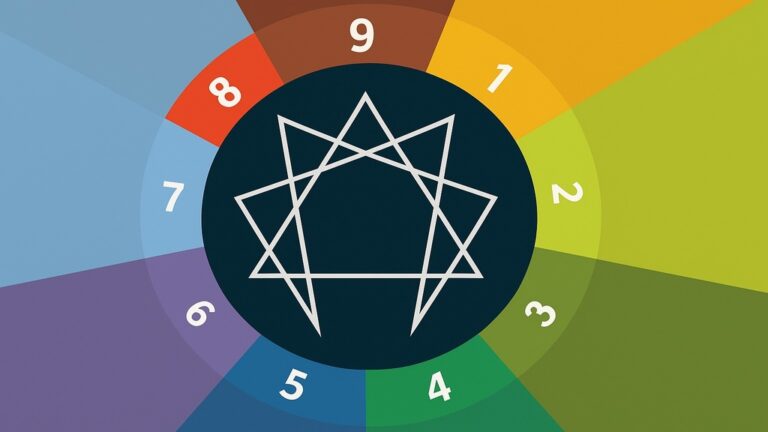
The Enneagram is a tool for self-knowledge that describes nine personality types, each with a particular way of thinking, feeling, and relating to the world. Its purpose is to help us understand our deepest motivations and the unconscious patterns that shape our lives. In this article, we explore what the Enneagram is, how it works, and how you can discover your dominant Enneatype to better understand yourself and grow as a person.
Table of Contents
- What Is the Enneagram of Personality?
- What Are the Enneatypes and How Are They Classified?
- What Are Wings in the Enneagram and How Do They Influence Us?
- What Does the Enneagram Symbol Represent?
- How to Discover Your Dominant Enneatype
- Self-Knowledge Through the Enneagram
- The History and Origin of the Enneagram
What Is the Enneagram of Personality?
The Enneagram is a system of self-knowledge that organizes human personality into nine main behavioral patterns, known as Enneatypes. Each person tends to live from one of these nine styles, which form during childhood as a response to an emotional wound. From there, we develop a personality that attempts to compensate for that pain, repeating beliefs, attitudes, and reactions we rarely question.
The word “Enneagram” comes from Greek and means “nine lines,” referring to the symbol that represents it. This symbol shows how the nine types relate to each other and helps us understand the changes we experience when we are emotionally balanced or unbalanced. The Enneagram is not a personality test, but rather a map that explains our automatic reactions and the psychological roots behind them.
The most valuable aspect of the Enneagram is that it not only reveals our defense mechanisms but also our potential for transformation. By identifying our dominant Enneatype, we can understand what limits us, what drives us, and what we need to evolve. For this reason, this tool is increasingly used in personal, therapeutic, educational, and professional development processes.
What Are the Enneatypes and How Are They Classified?
The Enneatypes are the nine personality types described by the Enneagram. Each one emerges from an emotional wound that shapes how we see the world and relate to others. These psychological structures are not rigid labels, but rather defense mechanisms developed in childhood to feel safe, loved, or valued. Knowing our dominant Enneatype allows us to understand what deeply motivates us, what our core fears are, and which patterns we tend to repeat unconsciously. Below, we describe each of the 9 Enneatypes in the Enneagram.
- Enneatype 1 (The Perfectionist): Their core wound is the belief that they are not good enough. To compensate, they constantly strive to do things “right,” following strict rules and high standards. They are usually responsible, ethical, and committed, but can also be rigid, critical, and prone to frustration when things don’t go as expected.
- Enneatype 2 (The Helper): They believe they must earn love by serving others. They devote themselves to caring, supporting, and being available, hoping for affection in return. While generous and empathetic, they can fall into emotional dependency and manipulative behaviors when they don’t feel appreciated.
- Enneatype 3 (The Achiever): They fear they are not worthy unless they prove their success or accomplishments. Their self-esteem is tied to performance and how others perceive them. Often efficient, ambitious, and charismatic, they may lose authenticity by adapting to expectations and avoiding vulnerability.
- Enneatype 4 (The Individualist): Their wound is the feeling of not being enough just as they are. They seek to stand out by being unique, special, and different. They experience emotions intensely and often feel misunderstood, which can lead to melancholy, envy, and disconnection from the present.
- Enneatype 5 (The Observer): Their main fear is not being able to cope with emotional demands. To protect themselves, they retreat into their minds, knowledge, and isolation. Analytical, independent, and intellectual, they may also be distant and disconnected from emotions and human contact.
- Enneatype 6 (The Loyalist): Their wound is rooted in mistrust of themselves and the world around them. They live in a state of alertness, anticipating danger and seeking certainty. Loyal, responsible, and cooperative, they can also be anxious, indecisive, and prone to relying on authority figures for guidance.
- Enneatype 7 (The Enthusiast): They avoid pain and discomfort by constantly seeking positive stimulation. They fill their schedules with plans, activities, and distractions to avoid confronting inner emptiness. Cheerful, versatile, and optimistic, they can also be inconsistent, superficial, and escapist.
- Enneatype 8 (The Challenger): They fear being hurt or controlled by others, so they adopt a stance of strength and dominance. They protect themselves by showing authority, confidence, and determination. While they can be leaders, protectors, and just, they may also come across as authoritarian, aggressive, and resistant to vulnerability.
- Enneatype 9 (The Peacemaker): Their wound lies in the fear of conflict and rejection from others. They tend to minimize themselves, avoid confrontations, and adapt to avoid discomfort. Calm, kind, and conciliatory, they may also be passive, disconnected from their desires, and struggle with decision-making.
What Are Wings in the Enneagram and How Do They Influence Us?
Within the Enneagram, each Enneatype is connected to the two neighboring types on the circle. These are known as “wings.” For example, someone whose dominant Enneatype is 5 may have a wing 4 or a wing 6. These wings don’t change the core type, but they do nuance our personality by adding secondary characteristics that broaden or balance our traits.
The influence of wings can be very strong or barely noticeable, depending on each person’s level of personal development. Some people clearly identify with one of the two wings, while others display traits from both. Wings function as extensions of the main type and often bring in abilities or resources that help compensate for certain limitations of the dominant Enneatype.
Understanding our wings not only deepens self-awareness, but also helps us better understand our inner contradictions. Through them, we can observe how our personality adapts, how we blend different traits, and how we expand our ways of responding to situations. Identifying the role of our wings is a key step toward working on ourselves with more consciousness and flexibility.
What Does the Enneagram Symbol Represent?
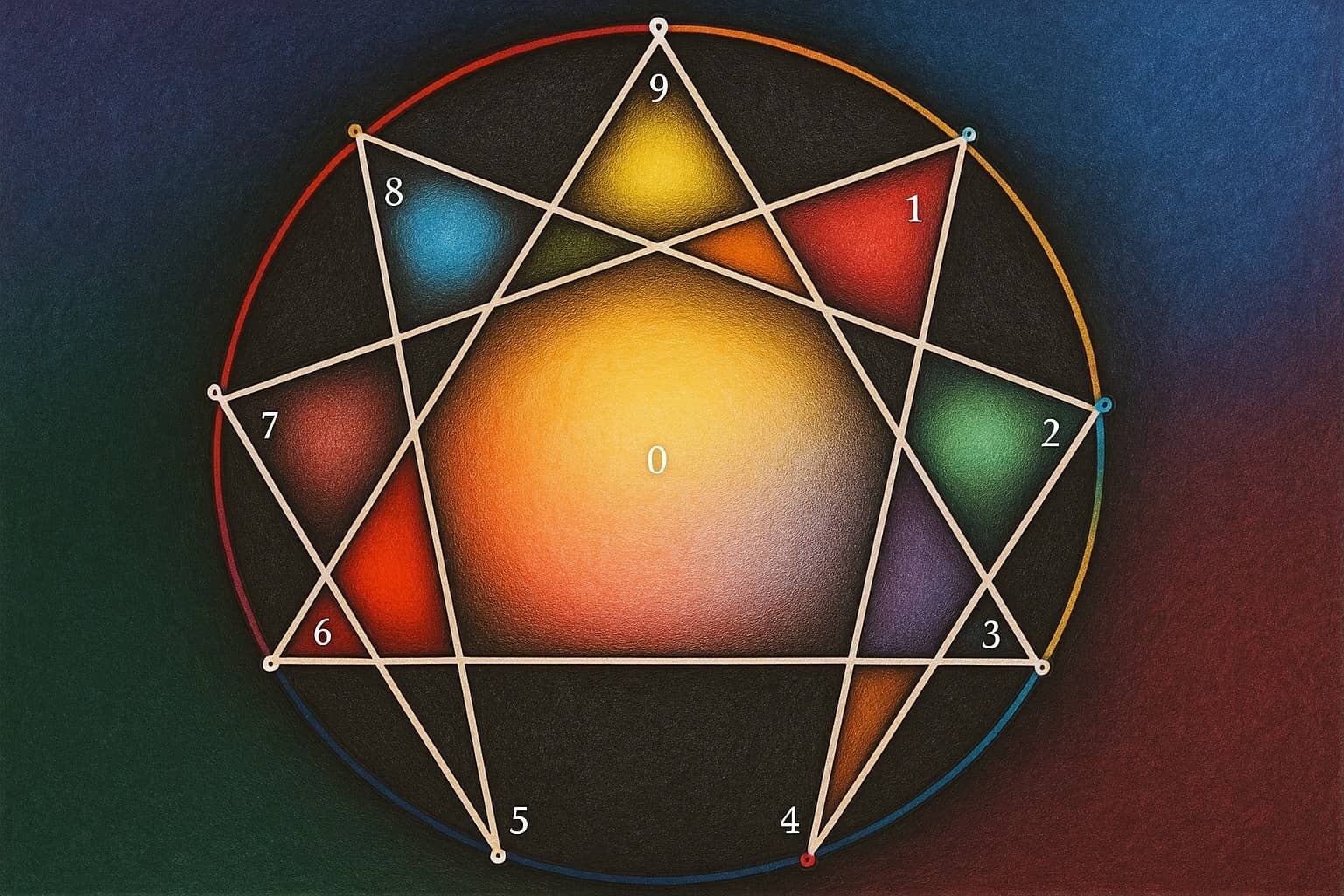
The Enneagram symbol is a geometric figure made up of a circle, an equilateral triangle, and a six-pointed irregular line. At first glance, it may seem complex, but each part has a deep meaning that helps us understand how this system works. The nine points around the circle represent the nine Enneatypes, and their placement is not random—they reflect a logical order related to energy and transformation.
The triangle connects points 3, 6, and 9, forming what is known as the “inner triad.” This shape represents three fundamental forces in the human being: action, emotion, and thought. The six-pointed figure (connecting points 1-4-2-8-5-7) illustrates the internal movement between types, showing how we shift depending on our level of balance or stress. This dynamic pattern is key to understanding growth or stagnation within each personality.
Beyond its shape, this diagram shows that we are in constant transformation as human beings. Rather than labeling us, the symbol invites us to see that we are always evolving—either growing or getting stuck. Visualizing how the Enneatypes relate to each other allows us to better understand our inner transitions and the possible paths for conscious evolution.
How to Discover Your Dominant Enneatype
Discovering your dominant Enneatype is not about taking a simple quiz, but about observing with honesty your most frequent emotional, mental, and behavioral patterns. While questionnaires can help point you in the right direction, true understanding comes when you recognize yourself in the description of a type—especially in its core emotional wound. Identifying the type that reflects your deepest motivations and defense mechanisms is a personal process that requires reflection and sincerity.
A good starting point is to carefully read through the descriptions of the nine Enneatypes, paying attention to what makes you uncomfortable or resonates with you intensely. It’s not just about identifying external behaviors, but about detecting the inner need that drives your actions. Are you seeking approval, control, security, freedom? Observing how you react to conflict, failure, or criticism can offer valuable clues about your primary type.
It can also be helpful to complement this process with books, courses, or professional guidance. Therapists and coaches trained in the Enneagram can support your self-discovery in a more structured way. As you gain a clearer understanding of your type, you can begin working on your blind spots, reconnect with your most authentic self, and move toward a more conscious and liberated version of who you are.
Self-Knowledge Through the Enneagram
The Enneagram is not a system for labeling people, but rather a tool for understanding how we disconnect from our essence and how we can return to it. It helps us clearly see the unconscious patterns we’ve repeated for years—often the source of suffering, conflict, or frustration. By identifying our Enneatype, we gain the opportunity to stop acting on autopilot and begin making choices from a more conscious place.
The self-knowledge process that the Enneagram proposes is neither immediate nor linear. It involves peeling back layers of self-deception, acknowledging emotional wounds, and observing our defensive behaviors with compassion. It also invites us to reconnect with our essential virtues—qualities that already live within us, but which we’ve often forgotten or suppressed out of fear. This journey is not about perfection, but about authenticity and balance.
Knowing yourself through the Enneagram involves a commitment to personal growth and greater emotional responsibility. As we understand ourselves better, we also learn to understand others. This model offers a shared language to speak about the human experience—with all its light and shadow—and reminds us that beyond personality types, we all share the same longing: to live with more awareness, freedom, and meaning.
The History and Origin of the Enneagram
The origin of the Enneagram is complex, combining philosophical, spiritual, and psychological influences. While its symbol has ancient roots tracing back to Middle Eastern traditions and Sufism, its modern application to the study of personality began in the 20th century. It was the Bolivian mystic Óscar Ichazo who first structured the nine character types into a coherent system, integrating knowledge from various traditions and philosophical schools.
Later, Chilean psychiatrist Claudio Naranjo developed the model from a therapeutic perspective, incorporating concepts from Western psychology. Through his clinical experience, he outlined the traits and defense mechanisms of each type, allowing it to be applied in educational and psychological settings. His contribution was key to transforming the Enneagram into a practical tool for self-discovery. In recent decades, its use has expanded and gained popularity around the world.