Toxic Guru Relationships: Osho and the Rajneeshees
While many agree that Jesus, Buddha, and Guanyin (among others) are enlightened and eternal light-beings, it’s a bit difficult to experience them in three dimensions, let alone receive a hug from them. It might be said that for those who cannot see their internal-masters in a living, breathing human being are missing out on something special.
The moment someone calls themselves a spiritual master, all the beings in all the realms perk up and get to work. These etheric forces will test potential spiritual masters, not to bring them down, instead, to prepare them for the paths of service they declare.
The universe continually seeks ways to infuse the eternal nature of consciousness into human beings. It loves to assist in the births of powerful spiritual avatars. This tendency is one of the most beneficial wonders of this world. Because of it, there’s always an abundance of living spiritual gurus, masters, and sages.
Avatars take births to teach us about love and consciousness, and to challenge our attachment to the physical universe so that we can know the world within us. Much to our collective chagrin, authentic spiritual gurus generally do not seek to validate our financial and physical realities, or reinforce society’s oppressive constructs and rules, although some of them do.
There are some who might judge and condemn today’s living gurus and their disciples, noting that this world is not holy enough to birth a living saint. These naysayers doubt many gurus’ divinity, teachings, and methods. Some protest, picket, and write books about how horrible one guru or God is versus another. These folks probably have similar doubts about themselves.
While discipleship can be a profound and liberating experience, it comes with challenges. A guru will help her followers reduce their attachment to their egos and minds, but she also peels away our layers of illusion and delusion, which, while freeing, can be painful. Being a disciple of a guru is not for the spiritually timid.
This process of devoting oneself to a guru can also be frightening and life-shattering because it has the potential to disrupt the false identities and lives we’ve built. Upon the guru’s glance, our egos might also become inflamed, causing us to think that we are the All and Powerful Oz. Egos don’t always dissolve without a fight.
From the outside, a community centered around a spiritual guru can appear quite insane. Why wouldn’t it? Most people living in traditional society are climbing ladders, pursuing goals, and conquering a temporal world. It’s difficult to defend the eternal against the emanations of the physical, especially to people who have no frame of reference for alternative spirituality, and no interest in change.
The Bhagwan
Gurus like India’s Osho, otherwise known as Bhagwan Shree Rajneesh, can be misinterpreted by society and misrepresented by devotees. In the documentary, “Wild, Wild Country,” fears and egos dominated what might otherwise have been a profoundly peaceful pursuit.
The Osho biography describes a variety of miracles, contradictions, and controversies. What does “Osho” mean? Originating from Sanskrit, it refers to a master or teacher. Osho was a renegade, which can be both a challenge and a blessing.
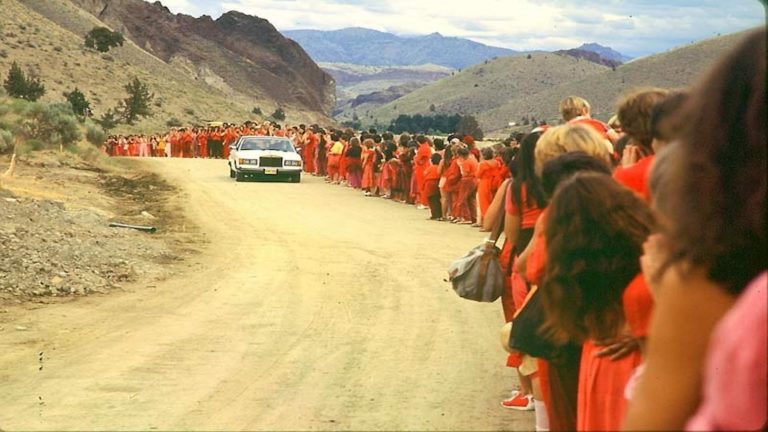
In the 1980s, Osho and thousands of his followers moved out of India and descended upon a small town in Oregon. Instead of infusing the city with love, they conquered it, which caused their neighbors to demonize them.
During their tenure, several of Osho’s followers were charged with crimes, including attempted murder, and eventually served time in prison. Chances are this wasn’t the original vision. Google “Rajneesh Oregon” and you’ll see a flood of fascinating pages.
Most of us weren’t there, and we can’t comment on what it was like to be a disciple of Osho’s or a local homeowner. I’m also not here to judge. That said, I believe there are some profound, applicable lessons to be extracted from the ordeal.
For the guru, it’s not about the details, drama, or press. Peaceful or not, and authentic or not, a guru’s path is about the spiritual journeys and advancement they’re called to inspire in their disciples. It might be said that when we are subject to change and catastrophe, our minds evaporate and our souls progress.
How to Avoid Toxicity
In all things “guru,” here are a few key lessons to consider:
-
- We need not adhere to rules and pursuits set by a tangential collective. The goal is to follow the teachings of the guru and the eternal.
- We need not adhere to rules and pursuits set by a tangential collective. The goal is to follow the teachings of the guru and the eternal.
-
- When engaging in a spiritual community, refrain from becoming entangled in heated activities, even if they appear to be benign.
-
- Each person’s journey is unique, each with her own pace and personal responsibilities. In the enlightenment scene, as long as it’s based in love and includes service to those in need, an individual’s spiritual growth takes precedence over the worldly goals of a group.
-
- Infuse your beliefs with love and base your projections in love. This will reduce your ego and fears.
-
- The communities that emerge around gurus are often spiritual hospitals. Refrain from being interested in or attached to the drama unfolding around you. After all, a fair number of spiritual aspirants tend to be little devils working out their small problems or new-age narcissists seeking to enroll others in their spiritual self-aggrandizement.
-
- A guru’s physical form is not reality. Their bodies are metaphoric vehicles meant to help us see their eternal nature within us. When we attach to a guru’s form or life, we put them in boxes, which, in turn, does the same to us.
- Refrain from blaming a guru for your participation in their ideologies, methods, and communities. We only lose our free will when we relinquish it, which is also a choice.
Wild, Wild Country
If you’ve not yet watched this fantastic documentary about what is often called, “the Rajneesh cult,” let me sum up its spiritual gems:
— Many of us do not know how we feel or how to express ourselves. Learning how to do this can open doors to our divinity.
— Having a spiritual master can expedite our evolution. This can be invaluable.
— For a sad, broken few, a guru relationship might send a disciple in the opposite direction, and deeper into their shadows.
— When we fuse our worldly desires with our spiritual projections, we might make other people jealous, confuse ourselves, and possibly set the world on fire.
— When we believe a guru to be anything but the embodiment of the universe, which includes everything, both good and bad, dark and light, love and evil, we are mistaken.
— Just like regular folk, some spiritual people love recognition, power, and control. Given the right conditions and motivations, they might consider doing anything to bring these darker attributes to life, especially when holding power-position within religious organizations. Think priests and little boys, nuns and rulers, and preachers who demonize gay people to avoid their self-hatred and gay natures.
— While certainly family-focused, loving, and prayerful, small-town America might not be the most open and aware populace in the world. Being landlocked has consequences.
— We don’t know whether or not there was a pre-birth pact between Osho and his infamous directors and their helpers. We also don’t know whether or not Osho was an enlightened master or if he encouraged some of the organization’s less benevolent activities.
— It might be that by allowing his directors to manifest their dangerous and illegal actions within his controlled, confined organization, thereby distilling them from society, Osho saved the world from another Jim Jones or Hitler.
— A few things about gurus: some gurus might have karma to work out before they blossom into embodiments of light. They might have pre-birth soul commitments to fulfill before merging with the eternal. They might also not be consciously omniscient or care about omniscience. The lessons and benefits from their missions might only be derived from the insanity they inspired.
— When a collective is seeking a particular style of spiritual advancement, radical gurus are required to awaken the group through specific, uncommon modalities. Without these modalities, a large number of people might never know their light.
— Praying for dark or damaged souls, whether they are evil are not, is helpful to all living beings and healing for our judgmental hearts and minds.
— Living within a judgment-free spiritual path means that we must look at all the attributes from an experience, whether it is our experience or another person’s, and we must use
Rajneeshpuram: The Rajneesh Compound
Osho’s mysterious compound, which the majority of inhabitants seemed to love and cherish, and where all sorts of drama and illegalities occurred, is a metaphor for our minds. This metaphor begs a few questions:
-
- If we were given the opportunity, would we live with an enlightened master in a community of like-minded souls?
-
- If it appeared to be the only way to protect our loved ones, would we use guns to defend ourselves?
-
- What spiritual chaos have we each created or fed in our lives?
-
- What imaginary fires have we turned into harsh realities
-
- Where have we allowed our needs to experience liberation to wreak havoc in our lives and the lives of others?
Who are the Living Spiritual Masters in the World?
Spiritual masters and gurus are not always public or famous people. Your babysitter, mechanic, or optometrist might be a living spiritual master. You might be one breath from becoming enlightened.
Luckily for humankind, many wonderful public masters have taken birth to bring light and healing to the planet. Steering clear of the gurus at the center of controversies and lawsuits, here are a few profound and divine rockstars whom I’ve met, enjoy and love:
Amma (Mata Amritanandamayi)
Known as “The Hugging Saint,” and found at Amma.org, this Amma is a profound master, teacher, and humanitarian. She has the broadest and most comprehensive mission of love and benevolence seen in recent centuries. With multiple hospitals, housing charities, and millions of followers, Amma has inspired volunteers from all walks of life to serve others. When receiving a hug from Amma, she chants in Sanskrit and helps unlock and dissolve your karma. You can get a mantra from Amma and ask her pertinent questions. Amma tours the US every summer and then returns in the fall. Her ashrams are found all over the world, most notably in San Ramon, CA and Kerala India.
There are other lovely spiritual masters, also known as “Amma.” For example, Karunamayi, who, from an early age, decided to shower the world with unconditional love through prayer and seminars. Karunamayi is known to be a beacon of light which seeks to remove suffering from the hearts of her followers. You can learn more about Karunamayi here: http://www.karunamayi.org/
Mother Meera
The lovers and followers of Mother Meera say that she is the Divine Mother on earth, the embodiment of the Divine Feminine. She offers free transmissions of light, love, and grace as her gift to the world. Visit https://www.mothermeera.com to learn more.
Thich Nhat Hanh
This enlightened soul is an inspiring spiritual leader, poet, peace activist, and teacher of mindfulness. Enjoy his books, entitled, How to Love, Peace in Every Step, Being Peace, and The Art of Power. You can learn more about this peaceful master here: https://plumvillage.org/about/thich-nhat-hanh/
Onward on the Path
There are many living masters, including but not limited to: Sadhguru, Eckhart Tolle, and Ram Dass. There are also many enlightened masters who have since passed, including Paramahansa Yogananda, Swami Vivekananda, Neem Karoli Baba, Jesus Christ, and Maharishi Mahesh Yogi.
Explore these beautiful human beings and others who appeal to you, and continue to seek the source of light within you. Engaging with and devoting oneself to a guru can have miraculous effects, especially if the master is rooted in love and is devoted to humbly serve humankind.
About the Author

Why Do I Keep Repeating the Same Patterns in Relationships?

Why Do I Keep Repeating the Same Patterns in Relationships?
You meet someone new. The details are different, and so is the story you tell your friends. Then, a few months in, the old feeling returns. You are chasing reassurance from someone distant. You are doing the emotional work for two people. You are editing your needs so you will not seem difficult. You are treating an apology as proof that the next time will be different. The relationship ends, and you wonder how you landed in the same place again. So how can you reclaim yourself in the process of breaking these patterns?
The short answer
People often repeat relationship patterns because learned expectations begin operating before conscious reasoning catches up. A delayed text can register as rejection. A partner’s need for space can trigger pursuit or withdrawal. Someone may silence a concern before deciding whether it is safe to speak. A calm, available partner can feel strangely unconvincing. Earlier relationships can shape these responses, and a current partner can reinforce them. The pattern can change, but seeing the automatic sequence usually comes before changing the behavior.
Calling it a pattern gives you a better question than “Why am I like this?” You can ask, “What keeps happening, and what part of it can I change?”
How does the subconscious affect relationships?
Gaia’s new original series Beyond the Program with Jim Curtis uses “programming” to describe beliefs and emotional habits that operate outside conscious awareness. Relationship researchers tend to write about automatic or implicit processes; the expectations involved are sometimes described as relational schemas. The language varies, but the basic idea is recognizable: experience creates expectations, and those expectations can begin shaping a response before you have put the situation into words.
The subconscious is sometimes discussed as though it contains a secret explanation for every choice. A more useful view is that it makes fast predictions. It draws on what has happened with caregivers and former partners, as well as other close relationships and the person in front of you now. Then it prepares a response based on what it expects will happen next.
It assigns meaning before you have the full story
Consider an unanswered text. One person assumes their partner is busy and returns to work. Another feels a drop in the stomach, checks the phone repeatedly, and begins writing a message they may regret. The cue is the same, but the learned meaning is different.
Experiments have found that threat-related cues can automatically make mental representations of attachment figures more accessible. The response also differed according to attachment anxiety and avoidance. (Mikulincer, Gillath, and Shaver, Journal of Personality and Social Psychology) In a small study of 35 women, participants processed partner-rejection cues differently from acceptance cues in under 300 milliseconds, with attachment tendencies influencing the strength of that early response. (Zayas et al., Psychological Science)
That is faster than a careful conversation with yourself. By the time you think, “I am worried they are pulling away,” your attention may already be scanning for more evidence.
It turns old expectations into present behavior
Automatic expectations often work like unstated if-then rules:
- If someone becomes distant, pursue harder before they can leave.
- If conflict starts, shut down until the danger passes.
- If a partner is unhappy, take responsibility for fixing the mood.
- If closeness feels uncertain, act unaffected and need less.
The rule may once have been useful. A child who learned to monitor a volatile adult was adapting to the situation available to them. In an adult relationship, the same vigilance can lead to overexplaining, testing a partner, accepting blame too quickly, or treating an ordinary disagreement as a sign that the relationship is ending.
These reactions also affect the other person. A fear-driven accusation can produce defensiveness. Withdrawal can provoke pursuit. Reassurance may calm the moment without changing the expectation beneath it. The subconscious pattern does not stay inside one person. It changes the interaction, and the partner’s response may appear to confirm the original fear.
It shows up in behavior you may not notice
In one study of couples discussing a disagreement, people with more positive automatic evaluations of their partners displayed more constructive nonverbal behavior. Independent observers coded cues such as facial expression and body posture, and the more constructive behavior was associated with greater satisfaction after the conversation and during the following eight days. (Faure et al., Psychological Science)
This helps explain why a conversation can sound reasonable on paper and still feel hostile in the room. The words may be controlled while the face, posture, timing, or tone communicates contempt or retreat.
It also learns from the current relationship
Automatic responses can be shaped by the current relationship as well as childhood. In a four-year study of 135 newlywed couples, participants’ automatic attitudes toward their partners were unrelated to their conscious relationship reports at the start. The automatic attitudes predicted later changes in marital satisfaction, while the conscious attitudes did not. (McNulty et al., Science)
A separate longitudinal study found that people who were treated less responsively and relied more on self-protective if-then responses early in marriage had less positive automatic partner attitudes four years later. (Murray et al., Journal of Experimental Social Psychology) Automatic reactions can carry residue from the past, while also recording repeated experience in the present.
Anxiety is not always proof that an old wound has been triggered. Sometimes your response is picking up on inconsistency, contempt, controlling behavior, or a pattern of broken trust. Both possibilities deserve examination; an uncomfortable reaction should not be dismissed as irrational by default.
That gap between conscious intention and automatic response is central to Beyond the Program. A person can understand the kind of relationship they want and still react from an older expectation once closeness or conflict activates it.
Why do subconscious relationship patterns repeat?
Once an automatic response has worked, even imperfectly, it becomes easier to reuse. Pursuit may have won reassurance. Self-silencing may have prevented an argument. Emotional distance may have reduced the risk of being hurt. The short-term result teaches the response to return, even when the long-term effect is loneliness or resentment.
Early relationships create expectations, not destiny
Your first experiences of care teach you what closeness tends to feel like. Was comfort available? Did affection disappear after conflict? Did you have to become useful, funny, accomplished, or undemanding to keep connection?
Longitudinal relationship research has found that some early experiences have small but lasting associations with adult expectations and behavior in romantic relationships. The same research also found that later partners can buffer earlier vulnerabilities. A committed, responsive relationship can change how those earlier vulnerabilities play out. (Simpson et al., Current Directions in Psychological Science)
Attachment language can help describe these tendencies. Someone high in attachment anxiety may become preoccupied with signs of rejection. Someone high in avoidance may pull back when intimacy or conflict feels too exposing. In a longitudinal study of emerging adults, anxious and avoidant attachment were associated with lower relationship quality and stability, with perceived conflict playing a role in some of those links. (Sheng et al., Current Psychology)
Attachment is often flattened into dating-app shorthand: anxious person meets avoidant person, chaos follows. That skips a lot. Multi-wave studies have documented within-person changes in relationship-specific attachment security, so attachment is better used to examine your response to closeness than to pin a permanent label on yourself or a partner.
The relationship in front of you also shapes the pattern
Childhood is only part of the picture because the relationship in front of you matters too. In a project that combined 43 longitudinal couples studies, some of the strongest predictors of relationship quality were current relationship experiences, including perceived partner commitment, appreciation, sexual satisfaction, perceived partner satisfaction, and conflict. Those factors predicted more than personality traits or a partner’s own report did. (Joel et al., Proceedings of the National Academy of Sciences)
That finding is a useful correction to the habit of treating every dating problem as an excavation of childhood. Sometimes your alarm makes sense because the person you are dating is unreliable. Sometimes you withdraw because conflict has become contemptuous. Personal history and present conditions can be operating at the same time.
Repetition happens inside the interaction
Many patterns are loops between two people:
- One partner seeks reassurance more urgently; the other feels crowded and pulls away.
- One person anticipates every need; the other gets used to contributing less.
- A concern is swallowed to avoid an argument; resentment builds and comes out sideways later.
- Intense reconciliation makes an unstable relationship feel newly convincing.
Over time, each response begins to cue the next one. Both people may feel that they are merely reacting, even as they recreate the same fight.
This is why naming only the type of person you date can miss the point. “I always choose unavailable people” may be accurate, but it does not show the full sequence. A more revealing question is: “When I sense distance, what do I do next, and what does that invite or allow?”
How do subconscious patterns affect attraction and partner choice?
People do not usually select partners from a calm spreadsheet of traits. Attraction involves timing, hope, physical chemistry, social context, and the meaning we attach to another person’s attention. We can also mistake the beginning of a familiar dynamic for evidence of a special connection.
“Familiar” does not always mean the person resembles a parent or an ex. It can mean the role you occupy feels familiar. Perhaps you know how to win over someone withholding. Perhaps being needed gives you a clear job. Perhaps you are comfortable longing for closeness but become restless once someone offers it consistently.
This is one way conscious intentions and automatic behavior can split. You may genuinely want a steady partner while giving more attention to someone unpredictable. You may value equality while slipping into the role of caretaker. The subconscious pattern does not choose a partner on its own, but it can influence which signals feel compelling, which warning signs get explained away, what role you occupy, and how much effort feels normal.
After the initial spark, check whether words and behavior remain aligned. Can the person tolerate a reasonable boundary? Do you feel freer to speak as the relationship develops, or do you begin managing the other person’s reactions?
Self-silencing can keep a relationship pattern alive
One of the most common loops is also easy to miss: you keep the peace by withholding what you think and need, including what you dislike. It may get you through one evening, while months of doing it can produce resentment and confusion.
Research on self-silencing describes the behavior as suppressing thoughts or feelings to avoid conflict or protect a relationship. In four studies involving 1,601 participants, self-silencing was common and was associated with more frequent and worse conflict, rather than the harmony people hoped it would preserve. (Carrillo, University of California, Berkeley) Research on daily sacrifice also found that sacrifices driven by avoidance motives, such as trying to prevent conflict, were associated with worse personal well-being and lower relationship quality. (Impett, Gable, and Peplau, Journal of Personality and Social Psychology)
There is a difference between choosing your moment and erasing your position. Expressing a preference, voicing disappointment, disagreeing, or saying no should not put a healthy relationship at risk.
Comedy Icon Reclaims Herself
In the first episode of Beyond the Program, comedy icon Amy Schumer talks with Jim Curtis about the messages women absorb about relationships. She remembers the implied rule as “Be quiet, be chosen,” a lesson that made another person’s approval more important than her own judgment.
Repeated often enough, a social message like that does not need to appear as a conscious sentence. It can become a relationship rule: keep the objection to yourself, monitor his mood before raising a concern, accept the explanation to avoid threatening the bond, and stay focused on being chosen even as your own ability to choose gets weaker.
Schumer also describes the personal cost of that dynamic. “I’ve been in relationships where I was completely questioning myself,” she says. “I was like a shell of myself.”
Her way of looking at the situation changed when she considered what the relationship was teaching her son. Would she want him to live inside that same dynamic? Would she want him to believe it was normal? That shift interrupted the old rule. Instead of asking whether she could endure the relationship, she looked at the behavior she was normalizing for someone she loved.
You do not need to be a parent for the exercise to work. Imagine someone you love describing your relationship as their own. Notice which details you would take seriously on their behalf.
How can I stop repeating unhealthy relationship patterns?
A good place to begin is by considering what you’ve learned to expect from relationships. Think about the messages you absorbed growing up, including the ones nobody said aloud but everyone seemed to follow. Do any of those expectations still influence how you see yourself in a relationship?
In the first episode of Gaia’s original series Beyond the Program with Jim Curtis, Amy Schumer reflects on the expectations placed on women, including the pressure to be chosen. She also recalls past relationships in which she questioned herself so much that people around her could barely recognize her. Her perspective shifted when she considered the kind of relationship she would want her own son to experience.
The conversation offers an opportunity to reflect on the beliefs we carry and whether they still serve us.
At the end of the episode, Curtis leads a short guided practice focused on self-acceptance. He invites viewers to repeat affirmations, including “I am worthy of love,” and reflect on moments of gratitude and joy.
Watch Beyond the Program with Jim Curtis on Gaia and experience the guided practice for yourself.
Frequently asked questions
What are subconscious relationship patterns?
Subconscious relationship patterns are automatic expectations and responses that influence how you interpret closeness and conflict, including possible signs of rejection. They can come from earlier relationships, cultural conditioning, repeated experiences with a current partner, or a combination of these influences.
Why do I keep attracting the same kind of partner?
You may be responding to familiar traits or occupying a familiar role before you have consciously examined the dynamic. Attraction is only one part of the cycle. Look at which signals capture your attention, what you tolerate once the relationship begins, how quickly you explain away inconsistency, and what you do when you fear losing it.
Do relationship patterns always come from childhood?
No. Early relationships can shape expectations, but current partners, adult experiences, cultural messages, stress, and learned habits also matter. Longitudinal research suggests that early effects are often modest and that later supportive relationships can buffer earlier vulnerabilities.
Can attachment patterns change?
Yes. Attachment tendencies can vary across relationships and over time. Consistent, responsive relationships and therapeutic work can support greater security. Change usually shows up in repeated behavior before it feels like a new identity.
How do I know whether a relationship can improve?
Look for evidence that both partners can acknowledge harm, tolerate honest conversation, respect boundaries, and change behavior consistently. An apology can begin repair, but follow-through is the part you can evaluate.
Should I try couples therapy for a repeated relationship problem?
Couples therapy can help when both people are willing to examine the pattern and it is safe to speak openly. If there is coercion, intimidation, surveillance, or violence, seek confidential guidance from an individual clinician or domestic violence advocate before starting joint therapy.
Disclaimer: When a “relationship pattern” is abuse
Some situations should not be framed as a communication loop that both people share equally. The Centers for Disease Control and Prevention defines intimate partner violence to include physical violence, sexual violence, stalking, and psychological aggression used to cause emotional harm or exert control.
If you are afraid of your partner, being monitored, threatened, coerced, isolated, or punished for setting limits, prioritize safety over a perfectly worded conversation. Leaving can increase danger in some abusive relationships, so individualized planning matters. In the United States, the National Domestic Violence Hotline offers confidential support and personalized safety planning by phone, chat, or text. If internet use may be monitored, use a safer device when possible. If you are in immediate danger, contact local emergency services.