Explore more [topic] on Gaia

These Esoteric Texts Could Unlock Hidden Powers

These Esoteric Texts Could Unlock Hidden Powers

When it comes to ancient texts that are inherently magical or purport to contain instructions for conjuring spells or demons, Wicca typically comes to mind. However, there are enchanted books from many different religious and spiritual backgrounds known as grimoires.

Grimoires usually contain instructions for casting hexes, summoning spirits, and the general manifestation of the metaphysical. There are myriad grimoires, varying in provenance and nature that have formed the basis for different religions as well as occult practices. There are even grimoires that have yet to be deciphered and continue to elude cryptologists.

Despite the enigmatic essence of grimoires, one thing that is certain is they contain power beyond just the nature of their words, whether by producing actual magic or not. Derived from the word “grammar,” grimoires teach us how to combine words in a grammatical way to conjure and achieve otherworldly effects; they are essential to esotericism.

The Voynich Manuscript

The Voynich Manuscript is likely the most elusive and confounding grimoire of all. Carbon dating has shown that the manuscript can be placed back to the 15th century, during medieval times. Its modern popularity emerged after an antique book collector, Wilfred Voynich, bought it in Italy in 1912. Since then, the book has yet to be decrypted, despite having been put under the eye of the best cryptologists of the past century. Even during WWII, the most notable code breakers attempted, to no avail, to crack the cipher of this grimoire.

Written on 240 pages of calfskin, the book depicts astronomical charts, drawings of unfamiliar plants, and naked women in bathtubs. Those who have studied it have split it into five subject categories; astronomical, biological, herbal, pharmaceutical, and recipes.

Since the manuscript has yet to be enciphered, many have come to believe it to be a hoax. However, those who have analyzed the structure and syntax of the writing, believe that it shows similarities to known languages in the way that informational segments are grouped.

One theory about its cipher is that it is an anagrammed, micrographic shorthand, which consists of rearrangement of the order of letters, an abbreviation system taken from ancient Greece, and microscopic pen strokes within different characters that are shorthand for other letters. Another attempt at encryption, left in an encrypted message itself by a researcher that was revealed posthumously, said that the Voynich Manuscript was an attempt to create an artificial or universal language.
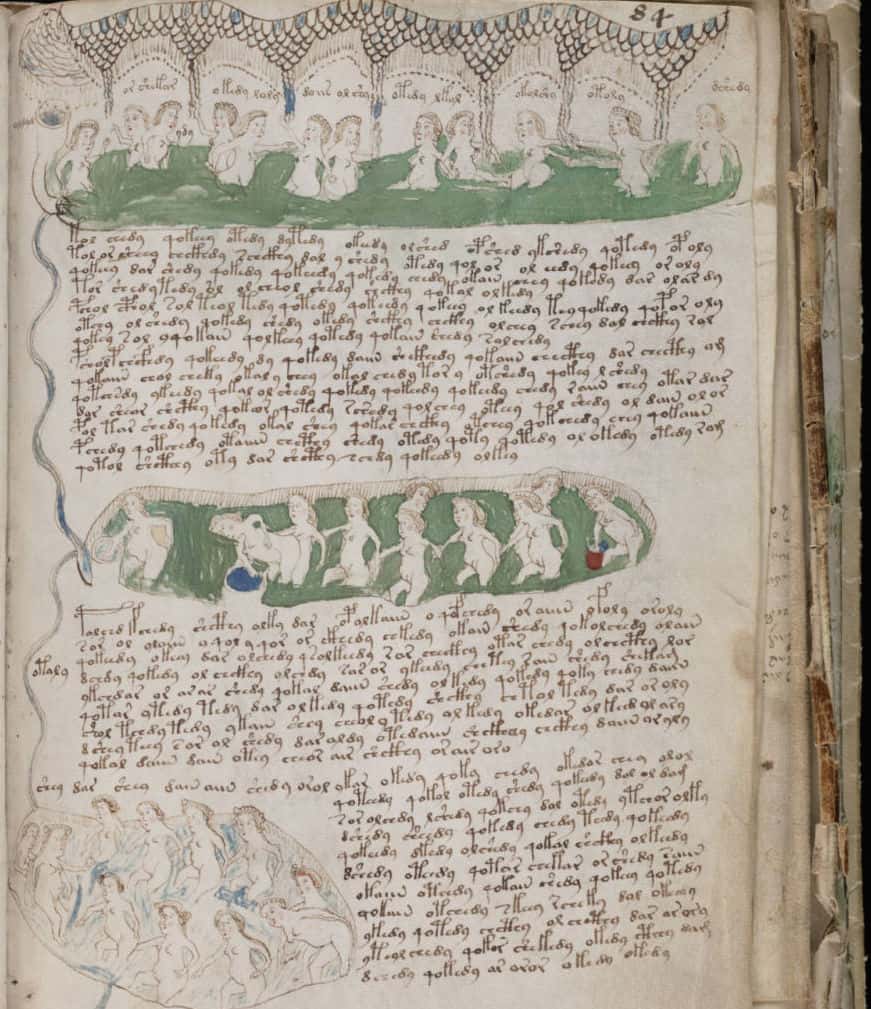
 

Page from the Voynich Manuscript


The Red Dragon or Grand Grimoire

The Red Dragon text, also known as the Great Clavicle of Solomon, is said to have been discovered in the tomb of King Solomon in the 18th century and is supposedly based on the writings of Honorius of Thebes, a mythical Greek character, claimed to have been possessed by the devil. The original copy of the Red Dragon is owned by the Roman Catholic church and is kept in a secret archive at the Vatican.

The Red Dragon’s function is for necromancy and summoning demons. Of course, since it deals with black magic, it was adopted by practitioners of voodoo, particularly in Haiti, where it is referred to as Le Véritable Dragon Rouge. It contains instructions to summon Lucifer, to make a deal with the devil. It is rumored to be fire-resistant.

The book is split into two segments with the first half, called the Sanctum Regnum, containing conjurations, invocations, and the tools needed to put a demon to work for you. The second book, called Secrets, instructs you how to make a pact with said demon without the aforementioned tools, however, it comes with greater risk – this is a demon you’re dealing with after all!


Page from the Voynich Manuscript


The Sixth and Seventh Book of Moses

These books are said to have been written by Moses himself. Contrary to the black magic of the Red Dragon, the sixth and seventh books provide instructions for creating miracles, like those performed in the Bible. It contains “seals,” or magical drawings with incantations for contacting the dead and biblical figures.
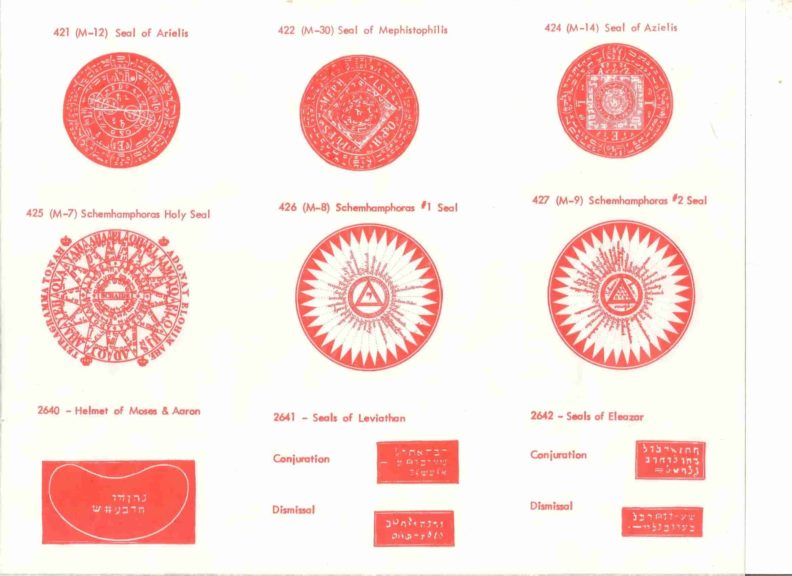
 

Page from Book of Moses Seal


These books originated in the 18th century in Europe having roots in the Kabbalah. They quickly spread from Germany to North America thanks to the Pennsylvania Dutch. From there it’s influence became widespread in African American culture, creating the foundation of Rastafarianism and the basis of Hoodoo in the American South. Hoodoo is an African folk spirituality similar to voodoo, that was brought over during the slave trade from areas of western Africa and was used for conjuring spells, spiritual hypnosis, and paranormal contact.

The powers of grimoires are rooted all over the world in many disparate cultures. The extent of this power continues to be shrouded in mystery, especially for those that have yet to be deciphered.


Gematria: Understanding the Numerical System that Decodes the Divine

Have you ever thought that numbers might tell stories just like words do? Gematria, a fascinating form of numerology found in Kabbalistic teachings, suggests that there’s a deep connection between numbers and words.

This ancient method, deeply rooted in sacred texts, proposes that every letter and word carries a numerical value that unveils deeper meanings. These connections might even offer clues to understanding both historical and future events through sacred texts like the Torah.

The concept of gematria numerology stems from the idea that mathematics is the universal language of nature and within it may be the keys to explaining our universe or evidence of supernatural power. Marty Leeds has taken this concept of the Kabbalistic gematria and applied it to the English language, believing that he has found a cipher in our alphabet to prove this theory.

What is Gematria?

Gematria is a numerological system where each letter of the Hebrew alphabet is assigned a specific numerical value. This system is used to interpret the hidden meanings within words, names, or phrases, based on the belief that God created the universe through the numerical values of Hebrew letters.

This practice, deeply rooted in the mystical aspects of the Hebrew Bible and embraced within Kabbalistic traditions, transcends simple word-to-number correspondences. It serves as a profound tool to explore the divine blueprint encoded within sacred texts, suggesting that every letter and word carries an intrinsic numerical value that reveals deeper, spiritual insights.

Modern scholars, including Marty Leeds, have extended the principles of gematria beyond Hebrew to the English language, proposing that these numerical ciphers uncover universal truths and mystical insights across different languages and cultures.

How Does Gematria Work?

The idea behind gematria numerology is that mathematics is a universal language, which might hold the keys to explaining our universe or even pointing to the existence of supernatural powers. In the practice of gematria, each Hebrew letter’s numerical value allows scholars and mystics to draw connections between words and uncover deeper meanings. These numerical values can also reflect broader concepts and beliefs. For instance:

  • Number 888: In Christian numerology, the number 888 represents Jesus, or more specifically Christ the Redeemer. This comes from the fact that in Greek gematria, the letters of Jesus’ name add up to 888. This number is seen as a representation of infinite love and redemption.
  • Number 666: Often recognized as the number of the beast from the Book of Revelation in the New Testament, 666 is associated with evil and Satan in popular culture. However, in the context of gematria, this number can have more complex interpretations depending on the scriptural and cultural context.
  • Number 4: The number 4 is often seen as a symbol of stability and order in many cultures. In the context of gematria, it can represent the four elements (earth, water, air, fire), the four cardinal directions, or the foundational aspects of creation. This reflects its universal significance in forming the basis of the world’s structure.
  • Number 33: This is a number with significant importance in Freemasonry where it signifies the highest degree of the Scottish Rite. In Kabbalistic tradition, it can represent the age at which Jesus was crucified and, by extension, a period of accomplishment or completion.

For example, the tzitzit, a shawl worn during Jewish ceremonies, provides a perfect illustration: the numerical value of its knots and strands adds up to 613, which intriguingly corresponds to the total number of commandments in the Torah. These numerical associations are believed to hold deeper spiritual or mystical significance, revealing connections that go beyond the surface and delve into the divine or universal truths.

What is Gematria Used For?

Gematria is not just about playing with numbers; it’s a tool embedded in the Kabbalistic tradition to interpret deeper meanings within sacred texts. Scholars use it to uncover insights about life, the divine, and cosmic mysteries. Beyond Judaism, gematria also appears in other cultures and languages, demonstrating its widespread influence and importance in various religious and philosophical traditions.

Exploring the Origins of Gematria

The practice of gematria is believed to have originated in the Jewish mystical tradition known as Kabbalah, but its influences can be traced back even further to ancient Greek and Arabic cultures. The practice was likely influenced by Greek isopsephy and Arabic abjad numerals, which also connect letters with numerical values. These practices highlight a universal quest to find deeper meaning in language and numbers across different cultures and historical periods.

Gematria in Different Cultures

While Hebrew gematria is most prominent, similar numerological practices exist in other cultures such as Greek and Arabic. These systems adapt to the peculiarities of their own languages and scriptures, providing a broad field of study for numerologists worldwide. The Greek system, for example, has been referenced by philosophers like Plato, showing gematria’s influence on early philosophical thought.

Examples of Gematria in Practice

  • Biblical Texts and Jewish Tradition: Gematria is often used to interpret the Hebrew Bible. For instance, the Hebrew word for ‘life’ (×—×™) sums to 18, making it a significant number in Jewish culture.
  • Modern Applications by Marty Leeds: Leeds argues that even the English alphabet can be broken down into numbers that reveal hidden codes, blending traditional and contemporary interpretations of gematria.

Kabbalistic Connections

In Kabbalah, gematria is not merely a numerological curiosity; it is an essential tool for exploring the esoteric and mystical dimensions of Hebrew scriptures. This practice is particularly valuable for interpreting the hidden meanings behind the names of God, such as the Tetragrammaton (YHWH) and other sacred words.

Kabbalists believe that each letter in these divine names carries specific numerical values that are direct expressions of cosmic energy and divine attributes. By decoding these numbers, mystics can gain insights into the fundamental structures of existence and the inner workings of the cosmos.

The use of gematria in Kabbalistic studies is seen as a method of interpretation and a form of meditation and spiritual practice, aimed at bringing practitioners closer to divine wisdom.

Key Aspects of Kabbalistic Gematria:

  • Interpretation of divine names and cosmic energy
  • Insights into the fundamental structures of existence
  • Meditation and spiritual practice to connect with divine wisdom

Practical Uses of Gematria Today

While its roots are ancient, gematria has evolved to meet the needs of modern society. Today, it finds applications in various personal and practical contexts:

  • Event Planning: Individuals use gematria to select auspicious dates for significant events, such as weddings or business openings. Aligning activities with favorable numerical values is believed to influence outcomes positively.
  • Personal Insight: Gematria is used to analyze personal names, birth dates, and keywords, helping individuals uncover deeper spiritual meanings and potential life paths.
  • Creative Applications: Artists and writers often use gematria to structure their works around specific numerical themes, adding a layer of symbolic significance to their creative outputs.
  • Digital Accessibility: In the digital age, the principles of gematria have been adapted for online use, making this ancient wisdom accessible globally and allowing its exploration across different languages and cultures.

The Ongoing Relevance of Gematria

Gematria’s roots stretch deep into Kabbalistic mysticism and have branched out into modern linguistic studies. It remains a vital tool in the study of sacred texts and offers a unique perspective on the numerical patterns that many believe govern the universe. Whether used for spiritual discovery, theological study, or philosophical exploration, gematria captivates those who seek to understand the intersection of numbers and words in various cultures.

Gematria FAQs

How do you calculate words using gematria? 

Calculating a word’s gematria value involves adding up the numerical values of each letter in the word. Different traditions may have their own set of values and methods, adding a layer of complexity to the calculations.

What is a Gematria Calculator?

A Gematria calculator is a digital tool that simplifies these calculations, allowing users to quickly find the numerical value of words and phrases across different Gematria systems.

How does gematria work in the Hebrew language? 

In Hebrew, each letter is assigned a numerical value, and these numbers are used to explore relationships and uncover deeper symbolic meanings between words, based on their numerical equivalence.

Read Article

Our unique blend of yoga, meditation, personal transformation, and alternative healing content is designed for those seeking to not just enhance their physical, spiritual, and intellectual capabilities, but to fuse them in the knowledge that the whole is always greater than the sum of its parts.


Use the same account and membership for TV, desktop, and all mobile devices. Plus you can download videos to your device to watch offline later.

devices en image
Monthly
$13 .99 /mo
BILLED MONTHLY
Select
First 7 days FREE
then $13.99 billed monthly, cancel anytime
Gaia+
$24 .92 /mo
BILLED ANNUALLY
$299 /yr
Select
Includes Events & Guides
$299 billed annually, cancel anytime
All prices USD plus applicable tax
Testing message will be here