5 Answers to the Fermi Paradox: Why Haven’t We Made Contact Yet?
The question posed almost 70 years ago by physicist, Enrico Fermi, arguably remains to this day, “Where is everybody?” There exists no widely agreed upon solution to the Fermi Paradox: If there is sufficient probability other life exists in the galaxy, why haven’t we found it? Astrophysicists and theorists have continued to debate this question with new discoveries constantly adding to the conversation. Here are some of their ideas.
Fermi Paradox Solutions
Enrico Fermi was a brilliant physicist, known for achieving the first controlled nuclear reaction. At the time, he was working at the Los Alamos National Laboratory for the Department of Energy, when one day he and several colleagues began discussing recent stories regarding the UFO phenomenon.
The conversation came to an end, with his colleagues assuming they had moved on from the topic, but later at lunch Fermi shouted in exasperation, “Where is everybody?” They found it amusing, but the question persisted, eventually being fleshed out with a formula that calculated the number of stars, solar systems, and planets in the galaxy and the supposed likelihood of life. It became known as the Fermi Paradox.
Since that day, Fermi’s epiphanic moment has given birth to a number of potential solutions based on three premises: Any extraterrestrial life does not exist; extraterrestrial life exists, but has not yet contacted us; or extraterrestrial life is present, but we are unaware.
The Rare Earth Hypothesis
The circumstances that led to our existence here on Earth today are pretty phenomenal, almost too much so. A laundry list of seemingly improbable events and circumstances allowed life to develop on Earth, one of which is our anomalous moon.
Our abnormally large moon is in near perfect orbit. Most planets our size don’t have moons this large and it is thought that without it, life on Earth wouldn’t exist. The tides, caused by the gravitational pull of the moon, play a key role in plate tectonics. Without plate tectonics, it’s theorized the continental crust would have covered the entire surface of Earth, preventing any oceanic crust. Without the moon, there might not be any oceans.

In our solar system, we’re at a perfect distance from the sun, with large gas giants like Jupiter and Saturn acting as “cosmic vacuum cleaners” on the outer rim. These planets capture the larger asteroids that would otherwise devastate the evolution of life as we know it.
Within the galaxy, our location on the outer edge of a spiral arm also prevents large asteroids, orbiting closer to the galactic center, from coming our way. Also, the inner orbits of the galaxy are mostly dead zones, where high levels of cosmic radiation emit from a massive black hole and a number of incredibly dense neutron stars. Is this the Fermi Paradox solution? We were improbably lucky?
The argument against this theory, proposed by Carl Sagan and Frank Drake, is that we’re pretty mediocre. Our rocky planet is pretty common, as is our solar system, while the region of the galaxy we’re in is non-exceptional, and our galaxy is a type that makes up 77 percent of galaxies in the universe. Therefore, there is a high probability of intelligent extraterrestrial life out there. In fact, there are probably about 200 million planets situated like we are.
The Great Filter
From here out, most Fermi Paradox solutions are based on the Kardashev Scale, a theory about how civilizations might develop to colonize beyond ours. The Great Filter is an attempt to imagine whether there is something preventing us from moving on to the next point of the Kardashev Scale, a Type II civilization that can harness all the energy of its sun.

The Great Filter is a concept, proposed by economist Robin Hanson, which attempts to describe an ambiguity that prevents life from developing past a certain point. It basically states there is something that prevents dead matter from developing and giving rise to life, beyond a certain point. Hanson developed a nine-step list, which may or may not be complete, describing the concept of evolution for intelligent life:
- Life starts with the right star system, followed by:
- Reproductive molecules (DNA, RNA)
- Simple single-cell life
- Complex single-cell life
- Sexual reproduction
- Multi-cell life
- Tool-using animals with big brains
- Our civilization as we know it
- Colonization beyond our level
The Great Filter posits at some point along this scale – most likely the next level beyond where we are now – something will kill us off. Basically, it’s improbable we will colonize beyond Earth or our solar system. Therefore, any other intelligent life forms would be subject to the same principle, and we’ll never meet them. Might there be a chance we made it past the filter? Were other civilizations not as lucky?
Deadly Probes Scenario, a.k.a. The Berserker Scenario
Anders Sandberg, Stuart Armstrong, and Milan Ćirković made a few hypotheses based on Fermi’s Paradox. The Deadly Probes Scenario is one of their most dystopian theories.
In this scenario, the three hypothesize an incredibly advanced, extraterrestrial intelligence created probes to monitor the galaxy or universe for other civilizations or signs of evolving life. These probes are self-replicating, also known as Von Neumann probes, so they can reproduce and autonomously patrol space to prevent another civilization from rising up and destroying them. There would be four conditions these probes might have to meet to possibly exist:
- They would have to be the cause of the great silence – the reason we haven’t heard anyone.
- They’d have to be compatible with our existence.
- They would be silent in their activities so as not to be visible.
- They would be impossible to overthrow by a new civilization.
There would also be two levels of stability with these probes. Type I stability would be a dominant species of probe that prevents other species from emerging, or Type II, which a coexistence of two or more probe species equally competed with each other for rule over the galaxy.
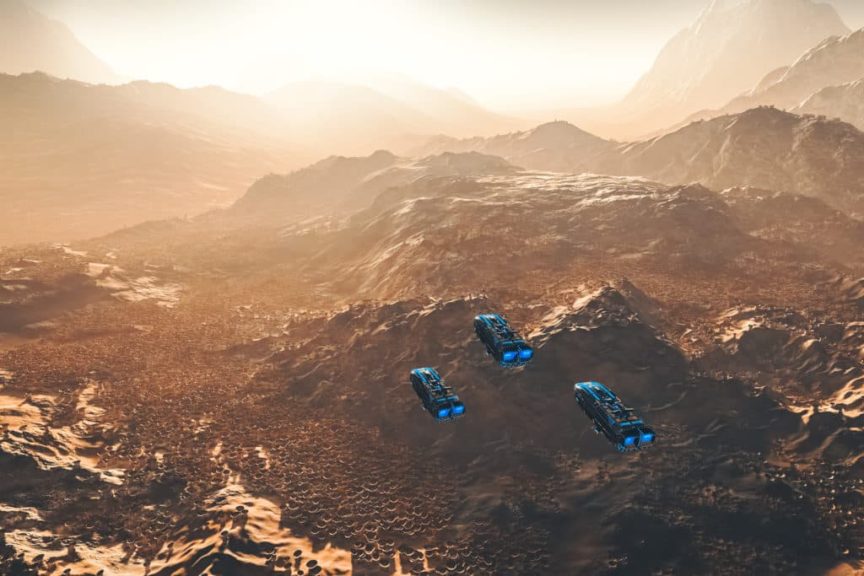
The authors of this scenario don’t think this is a plausible Fermi Paradox solution, at least within our galaxy. Because if it were, those berserker probes would be incredibly inefficient in not destroying us yet.
A Benevolent or Super Advanced Extraterrestrial Intelligence
Another belief, which is a bit more utopian, is we are still in the nascent phase of what we have the potential to become; a highly advanced race capable of things we can only dream of in sci-fi movies. This could theoretically mean an advanced extraterrestrial intelligence has reached this phase and observed us, but is waiting to reveal itself.
Why wouldn’t this race make its presence known? Most likely because it does not want to disturb us in our evolutionary process. This has become known as the zoo hypothesis: Compared to their level of intelligence, they view us like we view apes.
This civilization might understand it is necessary to let nature play its course as, if we became aware of their existence, we might screw something up. Chances are, they’re beyond the petty problems we face today including war, resource scarcity, and primitive modes of transportation. If they were to get involved, we might freak out and destroy ourselves.
They also might be slowly feeding us technology and information waiting for the time when we’re ready for them to make their presence known.
The authors of the Deadly Probes theory also proposed the aestivation hypothesis. Maybe these highly advanced civilizations are hibernating. The hypothesis states these types of civilizations may have uploaded their consciousness onto computers — a theory posited by Nick Bostrom — which would potentially allow for life to last long after the physical body deteriorates.
In this case, these conscious computer entities would want to wait for the universe to cool down to maximize energy efficiency. According to this theory the thermodynamics of computation makes the cost of a certain amount of computation proportional to temperature. Therefore, the colder the universe gets, the less it costs them to expend energy.
According to their hypothesis, these civilizations have seen it all in the universe’s current iteration. There’s no new information for them to obtain. Kind of depressing, right? So, they’re powering down into sleep mode and waiting until things cool down and maybe get more interesting.
The Holographic Universe
This theory gained a lot of traction lately, even though it was first widely proposed in the premise of The Matrix — nearly 20 years ago. Since Nick Bostrom, Elon Musk, and a slew of NASA scientists expressed their belief in this theory, it has become more popular. Maybe we haven’t made contact with extraterrestrial intelligence because we’re living in a computer simulation.
In this case, a number of theories have branched off from the broader concept. One idea is that an advanced extraterrestrial intelligence created a computer program to run a hyper-realistic simulation for whatever reason. If we had the computing power to achieve this, we probably would too. In that case, how deep does the rabbit hole go? Are they living in a computer simulation, too?
This theory seems to parallel the idea of a multiverse or the idea of infinite parallel dimensions. The difference is only a matter of semantics. Then again, the difference between us living in a computer simulation created by an advanced extraterrestrial race and us living in a world created by a god, is also a matter of semantics. Mind blown? Ours too.
So, what is the true solution to the Fermi Paradox? Will we ever find out? Only time will tell.
About the Author

Andromedans: Who They Are and How to Know If You’re One

The Andromedans are star beings from the Andromeda galaxy, known for their expanded consciousness and deep understanding of universal laws. Their mission on Earth is related to collective healing and the opening of new evolutionary pathways. In this article, we explore who the Andromedans are, their main characteristics, and how to identify if your soul shares this cosmic energy.
Table of Contents
- Who Are the Andromedans and Where Do They Come From?
- Main Characteristics of the Andromedans
- Are There Incarnated Andromedans on Earth?
- Is It Possible That Your Soul Has an Andromedan Origin?
- How to Contact the Andromedans and Receive Their Guidance
- Spiritual Practices to Open Yourself to Their Energy
- The Andromedans and Their Relationship with Other Star Races
- The Role of the Andromedans in Humanity’s Evolution
Who Are the Andromedans and Where Do They Come From?
The beings of light from the Andromeda galaxy, the closest one to the Milky Way, possess a high level of consciousness and a deep connection with cosmic laws, which allows them to actively participate in humanity’s expansion and the planet’s spiritual awakening. They act as cosmic guides and guardians of universal balance, transmitting teachings that strengthen the bond with the sacred and with unity.
These beings stand out for their capacity for vibrational healing and their respect for the diversity of life forms. It is said that their purpose includes sharing teachings that foster harmony between matter and spirit, promoting evolutionary processes that honor the essence of every being. Through lucid dreams, meditations, and spiritual practices, many people have felt the influence of the Andromedans in their lives, finding in them a beacon of wisdom and compassion.
In the series Initiation, available on Gaia, Matías De Stefano delves into cosmic history and the role that civilizations such as the Andromedans play in the expansion of consciousness. There, the multiple layers of reality are explored, and how these star races collaborate to guide humanity’s evolution and the construction of a new vision of the universe.
Main Characteristics of the Andromedans
The Andromedans possess spiritual and energetic qualities that distinguish them as cosmic guides and healers. Their influence may be felt in subtle ways, and their energy is perceived through dream encounters, deep meditations, or intuitive experiences. Below are some of their main characteristics:
- Expansive consciousness: They are deeply connected to the entirety of the cosmos. Their vision allows them to act from a place of unity and universal understanding.
- Peaceful energy: They radiate calm and serenity, acting as agents of balance in both personal and collective processes. Their presence helps to harmonize emotions and thoughts.
- Respect for diversity: They recognize the importance of every form of life and honor differences. Their mission is centered on inclusion and cooperation.
- Vibrational healing: They work with energetic frequencies to restore inner balance. They can influence physical, emotional, and spiritual health.
- Connection with higher dimensions: They communicate through dreams and meditations, offering guidance to those seeking to expand their consciousness. Their language is often symbolic and subtle.
- Cosmic orientation: They have deep knowledge of the universe’s evolutionary cycles. They help souls remember their purpose and align with universal laws.
- Unconditional love: Their vibration is based on respect, compassion, and cooperation. They serve as a reminder of the interconnection among all beings.
Are There Incarnated Andromedans on Earth?
Yes, there are incarnated Andromedans on Earth, living as human beings with the mission of contributing to the planet’s spiritual evolution. These souls carry the energetic frequency of Andromeda and are often drawn to topics related to the cosmos, healing, and personal transformation. Although they may not consciously remember their origin, their energy and actions reflect a purpose of service and expansion of consciousness.
These individuals often experience a strong sense of not belonging to this world, accompanied by a deep curiosity about the universe and realities beyond the physical. They usually have innate abilities for healing and energetic connection, and they seek to build bridges between spiritual knowledge and human needs. The connection with their star lineage manifests through dreams, meditations, and signs that confirm their purpose, reaffirming their commitment to harmony and peace.
The presence of incarnated Andromedans aims to anchor the energy of unity and harmony on Earth. By living with coherence and love, these souls activate codes of collective healing that help raise the planet’s vibration and guide others in their process of spiritual awakening. Their role is essential in maintaining energetic coherence and expanding collective consciousness. Every action and thought they emit strengthens the vibration of light and contributes to cosmic balance.
Is It Possible That Your Soul Has an Andromedan Origin?
It is possible that your soul has an Andromedan origin if you feel a deep connection with the universe and a constant desire to explore the mysteries of existence. People with this lineage often have a sharp perception of energies and a sense of purpose that goes beyond the earthly realm. These traits tend to appear early in life and intensify during moments of change or spiritual crisis, providing clarity about their life mission.
Another sign of an Andromedan origin is the inclination toward healing and the harmonization of energies, as well as the ongoing search for spiritual knowledge. These souls tend to see beyond appearances, feeling a need to help others reconnect with their essence and with the cosmic laws that govern life. Their sensitivity and openness lead them to develop practices that integrate body, mind, and spirit, and to always seek balance in every aspect of their lives.
To confirm this connection, you can have an Akashic Records reading. This tool allows you to access information about the journey of your soul and its cosmic origin, providing clarity and strengthening your connection with Andromedan energy. Knowing this information can help you align with your mission more confidently and fully manifest your potential in this lifetime. This practice is a powerful path to rediscovering your true essence and activating the gifts your soul has carried since its star-born origin.
How to Contact the Andromedans and Receive Their Guidance
Contacting the Andromedans requires a clear intention and an inner space of openness and respect. These beings communicate through subtle frequencies and often respond to those who seek to expand their consciousness and act from the heart. Creating moments of silence and reflection in your life is an essential step in perceiving their presence.
You can establish contact during deep meditations or through lucid dreams, where the conscious mind relaxes and perception expands. Visualizing the Andromeda galaxy and using sacred geometry symbols can facilitate this connection, serving as energetic portals to their vibration. Maintain an attitude of gratitude and humility so that Andromedan energy can flow naturally.
When receiving their guidance, pay attention to bodily sensations and signs in your environment. Their messages often arrive symbolically or intuitively, so it’s important to trust your perception and not force the process. Connection with the Andromedans strengthens with consistent practice and commitment to your own spiritual growth.
Spiritual Practices to Open Yourself to Their Energy
There are various spiritual practices that can help you open yourself to the energy of the Andromedans and strengthen your connection with them. These activities facilitate tuning into their vibration and allow their teachings to enter your life more clearly and lovingly. Here are some recommendations to begin integrating them into your daily life:
- Daily meditation: Set aside a few minutes for meditation to calm the mind and expand your perception. Visualize the Andromeda galaxy and allow its light to envelop you.
- Crystal work: Use crystals like celestite or labradorite to amplify the connection with higher dimensions. These crystals act as energetic bridges to cosmic frequencies.
- High-frequency music: Listen to sounds with higher frequencies or music that evokes cosmic harmony. These vibrations help align your energy field and attune you to the Andromedan vibration.
- Sacred geometry: Draw or meditate with symbols such as the Merkaba or Metatron’s Cube. These shapes contain universal patterns that activate cosmic consciousness.
- Conscious affirmations: Repeat affirmations that reinforce your intention to open yourself to the energy of the Andromedans. Spoken words and focused intention are powerful catalysts for manifesting this connection.
The Andromedans and Their Relationship with Other Star Races
The Andromedans maintain a close collaboration with other star races that share the purpose of guiding humanity toward its spiritual evolution. Each civilization contributes its unique frequency and wisdom, creating a network of cosmic support that sustains the planet’s transformation processes. Below are some of these connections:
- Pleiadians: Their energy is linked to unconditional love and emotional healing. Together, they foster heart-opening and the expansion of consciousness.
- Arcturians: They are experts in energy healing and managing high frequencies. Alongside the Andromedans, they help stabilize and protect energetic fields.
- Sirians: Their mission focuses on the activation of ancestral wisdom and the integration of sacred knowledge. This collaboration promotes the connection with humanity’s cosmic origins.
- Orions: Although they have been associated with cosmic conflicts, they now work with the Andromedans to heal ancient memories and move toward universal harmony.
- Lyrans: These beings bring the energy of creativity and manifestation. Together with the Andromedans, they guide the authentic expression of the soul’s purpose.
The Role of the Andromedans in Humanity’s Evolution
The role of the Andromedans in humanity’s evolution is centered on activating collective consciousness and remembering the connection with the universe. Their guidance encourages the opening to higher levels of perception and the understanding that everything is interconnected. Through their teachings, they help souls reconnect with their divine essence and manifest their true purpose on Earth.
These beings foster harmony and balance as pillars for spiritual transformation. Their presence stimulates the integration of cosmic knowledge with human needs, inspiring more sustainable and conscious ways of living. In doing so, they help humanity move toward a state of greater peace and cooperation, where respect and collaboration among all beings prevail.
By collaborating with other star races, the Andromedans strengthen the networks of light that support the planet. Their support becomes evident in times of change, helping people overcome fear, release old structures, and align with universal wisdom. With their loving guidance, humanity can embrace a more conscious, compassionate future aligned with the cosmic laws.