Is The Sumerian King’s List Proof of A Lost Civilization?

The Sumerian Kings List consists of several fragments of cuneiform-etched, clay tablets that paint a picture of a strange lineage of godlike and human monarchs. For years, the list has been considered an amalgam of mythology and actual historical record, but a recent discovery in human DNA may prove civilizations existed during the reign of ancient Sumer’s supposedly fabled kings.
A Strange List of Sumerian Kings
The list begins about 266,000 years ago, long before we understood human civilization to have even begun, at a time when “kingship first descended from heaven” in the ancient Sumerian city of Eridu in southeastern Iraq. Eridu is thought to have marked the beginning of the Sumerian civilization around 5400 BCE, and lasting until around 600 BCE.
From there, rulers are named up until the end of the Isin dynasty, about 1827-1817 BCE. The list is split into a few different segments and accounts for a great flood similar to the biblical deluge.
The pre-flood, or antediluvian, kings on the list reigned for tens of thousands of years, measured in units called sars, ners, and sosses, or 3600 years, 600 years, and 60 years respectively. In total, these eight antediluvian kings ruled for 241,200 years.
These, epochs measured in tens of thousands of years, are reminiscent of the Hindu Yugas, during which years of peace, chaos and everything in between are represented by cyclical ages lasting hundreds of thousands of years. The longest reign of the Sumerian King, En-men-lu-ana, lasted for 43,200 years, which is oddly similar to the Kali Yuga lasting 432,000. The number 432 is an auspicious number in mysticism and many ancient cultures, including the Vikings, Greek, and Mayans.
Some have speculated that these numbers are simply encoded in a formula implementing the famous base-60 Sumerian mathematics system. If these many-millennia-long epochs are divided by this formula one finds a more practical timeline. But when it comes to the list of postdiluvian kings with slightly less, but equally bizarre timelines, the formula doesn’t work.
After the flood, the list says the kingship descended from heaven in a new city called Kish, in what is now central Iraq. There, the postdiluvian kings reign for hundreds of years, i.e. Nangishlishma, who ruled for 670 years, and Zuqaqip, who ruled for 900 years. These supposed, multi-century lifespans reflect similar reports of men in the Old Testament, including multi-centenarians Enoch and Methuselah. Could there be a connection?
The postdiluvian list includes 23 kings who reigned for a total of 24,510 years, 3 months and 3 ½ days. After this period of rule, kingship was then moved to Eanna, followed by Uruk, Ur, and a subsequent series of back and forth movements throughout the area now known as Iraq. But as the list progresses, reigns get shorter with numbers that correspond with mortal life spans, save the occasional jumps back into several-hundred-year-long reigns.
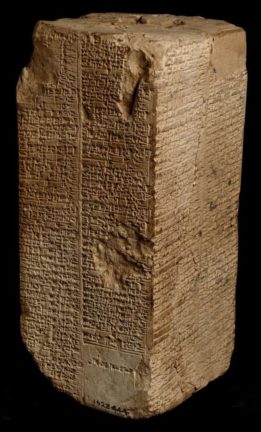
There are also figures in ancient Sumerian history, such as the famous Gilgamesh, who is not only a mythological figure but believed to have been an actual historical figure. Gilgamesh is thought to have ruled sometime between 2800 and 2500 BCE, with the Sumerian Kings List claiming his rule lasted for 126 years. Similar stories to the Epic of Gilgamesh are referenced or paralleled in the Old Testament, lending credit to the idea that these stories could have some factual basis.
Some historians believe these reigns represent achievements that a king made during his lifetime which were then translated into years tacked on to their actual lifetimes. But that would mean that more recent Sumerian Kings, whose reigns match practical lifetimes, weren’t making these achievements.
A New Discovery
Until recently, it was believed that all human DNA could be traced to a common ancestor in Africa somewhere between 60,000 and 140,000 years ago. This ancestor, who most referred to as ‘Adam,’ wasn’t the first human on earth, but rather the only one whose DNA can be traced directly to all humans today — that is, until Albert Perry’s DNA was tested and found to trace back to an even older ancestor.
After submitting a sample of his DNA to a lab for genealogical testing, Perry’s family was given some profound results: his sample contained a Y-chromosome not found in the known lineage of the majority of humans on Earth today, linking him to an ancestor who existed some 338,000 thousand years ago.
This timeline of 338,000 years would have extended back far before the era in which the divine rulers listed in the Sumerian Kings List are said to have lived. Is it possible that these kings were real and actually ruled over a lost, ancient civilization?
Since this discovery, there have been a small concentration of others with this ancient lineage found in a village in Cameroon, home to the Mbo people.
The extent to whether this DNA is indicative of an ancestor resembling anatomically modern humans or one closer to Neanderthals is debated, but it has led some to question if a human civilization, that eventually went extinct, could have existed that long ago.
About the Author

The Mathematical Genius Encoded in the Great Pyramid
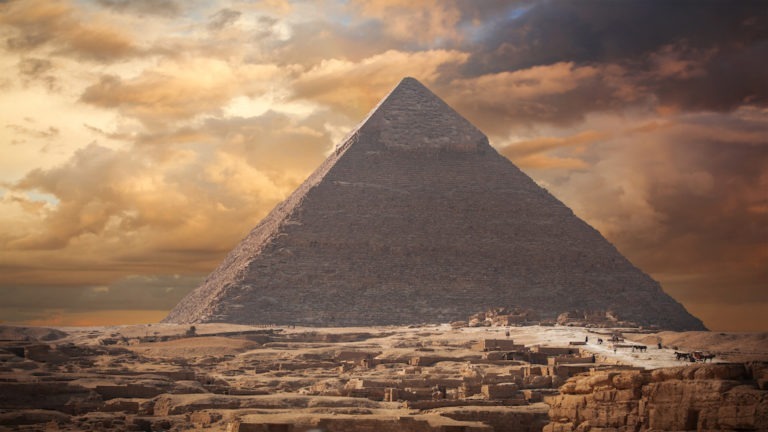
Across the shifting sands of time, nowhere has remained more mysterious than ancient Egypt. This desert beacon continues to allure millions due to its unsolved secrets, theories, and godlike pharaohs.
But perhaps the greatest reason for Egypt’s enduring popularity is a theory that places the age of this enigmatic land’s monuments so far back in history that Egyptology’s explanations seem untenable. This ultra-ancient origin has led many to surmise that the people who built these physical structures were capable of such an advanced level of engineering, in which they encoded the mathematical principles of life itself.
The architects of ancient Egypt’s monuments were far more purposeful in their proportions, measurements, angles, and equations than most modern-day archaeologists credit them with. There is also the distinct possibility that these architects found a way to naturally harness electricity from the Earth itself.
A Mathematical Code of the Universe?
While archaeologists have long been infatuated with the construction and grandeur of the Egyptian pyramids, the greatest mystery may have nothing to do with how these structures were precisely designed and crafted, but more about how they were potentially used as powerful devices to generate electrical power.
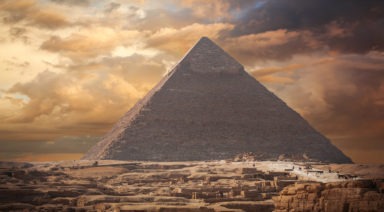
The Great Pyramid of Giza features both a shape and location designed to harbor mathematical constants. This same mathematical theory can be found throughout nature and across the universe.
Nikola Tesla, who sought to tap into the electromagnetic currents of the earth to bring the world unlimited electrical power, was in touch with these same mathematical underpinnings. Like the pyramid builders, Tesla realized Earth is a magnetic generator, spinning around two poles, with the potential to generate limitless energy.
In 1905, he filed a United States patent, titled “The art of transmitting electrical energy through the natural medium,” and conceptualized designs for a series of generators stationed in strategic sites worldwide that would collect energy from the ionosphere. With its two poles, Tesla saw the earth as a massive electrical generator of limitless energy and designed generators based on the pyramids’ design.