Study Shows Giza Pyramid Concentrates Energy Within its Chambers
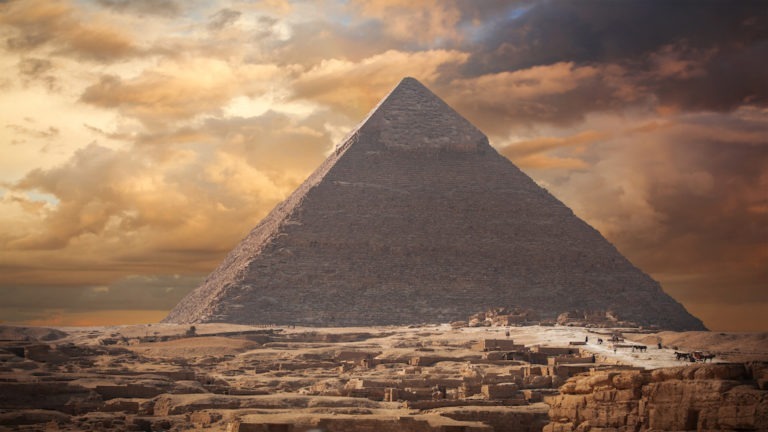
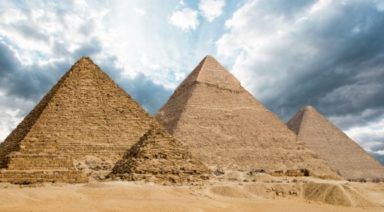
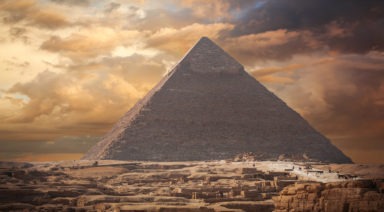
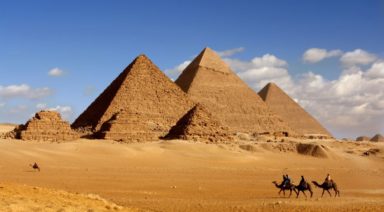
The Pyramids of Giza are an incredible engineering feat and have long been assumed to serve a greater purpose than simply being pharaonic tombs. Now, a group of physicists has discovered that the Great Pyramid can concentrate electromagnetic energy, leading scientists to believe they can use this ancient schema to create new nanoparticles for use in sensors and improved photovoltaic cells.
Using applied methods of theoretical physics, a team from ITMO University in St. Petersburg, Russia, and Laser Zentrum Hannover, a tech institute in Germany, found that the pyramids can interact with electromagnetic waves of resonant length.
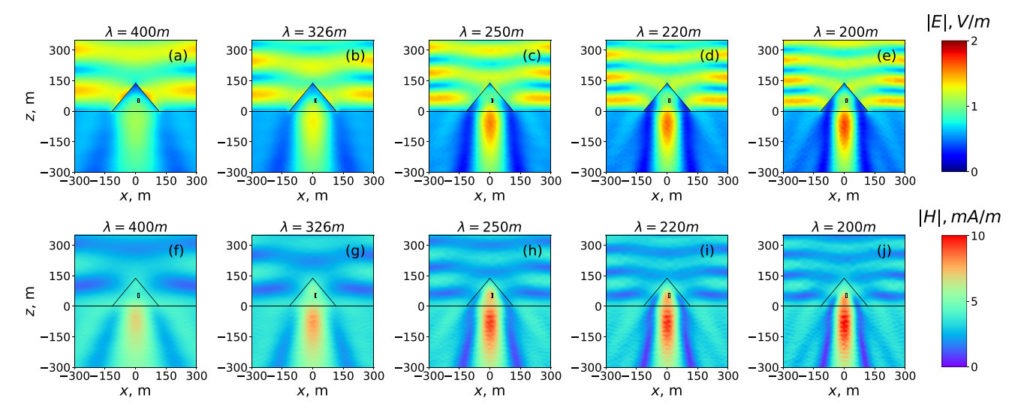
Researchers used numerical modeling and analytical methods to discover that radio waves can induce resonance in the pyramid at lengths ranging from 200 to 600 meters.
Mainstream media outlets reporting on this have already written off the discovery as a coincidence of the pyramid’s structure, saying it is highly unlikely the Ancient Egyptians knew about its conductive properties.
Similar narratives claim it is racist to be skeptical that a primitive, ancient people using stone tools could build such a monolithic structure aligned within 3/60th of a degree to the Earth’s cardinal directions, and encoded with the dimensions of the planet’s equatorial circumference, polar radius, and axial precession.
The recent study found that, under resonance conditions, the pyramid can concentrate electromagnetic energy in its internal chambers and under its base. This type of energy concentration in the chambers has been proposed by proponents of alternative archeological theories.
Researchers including Graham Hancock, Robert Bauval, and Christopher Dunn have proposed the idea that the Ancient Egyptians, or a lost civilization predating them, were much more advanced than we have credited them. Dunn says he believes that the pyramids were built as an instrument to draw energy from the Earth’s ionosphere, much like Nikola Tesla’s Wardenclyffe Tower intended.
“Egyptian pyramids have always attracted great attention. We as scientists were interested in them as well, so we decided to look at the Great Pyramid as a particle dissipating radio waves resonantly,” said Dr. Sc. Andrey Evlyukhin, scientific supervisor and coordinator of the research.
“Due to the lack of information about the physical properties of the pyramid, we had to use some assumptions. For example, we assumed that there are no unknown cavities inside, and the building material with the properties of ordinary limestone is evenly distributed in and out of the pyramid. With these assumptions made, we obtained interesting results that can find important practical applications,” he said.
About the Author

Emerald Tablet 101: The Birth of Alchemy
“As above; so below. As within; so without. As with the universe; so with the soul.” ~ Hermes Trismegistus
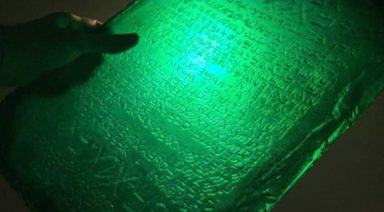
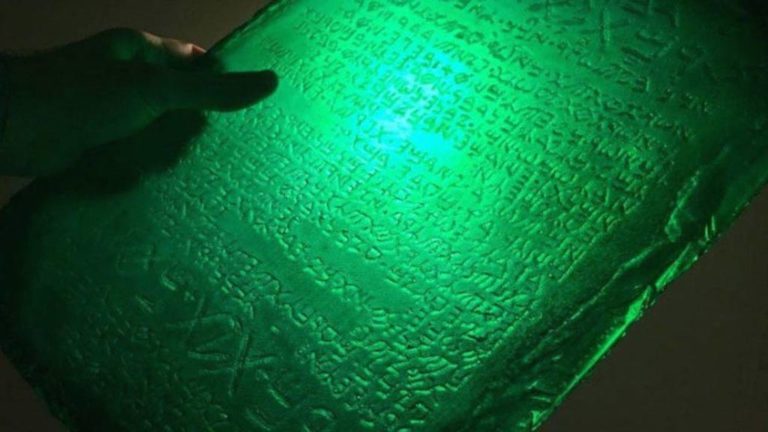
The story of the Emerald Tablet reads like the syllabus for an ancient civilization college course, with Egyptian pharaohs, Greek conquerors and philosophers, and travels through long-gone countries. While no one in the modern world has seen it, accounts of the Emerald Tablet of Hermes Trismegistus describe a slab of brilliant, crystalline green stone covered with bas-relief Phoenician text. Some believe the tablet holds the secrets of the universe.
Considered the original source of hermeticism, gnosticism, Western alchemy and science, the tablet is inseparable from the elusive Hermes Trismegistus, an ancient philosopher, healer and sage. References to Trismegistus can be found in Renaissance, Christian, Islamic, Roman and Greek literature.
No one knows what became of the original tablet — what remains are translations and translations of translations, along with a historic timeline punctuated with disconnects and gaps. The tablet appears and disappears across the ancient world, before and after the birth of Christ, with periods of revival, including the Italian Renaissance.
Dennis William Hauck, author of the classic “The Emerald Tablet,” wrote, “One of the most mysterious documents ever put before the eyes of man, the Emerald Tablet has been described as everything from a succinct summary of Neoplatonic philosophy to an extraterrestrial artifact or a gift from Atlantis.” The tablet’s premise that “All is One,” and that direct experience of the Divine is possible through meditation and psychological exercise, became the foundations of Freemasonry, and later Theosophy and esoteric schools including The Golden Dawn.