Do Thousands of Alien Contact Accounts Share Same Message?

Though UFO sightings have been traced to the days of prehistoric man — with ancient drawings of spacecraft, mysterious symbols, and humanoid creatures depicted on cave walls all over the world — the overwhelming number of encounters are only now starting to receive the attention they deserve. UFO abduction stories and alien contact have poured into the mainstream for decades, even while those who claim to have had these experiences find themselves as targets of social mockery.
UFO Abduction Experiences
Detractors who disbelieve abduction experiences often fail to take into consideration the character of the individuals who claim to have been abducted. A vivid stereotype stands in the way of fair treatment for experiencers: a delusional hillbilly at a rural bar rambling about far-fetched stories, or a drug-addled person ranting to no one in particular in the middle of a populated city center. But these abductee tropes are unfair and antiquated.
Giving actual credence to contact claims are the accounts of respected professionals who’ve come forward with their own stories, including military personnel, media personalities, and political figures. There are many people from all walks of life who have reported abductions and contact, such that a new generation of dedicated researchers has emerged, interested in learning more about these vivid and often terrifying experiences. Meanwhile, a number of psychologists have attempted to understand the lingering trauma and emotional scars of these abductees who work to cope with the ensuing trauma and disruption in their daily lives.
Harvard psychiatrist John Mack observed that the fear of social rejection and invalidation can often be more traumatic to an abductee than the actual experience of abduction. He said, “Every other culture in history except this one, in the history of the human race, has believed there were other entities, other intelligences in the universe… why are we so goofy about this? Why do we treat people like they’re crazy, humiliate them, if they’re experiencing some other intelligence?”
Similarly, physicist and UFO researcher Stanton Friedman noted, “I check all my audiences [on the lecture circuit] and find that, while in agreement with polls, 10% have had a sighting but only 5-10% of these witnesses have been willing to report what they saw. Biggest reason? Fear of ridicule.”

L. Harvard Psychiatrist John Mack R. Physicist Stanton Friedman
Photographer Kim Carlsberg was a few days into working on the set of the hit television show “Dallas” when she went home and saw her first UFO, which she dubbed the “Moon Over Malibu.”
A few weeks later, Carlsberg went to bed and woke up in a spacecraft, which would be the first of a series of abduction events that continued for seven years. During abductions, she says she was the subject of experimentation and claims to have been impregnated to create hybrids of aliens and humans. She says she has learned profound spiritual lessons, having been shown the oneness of the universe and all of its species. And she reports a resounding mission among the extraterrestrials “[T]hat it is time to save Mother Earth from her inhabitants.”
Carlsberg’s first book, “Beyond My Wildest Dreams,” discusses her personal UFO abduction story, while her second book, “The Art of Close Encounters,” serves as a forum for 150 people to tell their UFO abduction stories.
Skeptics often argue that celebrity personalities benefit by stepping into the limelight with stories of alien encounters, but this certainly isn’t the case for those in politics or the military, where the pressure to be credible and sane is vital to one’s career. To shield themselves from the expected derision and defamation, many military service personnel prefer to give their first-hand testimonies anonymously — though they are usually identified as being military professionals, presumably because this lends credence to their accounts.
Political candidates, on the other hand, are rarely given a leg to stand on if they discuss abduction experiences. They are almost guaranteed to be subjected to harsh criticism that includes attacks on their character, judgment, mental stability, and even their fitness to hold office. Just a few years ago, Bettina Rodriguez Aguilera, Republican candidate for Florida’s 27th Congressional District, admitted to the press that she had been abducted by aliens. Almost predictably, responses were quick, harsh, and used as political fodder against her.
The Miami News Times added fuel to the fire writing, “[O]f course, Rodriguez Aguilera’s alien-abduction story is extremely bonkers, and she still stands by it, which, by New Times’ estimation, either precludes her from being endorsed by anyone or should make her eligible for president of Earth because, if the story is true, she could be the One True Leader who unites humans against a future alien invasion.”
UFO Contact and Warnings
A U.S. military sergeant, whose name is protected behind the moniker Sergeant CJ, was traveling from Georgia to Kentucky with his family when he woke up one night in a motel bathroom, writing an uninterrupted string of squares and lines that ran for 27 rows. Startled, the line he was in the midst of writing trailed off, and he ended it with “…WTF.” From that point on, Sergeant CJ had vivid dreams of aliens telepathically communicating warnings to him.
When Sergeant CJ recounts his story he’s clearly the extraterrestrials who contacted him were not threatening, but rather trying to help preserve both humans and planet Earth — and they wanted him to convey a message. He explains they are concerned about humans sabotaging their own planet. One such concern regards the practice of sending satellites into space. Sergeant CJ conveyed that outside minds now need to come in and help solve the problems we create ourselves, providing us with advanced technologies, among other solutions.
The aliens issued a warning, Sergeant CJ, claimed. They explained there are other alien species with bad intentions toward humans. Although the species that contacted him are doing what they can to help us, they expressed they are nearly outnumbered. Humans, he said, were “[G]oing to need to assist, and get to where we need to be sooner, in order to stand a chance. We have the technology (though, Sergeant CJ did not specify what kind) that we need to develop, but it is kept from the public behind closed doors. That (technology) needs to be exposed, and all bright minds need to be involved in future advancement of what we have, and what we need to increase our technical side. We need to be able to improve at a faster rate.”
For decades, similar warnings have accompanied abductions, including in the case of Steve and Dawn Hess who claimed to have been captured by aliens while camping in the Mojave Desert. While under hypnosis, Dawn was asked why extraterrestrials wanted to experiment on humans. She responded by relaying a communication similar to Sergeant CJ’s; a supreme galactic leader wants to bring together five galaxies to live in harmony — but humans are on the verge of destroying Earth, and so alien species have to intervene for the sake of the universe.
At a time when there is so much devastation on our planet — genocides, famines, global warming, warfare, mass violence — could it be that alien species are indeed intervening to preserve the galaxy? Could humans not only be destroying themselves but also disrupting the fate of the universe with recklessness and greed? It seems this theme of warnings persistently arises out of many abduction cases.
Abductions are being reported at an astoundingly high number. A 1992 Roper Poll reported that four million Americans believed to have been abducted by aliens. As in the case of Arizona logger Travis Walton, one of the most famous abductees — who’s told the story of his abduction over and over again only to be met with public ridicule — those who undergo UFO abduction experiences have far more to lose than win.
If people are being contacted and abducted, returning with dire warnings to the rest of humankind, are the rest of us foolish to ignore them? Do we have to wait to see it to believe it, or will it be too late by then? Concern over the fate of our planet and its inhabitants is the message, but due to the stigma created around the abductee phenomenon, the topic is usually deflected to question the mental stability of the abductee. While the media and detractors are busy defaming traumatized abductees following harrowing experiences, the most important part of their ordeal seems to continually elude the public — the message they have returned to deliver.
About the Author

Who Are The Anunnaki? The Ancient Gods of Sumer
Who were the Anunnaki?
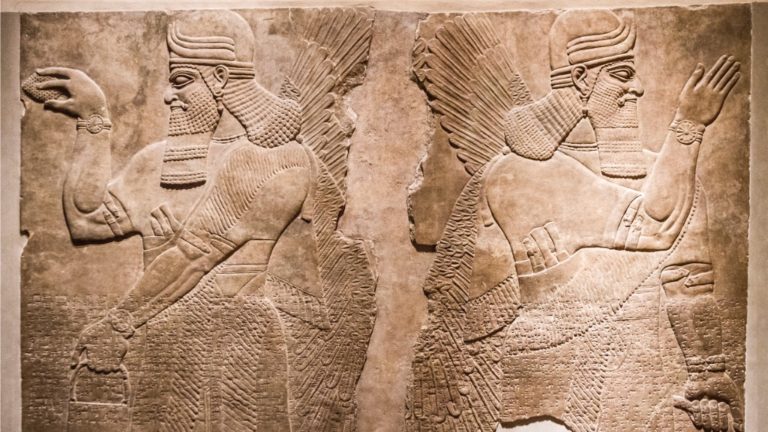
The short answer is: The Anunnaki were the central pantheon of deities worshiped by the ancient Sumerians and arguably the world’s first advanced civilization.
Interest in ancient Sumerian culture has been active and persistent since it was discovered in the 19th century, for several reasons, including the profound impact these early people had on religion, astronomy, law, and mythology. The Anunnaki, as divine figures, have fascinated scholars, theorists, and truth-seekers since their rediscovery.
Who Were the Sumerians?
The Sumerians appear on the archaeological record beginning around 4,500 BCE. Located in present-day Iraq, the region, f.k.a. Mesopotamia has long been referred to as “the cradle of civilization.”
Sumer was a handful of city-states initially ruled by priests, each organized around a city and temple now called a “ziggurat.” The ziggurats, dedicated to Anunnaki worship, were layered pyramids with flat tops. These communities were considered to be “servant-slave” populations dedicated to serving the temple gods — the Anunnaki.
Over time, priesthood rulership gave way to kings.
The Sumerians were skilled trade merchants and acquired lapis lazuli from Afghanistan, cedar from Lebanon, and gold from the Indus Valley. Their agrarian culture gave us the plow as well as “time” — the 24-hour day and 60-minute hour.
Sumerian history is gleaned from archaeological and geologic evidence — written records are in the form of cuneiform tablets. Reportedly, some half-million tablets have been recovered, but only a small number have been translated. Many of these tablets contain mythic and administrative insights that have shaped modern understanding of early Mesopotamian society. Much was also learned from translations of Babylonian records; Sumer was considered “ancient” in Babylonian times.