Scientists Find DMT Produces a Waking Dream State
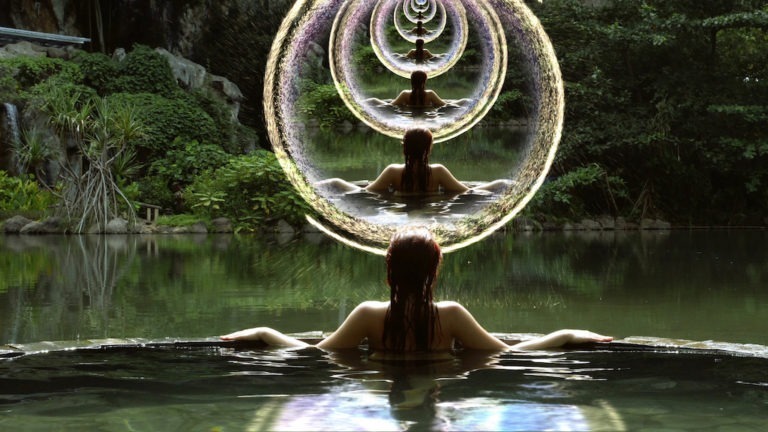
Since the beginning of humanity, dreams have played an important role in spirituality, with shamans and sages interpreting them for their deeper meaning. In modern times, Freud and Jung have brought dream study to a new level, exploring the relationship of dreams to the subconscious and unconscious, looking for ways that a deeper self tries to communicate with the conscious one. And now, we’ve come to an even greater look at dreams via the influence of natural plants that contain what has been termed “the spirit molecule” — DMT (dimethyltryptamine). Researchers are now studying DMT’s ability to actually create a type of waking dream.
DMT is well known to neuroscientists, avid users of hallucinogenic plants, and ethnobotanists. The DMT compound produces brief and intense visual and auditory hallucinogenic experiences, whether consumed through ayahuasca, or as an isolated chemical — a white crystalline powder derived from plants found in Mexico, South America, and parts of Asia.
Medical News Today reported that the chemical root structure of DMT acts as a non-selective agonist (a substance that initiates a physiological response when combined with a receptor) at most or all serotonin receptors in the body’s cells. Serotonin has been called the happy chemical because it contributes to wellbeing and happiness. DMT is also produced naturally in the body in the lungs and in minute doses in certain areas of the brain.
DMT Study and the Dream State
After untold generations of ayahuasca use, science has now begun to take a closer look into its brews in the context of its most active ingredient, dimethyltryptamine. The DMT study is the first to show how DMT changes waking brain waves in such a way that researchers have begun comparing its effects to dreaming while awake.
The Psychedelic Research team at London’s Imperial College, headed up a DMT study to examine transitions in and out of the altered state of consciousness caused by intravenous administration of a fast-acting form of DMT. They explained, “the phenomenology of the DMT experience suggests it may be an especially powerful scientific tool for illuminating the neurobiology of consciousness. DMT experiences can be said to resemble ‘world-analog’ experiences (i.e. interior analogs of external worlds) – similar to the dream state.”
As a result of their DMT study, the team concluded that, at high doses, the effects of DMT lead rapidly into a deep and profound immersion, sometimes described as a “breakthrough.” This experience is often described as a sense of entering into another, but completely real, world or dimension. Users commonly describe encounters with sentient “entities” or “presences” within this other world. The experience often challenges beliefs about the nature of reality and consciousness.
DMT Effects on Brain Activity
The Imperial College research team captured EEG (electrical brain activity) measures from 13 healthy participants who were given an intravenous infusion of DMT. Volunteers were fitted with electrodes in their caps to measure electrical activity before, during, and after their infusion. The analysis revealed that DMT significantly altered electrical activity in the brain, characterized by a marked drop off in beta waves – the human brain’s dominant electrical rhythm when a person is awake. Most significantly, researchers found a short-lived increase in brainwaves typically associated with dreaming — namely, theta waves.
In addition to changes in the types of brainwaves, the researchers also found that, overall, brain activity on DMT became more chaotic and less predictable. This is the opposite of what is seen in states of reduced consciousness, such as in deep sleep or under general anesthesia.
“The changes in brain activity that accompany DMT are slightly different from what we see with other psychedelics, such as psilocybin or LSD, where we see mainly only reductions in brainwaves,” the researchers said.
Ayahuasca DMT and Jungle Magic
Called the “vine of the soul,” ayahuasca is made of the Banisteriopsis caapi vine and the shrub Psychotria viridis (known as “chacruna”), which contains the primary psychoactive, DMT, as well as the plants Diplopterys cabrerana (also known as “chaliponga” and “chacropanga”) and Mimosa tenuiflora. At some point in history, perhaps because the jungle spirits called them to sacred places along the Amazon basin, shamans discovered that the ayahuasca vine needed these other plants to activate the DMT components in the body.
Making the ayahuasca brew is a ritual that begins with a shaman picking the lower chacruna leaf at sunrise, followed by a prayer. The vine is not just washed, but it is cleansed with wooden spoons and then pounded with wooden mallets until it turns to fiber.
Ayahuasca is no casual hallucinogen. Devotees and shamans of the Amazon teach that it needs to be treated with profound respect, and they regard the brew as a holy goddess. It is treated as a being, a soul of the Amazon jungle, who confers upon its users an experience of the divine and insight into the core of one’s being.
Ethnopharmacologist Dennis McKenna, younger brother of the famed ethnobotanist Terrance McKenna, said, “With ayahuasca, it’s often said that you should have a goal going into it and state your intentions. I used to emphasize that myself, but I’ve sort of come around in some ways. If you have an intention going into it, that’s fine. If there’s something that you really want to get some insight about then ok, do that. But my own preference lately has been to approach it with very little structured intent. I tend to say ‘Tell me what I need to know, tell me something that you want me to know,’ and that’s how I approach it.”
Science Proves What Is Already Known
While it may be obvious to centuries of shamans that DMT-containing plants bring the dream world into waking consciousness, science has lagged behind. The latest research merely confirms what has been experienced in all corners of the world. Unfortunately, the DMT spirit molecule remains a Schedule I controlled substance in the United States. Proponents of ayahuasca, magic mushrooms and other mind-expanding plants argue that it’s time to embrace what nature has provided to bring more insight and compassion into our lives. Author and ayahuasca user Graham Hancock questioned, “Why should it be the case that society is afraid of realizing human potential?”
Is Psychedelic Tourism Destroying the Sanctity of Plant Medicine?
As psychedelic healing and plant medicine go more mainstream, luxury psychedelic tourism is on the rise—good news for the spread of this medicine, but how might over-commercialism affect this sacred practice?
A recent Bloomberg article highlights the rise in all-inclusive psychedelic retreats. Indigenous plant medicine has been around for centuries, and its health benefits have been scientifically demonstrated, but as it gains mainstream acceptance and finds a bigger audience, some only see dollar signs.
Bloomberg reports, “according to Data Bridge Market Research the psychedelic market is expected to grow from $3.8 billion in 2020 to $10.7 billion by 2027.”
With the potential to make a lot of money, could some unscrupulous companies capitalize on this trend and remove the sanctity of this practice?
Carlos Tanner is the director of The Ayahuasca Foundation in Peru, he founded the center in 2009 as the result of his own healing journey. “When I started our retreat center, The Ayahuasca Foundation, I was coming off of a seven-year study myself; a four-year apprenticeship where I lived with a curandero and several years after that of studying with other teachers,” Tanner said.
“For most people that were starting centers at that time—which wasn’t many—you were a student first, and eventually after years of study, you came to the point where you wanted to offer this to people from outside of the culture. Now we see people who don’t have very much experience at all, but yet they’re opening a healing center.”
As this budding industry is dealing with rapid growth, there are some complicated issues regarding its increased popularity.
“When it comes to the commercialization of substances that have an ancestral background I would say that it is a delicate situation, and I hope that there would be a benefit to those indigenous populations from which those traditions were orignated. But at the same time, I know many indigenous people and they are for the spreading of what they believe to be their culture, which oftentimes was something that was looked upon negatively or was degraded as if they were second-class citizens, quite literally,” Tanner said.
“But now having people from the Western world, from the modern world, want to learn or experience elements of their culture, I think gives them a sense of pride. So it’s a complex question, to say the least.”