Incredible Evidence For Remembering Past Lives

Could your love of sushi be proof that you were Japanese in a past life? Maybe not, but for a group of 24 Burmese children, it might just be the case. After WWII, a large group of children in Burma claimed to have been Japanese soldiers in a past life. They could not tolerate the spicy Burmese cuisine; instead, they craved raw fish.
This is just one of the thousands of documented cases in which memories seem to carry over from past life experiences. The concept of reincarnation is held in many parts of the world, especially those areas where Hinduism and Buddhism are practiced, but not until recently has it come to be a widely accepted idea in the Western world. A number of researchers are seriously exploring the evidence for reincarnation, especially in the context of past life regressions.
It’s been estimated that about a million people have accessed past life memories in one way or another. The most common method is through a guided therapy session with a psychotherapist. During these sessions, the subject is put under hypnosis while a therapist guides them with directions and questions. Regressions are often cathartic, accessing memories that are somehow tied to physical afflictions or anxiety experienced in the current lifetime.
One of the most prominent names in past life regression is Dr. Brian Weiss. His daughter, Amy Weiss, had never had a successful regression, despite her father’s profession. Amy had recently been diagnosed with cataracts at the age of 25, an unusual condition for someone her age, and she decided to participate in one more session.
Surprisingly, Amy experienced a successful past-life regression; connecting with an old man in the middle ages who was accused of being a wizard. His house was set on fire by villagers, subsequently burning his eyes. She said she felt a connection with the man’s heart and realized it could be tied to her cataracts. The session proved to have a profound therapeutic benefit, and her cataracts cleared up shortly after.
Past life regressions can be a contentious topic among practitioners of psychology. The evidence and accounts are overwhelming, but there is debate as to what they really are.
Dr. Ian Stevenson was a well-respected psychologist and was the chair of the department of psychology at the University of Virginia. He was given a million-dollar grant to fund research into paranormal psychology, or parapsychology, with the intention of disproving the concept of reincarnation. Stevenson researched thousands of cases on the uncanny memories of young children from their past lives. While his intention was to disprove this phenomenon, in the end, he became one of its staunchest defenders and most dedicated researchers.
One child in India, who was born with boneless stubs for fingers on his right hand, remembered the life of a farm boy who had lost the fingers on his right hand in a grass-chopping accident. What really makes this case remarkable is that Stevenson was unable to find a single medical record of another birth with this unique deformity.
Today, Dr. Jim Tucker continues to conduct the work started by Stevenson. Unlike past life regressionists, Dr. Stevenson and Dr. Tucker do not study those put under hypnosis. Instead, they look at cases of kids who start to spontaneously remember things and who start speaking about their previous lives while fully cognizant. In one of Tucker’s papers, he recounts a story of a boy from Thailand who, at the age of three, started complaining that he had been shot and killed in his past life while riding a bicycle to school. He even remembered that he was a local teacher named Bua Kai. His grandmother took him to the village where he said he lived, and he lead her to a house. He recognized the people living there and they confirmed that five years earlier, their son Bua Kai had been shot and killed while riding a bicycle to work.
He was shot in the back of the head marked by a small entry wound with a larger exit wound in the front of his head. The little boy had been born with a small birthmark on the back of his head and a larger, oddly-shaped mark on his forehead.
Closer to home, Dr. Tucker investigated a truly uncanny case in Oklahoma that made national headlines. When Ryan Hammons was 5 years old, he began telling his mother “I used to be someone else” and “take me home to Hollywood.” The boy had a surprising array of specific facts on hand about his former life, including dancing on Broadway, starring in films with Mae West, and eventually becoming a Hollywood agent. Ryan’s mother began looking through books of old Hollywood, and when she reached a still image from the 1932 movie “Night After Night,” Ryan pointed to a man on the edge of a frame and said, “that’s me!” With the help of Dr. Tucker, they were able to identify this man after weeks of investigation as Marty Martyn, an extra who had danced on Broadway and eventually became a powerful agent.
All in all, Ryan was able to provide 55 specific details of Martyn’s life which would not have been available without an investigation: including the name of the street he lived on, his work history, details of his wives and children, and more.
Is it possible that we have led past lives in which memories could have transcended into this lifetime, continuing to remain in the depths of our subconscious? There is widespread evidence that is hard to refute or explain. Past life regression therapists and traditional psychiatrists are still at odds as to what is really being accessed when someone undertakes one of these sessions. But even some of the most astute academics and doctors have been convinced that there is some sort of phenomenon happening that can’t be easily explained.
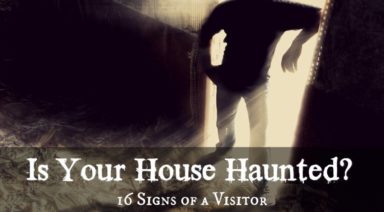
How To Tell if Your House Is Haunted? 16 Signs To Look For
Are you encountering strange sounds, items disappearing, or lights turning on randomly in your home? These may be telltale signs that your house is haunted. All hauntings are different and can vary from hearing a door slamming occasionally to seeing full apparitions. Commonly believed to occur only in old homes in the middle of the night, as seen in many horror movies, hauntings have also been investigated in new homes and can occur in broad daylight.
Not every mysterious noise or vision has a logical explanation. It’s important to understand if your house is haunted to determine the appropriate steps to take.
Common Signs of a Haunted House
If you noticed these early warning signs, then someone else or something else could be occupying your home:
1. Unexplained Noises
These strange noises can include footsteps, knocking, banging, scratching, or something being dropped. These noises can be subtle, and at other times, they can be quite loud.
2. Doors, Cabinets, and Cupboards Opening and Closing
Very rarely will the experiencer ever witness this phenomenon take place. Most often, the experiencer will hear creaks as a door opens or closes, and when investigated, the door is typically in the opposite position it was previously.
3. Lights Turning Off and On
Lights will turn on and off when the experiencer knows they previously left it on or off. This occurrence is also rarely witnessed. This can also happen to electrically powered devices like TVs and radios.
4. Items Disappearing and Reappearing
This phenomenon is called the DOPler Effect (DOP = Disappearing Object Phenomenon). Experiencers will place an everyday object in a typical spot in the house. Later, when they retrieve that item, it is gone and nowhere to be found after a thorough search. Hours, days, or weeks later, the object reappears in the exact position it was left in before it went missing.
5. Unexplained Shadowy Figures
Fleeting shadows are normally seen out of the corner of your eyes. These shadows typically take human forms, also known as Shadow People, while at other times, they are less distinguishable or smaller.
6. Strange Animal Behavior
Dogs will sometimes bark at something unseen, cower without reason, or refuse to enter a room they normally do. While cats seem to be watching something move about the room. Animals do have sharper senses than humans, and many researchers feel their psychic abilities are allowing them to notice this behavior quicker and better.
7. Feelings of Being Watched
Many people tend to get the feeling of being watched throughout the day, but if the feeling is consistently occurring in a specific part of the house at a particular time, it may be attributed to supernatural forces.
Stronger Signs of a Haunted Home
These next signs are rarer paranormal activity but could be stronger proof of a haunting:
8. Mild Psychokinetic Phenomena
Actually seeing a door open or close, a flickering light bulb, or a child’s toy turn on by itself. Others state they can hear or feel something sitting on the bed next to them.
9. Feelings of Being Touched
Some feel something brush past them, touch their hair, or a “hand” on their shoulder. Others can feel a gentle poke, push, or nudge.
10. Strange Sounds
Some can hear voices, whispering, crying, or even music from an unknown source.
11. Notable Temperature Changes
Cold spots in your house are one sign that your home could be haunted.
12. Unusual Smells
A fragrance of perfume or cologne that does not exist in your house. This phenomenon may be accompanied by shadows, voices, or psychokinetic phenomena.
Powerful Signs of a Paranormal Presence
Poltergeist activity is rare but is the strongest evidence of a true haunting:
13. Severe Psychokinetic Phenomena
Some instances of this phenomenon include plates sliding off the table, pictures flying off the walls, doors slamming with great force, or furniture sliding across the floor.
14. Physical Assault
This type of phenomenon is very rare but includes scratches, slaps, and hard shoves.
15. Other Physical Evidence
This can include unexplained writing on paper or walls, handprints, and footprints.
16. Apparitions or Ghostly Figures
This very rare phenomenon is a physical manifestation of a spirit or entity. These human-shaped forms can be seen as mist, transparent, or solid.
My House is Haunted, Now What?
If you suspect that your house is haunted, you have several options. Firstly, consider keeping a journal to document any unusual occurrences and their frequency. It may also be helpful to consult with a reputable paranormal investigator or psychic medium to assess the situation and provide support. Furthermore, you can perform cleansing rituals or prayers to create a sense of peace and protection in your home. Finally, if the paranormal activity persists and you feel unsafe, consider relocating to a new residence. Yes, this is particularly challenging for homeowners, but the alternative is having an evil spirit for a roommate.
Communicating with Spirits and Risks
While communicating with spirits can be tempting, it’s essential to approach such interactions with extreme caution due to the real-life dangers involved. Engaging in practices like using Ouija boards or participating in séances can open channels to the spirit world, inviting not only communication with loved ones but with negative energies or malevolent entities. Bad encounters can lead to emotional distress, psychological instability, or spiritual attachment if proper precautions are not taken. So, it’s crucial to be mindful of one’s intentions and boundaries when attempting to communicate with spirits and seek guidance from paranormal experts to ensure your safety.