Are You Blocking Spirit? Tips from James Van Praagh

It’s no coincidence that James Van Praagh was in Denver at Mile Hi Church speaking about spirits, connection, and love the very same day that gay marriage was legalized by the U.S. Supreme Court — June 26, 2015. The bubbly spiritual medium came on stage waving a rainbow flag a “Mile Hi-er” gave to him just moments ahead of time. It was synchronistic one could say.
JVP was at Mile Hi for An Evening of Spirit, a packed event where attendees came in the hopes of connecting with loved ones who have crossed over to the other side. It was more than that, though. Those not getting a personal reading still left that evening with plenty of tools in their spiritual toolbox in order to connect with not just loved ones, but with Spirit itself, the Divine love that created the universe.
Connecting with Spirit
James started out by explaining that in order to connect with spirit, one must look at it from a soul’s point of view, not a human’s point of view. Spirit tells us we must be mindful. Every single person is God. And that vibration, that God energy, is light. So how are you shining your light? Each choice we make originates from either love or fear. In every decision we make, we are moving toward one or the other.
Spirit is all around you and wants to help you clear your mindset of expectations, negative energy, and destructive thought patterns. Why? Because it’s easier to communicate with you this way. These spirit-blocking energies are a result of the ego. What does the ego do? The ego edges God out.
How to Attract Spirit
Here are some tips for being more open to attracting spirit(s) into your life.
Stay in the Light
Have an atmosphere of love and light. Do your best to move away from fear, anger, hate, and other negative emotions that cause you to vibrate at a lower level.
Be Open
Be open to whatever happens.
Detach Yourself from Expectations
Release all of your expectations. Expectations block energy!
Check Your Ego at the Door
The more you know, the less you will be afraid. Your ego tries to outsmart what you know deep down inside of your soul. Don’t let it edge God out.
Do Some Mental Housekeeping
Clean up the conditions of your mind. Thoughts become things, and you are the only one who controls which thoughts you manifest.
Meditate
The more you meditate, the closer you can get to spirit. Meditation helps you clean your energy field – your thoughts, your chakras, the vibrations you emit constantly simply by living.
James says that thoughts are like bullets. When someone thinks about you, it goes right to you. (Ever had the phone ring shortly after you’ve been thinking about the person on the other end? That’s energy exchange.)
Thoughts have colors, vibrations, character, and design. It is our thoughts, and corresponding choices arising from those thoughts, that creates the fabric that bleeds into the tapestry of life. Your thoughts and actions are a single thread in the larger tapestry of consciousness. You will be held responsible for your actions when you pass over to the other side. It’s called a life review. When you get there, what will yours look like?
Be patient
Manifestation of the Divine and connecting with those on the other side can take time on this physical plane called Earth. Physical vibration is slower than spiritual vibration. This is why you’ll notice James gets very excited and high energy when he’s channeling spirits; the spirits knocking on his door are vibrating at a much higher level.
Spirit is All Around Us
Spirit can connect with you in many different ways. You don’t have to see a spiritual medium in order to know that someone is with you. Music, guided meditations, individual or silent meditation, animals, and many other signs are spirit speaking to you.
Coming to see JVP with the expectation that a loved one will come through can actually block the occurrence from happening. If you’ll be meeting James any time soon, refer to the tips above to better prepare for the exchange.
About Mile Hi Church
Located in Lakewood, CO and known worldwide, Mile Hi Church teaches the principles of Science of Mind and Spirit, the basic principles being Love and Law. Their teachings are based on the work of Ernest Holmes. Their vision is oneness revealed…a world of love, peace, and abundance for all. Their mission? To serve as a spiritual beacon for personal empowerment and global enlightenment.
Learn more about Mile Hi Church at www.milehichurch.org and check out their event schedule. Many of their speakers have programming you can watch right here on Gaiam TV.
Not yet a member of the Gaia community? Sign up now and start watching our transformational programming, including original programs like Spirit Talk with James Van Praagh.
About the Author

Contacting the Dead Through Psychomanteum Mirror Gazing

Is it possible to connect with loved ones after they’ve moved on from this lifetime? Many people have reported apparitions or felt the presence of an otherworldly spirit at some point in their lives, but those experiences are often spontaneous or fleeting.
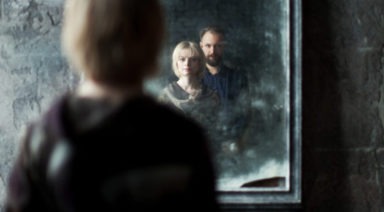
While séances and psychic sessions claim to produce connections with the departed, there is another lesser-known method that dates back to ancient Greece: the psychomanteum experience. This modernized practice of mirror gazing has been developed by Dr. Raymond Moody, a man who has devoted his life to studying near-death experiences and, through this process, has had some profound results.
The Ancient Greek Psychomanteum: A Portal to the Dead
In ancient Greece, people would go to a Necromanteion, a ziggurat-like temple that was devoted to Hades, Persephone, and the dead, in order to contact the spirits of their departed relatives. The word Necromanteion translates to “oracle of the dead,” and it was believed that these locations served as gateways between the worlds of the living and the deceased. The most famous of these temples was the Necromanteion of Ephyra, where visitors attempted to communicate with spirits.
Rituals at the Greek Necromanteion
To prepare for these encounters, visitors underwent elaborate rituals that included:
- A ceremonial meal – consisting of barley bread, broad beans, pork, and oysters.
- A cleansing process – involving purification ceremonies
- Animal sacrifices – offered to the Gods of the Underworld
- A mirrored hallway – created by filling a bronze cauldron with water, which was polished frequently to ensure a highly reflective surface.
Under dim lighting, with flickering lamps casting eerie reflections, participants gazed into the water, awaiting visions of their deceased loved ones. Temple priests guided the ritual, chanting invocations to summon spirits. If contact was made, apparitions appeared in the water, whispers echoed through the chamber, or messages came through the priests. To close the ritual, a banishing ceremony ensured no spirits lingered, allowing the living to return unharmed.
Dr. Raymond Moody’s Mirror Gazing
Dr. Raymond Moody, a philosopher, psychiatrist, physician, and author of Life After Life (1975) and Reunions: Visionary Encounters with Departed Loved Ones (1993) is best known for coining the term near-death experience and for his research on consciousness and the afterlife. Inspired by theater of the mind techniques found in ancient texts, Moody revived the concept of the psychomanteum as a method for making contact with spirits. He has dedicated his life to exploring NDEs and contact with the spirit world.
Dr. Moody’s psychomanteum approach differs from the Greek tradition by eliminating animal sacrifice and ritual meals, instead focusing on a structured and meditative environment designed to induce an altered state of consciousness. This process mirrors traditional scrying, also known as catoptromancy, where individuals use reflective surfaces to receive visions.