Hanuman: Myth, Mantra and Asana
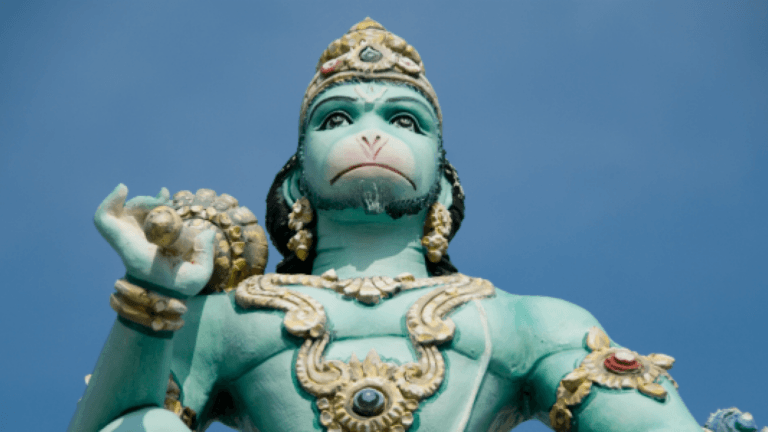
Hanuman was born on the wind and a prayer. His father was Kesari, a sort of meditating gladiator monkey-like humanoid, called in Sanskrit, a “vanara”. His mother, Anjana, held the essence of her name: “anj” in Sanskrit means reverence.
Anjana and Kesari really wanted a kid and prayed to Lord Shiva for the blessing of conceiving a son. Shiva, pleased by their devotion and prayers, sent Vayu, the god of wind, to carry Shiva’s essence to fulfill their wishes, perhaps something like a sacred stork.
Turns out that Vayu delivered a pretty gifted kid. Like his gladiator father and like many of our modern-day mixed martial art competitors, Hanuman had a plethora of skills and talents. He wrestled demons, transformed himself to fit the needs of the particular circumstances against which he was fighting, and did so all with unwavering devotion.
Hanuman was devoted to Lord Rama, the god of righteousness and virtue.
Through his devotion, he was characterized as a lifelong Brahmachari (celibate). The belief that Hanuman’s celibacy is the source of his strength became popular among the wrestlers in India.
Hanuman: Behind the Name
Sanskrit texts mention several stories about how Hanuman got his name. Hanuman had a lifelong obsession with the sun, and as a youngster, blazed towards it, mistaking the sun for a mango and mischievously chomping a bite out of it. This really pissed off Indra, the king of the gods, who struck Hanuman’s jaw with lightening, to scold his impetuous nature. A bit harsh, right? Regardless, Hanuman is said to have received his name from the Sanskrit words “hanu” meaning jaw, and “man” meaning prominent or disfigured.
Another lore credits the name as a derivative of the Sanskrit words “han” meaning killed or destroyed, and “mana” meaning pride; indicating that Hanuman is the one whose pride was destroyed.
As Saul David Raye shares in Earth Heart Hanuman, “humility comes when the jaw is broken.” Whether you’re an elite mixed martial artist, or simply a modern-day yogi maneuvering through daily challenges, we discover that when our hearts are full of devotion, our spirit is unbreakable. Saul David Raye says that the stories of Hanuman can teach us, “the balance of incredible opening while still staying balanced.”
It’s Hanuman we can thank for the devotion it takes to practice Sun Salutations, or Surya Namaskars, which are a series of poses linked by the breath. Sun Salutations invite us to bow to and unite with the sun, as a pathway to the divine.
Singing the Song of Hanuman
I never expected one of my fondest memories from my travels to India to be of a Hindi man and his love of a monkey. He was standing beside the 50-foot statue of Hanuman near Karol Bagh, New Delhi. “Do you know of Hanuman?” he asked, his excitement bubbling over like uncorked champagne.
I don’t think he introduced himself by name, as he proclaimed that, because of Hanuman, his elderly mother regained her health and his family was able to overcome losing their home. My neck hurt looking up at Hanuman in wonder. “Bring your troubles to Hanuman,” he said, looking directly at me, “and in return, you will receive blessings beyond belief.”
A while later, after returning home, I decided I wanted to learn to chant the Hanuman Chalisa, a Hindu hymn authored by Tulsidas, a 16th-century poet. Tulsidas wrote Hanuman Chalisa as an act of his devotion, and it’s said to continue to serve by keeping devotees’ minds free from evil.
My desire may have been influenced by the devoted man we met at the Hanuman in India, or the promise to have a free mind, but I thought it was simply because it had my name in it. Come to find out Chalisa actually means forty. So there are 40 verses in a derivative of Sanskrit to learn.
As much as I love a good challenge, this began to feel next to impossible; which apparently is right up Hanuman’s alley. My 40-day plan to practice each of the verses evolved into 108 days. Rising a few hours before dawn (said to be the best time for such spiritual undertakings), here are my favorite verses:
Sankata te hanumnaa chhudavai
Mana karma vachana dhyana jo lavai
“Hanuman will release those from troubles who meditate upon him in their mind, actions and words.”
Durgama kaja jagata ke jete
Sugama anugraha tumhare tete
“All the difficult tasks in the world become easy if there is your grace.”
Leaping Lizards
Legend has it that Hanuman took a courageous leap, doing the splits over the ocean to rescue Sita, the beloved of Rama, to whom Hanuman was entirely devoted. Hanuman took one look at the span across which he had to cross, thinking something along the lines of, “there’s no way I can do that!” Who hasn’t thought that same thing when faced with a monumental challenge du jour?
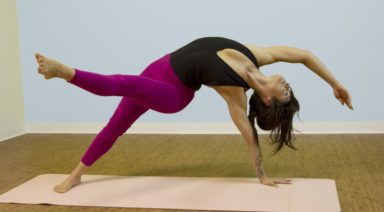
The pose associated with Hanuman is the splits. Often called ‘the leap of grace’.
I don’t know about you but my first attempts at doing the splits (aside from when I was five) were anything but graceful. Blessed with inflexible hamstrings and hips, practicing the splits has been a lengthy endeavor. It’s vital of course, to properly prepare by warming up the entire body, with particular attention to the backside of the legs, and hips.
Hanumanasana is often taught using one block at various heights to support beneath the forward extended hamstring. I’ve found that using two blocks underneath the hands (with stacked joints so wrists are in one line with elbows and shoulders) is more useful in progressing in depth over time in the asana.
The two-block method also provides additional support to lengthen the spine and extend the heart upwards. Getting out of the pose? Now that’s awkward. I’ve heard it said that on the other side of awkward, it is awesome.
It’s these moments in which we have the greatest opportunity to call upon whatever source of spiritual strength aids us. Hanuman exemplifies faith, trust, and being of service in such moments of doubt.
Hanuman Festival
Immerse yourself in a community of such devotion at the Hanuman Festival, every June, in Boulder, Colorado, a music-filled yoga festival at the foot of Colorado’s Rocky Mountains, with world-class yoga instructors. It’s an annual invitation to “immerse yourself in body, mind, and heart as you relax and rejuvenate, dance and devote, connect and expand, have fun and just be.”
Leap with Your Breath
Guiding students through Earth Heart Hanuman, Saul David Raye says, “When Hanuman leaps, he leaps with his breath.” In that way, Hanuman is an eternal entity in teaching us to find where the breath meets the body, where the body meets the bravery within our hearts, and enables our devotion to be a launching pad from which we meet life’s seemingly insurmountable challenges.
About the Author

Magical Mantras to Boost Your Energy

Energy is defined as “the capacity for vigorous activity.” Energy is also defined as the exertion of power. When thinking about energy on a personal level, think about having stamina and longevity to power your days. Energy is a key part of making the most of our days.
Sometimes we have all the energy we need to work, take care of our families, and even a little energy left for play. On the other hand, we all have days in which our energy supplies are so depleted we can hardly imagine doing any vigorous activity. Fatigue is a great way to put a damper on your day.
Beyond just feeling down, being low on energy might mean that your body isn’t getting all the care it needs. Your body demands lots of energy to operate at full capacity in order to build muscle, process toxins, repair body tissue, digest food, and perform many other daily functions. Many of these functions happen automatically without us having to think about it.
The Basics of Mantras
One way to boost your energy is to recite a mantra especially suited for enhancing your daily energy level. Mantras are an important part of many Eastern religions, including Hinduism and Buddhism, but are becoming more and more a part of Western culture as well. Merriam-Webster defines a mantra as “a word or phrase that is repeated often or that expresses someone’s basic beliefs.” They are generally a short phrase or a few words, so you can recall them easily and use them often. The more you repeat something, the more you give it meaning.
I use mantras for energy most often during exercise or when the late afternoon lull kicks in. A powerful mantra is a better work-out companion than a sugary sports drink, because it provides you with that extra boost of energy without setting you up for a sugar crash later. With an energy-boosting mantra there is all upside and no downside.
Another situation that lends itself well to mantra use is when that late afternoon lull hits. I used to work for a nonprofit in Washington. Our offices were in a large room filled with cubicles, with four desks to a group. Each of our desks faced a different corner, but at almost exactly 3 pm every day, we would all turn to the middle of the cubes and start talking to each other. Albeit better than downing a cup of coffee, but still not great. It was the afternoon lull, that time of day when your body is sick of being sedentary and is crying out for some energy. What we should have done is gone outside for a walk around the block, but a more likely alternative would have been to take two minutes and let a mantra give us a quick jolt to get us to the end of the work day.
Six Energy Boosting Mantras
Mantras can be an incredibly powerful tool. Begin by picking one of the mantras provided below and incorporate it into some aspect of your day or into your mediation or yoga practice. You will find that some mantras are more fitting to your personality, or similarly, a different situation might require a different mantra.
- In taking this time to be calm, I am rebooting. This time will help me rebuild my energy resources to get me through the rest of the day.
- Today I will be the best version of myself. I will call on my reserves of energy to give me strength today.
- I have more energy inside myself. I am taking time to be still, so that when I reopen my eyes, I will have found more energy.
- After this time, I will be rejuvenated. I will feel a new found strength and livelihood.
- Strength can be found within me. There is more energy inside of me.
- If I ask, I shall receive. If I ask my body for more energy, it will provide.
Creating Self-Tailored Energy Boosting Mantras
Powerful mantras can come from anywhere. They can be treasured lines from friends or family. For instance, my mom has a line that she says to each of her three daughters when she needs to get our attention. Over the years, she crafted them to suit each of our personalities perfectly. I’ll be honest that I can’t remember my sister’s special message, but mine comes through loud and clear, “You are the only Sarah I have.” My mom used this a lot when I was a teenager. Anytime she was concerned, instead of trying to tell me what to do, she would use this mantra to remind me to be cautious and to tell me I was important. Such a simple phrase was highly effective, because it was personalized for me.
While it’s not an energy-boosting manta, it still a good example of mantra coming from unusual places. Your perfect energy-boosting mantra could come from something inspirational a friend once told you or from a quote from a book or movie. All you need to do is ask yourself, after reciting this mantra, do I feel recharged?
I recently moved to a brand new continent – well brand new to me anyways – and have been struggling with culture shock and finding my place in what feels like a new world. While adjusting to a whole new life can be exhilarating at times, it can also be overwhelming. When I start to feel overwhelmed, I employ my new favorite mantra: This too shall pass. It reminds me that for every low, fatigued day, there are wonderful days filled with comfort and energy. Just this knowledge helps me reboot in that moment and look forward to the better days around the corner.
Mantras and Meditation
As I mentioned in my article on self-loving mantras, “a mantra is a great tool to deter one’s minds natural tendency to wander off.” In addition to mediation, mantras are associated with praying and certain types of exercise. Let’s walk through how you can incorporate a mantra into your mediation practice.
First, look for a quiet, peaceful place where you are unlikely to be disturbed for 10-15 minutes. I strongly recommend creating a space that you can use on a regular basis, but sometimes you need to use your mantra at work or on the metro and you will just have to make do. If you do create a space for yourself, a few options are a cozy chair in your bedroom or a blanket spread out in your garden. Be very particular about what you let into your space. Only allow objects that bring you joy and calm. For instance, I like to use candles and cozy blankets, but I have friends that prefer flowers, inspirational quotes, or soothing music.
Once you have your space settled, gently close your eyes, and begin to focus on your breathing. After ten deep breaths, start to recite your chosen mantra – either out loud or silently in your head. Let yourself go back and forth between focusing on your breath and your mantra for about ten to fifteen minutes. When you are ready, open your eyes and check in with yourself. Are you feeling a new surge of energy? If so, remember that mantra for the next time you are feeling low on energy.
Other Energy Boosting Techniques
In addition to employing these or your own energy boosting mantras, there are numerous other ways to increase your daily energy supply, the most important of which is to get a good night sleep. Other daily habits can boost your energy, such as:
- Stay hydrated or take it a step further and try a Hydrotherapy Detox
- Get your vitamin D (supplements are helpful, but barely scratch the surface compared to the benefit you can get from 15 minutes of sun each day)
- Eat healthy foods with lots of vitamins and high-levels of protein (like super greens and nuts)
- Energy Boosting Pilates
- Energy Lift Yoga, which can be combined with your energy boosting mantra for an added boost
- Go for a brisk walk. A fast-paced walk, with your arms moving, does wonders for jumpstarting many of the systems in your body from immune to respiratory system. Twenty minutes of brisk walking a day can dramatically increase your energy.
- Make plans to spend time with energetic, upbeat friends. Even looking forward to time with friends can give you a little energy boost.