Healing Frequencies of the Ancient Solfeggio Scale
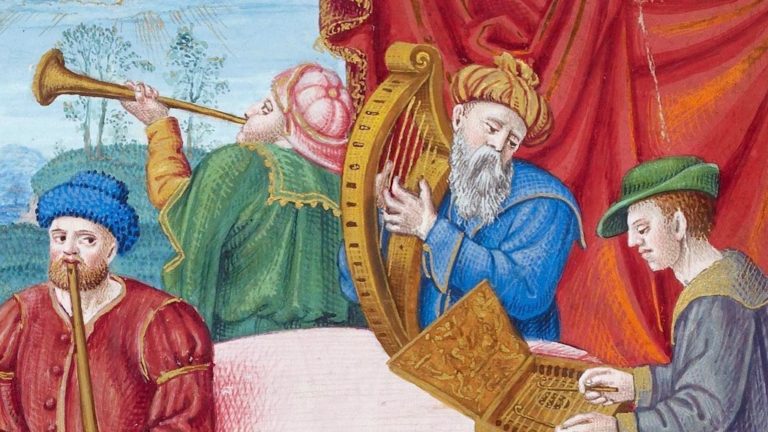
Early in the 11th century, an Italian Benedictine monk, Guido of Arezzo, was looking for ways to teach melodies and harmonies to monastic choirs. One of his methods was a mnemonic tool, called the “Guidonian Hand.” Notes were associated with places on the fingers and palm. Once mastered, a choirmaster could point to his hand to inform singers of the next note. This was a new way to teach music — but Brother Guido continued to innovate.
Finding a way to express a musical scale, he created staff notations to teach chants and hymns. Guido’s original notations were “UT RE MI FA SOL LA,” derived from the first syllable of each half-line of the ancient “Hymn to Saint John the Baptist,” descended from an even more ancient work by Horace, an 8th century BC Roman poet.
This scale of six notes (C, D, E, F, G, A), the ancestor of our “so re mi fa so la ti do,“ evolved into the modern diatonic scale after “UT” became “DO” in the 19th century, and “TI” (B) was added later. “Solfeggio” is based on the word “solfège,” the name for this notation method of teaching pitch and sight singing.
Solfeggio Healing Frequencies
Gregorian chants have a measurable influence on human psychology and physiology. Those who perform the chants experience the lowest heart rates and blood pressure of the day while singing, according to Dr. Alan Watkins, a neuroscience lecturer at Imperial College, London. Other research suggests that singing the ancient compositions relieves fatigue and alleviates depression. Scientists have also observed that monastic singers require much less sleep; as little as two hours a day.
Solfeggio Geometry and Cymatics
Cymatics is the science of observing the effects of sound and frequency on matter usually in the form of liquid or powder. The term was coined by Swiss scientist Hans Jenny, who used specialized equipment that allowed a viewer to observe shapes formed in a medium under the influence of sound wave frequencies.
A cymascope study for SomaEnergetics, a company specializing in education and equipment for sound therapy, recorded cymatic images of each of the Solfeggio frequencies. Each frequency image contained “nodes” and “antinodes,” or the tops and bottoms of visible standing sound waves.
Counting the antinodes, the researchers discovered discovered that most of the Solfeggio frequencies, precisely produced by tuning forks, are “divisible by 3, 6, and/or 9. Any whole number divisor of 72 carries a mathematical relationship between phi and certain frequencies; 12, 9, 8, 6, 3, and 2 all work.” 12, 9, 6 and 3 all have special significance in many number-based esoteric systems. And coincidentally, the hz frequency numbers (396, 417, 528, 639, 741, 852) can all be reduced to one of these numbers (369 = 18 = 9, 417 = 12 = 3, 528 = 15 = 6, 639 = 18 = 9, 741 = 12 = 3, 852 = 15 = 6).
Nikola Tesla said, “If you only knew the magnificence of the 3, 6 and 9, then you would have the key to the universe.” The researchers added that distortions in the images were the product of ambient background noise, but the structure and geometry of each frequency is apparent in the images.
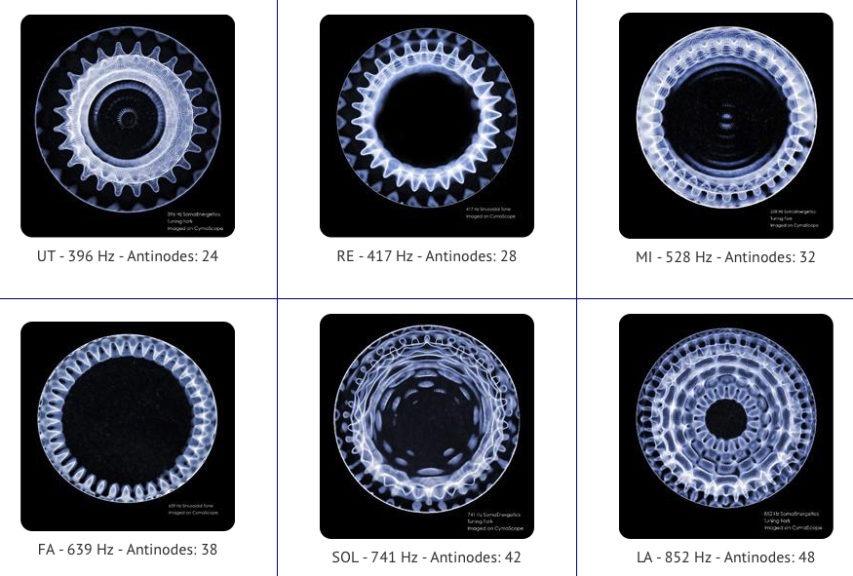
Image courtesy of somaenergetics.com.
Benefits of the Solfeggio Frequencies
Dr. Joseph Puleo, a physician and herbalist, began exploring the Solfeggio in the 1990s. He developed a theory that each of the six frequencies carried precise characteristics, and that the tones could be used therapeutically.
In 1988, Biochemist Glen Rein, Phd, converted and recorded Solfeggio scale Gregorian chants to scalar audio waves. The results were played to test tubes containing DNA. By measuring UV light absorption, Rein could document the effect of the music on DNA. He also compared the chants with other forms of music, including rock. While rock music had little or no influence, the chants caused a marked increase of light absorption, up to nine percent, leading Rein to conclude that Solfeggio scale sound frequencies cause resonance in DNA, and may have healing properties.
Since then, others have explored the healing potential of the Solfeggio frequencies. According to an article in Anti-Aging Medical News (Winter 2006), pulsed frequencies had a positive impact on osteoporosis. In another study, snails exposed to a range of frequencies, including some in the Solfeggio range, became more focused and active compared to a control group. “It was evident that exposure enhanced the creative capacity of the brain in snails,” the author wrote.
A Japanese study published in 2018 examined the stress reducing effect of 528 hz (MI or E) on the endocrine system. The researchers concluded that 528 hz music has “an especially strong stress-reducing effect, even after only five minutes of exposure.”
Using the Frequencies
Youtube has countless Solfeggio meditations that integrate the frequencies with music — over a million pages were returned in a Google search on “Solfeggio meditation.” Some websites offer expensive, specialized equipment — others offer precisely calibrated tuning fork sets. Some health practitioners strike the forks, then place them on specific acupuncture points and meridians while others create “sound baths” with gongs and singing bowls tuned to specific frequencies.
Someone wishing to experience the Solfeggio frequencies can spend a little or a lot, but a Youtube search and a good pair of headphones may be the best entry point for exploring the Solfeggio frequencies.
Solfeggio Frequency Characteristics
396 Hz — Releases Fear
417 Hz — Eases and Initiates Change
528 Hz — Healing and DNA Repair
639 Hz — Heals Relationships
741 Hz — Finding Creative Expression and Solutions
852 Hz — Spiritual Homecoming
About the Author

Clairvoyants Able to 'See' Energy Healing in Action, Study Finds
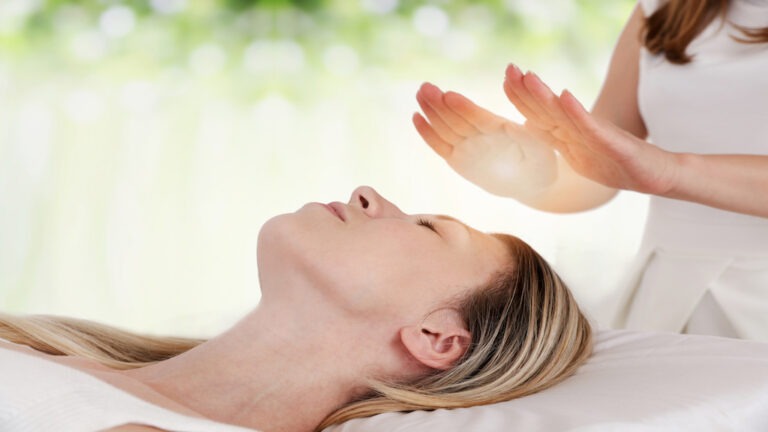
An important new scientific study shows that energy can be both channeled to produce healing, and “seen” through extended perception, beyond the five senses.
The Institute of Noetic Sciences, or IONS, has been studying the nature of reality through rigorous scientific exploration for nearly 50 years. In their latest study, IONS scientists set out to validate both the practice of reiki and the phenomenon of clairvoyance or “extended seeing.”
Dr. Helanè Wahbeh is the head of research at IONS, and has been studying energy medicine for decades.
“People who are energy medicine practitioners might call energy this system that runs throughout the body that they experience as energetic, magnetic, tingling, etc. around the body,” Wahbeh said.
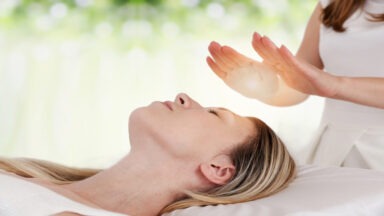
“One type of energy medicine that is commonly used around the world is called Reiki, and Reiki is a technique that originated in Japan. It’s based on the principle that the therapist can actually channel energy into the patient and activate their natural healing process — their innate ability to heal themselves, often releasing obstacles and allowing an optimal flow throughout the body.”
Reiki is one of the best-studied energy medicine modalities, having been shown in clinical studies to be effective in conditions including pain, anxiety, depression, cancer, and others.
In this IONS experiment, researchers wanted to study the effect of Reiki on people with a variety of physical and mental health conditions to test the principle that the modality uses a universal life force energy and can therefore be applied to anyone for any condition.
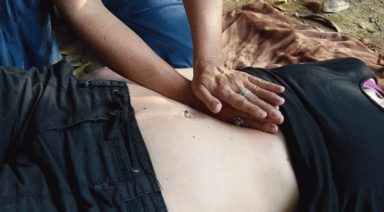
“We had six Reiki masters with extensive experience give 30-minute sessions to 40 participants. The participant would come in, they would lay down in this reclining chair, and the Reiki practitioner would say that they were going to start their session, they would place their hands on different parts of their body and direct the Reiki energy for 30 minutes,” Wahbeh said.
The results were profound.