Archetypal Moon Energy; a Lunar Love Ritual

The moon cycles possess archetypal energies that offer women deeper insight into her own natural rhythms and how her divine flow guides her to have greater control over her mental and emotional well-being as well as harness the full potential of her creativity, strength, and nourishment. A woman who becomes consciously aware of her connection to the moon’s influence through her womb can begin to intentionally craft her life’s events in a way that will bring her the results she truly desires. Practice this Lunar Love Ritual to align with these archetypal energies and receive the full power of their guidance.
The 4 Archetypes of the Moon
It’s quite common for women to menstruate and ovulate in sync with the moon cycle. Since there is no evidence of women possessing greater or lesser health whether their menstrual cycles sync with the moon or not, please do not get too attached to these or allow them to mean something about your identity or worth as an individual. These are simply here to act as a framework to help guide you into an exploration of yourself.
A woman’s menstrual cycle is around the same length as the 28-day moon cycle, give or take a few days. There are two types of women depending on when they ovulate and menstruate – a white moon woman and a red moon woman. A white moon woman, which is the more common of the two types, will menstruate around the darkness of the new moon and ovulate with the full light of the full moon. A red moon woman will menstruate with the full light of the full moon and ovulate with the darkness of the new moon.
Depending on how our cycle aligns with the four moon phases – new moon, waxing moon, full moon, and waning moon – there are four archetypal energies that we can use as a guide to feel more in tune with our natural rhythms and those of the moon. Although the new moon is the start of a new cycle, for the purpose and ease of learning here, we will start with the virgin phase which corresponds to the waxing moon.
The Virgin or Maiden Phase
After the darkness of the new moon, outshines a sliver of fresh new light. Welcome the virgin phase. She is a strong and playful delight. Her fresh new energy feels quick and sharp. Where the seeds of intention were embedded in the new moon’s dark soil, now begins the process of growth.
How to use this energy
This renewed sense of lightness comes post-menstruation when your body has released the blood and the egg and is now in its most lean and agile state. It’s a great time to commit to short-term projects, new routines or workouts, or even start a cleanse. The playful and curious virgin is also strong and she has the capacity to take on more physical activity. This can translate into the bedroom as well. You may feel more open to trying new things and even take on more of a leading role. Be aware that some people might actually feel a little intimidated by this more masculine energy the virgin exudes.
Take caution as to not get ahead of yourself with this newfound inspiration to take on the world and achieve more. Be sure that you are not over-committing or over-promising on events in the future where your energy may not feel as up to the task as it does in the virgin phase.
Colors to consider
White or light-colored clothing can support this virgin energy.
The Mother Phase
As the full moon shines the fullness of her light, we arrive in the mother phase. With this fullness, comes the fullness of her love. Whereas the virgin’s outward energy is directed at her personal growth, the mother feels grounded in who she is and desires to be in service and support of others. The mother is comfortable in her sensual nature and unafraid to fully offer this part of herself to her partner.
How to use this energy
This is typically during a woman’s ovulation phase so her ability to bring to life what she has been creating is at its peak. This is a great time to host guests, lead workshops, or present final projects. However, the mother has the tendency to be so outward with her energy, she can neglect to tend to her own needs. Share your energy and your love, but remember to receive your energy and your love as well or you will be left feeling burnt out and underappreciated.
Colors to consider
Earth tones such as greens and browns may support you during the mother phase. You can also play with wearing more natural fibers and floral patterns.
The Enchantress Phase
Now the moon’s light begins to revolve towards the darkness during the moon’s waning phase. The enchantress phase is typically associated with the pre-menstrual phase. Here begins the process of withdrawal and the destruction that will come into full form in the next phase, the wise woman phase.
How to use this energy
The enchantress is intuitive and inquisitive, and she represents all the most mystical parts of Self. She is the evolved woman who has lived through experiences that moved her beyond her attachment to the material and into a deeper awareness of her internal worth and wisdom. Set aside time to begin creating sacred space for you to turn inward. You may feel called to spend more time with your tarot cards and crystals, connecting with the more mystical aspects of you.
See this as the transitional phase from outward energy to inward energy. Like a wave returning back out to sea to regather its energy, begin to pull back from outward activities, although you may still have the energetic capacity for some of it. Be sure to eat and consume in a way that feels intuitive without being too restrictive or over-indulgent.
Colors to consider
Blues, purples, and reds might be the colors you choose to adorn yourself with now to align with the enchantress within.
The Wise Woman Phase
The light has now returned back to the darkness of the new moon. It is important not to mistake the term darkness as something negative. The darkness is where space is created for the full potential of life to be birthed. The wise woman phase, typically associated with the menstrual phase, is a really important phase that, for some women, is easily neglected because it asks you to really slow down, be still, and honor your time for self-care. Knowing this phase is coming, you can plan ahead to not have guests over or schedule outings that will require a lot of outward energy from you.
How to use this energy
You might experience vivid dreams or, if honored properly, plant the seeds of visionary ideas to be nurtured into physical manifestation during the virgin and mother phases that follow. Be careful to not over-eat or over-drink or consume media that will negatively impact your consciousness, as to not miss your opportunity for connecting fully to your intuition. And perhaps most importantly, don’t forget to celebrate. Celebrate what worked well and what you did well in the last cycle. Journal and identify all that which you choose to leave behind and that which you want to either carry with you or create anew in this next cycle.
Throughout the month, make it a point to go outside and look up at the moon, observe her positioning and see her beauty in darkness and in light, and receive the wisdom she is pouring down and over you. Below is a ritual you can practice for connecting with the moon and to feel her divine energy running through you. This practice can be done at any time throughout the month to receive the fullness of the present archetypal energy.
Colors to consider
Red and black are colors that will support your wise woman at this time of bleeding.
Lunar Love Ritual
- Fill a cup or a bowl with your choice of drinking liquid such as tea or water. You may also use your bare hands in the shape of the lotus mudra.
- Standing under the moonlight, hold your cup or your hands in front of your heart.
- Receive the moon’s energy, feel her love pouring down through your crown and into your heart and all through your body.
- Ask the moon to show herself to you, through you. Ask her to illuminate the parts of self that desire to be seen and loved. Ask her to guide you deeper into your own Virgin, Mother, Enchantress, or Wise Woman.
- Feel her energy pouring down into you and filling your cup or hands in front of your heart, infusing it with her love.
- Now, hold the cup to your lips and drink this elixir of love with blessed intention, feel it being absorbed through your whole being.
- Sit in the sensation of this love and thank the moon for her presence. Thank yourself for choosing to be on this path and for giving yourself this time to receive and become. Blessed be.
About the Author

The Glass Ceiling of Yoga: Body Positivity
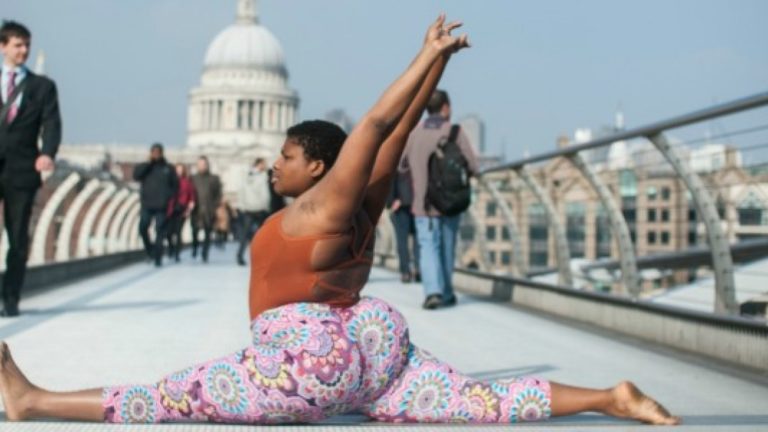
The picture of a serene and beautiful yoga community that is celebrated by the media actually disguises a disturbing layer of normalized and ubiquitous body type discrimination. However, by unveiling a previously “invisible” glass ceiling over the Western yoga community, students, teachers, and administrators can find ways to effortlessly mold body-positive practice spaces for current, new, and future yoga practitioners.
Gender vs Body Type
I’ve encountered a lot of glass ceilings in my life. Honestly, when you’re black, queer, and born with female genitalia, you encounter them constantly and I’ve grown to expect situations wherein boundaries and limitations are the norm. However, there’s a glass ceiling that limits our Western yoga community to a troubling degree and it’s something I never expected to encounter. I mean, when “glass ceilings” are typically identified in Western society, they are almost invariably related to gender.
Ironically, the yoga community doesn’t really suffer from a gender glass ceiling, at least not one that negatively effects women.
Even though women weren’t taught asana until the 20th century, the vast majority of Western yoga teachers and students are female. And while discrimination against male yoga students and teachers is probably more common than any of us could imagine, it’s still not the most expansive and divisive glass ceiling in the yoga community.
No, the real ceiling within our community is based entirely upon physical presentation and, specifically, body type.
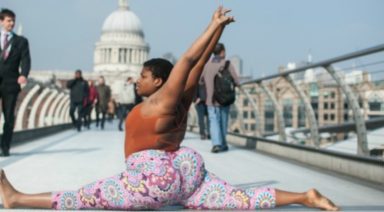
This ceiling is clear as day to those of us who have atypical yoga practitioner bodies. Instead of being slender, white and heaped with physical ability, there’s a growing wave of yoga teachers and students who are plump, multiethnic and powering through life with a wide range of disabilities. However, those of us who challenge the white washed yoga teacher stereotype face a very different practice landscape than our colleagues. For example, it’s inappropriately common to hear a story about a yoga student being shamed out of a yoga studio, based upon comments made by discriminatory yoga teachers and students.
In some communities, it’s nearly impossible for atypical yoga teachers to find teaching opportunities. And even when teaching opportunities are available, they are not on par with options for more traditionally bodied teachers. This problem is well documented within small communities of “different” yoga teachers, but it’s essentially invisible to those who don’t see themselves as “different”. And, what’s worse, there are way too many practitioners and teachers who don’t see this kind of discrimination as a problem. Thus, an “invisible” glass ceiling has domed over our community, and only those who have been discriminated and oppressed are fully aware of its existence.
What Does This “Glass Ceiling” Actually Look Like?
Here’s the thing, no one in the yoga community is ever going to openly bad mouth someone who looks different from the traditional idea of a practitioner. Ok, let me back up. I’m sure it happens. But being openly mean to people is not condoned in our yoga community. It’s a pretty big no-no, actually. Therefore, I wouldn’t be surprised if someone reading this article right now is truly shocked by the idea that discrimination exists in a community which oozes the kind of saccharine sweetness that can only be honed by decades of marketing and product advertising. Unfortunately, the prettiest bandages can hide the ugliest wounds.
And beneath the surface of our saccharine sweet, mass media approved industry is a festering wound characterized by offensive language, discriminatory hiring practices and a bunch of other negativity that gets swept under the rug.
Admittedly, it’s not fun to acknowledge discrimination. In most cases, it feels very embarrassing, and many people would prefer to pretend as though they are not part of the problem. But anyone who turns a blind eye to this problem is also a key contributor to its existence. But how does this problem actually manifest and what does it look like? Let me paint a clearer picture for you.
Imagine you’re a curvy person who has finally decided to face your fear of practicing yoga in a group setting. Perhaps you’ve practiced yoga online with free videos, and you’re finally feeling confident enough in your understanding of asana to venture out of your living room and into a communally supportive environment under the watchful gaze of a knowledgeable instructor.
With a yoga mat under your arm and an emotionally swollen heart on your sleeve, you proudly stride into your local yoga studio.
When you approach the reception desk to check-in for class, the teacher (who looks, as expected, like a human Barbie doll) gives you a curt visual once-over. “Is this your first class?” Yoga Teacher Barbie chirps nonchalantly. While your knee jerk reaction may be defensive, you calm yourself down mentally. You remind yourself that she’s not trying to be offensive, and that she’s merely trying to take the proverbial temperature of a student she’s never met before. You smile and shake your head. “Nope, but I’m excited to take your class!” you say. Barbie smirks. “Well, this class is pretty intense,” she says.
You stare at her blankly. You’re wondering why she’s decided to tell you that the class is intense. Is it because she thinks you can’t handle the class? All of a sudden, you’re second guessing yourself and hiding sweaty palms. Why did you think you were strong enough to attend live classes? By the time you’ve rolled out your mat and gotten settled with props, the tissue thin confidence you brought into the studio has been shredded beyond repair by the self-doubt you’d managed to keep at bay prior to arrival.
During the class, you notice for the first time that your expressions of various yoga poses look a little different than other people in the class. Maybe your balance is a little less sharp, or you use props and modifications at times when other students seem to be able to go without. While that acknowledgement makes you a little self-conscious, it pales in comparison to the shame you feel at having your movements constantly corrected by Yoga Teacher Barbie.
Because, yes – Barbie has also noticed that your movements look a little different. And she’s decided to make your differences an opportunity for a teaching exercise by constantly correcting your alignment and offering more physical adjustments than you could have ever wanted. Ultimately, it doesn’t matter if she’s offering more or less advice to anyone else in the room – in fact, it’s entirely possible that she offers this level of adjustment to every student. But your confidence has been shattered.
The emotionally swollen heart you proudly wore on your sleeve is now openly bleeding.
In the best case scenario, you somehow find the strength to believe in yourself again. In the worst case, you vow to never darken the doorstep of another yoga class for fear of ever feeling this way again.
The thing is, if you’re reading this right now, you’ve probably worn the moccasins of either Yoga Teacher Barbie or our Curvy Protagonist. Maybe both. And the weird thing is, I’ve heard this exact same story told by people who are not necessarily “curvy” or “different” in some other way.
In fact, it’s startlingly common for people who look just like Yoga Teacher Barbie to still feel discrimination at the hands of their instructors.
I could be wrong, but I think this is all the result of the fact that we live in a staunchly body negative society.
Body negativity is endorsed by the mass media – let’s face it, that’s how they get us to buy things. We make purchases because we find ourselves wanting or lacking in one way or another. Unfortunately, in addition to the mass media, body negativity has also fully permeated the yoga community. In fact, many teachers believe their discrimination isn’t discrimination at all – they see it as a kind dose of realism to students who don’t meet their personal standards of yoga perfection. Because that’s really all discrimination is – it’s the state of our judgment when we encounter people, places, and things which jibe with our personal definitions of perfection.
It’s sad to see this happen in a community which has the potential to include every single human being on the planet. Frankly, it’s not absurd to imagine a world where everyone practices a style or hybrid blend of yoga. However, that reality will never come to fruition if we don’t resolve the body negativity and discrimination problem. How do we do that? Well, fight fire with fire.
If body negativity is the disease, then body positivity must be the antidote.
The Antidote: Body Positivity
Body positivity is frequently confused concept. It’s pretty confused even within the body positivity community. You could get a different definition depending on the person you ask, the day of the week, etc. Some people think body positivity is solely tied up in body size acceptance, and others might even go so far as to equate it with fat acceptance and fat positivity. While fat positive movements have their rightful place of importance in the evolution of our society, I don’t believe they are synonymous with body positivity. Another popular way of describing body positivity is by equating it with constant self-pep talks. You know, a pattern of methods to remind yourself that “I’m Great! I’m Beautiful! I’m worthy of breathing oxygen in front of other humans without feeling suicidal!” While pep talks are rad and I fully endorse them, I don’t think they speak to the core of body positivity.
You see, body positivity assumes your constant perfection. It assumes that you’re always beautiful. That you’re always worthwhile. That you’re always capable. That you’re always strong.
In a truly body positive world, these statements are not up for debate – instead, they are seen as impenetrable fact. The only perspective up for debate is that of each individual – are you willing to accept your own perfection? Especially when the mass media tells you that those statements are definitely not true. Body positivity is the confidence to accept your constant perfection and beauty, no matter the proverbial weather. And, most importantly, to accept the constant perfection and beauty of those around you, even if they look and act different from yourself.
When we implement body positivity in our yoga studios and spaces, we create environments where students across an infinite spectrum of differences all feel as though they are equal to one another. This type of attitude is absolutely critical in order to see the yoga community grow beyond the one dimensional image offered by the media. Body positivity doesn’t mean teachers aren’t free to offer alignment tips and adjustments to their students without fear of offending someone. But it does mean that every word, every gesture, and every moment is an opportunity to be encouraging. To make someone feel welcome. To actively avoid discouragement.
Eventually, this kind of environment will lead to the end of classes where certain students are viewed as superior to their fellow students. Good riddance, as far as I’m concerned. This is a glass ceiling that desperately needs to be shattered.
We must all take responsibility for the role we play in a yoga culture which is thoroughly embedded in discrimination and negativity.
We need more than a few people who are proud of their bodies. We need a legion of yoga teachers, administrators and advanced practitioners who truly walk the walk of the eight-limbed path, and who will stop at nothing to spread the practice to every soul across the planet.