Giant Human Skeletons Found Buried in Mounds Across North America

Around the turn of the 19th century, there were hundreds of reports from reputable sources of giant skeletons unearthed from ancient burial mounds across America. Human giants are not entirely a product of legend in our history.
André the Giant is a known example of a man with superhuman proportions and strength, reaching 7 feet 4 inches tall. But André’s size was the result of gigantism and acromegaly, disorders caused by an overactive pituitary gland, which releases too much growth hormone. And with the average human height at 5 feet 6 inches for men and 5 feet 2 inches for women, it’s rare to find someone of André’s height, let alone his stature.
With the extreme rarity of gigantism, affecting roughly three in a million, it’s surprising how often giants are spoken of in the Bible and North American folklore. David and Goliath, Jack and the Beanstalk, and Paul Bunyon are familiar examples of tales involving giants. But while these are thought to be myths or legends, is there any possibility that a race of giants once existed or were there humanoid ancestors significantly larger than us?

The Mound Builders: Unusual Burial Sites
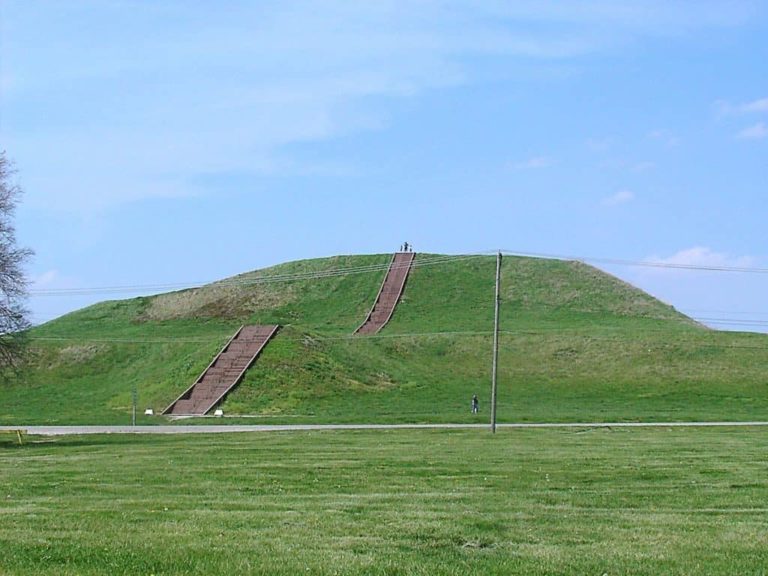
Across the United States, there are burial mounds, or at least their remnants, some as extensive in size as the Great Pyramid of Giza. The Cahokia and Monk’s mounds in Illinois and Missouri are two thought to have been built before the arrival of Columbus. The Cahokia mound is 100 feet tall with a 14-acre base, almost an entire acre larger than the pyramid at Giza. Monk’s Mound is just as tall with a 1,000-foot-wide base. But what makes these and other mounds of their kind even more intriguing is what has been found buried inside of them.
Jim Vieira has made it his mission to explore the mystery behind these mounds and others where there is documentation of unearthed skeletons, often of gigantic proportions. Vieira, a stonemason by trade, found himself intrigued after finding a plethora of mysterious stone mounds throughout New England.
He found that the construction, and particularly the stonework, of these mounds, was impressive, considering the level of technology at the time. He also noticed that the orientation of the mounds was such that the entrances faced a direction that was in alignment with the sun during the Equinoxes. The mounds were built with massive stones and were present long before colonists from Europe crossed over.
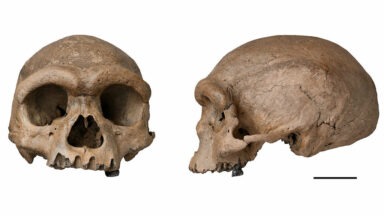
Vieira uncovered old reports in New England of giant skeletons unearthed from these mounds, often with two rows of teeth and jaws that could fit over the head of a normal-sized human. The skeletons ranged in length from 7 to 10 feet tall. While this may sound ridiculous at first glance, it was not an isolated incident and is supported by reports from reputable news sources of the time.
Ancient Giants
Discoveries of the giant skeletons were found all over the Northeast, from Martha’s Vineyard and Deerfield Valley Massachusetts, to Vermont and upstate New York. Other reports of the discovery of buried giants were also found in the South, Midwest, and West coast.
In the Ohio River Valley, a report from a local paper, that was backed up by Scientific American, found bodies of several giants buried under a ten-foot-tall mound. One female skeleton was found holding a three-and-a-half-foot long child. Another of the giant skeletons was buried in a clay coffin and an engraved stone tablet was also recovered. This particular mound was 64 feet long by 35 feet wide.
The Chichasawba mound in Arkansas is another instance of the uncovering of a giant skeleton under similar circumstances. The 12-square-mile mound had its name taken from the chief of the Shawnee tribe who was essentially known to be a giant with incredible strength. Chief Chicasawba lived in that area of Arkansas and when the mound was uncovered, the skeleton of a massive human being was found. Subsequently, other skeletons up to ten feet tall were unearthed in the same area, all with similar burial artifacts found with them. Some reports claimed the length of the skeleton’s legs to be five feet alone. Other reports show large craniums of skeletons with double rows of teeth.
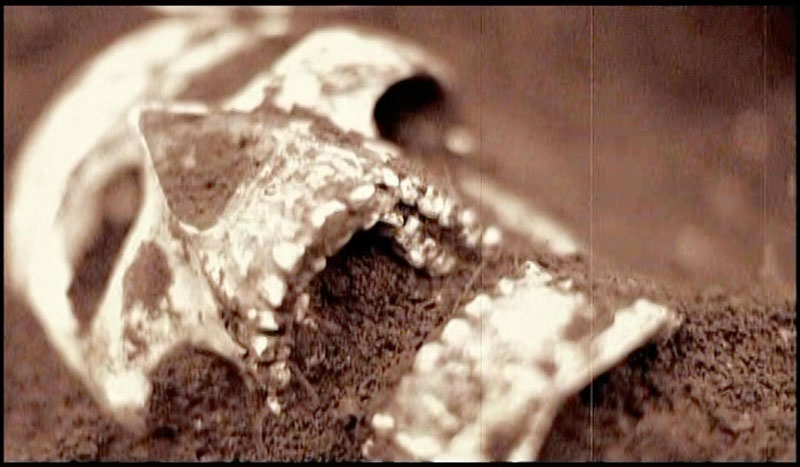
double rows of teeth courtesy grahamhancock.com
A Controlled Narrative
While stories of this nature sound fantastical, there are numerous reports of skeletons of the same size appearing in newspaper articles from The New York Times and other reputable sources. The majority of these reports occur during the mid to late 19th century, which Vieira sees as being the turning point in a censored narrative that has now dominated our history textbooks. He says he thinks that awareness of both the mounds and giants was common knowledge during this primarily agrarian time. There is even supposed reference to it from Abraham Lincoln. In a written account of a speech that he was preparing to give at Niagara Falls, he wrote,
“The eyes of that species of extinct giants, whose bones fill the mounds of America, have gazed on Niagara, as ours do now.”
Vieira believes that a prejudiced narrative was created to discredit Native Americans or portray them as savages because if they were seen as having built the mounds it would show them as mathematically and technically advanced. Vieira says he thinks that the removal of any evidence of the giants might have occurred because they wouldn’t fit into the controlled narrative of manifest destiny. Subsequently, many of the mounds were allowed to be destroyed by settlers and farmers as America was colonized, with no regard to the reverence that the natives held for them.
And whether the tall skeletons belonged to a race of giant natives themselves or another race that predated them is unknown, but it is thought that the American Indians venerated them.
Another conspiracy surrounding the hidden history of these giants points to the Smithsonian. Within the ethnology reports of the museum, there are 17 cases of the Smithsonian uncovering giant skeletons over seven feet tall. The probability of a human growing seven feet tall is .000007 percent, meaning they would have had to excavate roughly 2.5 million bodies to have found that many skeletons of that size.
There are also supposed reports of the Smithsonian Institution purchasing giant skeletons excavated by citizens, which then disappeared, never to be heard from again.
The Smithsonian even had a division for exploring mounds, of which there is a written record of them uncovering giant skeletons whose bones crumbled to dust when exposed to air. Was this a coverup by the famed museum, or did they simply dispose of a debunked myth?
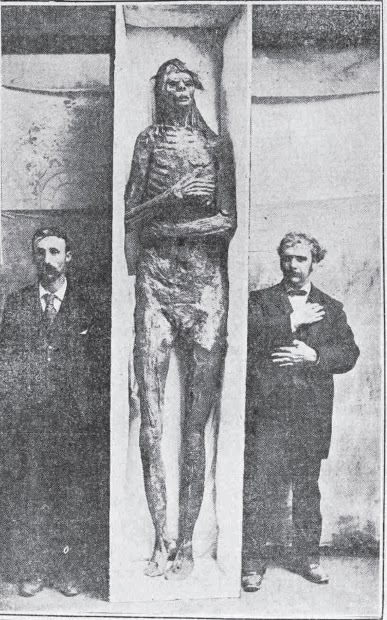
courtesy grahamhancock.com
For more incredible evidence of giant human remains discovered around the world, check out this special season of Gaia’s original series Open Minds: Evidence of Giants in Sardinia.
About the Author

What Are the Earth’s Chakras and Where Are They Located

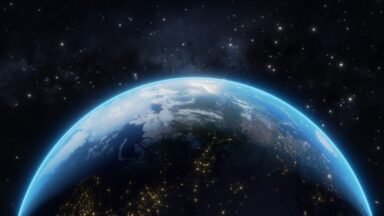
The Earth’s chakras are geographical points where planetary energy is concentrated and distributed. They act as centers of power that influence ecosystems and human consciousness. In this article, we explore what these centers are and where they are located from the perspective of Matías De Stefano, who offers an integrative interpretation of the Earth’s energetic map.
Table of Contents
- The Earth as a Living Being With Energetic Centers
- Planetary Chakras and Human Chakras: An Energetic Connection
- The 7 Main Chakras of the Earth
- First Chakra: Africa as the Planet’s Root Center
- Second Chakra: Asia and Oceania as Centers of Creative Energy
- Third Chakra: South America as the Solar Plexus and Center of Identity
- Fourth Chakra: Europe as the Planet’s Heart Center
- Fifth Chakra: North America as the Channel of Global Communication
- Sixth Chakra: The Andes and Andean Regions as the Planetary Third Eye
- Seventh Chakra: Antarctica as the Connection With the Divine
- Vortices, Ley Lines, and Energy Portals: The Planet’s Hidden Network
- Why Are the Earth’s Chakras Changing?
- How to Connect With the Energy of the Earth’s Chakras
The Earth as a Living Being With Energetic Centers
The idea that the Earth is a living organism is not new. Various ancient cultures already regarded it as a conscious entity, capable of feeling, transforming, and evolving. This view is compatible with an energetic understanding of the planet, in which each area fulfills a specific function within a greater system.
From this perspective, continents, mountain ranges, rivers, and oceans are not isolated elements, but interconnected parts of a body in motion. Just as a nervous system regulates the functioning of the human body, the Earth also possesses an energetic network that maintains balance among the planet’s different elements. This system is activated or weakened according to the state of consciousness of those who inhabit it.
The Earth’s chakras are points of high energetic concentration that regulate the planet’s vital flow. Through these centers circulate impulses that affect both ecosystems and human societies. Understanding the function of each one allows not only for honoring the territory, but also for aligning with a way of life that is more coherent with the environment.
Planetary Chakras and Human Chakras: An Energetic Connection
The relationship between human chakras and those of the Earth is not merely symbolic. Both systems share a structure of seven main centers, each associated with a specific function: survival, creativity, identity, love, expression, vision, and higher consciousness. This correspondence confirms that there is a direct resonance between the human body and the planetary body.
When a person works on their inner development, they also influence the collective energetic field. In the same way, changes in the planet’s chakras impact people’s emotional and spiritual states. This connection is strengthened when one consciously visits these energetic centers or participates in practices that activate them.
Living in a territory is not a casual fact. Each person is born in a zone with a specific energetic frequency that offers particular lessons and challenges. Connecting with the chakra corresponding to the place where one lives brings clarity about personal and collective purpose, while also strengthening the bond with the Earth.
The 7 Main Chakras of the Earth
Just like the human body, the Earth has seven main chakras that channel its vital energy. Each of these centers is manifested in a specific continent and fulfills a key role in planetary evolution. In this section, we explore the location and meaning of these chakras from the perspective of Matías De Stefano, who presents them in the series Initiation, available on Gaia.
-
First Chakra: Africa as the Planet’s Root Center
The first chakra of the Earth is located in Africa, considered the point of origin of the planet’s vital energy. This root center represents the connection to matter, survival, and ancestral memory. Africa holds the energetic foundation of humanity and is the point from which the Earth’s kundalini begins to flow.
-
Second Chakra: Asia and Oceania as Centers of Creative Energy
The second chakra is associated with Asia and Oceania, areas that act as centers of creative and emotional processing. This energy relates to movement, fertility, relationships, and the expression of life in its diversity. At this point, energy transforms and divides, generating momentum and expansion.
-
Third Chakra: South America as the Solar Plexus and Center of Identity
South America represents the planet’s solar plexus, where energy becomes conscious of itself. This chakra is related to self-recognition, willpower, and personal strength. It is a key territory for developing a new collective identity based on connection with the Earth and spiritual awakening.
-
Fourth Chakra: Europe as the Planet’s Heart Center
Europe represents the heart of the Earth, the point where both cultural expansion and processes of integration and conflict converge. This chakra is connected to love, empathy, and the ability to connect with others from a human place. From Europe emerged movements that promoted freedom, science, and cooperation, as well as structures that also imposed domination. Its energy reflects the duality of the heart: the power to unite or to divide.
-
Fifth Chakra: North America as the Channel of Global Communication
The planet’s fifth chakra is located in North America and is related to expression, technology, and outward projection. It is the center of global communication, where messages, narratives, and innovations that influence the world are generated. Through this point, planetary energy is translated into action, speech, and collective impact. It also represents the challenge of finding an authentic voice amidst global noise.
-
Sixth Chakra: The Andes and Andean Regions as the Planetary Third Eye
The sixth chakra, associated with the third eye, is manifested in the Andes and Andean regions of South America. This area is key for activating spiritual vision and deep perception of reality. In this territory, ancestral memory is preserved and knowledge is cultivated that connects the human with the sacred. It is a center of consciousness that invites us to see beyond the visible and awaken a new way of looking at the world.
-
Seventh Chakra: Antarctica as the Connection With the Divine
Antarctica is the seventh chakra of the planet, the highest point on the energetic scale, where the connection with the divine and universal consciousness is anchored. Its isolation, purity, and natural silence make it a space of integration with the most subtle aspects of the cosmos. It is a land without ownership, without permanent population, which reinforces its role as a portal to the transcendent. There, energy is not expressed through form, but through presence.
Vortices, Ley Lines, and Energy Portals: The Planet’s Hidden Network
In addition to the main chakras, the planet is traversed by a subtle energy grid formed by ley lines and vortices. These lines are invisible routes that connect points of high vibration and intersect in areas considered energy portals. Throughout history, many cultures have built temples, pyramids, and ceremonial centers at these intersections, intuitively recognizing their power.
Energy vortices act as activation or amplification points for Earth’s energy. They are located in places where multiple ley lines converge and where energy flows more intensely. Some are widely known, such as Machu Picchu, Uluru, or the pyramids of Giza, and they are often surrounded by natural or spiritual phenomena that are difficult to explain through rational means.
Energy portals are not only linked to physical geography but also to collective consciousness. They are activated when people engage with them through intention, respect, and deep connection. These points function as bridges between dimensions, facilitating experiences of personal and collective transformation, as well as access to information or higher states of consciousness.
Why Are the Earth’s Chakras Changing?
According to Matías De Stefano, the Earth’s chakras are not static; they are undergoing reconfiguration due to shifts in the planet’s frequency. The energy that once circulated through certain regions is now moving to adapt to a new evolutionary stage. This adjustment is linked to the awakening of a global consciousness more aligned with cooperation, unity, and regeneration.
Energetic movement responds both to cosmic cycles and to human actions. When people become aware of the territory they inhabit and recognize it as part of a whole, they activate healing and transformation processes that directly impact the planet’s energy network. In this way, what happens in one specific place can have effects in other parts of the world.
This shift also calls for a new kind of relationship with the Earth. Instead of seeking to control the environment, the invitation is to listen to it, feel it, and collaborate with it. Understanding the relocation of the planetary chakras helps align with this transition, both personally and collectively.
How to Connect With the Energy of the Earth’s Chakras
Connecting with the Earth’s chakras doesn’t require physically traveling to each of them—although visiting them can enhance the experience. The key lies in developing a conscious relationship with the territory one inhabits: observing its geography, acknowledging its history, and feeling its vibration. Each place has a specific frequency and offers a particular teaching.
There are practices that can facilitate this connection: focused meditations, sound work, circular dances, ceremonies with the Earth, and symbolic acts of gratitude or healing. These actions not only activate the energy of the place but also awaken internal memories that have lain dormant. Simply bringing attention and presence to a site already creates an impact.
Matías De Stefano encourages each person to discover the energetic role of their territory and how they can contribute to the global process from there. This approach doesn’t arise from obligation but from recognition: by understanding the function of the place we inhabit, we can align our actions with the collective purpose of the planet. In this way, connecting with the Earth’s chakras becomes a path to the awakening of a new humanity.