What Are Twin Flames and How to Know if You’ve Found Yours

The concept of twin flames has been interpreted in many ways throughout time, and today it remains a topic of debate within spirituality. Beyond the romantic idea of two halves of the same soul destined to reunite, this connection is perceived as a deep energetic bond that transcends the common experience of relationships. It is a union that drives intense, challenging, and, in many cases, transformative personal development.
In this article, we explore what twin flames really are, how they differ from soulmates, and how to recognize if you’ve found yours.
Table of Contents
- What Is a Twin Flame and What Is Its Spiritual Meaning
- Twin Flames and Soulmates: Key Differences
- How to Know if You’ve Found Your Twin Flame
- Why Twin Flames Experience Challenges and Separations
- The Spiritual Purpose of Twin Flames
- Do All People Have a Twin Flame?
What Is a Twin Flame and What Is Its Spiritual Meaning
A twin flame is a soul with which we share an exceptional bond, one that goes beyond the physical or emotional. This connection transcends time and circumstances, manifesting as a profound recognition and an inexplicable sense of familiarity. Their presence in our life usually marks a before and after in our personal and spiritual development.
The purpose of twin flames is not limited to romantic love; rather, it is tied to the evolution of the soul. Their union awakens deep aspects of the self, which can create moments of both harmony and challenge. This relationship brings to light emotional wounds, unconscious patterns, and unresolved lessons that each must heal individually, forcing each person to face themselves and grow spiritually.
This connection has a high vibration and functions as a mirror that reflects both the light and the shadows of each individual. For this reason, the bond between twin flames can be as revealing as it is complex, challenging beliefs, emotional structures, and internal limitations to lead both people to a greater understanding of themselves and the universe.
Twin Flames and Soulmates: Key Differences
Although both concepts are related to deep spiritual connections, there are key differences between a twin flame and a soulmate. Soulmates are people with whom we share a significant bond, whether in a romantic relationship, friendship, or family. They are harmonious connections that provide support, companionship, and valuable lessons throughout life.
On the other hand, the relationship with a twin flame is much more intense and challenging. Instead of giving us immediate stability, this connection is a unique experience that goes beyond attraction or compatibility, propelling you into accelerated personal growth. While we may have several soulmates in a single life, there is only one twin flame, and its purpose is not to complete us but to help us reach our highest spiritual evolution.
How to Know if You’ve Found Your Twin Flame
Finding your twin flame is a unique experience that goes beyond attraction or compatibility. From the very first encounter, an intense and inexplicable connection emerges, accompanied by a deep sense of recognition, as if you already knew each other on a soul level.
This relationship stirs strong emotions and acts as a mirror that reflects both your virtues and your shadows, propelling you into accelerated personal growth. Along the way, challenges, periods of separation, and intense lessons may arise, but the connection always remains, guiding you toward a shared evolution and a higher purpose.
Most Common Signs of a Twin Flame Connection
The relationship with a twin flame has unique characteristics that set it apart from any other bond. Here are some signs that may indicate you have found yours:
- Instant and intense attraction: From the very first meeting, you feel a magnetic connection that is difficult to explain. No matter how much time passes, the energy between you always remains.
- Sense of recognition: Even if you barely know the person, you feel that you have met them before. Their presence awakens memories or deep emotions without any logical reason.
- Mirror effect: Your twin flame reflects both your strengths and your unresolved fears and wounds. This relationship pushes you to grow and face what you need to heal.
- Telepathic connection: Many times, you can feel what the other person is experiencing without needing to speak. It is common to share thoughts, emotions, and even dreams in which you meet.
- Separations and reunions: The relationship may go through periods of distance in which each person must work on their own growth. However, the bond never breaks, and destiny brings you back together at the right time.
Stages of Meeting a Twin Flame
The journey of twin flames is not linear; it goes through different phases that accelerate the growth of both parties. These are the most common stages in their process of union:
- The recognition: From the first meeting, both feel a profound and inexplicable connection. There is a sense of destiny and familiarity that goes beyond the rational.
- The initial fusion: The relationship advances with intensity, creating moments of unconditional love and a deep emotional connection. It is a stage of expansion and spiritual awakening.
- The challenges and crisis: Internal conflicts arise as they face the mirror effect. Both must work on their shadows, which can create tension or even a temporary separation.
- The healing phase: During the distance, each person undergoes a process of personal growth. They learn key lessons for their individual evolution before they can reunite.
- The conscious union: After overcoming the obstacles, the relationship balances and strengthens. In this stage, the twin flames work together on their spiritual purpose and in the development of their highest connection.
Why Twin Flames Experience Challenges and Separations
The bond between twin flames is deeply transformative, but also challenging. As they are reflections of one another, the relationship brings to light emotional wounds, fears, and unresolved patterns that each must heal individually. This confrontation can create moments of tension and instability, as both must face their own evolution before reaching balance in the connection.
Separations are often a necessary part of the process, as they allow for personal growth and the integration of the lessons that the relationship brings. In many cases, one of the two may not be ready for the intensity of the connection and needs to step away to work on their internal development. Although the distance can be painful, it is a period of healing that helps strengthen the bond on a higher level.
More than an obstacle, the challenges that twin flames face are part of the evolutionary path they have chosen. Rather than depending on each other, the true purpose is to learn, heal, and develop a connection based on individual wholeness. Only when both have achieved this internal balance can the union occur in harmony.
The Spiritual Purpose of Twin Flames
Twin flames are not only united by an energetic bond, but also by a soul agreement made prior to their incarnation. These spiritual agreements establish encounters and experiences designed to accelerate the growth of both parties. Their purpose is not to provide an easy or perfect relationship but to awaken personal transformation and guide them toward a greater understanding of themselves and their mission in the world.
Beyond individual growth, many twin flames have a shared purpose that goes beyond their personal relationship. Their union generates a high-vibration energy that can manifest as healing projects, spiritual teachings, or contributions to humanity. In many cases, this connection is a catalyst for the awakening of others and the expansion of collective consciousness.
The twin flame path does not always involve a romantic relationship or permanent cohabitation. In some cases, the union manifests as a spiritual collaboration or a bond of deep understanding without the need to be physically together. What matters is not the type of relationship they form, but the impact they create on their evolution and that of others.
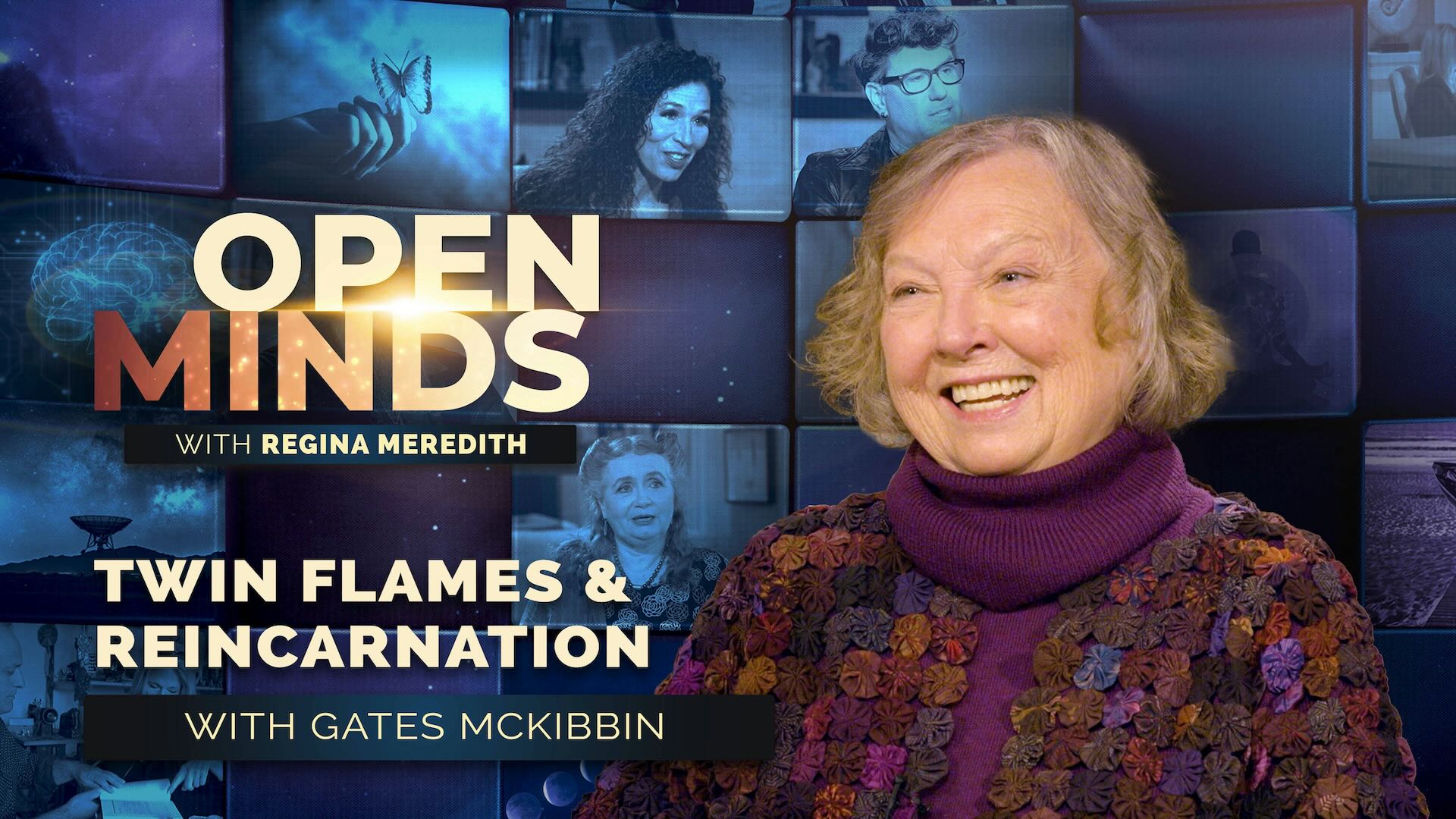
In the Open Minds series, available on Gaia, Regina Meredith converses with Sheila and Marcus Gillette about the role of twin flames in the evolution of the soul. Through the channeling of THEO, they reveal how these connections are designed to help us release limiting beliefs and access a greater spiritual understanding.
Do All People Have a Twin Flame?
Not all souls have a twin flame incarnated in the same life. Some may be in different planes of existence or in distinct evolutionary processes, so a reunion is not always possible in this incarnation. However, this does not mean that a person cannot experience deep and meaningful relationships that contribute to their spiritual growth.
The path of each soul is unique, and the absence of a twin flame in this life does not prevent personal development or spiritual evolution. Many people find equally transformative connections with soulmates, kindred spirits, or other types of relationships that help them fulfill their purpose. What is essential is not to seek a twin flame, but to focus on one’s own growth and on the lessons that each bond brings.
About the Author

The Law of One: The Ra Material and the Idea That All Is One

The idea that nothing is truly separate appears, in various forms, in many spiritual traditions. In the Law of One, that vision takes a more concrete form by maintaining that everything that exists is part of a single consciousness, and life can be understood as a learning process for recognizing that unity.
This teaching comes from the Ra Material, a set of channeled texts that for decades has fueled conversations about consciousness, channeling, and the purpose of life.
In this article, we explore what the Law of One is, where it comes from, what the Ra Material teaches, and why it continues to spark so much interest today.
Table of Contents
- What Is the Law of One
- Where the Law of One Comes From: The Contact With Ra
- What the Ra Material Teaches
- Free Will as a Fundamental Law
- The Books of the Law of One
- Why the Law of One Remains Relevant Today
What Is the Law of One
To understand the Law of One, it is best to begin with its central statement, as simple to express as it is difficult to assimilate: everything that exists is, at its core, one single thing. The stars, people, animals, even the thoughts now crossing your mind would be expressions of the same infinite consciousness. The separation we perceive—you on one side, me on the other—would be real only on the surface.
From this perspective, what you call “I” is not separate from the rest: you would be a part of that broader whole, one of the many ways in which that consciousness expresses itself. The idea is not new: different spiritual traditions, from East and West, have intuited that underlying unity for centuries. What the Law of One contributes is its own language and an orderly framework for thinking about it.
Where the Law of One Comes From: The Contact With Ra
The Ra Material did not emerge as a book written by an author, but from a series of channeling sessions carried out in the United States in the early 1980s. Behind them was a small research group dedicated to studying this type of phenomenon, and it was that group that made the contact possible.
Three people formed that group. Carla Rueckert was the channel: the person through whom, in a trance state, what identified itself as Ra expressed itself. Don Elkins asked the questions, and Jim McCarty recorded every word; between 1981 and 1984, they carried out 106 sessions.
Ra did not present itself as an individual, but as a sixth-density social memory complex: something similar to a collective consciousness that would have evolved far beyond physical form.
Throughout the 106 channeling sessions, spiritual, philosophical, and cosmological questions were addressed: from reincarnation and the evolution of consciousness to the nature of time, ancient civilizations, and the existence of non-human intelligences. Over the years, that exchange gave shape to a system of ideas now known as the Law of One.
The Ra Material—with its channeled origin, its protagonists, and its teachings—is one of the examples that appear in Channeling: A Bridge to the Beyond, available on Gaia. In the episode Free Will & Off-World Allies, it is presented alongside other experiences of contact and channeling linked to intelligences from other worlds.
What the Ra Material Teaches
Beyond its central statement—that all is one—the Ra Material develops an entire vision of how reality works and how consciousness evolves. It is not possible to summarize it entirely in a few lines, but there are three ideas that return again and again and support much of the rest. Knowing them helps explain why this material sparks so much interest.
-
The Densities of Consciousness
Consciousness, according to this material, would not evolve all at once, but little by little, like someone climbing a staircase step by step. Each step is a different level—what Ra calls a density—and it is not a physical place, but a broader and subtler state of consciousness than the previous one. In total, seven densities are described.
In the first would be minerals and the elements; in the second, plants and animals, which already move and grow toward a certain consciousness. The third is ours: that of human beings, marked by self-awareness and the capacity to choose. Higher up would come the fourth density, linked to love and compassion; the fifth, to wisdom; and the sixth, where love and wisdom would unite, and from which Ra said it spoke; the seventh would be the return to the single consciousness from which everything began.
-
Service to Others and Service to Self
If the third density is that of choice, what exactly is being chosen? In the Ra Material, that choice does not refer to an isolated decision, but to the deep orientation from which a consciousness lives, acts, and relates to others.
That orientation can move toward service to others or toward service to self. The first path begins with cooperation, compassion, and the recognition that others are also part of oneself. The second is based on separation, control, and the pursuit of personal power above the whole.
The difference is not only in what a person does, but in the intention that supports their actions. For the Ra Material, every everyday choice reinforces an internal direction: opening to unity or shutting oneself away in separation. That is why this theme is so important within the Law of One: it defines how a consciousness uses its freedom.
-
The Evolution of the Soul Through Many Lives
In the Ra Material, a single life is not enough to travel that entire path. The soul would return again and again, through many existences, to gradually learn what it needs at each stage.
Each experience, especially the difficult ones, would function as a kind of learning material: situations that your soul would use to grow and define where it wants to move forward. From this perspective, reincarnation is neither a punishment nor a reward, but a patient process of maturation. And once the lessons of a density have been learned, consciousness would be ready to make the leap to the next one.

Free Will as a Fundamental Law
If one had to choose a principle that runs through the entire Ra Material, it would be free will. In this vision, the freedom of each being is the most valuable thing that exists: each consciousness needs to choose, experience, understand, and move forward from its own process. It is not only about being able to decide, but about learning through what those decisions reveal.
From there, it becomes clear why Ra answered only the questions it was asked: imposing a truth, however certain it might be, would have been a way of overriding that freedom. The same would apply to any more advanced intelligence. According to the Ra Material, a guide can point to a possibility or open a question, but should not intervene without invitation or reveal what a consciousness is not yet ready to integrate.
Free will also connects with another idea that may seem like its opposite: destiny. In this vision, both coexist. Your soul would have chosen certain themes to explore before being born, but the way of traveling that path would still depend on you. Destiny would be the hallway; free will, the way you decide to walk through it.
The Books of the Law of One
Those 106 sessions were transcribed almost word for word and published in book form, gathered in five volumes that preserve the original question-and-answer format.
One particular feature of these texts is that their transcriptions can be found free of charge on the internet: the group that received them wanted them to be freely available to anyone.
That said, they are not books to read all at once. They are demanding texts, closer to study material than to light reading. To enter into them, it is best to do so with patience: stopping, going back, and accepting that some answers may feel abstract at first.
Why the Law of One Remains Relevant Today
Few channeled texts have left such a visible mark on contemporary spirituality. Concepts such as the “densities,” the transition from third to fourth density, or the difference between “service to others” and “service to self” were born in the Ra Material and today circulate far beyond its books.
But its influence is not explained only by its terms. The Law of One offers a broad spiritual map, capable of organizing questions that many of today’s spiritual searches still leave open: why we are here, how consciousness evolves, what meaning difficult experiences have, what role our decisions play, and how far that thing we call “I” extends.
There is also something very current in its way of approaching spiritual knowledge. The Ra Material does not demand obedience or ask you to accept everything without questioning it; it proposes taking what resonates and leaving the rest. For an era in which many people distrust closed truths, but continue searching for meaning, that freedom is an important part of its appeal.
Deep down, its relevance has to do with the question it has sustained from the beginning: what changes when you start looking at life as part of a single consciousness? From there, every bond, every choice, and every experience takes on another meaning. Rather than closing the mystery, the Law of One invites us to look at it more deeply.