5 Core Strengthening Yoga Poses
Yoga has taught me a lot about my body. It’s made me realize I had muscles I didn’t even know existed, has given me better flexibility, eased some back issues I was having and made me understand the importance of building a strong core.
Your core region consists of your obliques, pelvic region, hip muscles and those that support your spine. Vaguely speaking, they are responsible for keeping your torso upright.
A lot of people don’t understand the importance of strengthening all of these muscles, but they are missing out on some great benefits.
A strong core can help you improve sport performance. Sports, like tennis that require dynamic movements between your upper and lower body, can seriously benefit from a stable core.


Did you know that your risk of injury reduces significantly when you take care of your entire midsection? Many injuries are caused from a lack of balance and excess strain on the lower back. Core strengthening exercises build your back muscles so you can protect it from unnecessary strain.

Other benefits include better posture, improved ability to complete everyday activities, and of course, flatter abs.
If you’re interested in reaping all these rewards, here are my five favorite yoga poses for a strong, lean core!
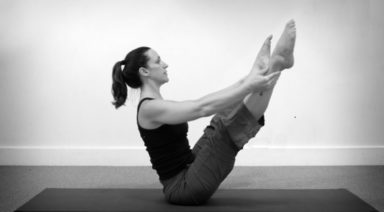
- Boat Pose – The boat pose can be a real abdominal killer. To do this sit on your mat, lift your knees so they are parallel to the ground and stay balanced by leaning back on your sit bones. It’s important to keep your back straight while doing this pose.
If you can, straighten your legs. If your back starts to curve, bring your knees back into a bent position. Hold this pose for five complete breaths then release. This pose always makes my midsection quiver, but makes me feel oh so strong afterwards.
- Side Plank – Remember when I mentioned the importance of obliques? This is a great exercise for targeting that muscle group.
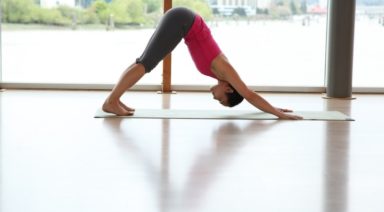
Start in downward dog then step both feet together so your big toes are touching. Move your right hand over to the left so it’s centered with the top middle of your mat. Roll over to the left and plant your left heel down. The key here is to balance on your outer left, flexed foot. Reach your arm straight up above you and take five full breathes. Release and repeat the movements on the other side.
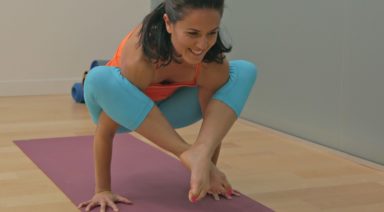
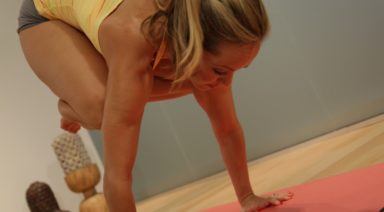
- Crow – This one looks tough, but I assure you it’s not so bad. Begin in a wide squat with your hands firmly planted on the ground with your fingers spread wide. Slightly straighten your legs and place your knees as high on your triceps as possible. Shifting your weight forward, balance on your arms and slowly begin to lift each foot off the floor. Again, remain here for five breaths.
- Four-Limbed Staff/ Chaturanga Dandasana – This position is frequently used when doing Sun Salutations. When held for longer it is a great core strengthener.
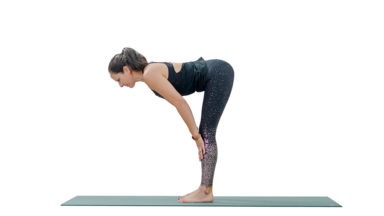
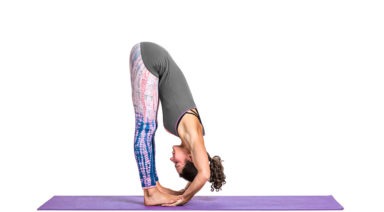
Come into a Standing Forward Bend with your palms flat on the floor. As you inhale, jump both feet back so your shoulders are above your wrists and your body is straight. Exhale and bend your elbows as you lower your torso towards the ground. Once your elbows are parallel with your back, stop and hold for five deep breaths.
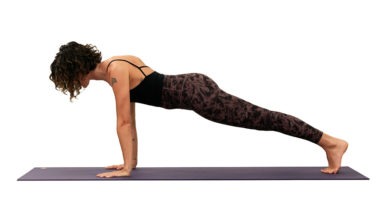
- Plank – I like to call this the old faithful because it’s simple, yet effective.
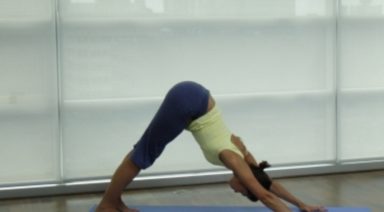
From Downward Facing Dog, draw your torso forward until your shoulders are above your wrists. You want your body to be in one straight line. Pressing your hands firmly on the ground, press back through your heels. Keep your neck in line with your spine, broaden your shoulder blades and hold for 60 seconds. Don’t forget to breathe!
If you add these five core savvy yoga exercises into your daily routine you will have a slender and strong core in no time at all. Namaste.
Redefining the Core
A woman referred by a yoga colleague came to me for an Alexander Technique lesson, hoping to relieve her agonizing neck and shoulder pain. I began by explaining Alexander’s central concept: release your neck to free the spine and relieve the shoulders. Then I stepped back to consider her overall stance. Though she had what might be considered “good” posture, I noticed a strange contraction in the front of her torso.
“What are you doing with your abdominals?” I asked.
“Holding them,” she replied.
“Well,” I said, “let them go.”
She did. Her torso did not collapse without that alleged “support.” After her first and, as it turned out, only lesson, her acute shoulder pain disappeared. What does this show? 1) A symptom may be far from its cause and 2) a flawed concept of abdominal support can be damaging.
Such a quick resolution is rare. Usually, in a private Alexander session or yoga class, we are on a quest to change neuromuscular habits bit by bit, refining awareness, unraveling tension and marshaling the body’s inherent postural support.
Many students pat themselves just above the navel and say, “I’ve got to strengthen my core,” with a vague idea of what that means. There are legions in the fields of physical conditioning and performance who will tell you that maintaining a conscious contraction in the superficial abdominals – those we can see and feel – will resolve back pain, foster better balance and improve posture. But misusing abdominal muscles can actually compress the spine and increase back pain, send you off balance, restrict your breath and compress your posture. In a class or private lesson, I have used the same instruction – let your abdominals go – to help people resolve sciatica, improve their singing, free their hip joints and restore full breathing. I don’t mean a slump or a droop, but the dynamic lengthening that comes from marshaling oppositional forces throughout the whole body.
Let’s correct some prevalent misconceptions and expand our idea of what core support really is.
Don’t Hold Anything
You wouldn’t strengthen your biceps by holding them in contraction all the time, so why do that with your abs? No muscle group should be held.
Muscles work reciprocally, and abdominal muscles work in relation to the head, neck, back and legs. As you walk, your abdominals – which connect from the pelvis to the lower ribs – work automatically. It may take some enlightened instruction to get there, but when you let your abdominals release and you envision ease and length in your spine, your abs work as they should.
The body is a marvelously complex creation – easy to move, hard to understand. Our body’s real function is a dazzling interplay of forces. As we try to sort out how it works, it’s easy to over-simplify. People try to stabilize one area rather than coordinate the entire body in motion. But a little anatomical understanding and some guiding principles can help you access your torso’s genuine support and truly enliven your core.
Abdominal Muscles
There are four layers of abdominals:
- Rectus abdominis are straight up and down, easily felt on the front surface of the torso. The goal of crunches is to develop these into “washboard abs.” Washboards – not much in use these days – are made of metal, a hard substance unlike human tissue. I’m all for strong abdominals, but they can be strong without being hard.
- Oblique abdominals are slanted and come in two layers – internal and external. They work when you do a yoga twist, when you breathe and as you walk. They wrap around your torso and go almost all the way back to the spine.
- Transversus abdominis is the deepest of the four layers, wrapping all the way around the torso, connecting to the lower spine. Roughly horizontal, transversus helps contain the internal organs and participate in upright posture.
Core Is So Much More
Let’s keep going, to underlayers you can’t consciously feel or directly engage, deeper within the body.
- Diaphragm – This mushroom-shaped structure at the bottom of the rib cage is the primary muscle of respiration. It coordinates with other torso muscles to expel CO2 – the waste product of breath – and inhale O2, the oxygen we need for survival. You can’t get more “core” than this. The entire rib cage expands as we inhale and contracts as we exhale. Allowing your breath to work fully and easily supports upright posture, calms the mind and conditions torso muscles – subtly and without effort.
- Psoas – You’ll hear this word thrown around a lot in yoga classes as a problem area. Some – not all – anatomy geeks consider this part of your core. Psoas expert Liz Koch calls her work Core Awareness. The full name is iliopsoas. Toward the top, it connects to the diaphragm and lumbar spine, relates to each breath we take and helps support upright posture. The “ilio” part coats the inside of the pelvis. The “psoas” part loops under the thighbone and, when it contracts, bends the hip joint. It is so central, so deep, that some consider it a barometer of our emotional state and level of stress.
- Pelvic floor – This web of muscle at the bottom of the torso helps support the internal organs. A busy intersection devoted to elimination and sexual activity, it connects to fascia in the body’s front and back that indirectly link all the way up to the base of the skull.
- Multifidus – Some back muscles – the ones you use when you arch your back in yoga – are on the torso’s surface. When they engage, they extend the whole length of the spine. Beneath those big surface muscles are intermediate layers and, deepest and closest to the spine are these little ones: multifidus, linking one vertebrae to another. They support us to stand, sit well and initiate larger movements. Studies show that to protect the spine from injury, the multifidus muscles activate before any motion.
The Body Works as a Whole
When you bend your elbow, your biceps work and your triceps release. When you straighten your arm, the triceps engage. If both are working, your shoulder and elbow joints will compress. When muscular work is efficient, one muscle group is active and the opposing group releases. That release is a neuromuscular function called inhibition. We can make that function conscious by pausing before we do a yoga posture to envision the posture as a whole and move into it with ease.
When you learned how to throw a ball or swing a racket, you didn’t analyze a sequence of muscles engaging. You looked where you wanted the ball to go and imitated your teacher, an athlete or adept older kid. You got a whole picture. Your eyes delivered that picture to your brain and nervous system in a flash, and you did your best to fulfill the action you saw. Over time, you practiced and got better at it, not from analysis, but from keeping your eye on the ball and repeating a whole body experience. When we see the objective of an action in the mind’s eye, we are better able to engage the body’s complex, integrated response.
Many people think that surface muscles – the back and superficial abdominals – support upright posture. It’s nice to know where the abs are and what they do, but here’s the big news: if the outside shell of muscle is tense, the inner muscles fail to engage. Rather than working, the core muscles actually inhibit, making the spine less spacious and more vulnerable. Before we do something, the spine can enliven and lengthen to prepare for our next move. When you understand this, it can bring more ease and balance to your daily tasks and to the practice of yoga.
Ways to Build the Core
Here are some ways in everyday movement and yoga to build a truly strong core:
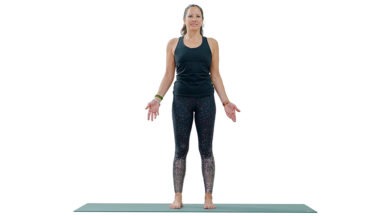
- Standing – Whether waiting for a train or standing in tadasana, Mountain Pose, notice whether your weight is more toward the front of your feet or the heel. If you’re not centered, envision the top of your head guiding you right over your feet. If it feels weird, you’ll know you habitually stand back on your heels. Once you’re in balance, central muscles naturally engage and upright poise can become effortless.
- Sitting – To sit well, envision space and ease where the spine joins the head – a point between the ears. Balance your weight on your sitbones, breathe easily and envision those little muscles along the spine supporting you from within. If in yoga class you find it a strain to sit with legs crossed, sit on a folded blanket or bolster to make upright posture easier. Rather than lifting your rib cage, let it be buoyant with breath.
- Breathing – Believe it or not, a full easy breath is one of the most accessible ways to improve your posture and engage your core. Your lungs go from your shoulders to near the bottom of the rib cage. Allow your breath to fill the whole torso, including the back where you have more lung tissue.
Many yoga poses demand and can inspire core support. Here are just a few:
- Seated Spinal Twist – Allow your breath to support the easy movement of your rib cage and shoulders as you wring out the waist.
- Plank – When you do this pose in yoga class or at the gym, allow your head to rotate slightly at the top of your spine. That will allow the spine to lengthen and give this strong pose a foundation of ease. Your core – you can’t do this pose without it – will engage as needed.
- Side Plank – In Vasistasana, allow that slight rotation as you send the crown of the head away from the heels of your flexed feet.
Practice either of these plank variations as you hold a block between your thighs to spark deep, genuine core support.
We’re not like an ice cream sandwich, with a slab of muscle on the front facing another slab on the back. We are round and multi-layered, with the largest muscles on the outside and the smallest deep within. Isolating and overworking one surface muscle group is misguided. It’s not how movement and function work. In fact, one part of engaging the core is breathing fully and easily. You can think of your core as beginning from the long arch in your feet, your inner heels and big toes, and ending at the top of your head.
And please, don’t hold your abdominals. Remember that your body is supported by a complicated, orchestral set of interactions that harmonize when you envision your body working – as a whole. Enjoy your new core.