Post-Traumatic Growth and the Hero’s Journey

Post-Traumatic Growth and the Hero’s Journey
A companion to Dark Night of Our Souls for anyone considering what growth after trauma can mean.
A note before you read: This article discusses trauma and suicidal crisis. Read at your own pace. If you may hurt yourself or someone else, call emergency services. In the United States or Canada, call or text 988 at any hour. Elsewhere, contact the crisis service where you live.
After a film about trauma ends, the room can feel strangely ordinary. The dishes still need doing, and your phone may light up with a name that changes your breathing. You may recognize yourself in a story and still be unsure how to understand that recognition.
Dark Night of Our Souls brings first-person accounts of combat, abuse, grief, chronic pain, addiction, and loss into conversation with clinical research and spiritual inquiry. Guided by Richard Rudd, the film includes perspectives from Danielle Alexander, Trung Ngo, Anderson Todd, John Vervaeke, Nadine Purdy, and other contributors. They examine how a person can live after an experience changes their sense of safety and identity.
The film moves between research, personal testimony, spiritual traditions, and the mythic pattern Joseph Campbell called the hero’s journey. That range needs context. When someone in the film describes a practice that helped them, the account belongs to that person. It does not become a recovery protocol for every viewer.
This article stays with the film’s central ideas and the questions they raise. It does not prescribe a trauma practice. The material is educational and cannot diagnose or treat trauma, post-traumatic stress disorder (PTSD), depression, or any other health condition.
What Is Post-Traumatic Growth?
Post-traumatic growth is a research term for positive psychological change that some people report through the struggle with trauma or severe adversity. Psychologists Richard Tedeschi and Lawrence Calhoun described changes in five broad areas: appreciation of life, relationships with other people, personal strength, new possibilities, and spiritual or existential understanding. The American Psychological Association’s overview explains the concept and its development.
Researchers locate the growth in the struggle that follows, rather than in the traumatic event itself. No survivor is required to produce growth from harm. Some people do not identify with the idea at all. The event can remain unnecessary, undeserved, harmful, and costly even when a person later finds a different way to live.
A report of growth tells us little about whether trauma symptoms remain. Research has found that perceived growth and post-traumatic stress symptoms can exist at the same time. Their relationship varies with the person, the kind of trauma, age, and time since the event, according to a meta-analysis indexed by the National Library of Medicine.
In ordinary life, growth may be less visible than the word suggests. A relationship may begin to feel trustworthy again. A boundary may become clearer while an old priority falls away. An ordinary routine may carry new importance. None of these changes erases grief, symptoms, disability, or the cost of what happened.
Why the Film Uses the Hero’s Journey
The hero’s journey is a story pattern associated with mythologist Joseph Campbell. In its familiar form, a person leaves known ground, crosses a threshold, undergoes an ordeal, and returns to ordinary life changed. The Joseph Campbell Foundation describes it as a movement from the familiar world into an unfamiliar one and back again.
Dark Night of Our Souls uses that pattern as a language for meaning-making. The film describes crisis as a call, trauma as a kind of descent, and integration as a return to life with a changed understanding of oneself. For some viewers, that story can give shape to an experience that has felt shapeless.
The metaphor has limits. Trauma is not an adventure someone must welcome, and survival does not require a heroic identity. A story pattern also cannot establish how long recovery should take or which form it should assume.
The film places this mythic lens beside a disaster-response curve. The curve moves through pre-trauma, impact, a temporary heroic phase, disillusionment, and reconstruction or recovery. Its most useful feature may be the uneven line. An early surge of action can give way to exhaustion. Later growth can coexist with periods of distress. The film emphasizes that the route and timetable differ from person to person.
Where the Two Ideas Meet
Post-traumatic growth gives researchers language for changes that some people report after severe adversity. The hero’s journey gives storytellers language for departure, ordeal, transformation, and return. They describe different kinds of knowledge, yet both are attempts to understand how a life continues after its earlier assumptions have been disrupted.
For viewers who find the framework useful, it may open questions that have no forced answer:
- Did this experience divide my life into a before and an after?
- Which beliefs about myself or the world no longer hold?
- Has the way I relate to other people changed?
- Which parts of the experience remain difficult even alongside change?
Some people will recognize their lives in those questions. Others will not. Post-traumatic growth is a possibility described in research, not an assignment.
Common Questions About Post-Traumatic Growth
Can I Experience Growth and Still Feel Terrible?
Growth and distress can exist at the same time. A stronger boundary does not erase nightmares. A renewed relationship does not cancel grief. Post-traumatic growth and post-traumatic stress can develop alongside each other, and improvement rarely moves in a straight line.
Does Trauma Always Involve Another Person?
Trauma does not always involve another person. It can follow a serious accident, disaster, illness, sudden loss, combat, or interpersonal violence. The National Center for PTSD describes a wide range of reactions that may follow traumatic events. Questions about forgiveness or contact apply only when another person was involved.
How Long Does Post-Traumatic Growth Take?
There is no reliable timetable. The National Center for PTSD describes recovery as an ongoing process that happens little by little. Acute safety, housing, money, physical health, social support, and access to care can all affect what is possible at a given time.
Do I Have to Forgive Someone If Another Person Was Involved?
Forgiveness is not a condition of post-traumatic growth. The film includes personal testimony in which forgiveness matters to the speaker. That account reflects one person’s process. Another person may choose distance or no contact while still wanting accountability. Forgiveness and renewed contact are separate decisions.
Can Meditation, Breathwork, Ritual, or Plant Medicine Help?
The film suggests that meditation, breathwork, ritual, and plant medicine may help some people in some circumstances. It presents these approaches through testimony and discussion rather than as a universal protocol. Each person’s case is unique, and these practices differ in their evidence base, legal status, risks, and required support. Questions about whether any of them fit a person’s health history belong with a qualified professional.
Does Post-Traumatic Growth Mean the Trauma Happened for a Reason?
The concept does not require that conclusion. Growth after harm does not retroactively justify the harm. A person can find meaning in what followed while still regarding the event itself as senseless, preventable, or wrong.
Is Post-Traumatic Growth the Same as Recovering From PTSD?
They are different concepts. PTSD is a mental health diagnosis. Post-traumatic growth describes positive changes a person may perceive after struggling with adversity. Someone may report growth while still having PTSD symptoms, and someone can recover from PTSD without describing the experience as growth.
When the Questions Need Clinical Context
The National Center for PTSD explains trauma symptoms and treatments with strong research support. In the United States, SAMHSA’s Find Help page provides treatment locators and referral services. A licensed clinician can consider symptoms, current safety, physical health, medication, cost, and personal preferences in a way that a documentary or article cannot.
Continue the Conversation
In Dark Night of Our Souls, survivors describe experiences that resist a clean before-and-after story. Contributors from clinical research and contemplative traditions approach post-traumatic growth from different directions. Their accounts sometimes use different language for the passage from disruption toward return.
The film’s value lies in hearing how particular people understood what changed for them. Viewers can consider those accounts without adopting every conclusion or practice.
Watch or continue Dark Night of Our Souls on Gaia.
Editorial Sources
- Dark Night of Our Souls: Gaia
- Growth After Trauma: American Psychological Association
- A Meta-Analytic Clarification of the Relationship Between Posttraumatic Growth and Symptoms of Posttraumatic Distress Disorder: PubMed
- Joseph Campbell and the Hero’s Journey: Joseph Campbell Foundation
- Common Reactions After Trauma: National Center for PTSD
- Coping With Traumatic Stress Reactions: National Center for PTSD
- Understanding PTSD Treatment: National Center for PTSD
- Trauma-Informed Approaches and Programs: SAMHSA
- 988 Suicide & Crisis Lifeline: United States
- 9-8-8 Suicide Crisis Helpline: Canada
About the Author

What the Enneagram Is and How to Identify Your Dominant Enneatype
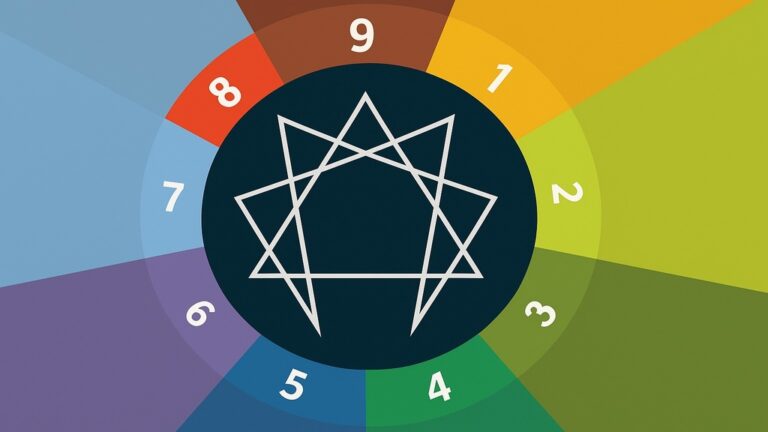
The Enneagram is a tool for self-knowledge that describes nine personality types, each with a particular way of thinking, feeling, and relating to the world. Its purpose is to help us understand our deepest motivations and the unconscious patterns that shape our lives. In this article, we explore what the Enneagram is, how it works, and how you can discover your dominant Enneatype to better understand yourself and grow as a person.
Table of Contents
- What Is the Enneagram of Personality?
- What Are the Enneatypes and How Are They Classified?
- What Are Wings in the Enneagram and How Do They Influence Us?
- What Does the Enneagram Symbol Represent?
- How to Discover Your Dominant Enneatype
- Self-Knowledge Through the Enneagram
- The History and Origin of the Enneagram
What Is the Enneagram of Personality?
The Enneagram is a system of self-knowledge that organizes human personality into nine main behavioral patterns, known as Enneatypes. Each person tends to live from one of these nine styles, which form during childhood as a response to an emotional wound. From there, we develop a personality that attempts to compensate for that pain, repeating beliefs, attitudes, and reactions we rarely question.
The word “Enneagram” comes from Greek and means “nine lines,” referring to the symbol that represents it. This symbol shows how the nine types relate to each other and helps us understand the changes we experience when we are emotionally balanced or unbalanced. The Enneagram is not a personality test, but rather a map that explains our automatic reactions and the psychological roots behind them.
The most valuable aspect of the Enneagram is that it not only reveals our defense mechanisms but also our potential for transformation. By identifying our dominant Enneatype, we can understand what limits us, what drives us, and what we need to evolve. For this reason, this tool is increasingly used in personal, therapeutic, educational, and professional development processes.
What Are the Enneatypes and How Are They Classified?
The Enneatypes are the nine personality types described by the Enneagram. Each one emerges from an emotional wound that shapes how we see the world and relate to others. These psychological structures are not rigid labels, but rather defense mechanisms developed in childhood to feel safe, loved, or valued. Knowing our dominant Enneatype allows us to understand what deeply motivates us, what our core fears are, and which patterns we tend to repeat unconsciously. Below, we describe each of the 9 Enneatypes in the Enneagram.
- Enneatype 1 (The Perfectionist): Their core wound is the belief that they are not good enough. To compensate, they constantly strive to do things “right,” following strict rules and high standards. They are usually responsible, ethical, and committed, but can also be rigid, critical, and prone to frustration when things don’t go as expected.
- Enneatype 2 (The Helper): They believe they must earn love by serving others. They devote themselves to caring, supporting, and being available, hoping for affection in return. While generous and empathetic, they can fall into emotional dependency and manipulative behaviors when they don’t feel appreciated.
- Enneatype 3 (The Achiever): They fear they are not worthy unless they prove their success or accomplishments. Their self-esteem is tied to performance and how others perceive them. Often efficient, ambitious, and charismatic, they may lose authenticity by adapting to expectations and avoiding vulnerability.
- Enneatype 4 (The Individualist): Their wound is the feeling of not being enough just as they are. They seek to stand out by being unique, special, and different. They experience emotions intensely and often feel misunderstood, which can lead to melancholy, envy, and disconnection from the present.
- Enneatype 5 (The Observer): Their main fear is not being able to cope with emotional demands. To protect themselves, they retreat into their minds, knowledge, and isolation. Analytical, independent, and intellectual, they may also be distant and disconnected from emotions and human contact.
- Enneatype 6 (The Loyalist): Their wound is rooted in mistrust of themselves and the world around them. They live in a state of alertness, anticipating danger and seeking certainty. Loyal, responsible, and cooperative, they can also be anxious, indecisive, and prone to relying on authority figures for guidance.
- Enneatype 7 (The Enthusiast): They avoid pain and discomfort by constantly seeking positive stimulation. They fill their schedules with plans, activities, and distractions to avoid confronting inner emptiness. Cheerful, versatile, and optimistic, they can also be inconsistent, superficial, and escapist.
- Enneatype 8 (The Challenger): They fear being hurt or controlled by others, so they adopt a stance of strength and dominance. They protect themselves by showing authority, confidence, and determination. While they can be leaders, protectors, and just, they may also come across as authoritarian, aggressive, and resistant to vulnerability.
- Enneatype 9 (The Peacemaker): Their wound lies in the fear of conflict and rejection from others. They tend to minimize themselves, avoid confrontations, and adapt to avoid discomfort. Calm, kind, and conciliatory, they may also be passive, disconnected from their desires, and struggle with decision-making.
What Are Wings in the Enneagram and How Do They Influence Us?
Within the Enneagram, each Enneatype is connected to the two neighboring types on the circle. These are known as “wings.” For example, someone whose dominant Enneatype is 5 may have a wing 4 or a wing 6. These wings don’t change the core type, but they do nuance our personality by adding secondary characteristics that broaden or balance our traits.
The influence of wings can be very strong or barely noticeable, depending on each person’s level of personal development. Some people clearly identify with one of the two wings, while others display traits from both. Wings function as extensions of the main type and often bring in abilities or resources that help compensate for certain limitations of the dominant Enneatype.
Understanding our wings not only deepens self-awareness, but also helps us better understand our inner contradictions. Through them, we can observe how our personality adapts, how we blend different traits, and how we expand our ways of responding to situations. Identifying the role of our wings is a key step toward working on ourselves with more consciousness and flexibility.
What Does the Enneagram Symbol Represent?
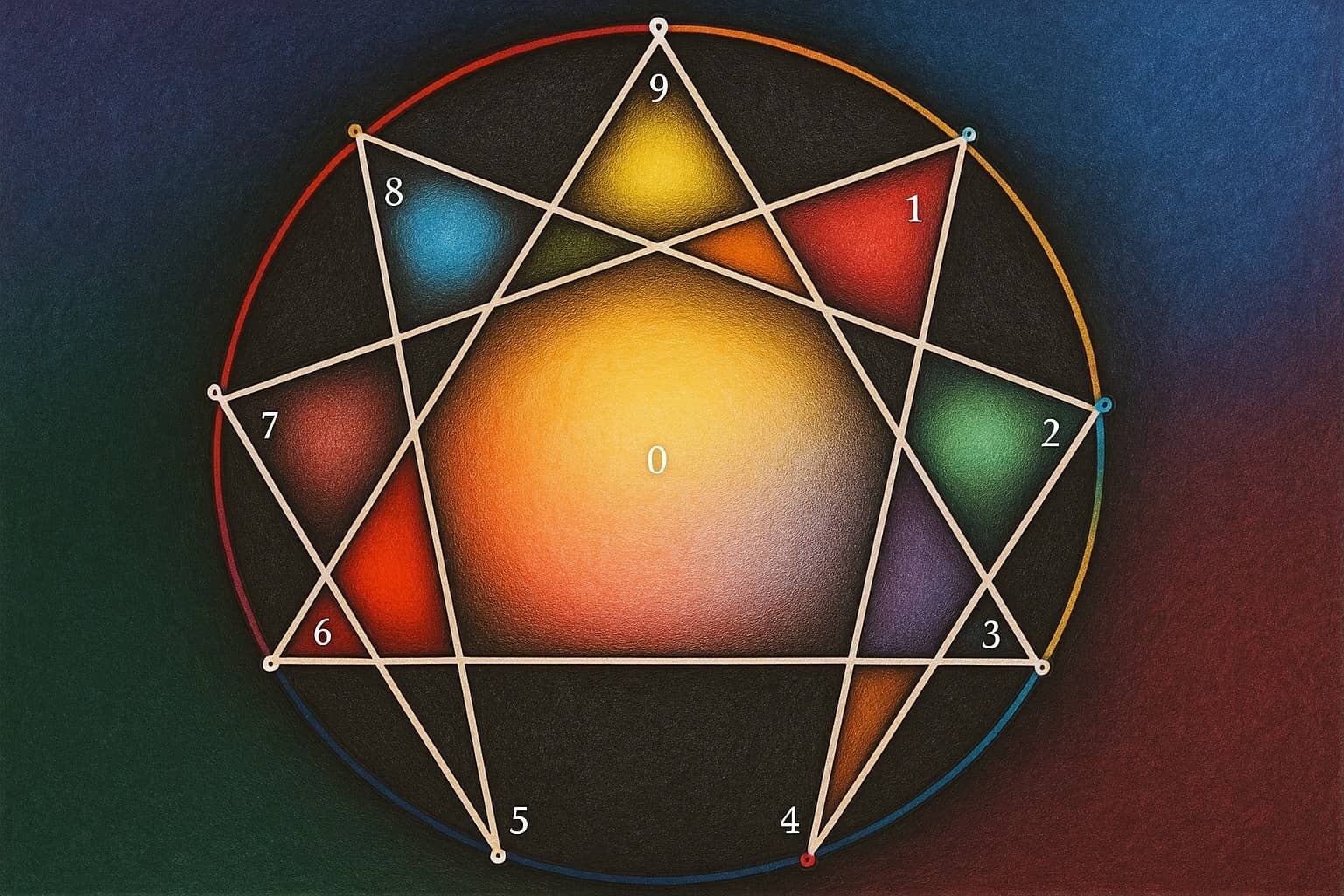
The Enneagram symbol is a geometric figure made up of a circle, an equilateral triangle, and a six-pointed irregular line. At first glance, it may seem complex, but each part has a deep meaning that helps us understand how this system works. The nine points around the circle represent the nine Enneatypes, and their placement is not random—they reflect a logical order related to energy and transformation.
The triangle connects points 3, 6, and 9, forming what is known as the “inner triad.” This shape represents three fundamental forces in the human being: action, emotion, and thought. The six-pointed figure (connecting points 1-4-2-8-5-7) illustrates the internal movement between types, showing how we shift depending on our level of balance or stress. This dynamic pattern is key to understanding growth or stagnation within each personality.
Beyond its shape, this diagram shows that we are in constant transformation as human beings. Rather than labeling us, the symbol invites us to see that we are always evolving—either growing or getting stuck. Visualizing how the Enneatypes relate to each other allows us to better understand our inner transitions and the possible paths for conscious evolution.
How to Discover Your Dominant Enneatype
Discovering your dominant Enneatype is not about taking a simple quiz, but about observing with honesty your most frequent emotional, mental, and behavioral patterns. While questionnaires can help point you in the right direction, true understanding comes when you recognize yourself in the description of a type—especially in its core emotional wound. Identifying the type that reflects your deepest motivations and defense mechanisms is a personal process that requires reflection and sincerity.
A good starting point is to carefully read through the descriptions of the nine Enneatypes, paying attention to what makes you uncomfortable or resonates with you intensely. It’s not just about identifying external behaviors, but about detecting the inner need that drives your actions. Are you seeking approval, control, security, freedom? Observing how you react to conflict, failure, or criticism can offer valuable clues about your primary type.
It can also be helpful to complement this process with books, courses, or professional guidance. Therapists and coaches trained in the Enneagram can support your self-discovery in a more structured way. As you gain a clearer understanding of your type, you can begin working on your blind spots, reconnect with your most authentic self, and move toward a more conscious and liberated version of who you are.
Self-Knowledge Through the Enneagram
The Enneagram is not a system for labeling people, but rather a tool for understanding how we disconnect from our essence and how we can return to it. It helps us clearly see the unconscious patterns we’ve repeated for years—often the source of suffering, conflict, or frustration. By identifying our Enneatype, we gain the opportunity to stop acting on autopilot and begin making choices from a more conscious place.
The self-knowledge process that the Enneagram proposes is neither immediate nor linear. It involves peeling back layers of self-deception, acknowledging emotional wounds, and observing our defensive behaviors with compassion. It also invites us to reconnect with our essential virtues—qualities that already live within us, but which we’ve often forgotten or suppressed out of fear. This journey is not about perfection, but about authenticity and balance.
Knowing yourself through the Enneagram involves a commitment to personal growth and greater emotional responsibility. As we understand ourselves better, we also learn to understand others. This model offers a shared language to speak about the human experience—with all its light and shadow—and reminds us that beyond personality types, we all share the same longing: to live with more awareness, freedom, and meaning.
The History and Origin of the Enneagram
The origin of the Enneagram is complex, combining philosophical, spiritual, and psychological influences. While its symbol has ancient roots tracing back to Middle Eastern traditions and Sufism, its modern application to the study of personality began in the 20th century. It was the Bolivian mystic Óscar Ichazo who first structured the nine character types into a coherent system, integrating knowledge from various traditions and philosophical schools.
Later, Chilean psychiatrist Claudio Naranjo developed the model from a therapeutic perspective, incorporating concepts from Western psychology. Through his clinical experience, he outlined the traits and defense mechanisms of each type, allowing it to be applied in educational and psychological settings. His contribution was key to transforming the Enneagram into a practical tool for self-discovery. In recent decades, its use has expanded and gained popularity around the world.