What the Enneagram Is and How to Identify Your Dominant Enneatype
The Enneagram is a tool for self-knowledge that describes nine personality types, each with a particular way of thinking, feeling, and relating to the world. Its purpose is to help us understand our deepest motivations and the unconscious patterns that shape our lives. In this article, we explore what the Enneagram is, how it works, and how you can discover your dominant Enneatype to better understand yourself and grow as a person.
Table of Contents
- What Is the Enneagram of Personality?
- What Are the Enneatypes and How Are They Classified?
- What Are Wings in the Enneagram and How Do They Influence Us?
- What Does the Enneagram Symbol Represent?
- How to Discover Your Dominant Enneatype
- Self-Knowledge Through the Enneagram
- The History and Origin of the Enneagram
What Is the Enneagram of Personality?
The Enneagram is a system of self-knowledge that organizes human personality into nine main behavioral patterns, known as Enneatypes. Each person tends to live from one of these nine styles, which form during childhood as a response to an emotional wound. From there, we develop a personality that attempts to compensate for that pain, repeating beliefs, attitudes, and reactions we rarely question.
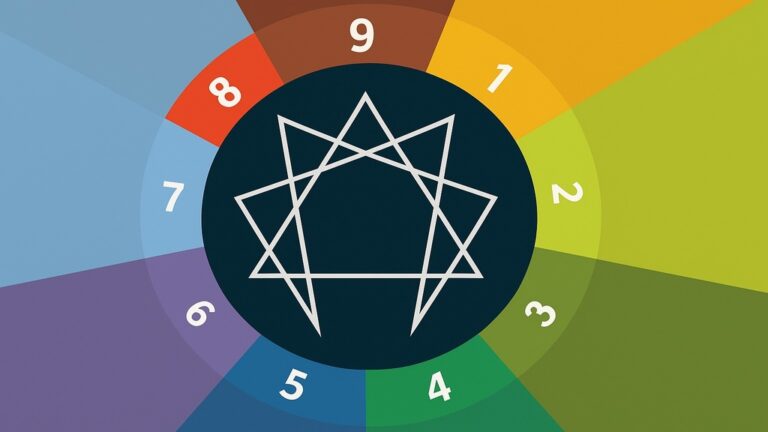
The word “Enneagram” comes from Greek and means “nine lines,” referring to the symbol that represents it. This symbol shows how the nine types relate to each other and helps us understand the changes we experience when we are emotionally balanced or unbalanced. The Enneagram is not a personality test, but rather a map that explains our automatic reactions and the psychological roots behind them.
The most valuable aspect of the Enneagram is that it not only reveals our defense mechanisms but also our potential for transformation. By identifying our dominant Enneatype, we can understand what limits us, what drives us, and what we need to evolve. For this reason, this tool is increasingly used in personal, therapeutic, educational, and professional development processes.
What Are the Enneatypes and How Are They Classified?
The Enneatypes are the nine personality types described by the Enneagram. Each one emerges from an emotional wound that shapes how we see the world and relate to others. These psychological structures are not rigid labels, but rather defense mechanisms developed in childhood to feel safe, loved, or valued. Knowing our dominant Enneatype allows us to understand what deeply motivates us, what our core fears are, and which patterns we tend to repeat unconsciously. Below, we describe each of the 9 Enneatypes in the Enneagram.
- Enneatype 1 (The Perfectionist): Their core wound is the belief that they are not good enough. To compensate, they constantly strive to do things “right,” following strict rules and high standards. They are usually responsible, ethical, and committed, but can also be rigid, critical, and prone to frustration when things don’t go as expected.
- Enneatype 2 (The Helper): They believe they must earn love by serving others. They devote themselves to caring, supporting, and being available, hoping for affection in return. While generous and empathetic, they can fall into emotional dependency and manipulative behaviors when they don’t feel appreciated.
- Enneatype 3 (The Achiever): They fear they are not worthy unless they prove their success or accomplishments. Their self-esteem is tied to performance and how others perceive them. Often efficient, ambitious, and charismatic, they may lose authenticity by adapting to expectations and avoiding vulnerability.
- Enneatype 4 (The Individualist): Their wound is the feeling of not being enough just as they are. They seek to stand out by being unique, special, and different. They experience emotions intensely and often feel misunderstood, which can lead to melancholy, envy, and disconnection from the present.
- Enneatype 5 (The Observer): Their main fear is not being able to cope with emotional demands. To protect themselves, they retreat into their minds, knowledge, and isolation. Analytical, independent, and intellectual, they may also be distant and disconnected from emotions and human contact.
- Enneatype 6 (The Loyalist): Their wound is rooted in mistrust of themselves and the world around them. They live in a state of alertness, anticipating danger and seeking certainty. Loyal, responsible, and cooperative, they can also be anxious, indecisive, and prone to relying on authority figures for guidance.
- Enneatype 7 (The Enthusiast): They avoid pain and discomfort by constantly seeking positive stimulation. They fill their schedules with plans, activities, and distractions to avoid confronting inner emptiness. Cheerful, versatile, and optimistic, they can also be inconsistent, superficial, and escapist.
- Enneatype 8 (The Challenger): They fear being hurt or controlled by others, so they adopt a stance of strength and dominance. They protect themselves by showing authority, confidence, and determination. While they can be leaders, protectors, and just, they may also come across as authoritarian, aggressive, and resistant to vulnerability.
- Enneatype 9 (The Peacemaker): Their wound lies in the fear of conflict and rejection from others. They tend to minimize themselves, avoid confrontations, and adapt to avoid discomfort. Calm, kind, and conciliatory, they may also be passive, disconnected from their desires, and struggle with decision-making.
What Are Wings in the Enneagram and How Do They Influence Us?
Within the Enneagram, each Enneatype is connected to the two neighboring types on the circle. These are known as “wings.” For example, someone whose dominant Enneatype is 5 may have a wing 4 or a wing 6. These wings don’t change the core type, but they do nuance our personality by adding secondary characteristics that broaden or balance our traits.
The influence of wings can be very strong or barely noticeable, depending on each person’s level of personal development. Some people clearly identify with one of the two wings, while others display traits from both. Wings function as extensions of the main type and often bring in abilities or resources that help compensate for certain limitations of the dominant Enneatype.
Understanding our wings not only deepens self-awareness, but also helps us better understand our inner contradictions. Through them, we can observe how our personality adapts, how we blend different traits, and how we expand our ways of responding to situations. Identifying the role of our wings is a key step toward working on ourselves with more consciousness and flexibility.
What Does the Enneagram Symbol Represent?
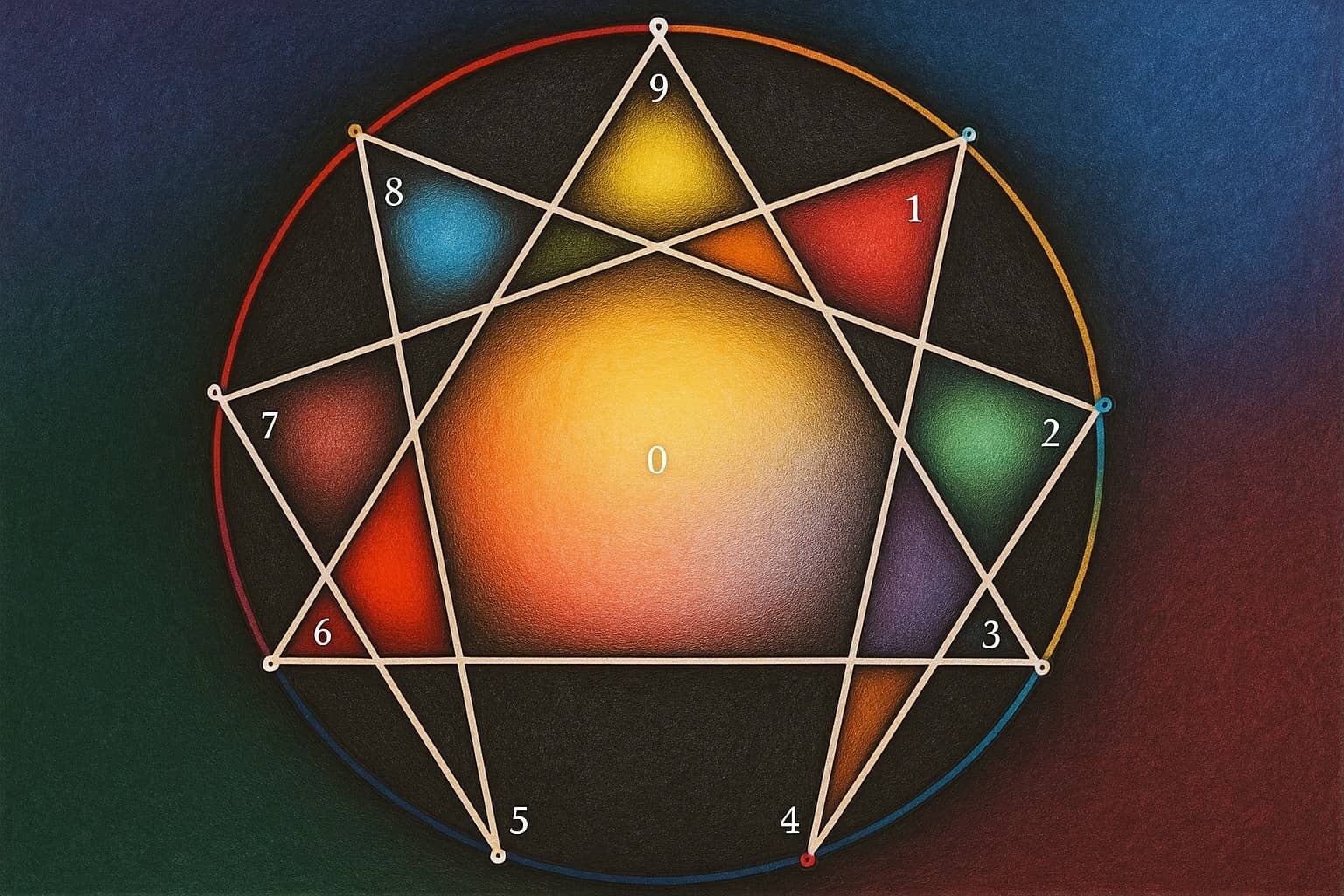
The Enneagram symbol is a geometric figure made up of a circle, an equilateral triangle, and a six-pointed irregular line. At first glance, it may seem complex, but each part has a deep meaning that helps us understand how this system works. The nine points around the circle represent the nine Enneatypes, and their placement is not random—they reflect a logical order related to energy and transformation.
The triangle connects points 3, 6, and 9, forming what is known as the “inner triad.” This shape represents three fundamental forces in the human being: action, emotion, and thought. The six-pointed figure (connecting points 1-4-2-8-5-7) illustrates the internal movement between types, showing how we shift depending on our level of balance or stress. This dynamic pattern is key to understanding growth or stagnation within each personality.
Beyond its shape, this diagram shows that we are in constant transformation as human beings. Rather than labeling us, the symbol invites us to see that we are always evolving—either growing or getting stuck. Visualizing how the Enneatypes relate to each other allows us to better understand our inner transitions and the possible paths for conscious evolution.
How to Discover Your Dominant Enneatype
Discovering your dominant Enneatype is not about taking a simple quiz, but about observing with honesty your most frequent emotional, mental, and behavioral patterns. While questionnaires can help point you in the right direction, true understanding comes when you recognize yourself in the description of a type—especially in its core emotional wound. Identifying the type that reflects your deepest motivations and defense mechanisms is a personal process that requires reflection and sincerity.
A good starting point is to carefully read through the descriptions of the nine Enneatypes, paying attention to what makes you uncomfortable or resonates with you intensely. It’s not just about identifying external behaviors, but about detecting the inner need that drives your actions. Are you seeking approval, control, security, freedom? Observing how you react to conflict, failure, or criticism can offer valuable clues about your primary type.
It can also be helpful to complement this process with books, courses, or professional guidance. Therapists and coaches trained in the Enneagram can support your self-discovery in a more structured way. As you gain a clearer understanding of your type, you can begin working on your blind spots, reconnect with your most authentic self, and move toward a more conscious and liberated version of who you are.
Self-Knowledge Through the Enneagram
The Enneagram is not a system for labeling people, but rather a tool for understanding how we disconnect from our essence and how we can return to it. It helps us clearly see the unconscious patterns we’ve repeated for years—often the source of suffering, conflict, or frustration. By identifying our Enneatype, we gain the opportunity to stop acting on autopilot and begin making choices from a more conscious place.
The self-knowledge process that the Enneagram proposes is neither immediate nor linear. It involves peeling back layers of self-deception, acknowledging emotional wounds, and observing our defensive behaviors with compassion. It also invites us to reconnect with our essential virtues—qualities that already live within us, but which we’ve often forgotten or suppressed out of fear. This journey is not about perfection, but about authenticity and balance.
Knowing yourself through the Enneagram involves a commitment to personal growth and greater emotional responsibility. As we understand ourselves better, we also learn to understand others. This model offers a shared language to speak about the human experience—with all its light and shadow—and reminds us that beyond personality types, we all share the same longing: to live with more awareness, freedom, and meaning.
The History and Origin of the Enneagram
The origin of the Enneagram is complex, combining philosophical, spiritual, and psychological influences. While its symbol has ancient roots tracing back to Middle Eastern traditions and Sufism, its modern application to the study of personality began in the 20th century. It was the Bolivian mystic Óscar Ichazo who first structured the nine character types into a coherent system, integrating knowledge from various traditions and philosophical schools.
Later, Chilean psychiatrist Claudio Naranjo developed the model from a therapeutic perspective, incorporating concepts from Western psychology. Through his clinical experience, he outlined the traits and defense mechanisms of each type, allowing it to be applied in educational and psychological settings. His contribution was key to transforming the Enneagram into a practical tool for self-discovery. In recent decades, its use has expanded and gained popularity around the world.
About the Author

7 Self-Knowledge Exercises To Truly Discover Who You Are

Self-knowledge is a process of inner exploration that helps us understand how we think, what we feel, and why we act the way we do. It involves looking inward with honesty, acknowledging both our strengths and limitations.
In this article, we explore why it’s important to know ourselves, how to begin that journey, and which practical exercises can help us discover who we really are.
Table of Contents
- The Importance Of Discovering Who We Are
- How To Begin Our Path Toward Self-Knowledge
- Self-Knowledge Activities To Deepen Our Understanding Of Ourselves
- Writing A Personal Journal
- Answering Deep Self-Knowledge Questions
- Taking A Personality Test
- Exploring The Birth Chart
- link text=”Using Cards As A Tool For Symbolic Introspection” url=”#using-cards-as-a-tool-for-symbolic-introspection” target=”_self” /]
- Exploring Our Personality With The Enneagram
- Analyzing Our Wheel Of Life To Detect Imbalances
- Explore More Self-Knowledge Tools On Gaia
- Integrating Self-Knowledge Into Everyday Life
The Importance Of Discovering Who We Are
Many times we go through life following routines, expectations, or obligations without asking ourselves if what we do is actually connected to who we are deep down. We may reach certain goals or meet what’s expected of us, but if we do it from a place of disconnection, it’s common to feel exhausted, empty, or find it hard to see real meaning in what we do. Living without an inner compass can lead us to make decisions that don’t represent us and to maintain relationships or lifestyles that pull us away from our essence.
On the other hand, when we begin to understand what moves us, what we value, and what we need, decisions stop being automatic. A sense of internal order arises, which is reflected in how we live, how we relate, and how we respond to daily challenges. Living from our truth, even if it brings discomfort or uncertainty at first, brings a deeper sense of calm—less dependent on what’s outside.
This process of knowing ourselves isn’t a goal we reach once and for all—it’s a constant practice cultivated in everyday life. It is a way of being in relationship with ourselves: observing ourselves honestly, questioning our beliefs, reviewing what we choose and what we avoid. And in that movement of self-exploration and reconstruction, we gain clarity, depth, and meaning.
How To Begin Our Path Toward Self-Knowledge
Self-knowledge begins with an internal decision: to look at ourselves with more attention. Sometimes, it’s enough to pause for a moment, take a deep breath, and notice what’s happening inside us. That small pause can be the starting point for establishing a more conscious relationship with our inner world.
Over time, that space of observation becomes clearer and more natural. We begin to notice recurring thoughts, emotions that are hard to express, or decisions we make without questioning them. It’s not about correcting everything at once, but about recognizing what’s there so we can act with greater clarity and meaning.
Self-Knowledge Activities To Deepen Our Understanding Of Ourselves
If we feel the urge to know ourselves better but don’t know where to begin, we can rely on certain practices that offer us valuable guidance. Writing in a journal, answering reflective questions, or taking a personality test can help us see more clearly what we think, feel, and do.
These tools don’t offer definitive answers, but they do open inner doors that are worth exploring. What’s essential is to maintain an honest attitude and openness to the process.
-
Writing A Personal Journal
Keeping a journal is a simple yet powerful practice for exploring what we think and feel. By recording our daily experiences, we can detect emotional patterns, recurring reactions, or themes that need attention. You can also practice automatic writing, with no filters or corrections, to connect with deeper parts of your inner world.
-
Answering Deep Self-Knowledge Questions
Asking ourselves deep questions can open up spaces that usually remain hidden. Questions like “What gives us meaning?”, “What are we avoiding?”, or “What do we need to let go of?” activate reflection and allow us to explore motivations, fears, and desires we may not have previously considered. It doesn’t matter if no immediate answer comes—the very act of asking already sets the process in motion.
-
Taking A Personality Test
Taking a personality test can help us put into words certain traits or tendencies that are part of who we are. Tools like MBTI, DISC or the Big Five offer frameworks for understanding how we think, how we relate to others, and what kind of environment supports our development. It’s not about labeling ourselves, but about gaining clarity on how we function internally.
-
Exploring The Birth Chart
The birth chart reflects the configuration of the sky at the moment of our birth. Through its symbols and archetypes, we can identify emotional patterns, relationship styles, talents, and personal challenges. It is a symbolic guide that does not define who we are, but it does allow us to understand ourselves from a broader and deeper perspective.
-
Using Cards As A Tool For Symbolic Introspection
Tarot, oracle, or archetype cards can serve as gateways to our inner world, through images, symbols, and intuitive associations. By asking a question and observing the card that emerges, a dialogue with the unconscious opens. It’s not about predicting the future, but about giving shape and language to what we may not yet be able to see clearly.
-
Exploring Our Personality With The Enneagram
The Enneagram is a system of nine personality types that describes how we perceive the world, how we react to our environment, and what we seek on an emotional level. Recognizing our type allows us to more consciously observe our automatic behaviors, fears, and deep motivations. From there, we can work on our growth with more clarity and direction.
-
Analyzing Our Wheel Of Life To Detect Imbalances
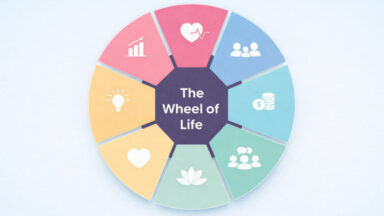
The Wheel of Life is a visual exercise that helps us assess how we feel in different areas: health, relationships, purpose, work, finances, among others. By completing it, we can identify which areas are balanced and which need attention. It is a practical tool to focus our energy more consciously and in alignment.
Explore More Self-Knowledge Tools On Gaia
On Gaia you’ll find a wide variety of content designed to support you in your self-knowledge process. There are series, documentaries, courses, and guided practices that cover all the topics we’ve discussed in this article: astrology, enneagram, meditation, tarot, personal development, and more. These resources are designed to help you go deeper into your inner world with clear, accessible, and high-quality information.
An excellent place to start is with the series Transcendence, which offers a comprehensive view of how mind, body, and consciousness are connected. It’s an introductory program that combines science, spirituality, and practical tools to help you begin to know yourself from a broader and more transformative perspective.
Integrating Self-Knowledge Into Everyday Life
Knowing ourselves doesn’t mean much if we leave it at the level of reflection. True value arises when we begin to bring that understanding into daily life: into how we make decisions, how we set boundaries, and how we respond when something makes us uncomfortable. Self-knowledge becomes alive when it influences our actions—not just our thoughts.
Integrating what we discover takes practice and patience. Sometimes it means making small adjustments, other times holding onto decisions that may not be comfortable. It’s not about getting it perfect, but about staying aware of when we stray from what we know is true for us—and choosing to return.
Over time, this internal work translates into a more honest relationship with ourselves. We learn to listen before reacting, to recognize when we need to pause, and to choose from a more conscious place. That is one possible closure for this journey: not arriving at a final answer, but continuing to inhabit the process with greater clarity and presence.