The Story of Mu, the Lost Continent of the Pacific
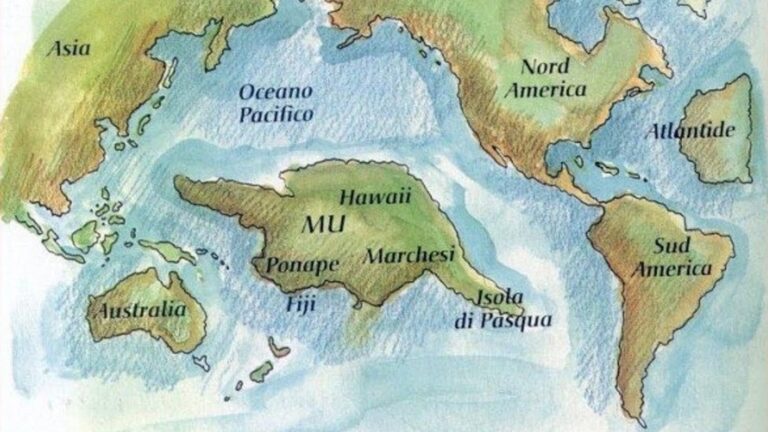
Mu was an ancient civilization that existed in a vast region of the Pacific Ocean, long before Lemuria or Atlantis. According to various traditions, it was a culture deeply connected with the energies of the planet and with a way of life centered on consciousness and balance. In this article, we explore what Mu was, its origins, evolution, and its role within the spiritual journey of humanity.
Table of Contents
- What Was the Continent of Mu?
- Origins and Evolution of Mu
- The Civilization of Mu and Its Main Characteristics
- Spiritual Society and Connection with the Divine in Mu
- Mu and Lemuria: Similarities and Differences
- The Fall of the Lost Continent of Mu
- The Legacy of Mu in Ancestral Cultures Around the World
What Was the Continent of Mu?
The Mu continent was a vast territorial expanse located in the Pacific Ocean, where flourished one of the oldest and least understood civilizations on the planet. Its existence dates back to a stage when Earth had a much subtler vibration, and life forms functioned in synchronicity with the energetic laws of the cosmos. Instead of building a society based on the material, the inhabitants of Mu cultivated a deep awareness of their connection with the whole.
Far from being an expansionist or technologically dominant culture, the Mu civilization represented a model that valued balance, introspection, and vibrational frequency as pillars of its existence. Daily life was organized according to natural cycles and the energetic perception of the environment. Every act carried a spiritual charge, from rituals to the simplest tasks, and each action was understood as a form of resonance with the universe.
This civilization has not left obvious physical traces, but its influence subtly persists in ancestral stories, symbols, and spiritual teachings that appear across different cultures of the world. The marks of its wisdom can be recognized in ceremonial practices and knowledge about energy that point to an ancient humanity, connected with the divine through vibration and intention.
Origins and Evolution of Mu
The origins of the island of Mu go back to a stage when Earth was just beginning to stabilize its energetic field. According to different accounts, its first inhabitants did not arrive in ships or by physical means, but rather descended as forms of consciousness from subtler planes. They manifested gradually, adapting their existence as Earth’s vibration became denser.
At first, life in Mu was predominantly etheric. The beings of this civilization communicated through frequencies, perceived their environment in an expanded way, and did not need complex material structures. Matter was not a limitation, but a transitory tool. Over time, they began to organize around energetic centers from which they sustained the balance of the planet.
The evolution of Mu was not focused on external development but on inner refinement. Their purpose was not to conquer or accumulate power, but to act as guardians of a stable frequency that would benefit all humanity. Their technology was based on vibration, geometry, and a harmonious relationship with the natural elements. They did not build to dominate, but to amplify consciousness.
In the series Initiation, available on Gaia, Mu is described as a key civilization at the dawn of human history. It is explained there how this culture functioned as a bridge between higher planes of consciousness and physical experience, preparing the way for the appearance of civilizations such as Lemuria and Atlantis.

The Civilization of Mu and Its Main Characteristics
The civilization of Mu developed in a state of constant balance between the physical and the subtle. Their way of life was not governed by structures of power or material hierarchies, but by collective vibration and respect for natural cycles. Everything in their society responded to an energetic logic, and their organization reflected a deep knowledge of the universal flow.
- Vibrational consciousness: The inhabitants of Mu lived guided by the energetic frequency of the environment. Every act was measured by its vibrational impact, not by its material result.
- Nonverbal communication: The transmission of information took place through vibration, mental imagery, or sensation. Spoken language was secondary or nonexistent.
- Temples as energetic nodes: The structures were not ordinary buildings but centers of alignment with the planetary energy grid. They functioned as anchoring points of consciousness.
- Direct relationship with the elements: They not only venerated nature but interacted with it consciously. Water, fire, air, and earth were living forces with which they collaborated.
- Horizontal organization: There were no permanent figures of authority. Decisions were made by group resonance, following the wisdom of the shared energetic field.
- Interdimensional mobility: Some accounts suggest they had the ability to move between planes of reality—not by technological means, but through expansion of consciousness.
- Collective memory: Knowledge was not stored in objects or texts, but in the vibratory field of the group. Each member could access the shared wisdom through inner connection.
Spiritual Society and Connection with the Divine in Mu
Spirituality was not an isolated aspect of life in Mu: it was the base on which the entire experience was built. There were no institutionalized religions or intermediaries between beings and the divine. Each individual was considered a direct expression of universal consciousness, and daily life was a constant practice of sacred connection.
Rituals did not follow dogma or tradition but were conscious acts of energetic alignment. Everything had a vibrational purpose: from the ways of inhabiting, to sounds and movements. Through breathing, visualization, and intention, the people of Mu cultivated states of deep unity with creation.
This connection with the divine was not experienced as a distant goal, but as a present reality. Living in Mu meant recognizing that each thought generated form, that every action was an extension of the spirit, and that all matter was an expression of energy. This understanding guided every aspect of their civilization, in perfect coherence between consciousness and form.
Mu and Lemuria: Similarities and Differences
Both Mu and Lemuria were deeply spiritual civilizations, born at a time when humanity was more connected to the subtle dimensions of existence. Both shared a worldview based on energy, resonance, and harmony with nature. However, their way of life and their purpose had different nuances that set them apart.
Mu represented a more etheric and contemplative state. Its society was centered on sustaining a stable planetary frequency, functioning as a point of global balance. Lemuria, on the other hand, was a civilization more developed on a structural level, with greater interaction with other cultures and a practical focus on the use of vibrational technologies.
While Mu prioritized silence, inwardness, and attunement with higher planes, Lemuria organized itself into cities and transmitted knowledge through spiritual schools. Mu was the energetic foundation, Lemuria the conscious expansion. Both played an essential role in humanity’s evolution, but from different levels of the same path.
The Fall of the Lost Continent of Mu
The disappearance of Mu was not the result of war or internal collapse, but of a change in the vibration of the planet. As Earth’s energetic field became denser, the civilization of Mu—whose existence was based on subtle frequencies—began to dissolve. Matter gained prominence, and the consciousness that inhabited that plane could no longer be sustained under the new conditions.
There is talk of tectonic shifts, tidal waves, and geological transformations that may have altered the surface of the Pacific Ocean, causing much of Mu’s territory to sink. However, beyond the physical causes, what occurred was a vibrational transition: a stage of human consciousness came to an end, giving way to a more material one, with new lessons to integrate.
Before its dissolution, many of its inhabitants managed to relocate to other regions of the planet, carrying with them the seed of their wisdom. Their legacy was not destroyed but distributed. Fragments of that memory were imprinted in the energy of different places, ready to be awakened by future cultures that could recognize that frequency.
The Legacy of Mu in Ancestral Cultures Around the World
Although the civilization of Mu disappeared as an organized structure, its influence is still alive in different ancestral cultures that preserve fragments of its knowledge. In many Indigenous traditions, especially from Asia, Oceania, and the Americas, there are symbols, myths, and practices that reflect a similar understanding of the world to that which existed in Mu. It is not a copy, but a vibrational echo that continues to transmit its essence.
The ceremonial use of the elements, the construction of temples in energetic points, and the conception of the human being as a channel of universal energy are common aspects between these cultures and the wisdom of Mu. Also, the idea that knowledge is not transmitted only with words, but can be activated internally through resonance. These similarities are not coincidences—they are vestiges of the same original source.
In a world that values speed and accumulation, the memory of Mu invites us to return to the essential: the connection with the energy that sustains all form and the wisdom of living in harmony with it. It is not about reconstructing the past, but about remembering a way of existence where the spiritual and the everyday were not separate. Mu leaves us with a silent but powerful teaching: when life is organized from inner coherence, balance is not a distant ideal, but a possible experience.
About the Author

The Orion War: History of a Stellar War

The Orion War was a cosmic conflict that involved several galactic civilizations fighting for control of an interdimensional portal in the Orion constellation. This confrontation had both physical and spiritual repercussions, affecting the evolution of multiple races and star systems.
In this article we explore what the Orion War was, its protagonists and its impact on our understanding of the Universe.
Table of Contents
- What Was the Orion War?
- The Origin of the Orion War
- The Forces Involved in the War
- The Development of the Orion War
- Impact of the Orion War on Earth
- The Legacy of the Orion War
What Was the Orion War?
The Orion War was an interstellar conflict that involved various galactic civilizations, fighting for control of an interdimensional portal in the Orion constellation. This portal was crucial for the balance of cosmic energies, and its control could determine the fate of many races and star systems. The draconian forces, known for their aggressive nature and advanced technology, attempted to dominate this portal by confronting a confederation of beings of light seeking to preserve universal harmony.
This confrontation did not only take place on the physical plane, but also had significant spiritual implications. The forces involved had the ability to manipulate the chakras of living beings, opening portals to other realms and dimensions. This control over subtle energies meant that the war had direct repercussions on the spiritual evolution of the souls involved, marking a struggle not only for stellar territories, but for the very destiny of universal consciousness.
In the series Initiation, available on Gaia, there is an episode titled Fighting for Universal Harmony that explores in detail the Orion War and its cosmic implications. There, Matías de Stefano explains how this conflict was a crucial point in the history of the universe, influencing the evolution of multiple galactic civilizations.
The Origin of the Orion War
The origin of the Orion War dates back to the first civilizations that inhabited this constellation, including the beings of the Lira system and the draconians of the Alpha Draconis system. These civilizations had very different philosophies and objectives, which generated tensions from the beginning. The Lirians, peaceful and spiritually advanced beings, sought to expand knowledge and harmony in the universe, while the draconians, with their inclination toward control and domination, sought to impose their will on other star systems.
The spark that ignited the conflict was the discovery of an interdimensional portal in Orion, a crucial connection point between various dimensions and planes of existence. This portal not only had strategic value, but was also a source of immense spiritual energy, capable of influencing the flow of consciousness and the evolution of souls. The struggle for control of this portal led to a series of epic battles that lasted for millennia, involving multiple races and civilizations that aligned with one side or the other.
The conflict escalated to unprecedented levels, affecting not only Orion but also other constellations and allied star systems. The intervention of the Galactic Federation, a coalition of diverse races and civilizations that promoted peace and balance, was fundamental in countering the draconian threat. This conflict, although devastating, also led to greater unification and collaboration among stellar races, laying the foundations for lasting peace and a deeper understanding of cosmic interconnectedness.
The Forces Involved in the War
The Orion War involved several powerful forces with different objectives and philosophies. The main actors were the draconians, the Lirians, the Orion group, and the Galactic Federation. Each group had its own motivations and strategies, which further complicated the conflict and increased its scale and duration.
-
Alpha Draconis and the Draco System
Alpha Draconis, also known as the Draco system, was the home of a race of beings known as draconians. The draconians were recognized for their warlike nature and their desire for control and domination. They were highly technological and strategic beings, using their advanced science to subjugate and control other star systems. Their hierarchical and authoritarian social structure allowed them to organize efficiently in their conquest campaigns.
The Draco system was not only composed of draconians but also of several subordinate races that had been conquered or had aligned with them out of convenience or coercion. This alliance provided them with considerable military strength, with combined resources and knowledge from various civilizations. The draconians, with their combination of military and technological power, represented a significant threat to peace and stability in the galaxy.
-
The Lira System and Its Inhabitants
The Lira system was known for its peaceful and spiritually advanced inhabitants. The Lirians valued harmony, knowledge, and spiritual development, and their society reflected these principles. They were masters in the use of energy and consciousness, which allowed them to live in a state of balance and prosperity. Their technology was aligned with nature and universal energy, promoting well-being and spiritual growth.
The Lirians were among the first to recognize the threat posed by the draconians and became key defenders in the Orion War. Their pacifist approach did not prevent them from fighting for justice and the protection of the most vulnerable. They formed alliances with other races that shared their values, creating a coalition of forces that opposed draconian expansion.
-
The Orion Group and Its Alliances
The Orion group was composed of various races and civilizations that inhabited the Orion constellation. These beings had a diversity of cultures and levels of development, but they united in the face of the common threat of the draconians. Some of these groups already had historical conflicts among themselves, but the urgency of the situation led them to form strategic alliances.
These alliances were based on the common interest of protecting their worlds and the stability of their region of space. Through cooperation, they shared technology, knowledge, and military strategies. This collaboration not only strengthened their resistance against the draconians, but also fostered greater understanding and respect among the different races and cultures within the Orion group.
-
The Galactic Federation and Its Role in the Conflict
The Galactic Federation was a crucial actor in the Orion War. This coalition of diverse galactic civilizations had as its main objective to maintain peace and harmony in the galaxy. Its structure included representatives from multiple races, each contributing their knowledge and resources to face common threats. The Galactic Federation acted as a mediator and defender, promoting collaboration and understanding among the different forces involved in the war.
During the conflict, the Galactic Federation provided logistical, technological, and military support to the races that fought against the draconians. Their combined forces and their focus on peace and justice were vital in countering draconian aggression. In addition, their intervention helped coordinate defense efforts and maintain morale among allied races, becoming a symbol of hope and resistance amid the chaos of the conflict.
The Development of the Orion War
The Orion War unfolded in several stages, beginning with small clashes between the draconian forces and the Lirians. These initial battles were mainly over the control of strategic resources and key positions within the Orion constellation. As both sides understood the magnitude of the threat they faced, they began to mobilize their forces and resources on a much larger scale.
Over time, the conflict intensified, becoming a total war involving multiple star systems. Battles were fought not only on the physical plane, but also on the spiritual one, as both sides attempted to manipulate energies and interdimensional portals to gain an advantage. The draconian forces, with their advanced technology and aggressive tactics, managed to conquer several important positions, but faced fierce resistance from the coalitions of Lirians and other allied races.
The intervention of the Galactic Federation was a crucial turning point in the war. With its help, the forces of light were able to reorganize and launch a series of offensives that changed the course of the conflict. These strategic campaigns not only recovered lost territories, but also significantly weakened the draconians’ ability to sustain their war effort. Eventually, the war culminated in a series of treaties and agreements that established a fragile but lasting peace in the Orion region.
Impact of the Orion War on Earth
The Orion War had significant repercussions on Earth, both physically and spiritually. During the conflict, various races involved in the war directly influenced the development of humanity, transmitting advanced knowledge and technologies that helped shape early terrestrial civilizations. In addition, many of the myths and legends about gods and celestial beings in different human cultures have their roots in the events and figures of the Orion War.
Spiritually, the war deeply affected the evolution of human souls. The manipulation of chakras and energies by both draconian forces and the forces of light left a lasting imprint on humanity’s collective consciousness. This cosmic conflict awakened in many humans a sense of purpose and spiritual mission, leading them to seek a deeper understanding of their place in the universe and their connection with other forms of life. This spiritual search continues to influence modern culture and spirituality, reflecting the lessons learned from this ancient confrontation.
The Legacy of the Orion War
The legacy of the Orion War manifests on multiple levels and continues to affect the cosmos today. One of the main legacies is the establishment of the Galactic Federation as a force of peace and balance in the universe. The war demonstrated the need for cooperation and unity among diverse stellar races, which led to greater collaboration and understanding throughout the galaxy. This legacy of unity and peace remains an aspiration and guiding principle for many civilizations.
Another important aspect of the legacy is the spiritual evolution of the races involved. The Orion War was not only a physical conflict, but also a battle for consciousness and spiritual development. The experiences and lessons learned during this conflict have been passed down through generations, fostering deep growth and transformation in the souls of those who participated directly or indirectly. This spiritual legacy continues to be a source of inspiration and learning for those seeking to understand the true meaning of universal harmony.
Finally, the Orion War left an indelible mark on the history of the universe, serving as a constant reminder of the dangers of domination and the importance of peace. The stories and knowledge passed down about this conflict continue to educate and warn new generations about the need for balance and respect among the different forms of life in the cosmos. This legacy is essential for preventing future conflicts and promoting a more harmonious and evolved universe.