What is Astral Projection?
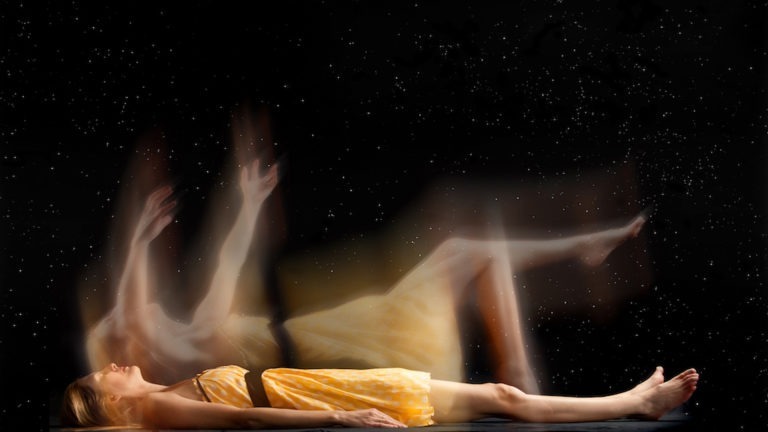
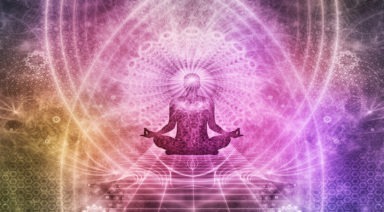
Call it what you like — dream body, astral body, energy body, Buddhist light body, Taoist diamond body, Egyptian ka, Tantric subtle body, Hindu body of bliss — and in Christianity, the experience of different “heavens,” i.e. “I know a man who was caught up to the third heaven. Whether it was in our out of body, I do not know,” from Corinthians 12:1-4. The subtle body is a universal human experience, and apparently part of our standard human design like toenails and kidneys. It is this subtle body that projects astrally and is active during unconscious and lucid dreaming; astral projection and dreaming often go hand-in-hand as “out-of-body” experiences, or OBEs.
The subtle body, when cultivated, can survive the physical body as a matrix for consciousness, and astral projection and lucid dreaming are part of spiritual training paths for subtle body cultivation. Neophytes confuse the subtle body with the soul or spirit, two additional aspects of multi-dimensional humans.
Out of Body Experiences and Astral Projection
The OBE can be intentional or involuntary, as with near-death events when people report finding themselves floating near the ceiling of their hospital rooms, perhaps observing medical staff attempting to revive them. Trauma, illness, or water and food deprivation, as with Native American vision quests, can trigger OBEs. Lucid dream states are opportunities for intentional OBEs. For the purposes of this article, OBEs may be spontaneous, and astral projection a conscious choice, though some would argue otherwise.
Essentially, the OBE begins with an experience of leaving the body and consciously observing it from a detached perspective. With practice and lucidity, awareness can be directed to locations or activities like flight. Yes, flight. If you’ve had flying dreams — literal flying, no 747 required — or being in the sky, you’ve had OBEs. Some say that we have regular OBEs during sleep, often hovering a few inches over our physical bodies.
Neuroscientists are puzzled — while the experience is no longer dismissed out of hand by medical professionals, science holds the view that OBEs involve neurological or brain dysfunction. After his own experience, Dr. Raymond Moody MD became interested in near death OBEs, and for decades interviewed hundreds of experiencers and collected data, defining common qualities of OBEs. Moody identified nine common elements of a near-death OBE — some experiencing all, some, only two or three.
Benefits of OBE
The tantrics mastered lucid OBE and dream states to overcome the fear of death by learning that we are not our “bodies.” They also discovered that the physical body can experience deep healing during OBEs — the mind can be tough on the body. And rather than losing time to practice meditation during sleep, yogis continued working through the night while the body rested.
Some athletes learn lucid dreaming to practice and visualize their game. By working in a dream or out-of-body, not only do they visualize, they have a “felt sense” of their practice, and can actually acquire the muscle memory for winning habits. Others benefit from the opportunity to explore past lives as well as accelerated personal development.

It is our energy, or subtle body that comes and goes from our physical form.
Astral Projection Methods
There are dozens of methods to learn conscious OBE and astral projection. There are two approaches — one is to keep the mind awake while the body falls asleep. It’s tricky — the mind wants to do what the body is doing. The goal is to take the body into deeper and deeper states of relaxation without drifting into unconsciousness. Yoga Nidra is one method. Once the body enters sleep state, practitioners simply “roll” out of their physical form.
Ancient yogis would tie two frogs together before sleep. Once tied, the frogs would continuously croak— a yogi would use the sound to anchor awareness as the body drifted into sleep, and either leave the body, or enter lucid dream states. If, during a dream, the yogi could no longer hear the frogs, he/she knew lucidity had been lost, and could “wake” again within the dream.
How to Astral Project/Travel
Monroe Institute Steps
Bob Monroe, founder of the leading research organization in the field of human consciousness called The Monroe Institute, penned a body of work titled “Journeys Out of the Body” in 1971 in which he provides a detailed outline for how to astrally project one’s self in seven steps:
- Step 1: Relax, both physically and mentally.
- Step 2: Enter a hypnagogic state, or half-sleep.
- Step 3: Deepen the state by prioritizing mental sensation over physical sensation.
- Step 4: Pay attention to the presence of vibration in your environment, which becomes apparent in a state of deep attention.
- Step 5: Incur the vibration in your physical body, and relax into its presence. The purpose of this is to gently jiggle the subtle body out of the physical body.
- Step 6: Focus your thoughts on leaving the limbs and the torso, and try to do so one at a time.
- Step 7: Known as “lifting out,” focus on effortlessly drifting out of your physical body.
The Astral Projection Rope Technique
From the work of Robert Bruce, founder of the Astral Dynamics movement, the rope technique is regarded one of the most accessible astral projection methods.
Step 1: Relax the physical body by visualizing each muscle.
Step 2: From your space of relaxation, enter a vibrational states; this should feel like an amplified version of a cell phone’s vibration mode pulsations coursing through the body.
Step 3: Imagine a rope hanging above you.
Step 4: Using the astral, or subtle, body, attempt to hold on to the rope with both hands. The physical body remains completely relaxed.
Step 5: Begin to climb the rope, hand over hand, all the while visualizing reaching the ceiling above you.
Step 6: Once you are aware of your full exit of the physical body, you are able to explore the astral plane.
Lucid Dreaming Techniques
Again, there are numerous lucid dreaming techniques. Some are designed to train the sleeper to wake within the dream, others offer methods of staying lucid while letting the body fall asleep.
A Nootropic Approach
Yes, it’s sounds weird. Nicotine has specific actions on brain chemistry — but no, it’s not about smoking. Considered a cognitive enhancer, nicotine is gaining fans among biochemical brain hackers.
Many, using nicotine patches to quit smoking, have inadvertently discovered what happens when they forget to remove a patch before sleep. Nicotine can induce hyper-realistic, but bizarre dreams that are so outrageous that many simply say to themselves, “Omg. This MUST be a dream. It’s too nuts to be anything else.” And voila — lucidity is attained. This is not an endorsement of the method, as many report nightmares when using nicotine.
Lucid Dreaming With Habit and Repetition
We attain lucidity the instant we recognize we’re in a dream state. Some people train by asking themselves, several times a day for days or weeks, “is this a dream?” The question eventually gets stuck in the place songs and jingles get stuck and are hard to unstick — things like “Afternoon Delight” by the Starlight Vocal Band. You know what we’re talking about.
The premise is that the question begins to habitually repeat by itself, and that eventually the mind will ask during a dream. When the dreamer answers, “why yes, this IS a dream!” they achieve lucidity.
The best opportunities for becoming lucid within a dream are during REM (rapid eye movement) sleep. This stage happens in the first two hours after we fall asleep and before we wake up. By waking and going back to sleep during the night we increase REM sleep time. Some use the sleep/wake method by setting interval alarms during the night, getting up for a few minutes, and going back to sleep with an intention of keeping the mind awake. If awakened during a dream, immediately go back to sleep — if possible, re-enter the dream with lucidity.
About the Author

Dowsing: What It Is, How It Works, and What It’s Used For

Dowsing is a technique that allows one to detect vibrations or subtle fields present in people, objects, and places. It relies on the natural human ability to perceive energetic frequencies that escape the physical senses but can influence our well-being and our environment.
In this article, we explore what dowsing is, how it works, and how it can help us understand the relationship between mind, energy, and matter.
Table of Contents
- What Is Dowsing?
- Brief History and Evolution of Dowsing
- How Dowsing Works and What Energy It Detects
- Uri Geller and His Relationship With Dowsing
- Tools Used in Dowsing
- Applications of Dowsing in Everyday Life
- Everything Is Energy: Understanding the Basis of Dowsing
What Is Dowsing?
Dowsing is based on the idea that everything in the universe emits a vibrational frequency that can be perceived by the human body. Using tools like pendulums or rods, it is possible to translate this energetic information into physical movements that reveal data about the state of a person, a space, or a situation. This technique starts from the principle that we are sensitive receivers of subtle fields and that this perception can be trained for practical or introspective purposes.
The body acts as a bridge between the visible and the invisible: when it is in a receptive state, it can register signals that bypass logical reasoning and instead reach us through intuition. The movements generated in dowsing tools—such as spins, oscillations, or vibrations—are not caused by the object itself, but by an interaction between the energetic field of what is being consulted and the sensitivity of the dowser.
In addition to its use in the search for water, minerals, or lost objects, dowsing is also used to explore emotional, physical, or spiritual aspects of a person. It serves as a gateway to a more subtle dimension of reality, where mind, energy, and consciousness intertwine in a deep dialogue.
Brief History and Evolution of Dowsing
The use of dowsing dates back to ancient civilizations that used rods or Y-shaped branches to locate underground water or minerals. In cultures such as the Chinese, Egyptian, or Roman, it was acknowledged that the Earth emitted energetic currents that could influence people’s well-being and the harmony of spaces. Over time, this practice took on different approaches depending on the spiritual and scientific traditions of each era.
During the 19th and 20th centuries, dowsing began to be systematized and studied as an energetic discipline. More precise instruments were developed, such as the dowsing pendulum and vibrational measurement scales, which allowed the technique to be applied in fields as diverse as health, geobiology, and the exploration of natural resources. Today, it continues to be used as a complementary tool to explore the relationship between energy, consciousness, and matter.

How Dowsing Works and What Energy It Detects
Dowsing works through the interaction between the energetic field of the environment and the sensitivity of the dowser. When a person enters a relaxed state of attention and holds a tool such as a pendulum or a rod, their body acts as an amplifier that responds to subtle stimuli. The movements produced in the instruments are not random; they reflect an unconscious response that can be interpreted as “yes,” “no,” or as a direction to follow.
The energy detected in dowsing corresponds to vibrations present in everything that exists. These may be related to a person’s vital state, the geobiological energy of a piece of land, the vibrational quality of food, or even emotional imprints that persist in a space. The technique helps identify variations in these fields, aiding in more balanced and aligned decision-making.
The key to how dowsing works lies in its ability to translate the invisible into observable signals. It is not a form of divination, but rather an energetic reading based on a fundamental principle: everything is made of energy, and it is possible to tune into it by training perception and using the right tools.
Uri Geller and His Relationship With Dowsing
Uri Geller, world-renowned for his psychic abilities and telekinetic phenomena, also explored dowsing as a way to understand the energetic field that surrounds us. In the series Uri Geller’s Legacy of Paranormal Experiences, available on Gaia, his experiences with this practice are explored in depth—from its use in the search for deposits to its role in his spiritual transformation.
In the episode From Dowsing to Spirituality, Geller reveals how this technique was key to opening new dimensions of perception in his life.
Tools Used in Dowsing
Although energetic perception can be developed without instruments, many people use tools that amplify and translate subtle impulses into physical signals. These tools hold no inherent power but function as extensions of the operator’s field of consciousness. Each one serves a specific purpose and can be adapted to different types of energetic inquiry.
- Dowsing pendulum: A small mass suspended by a thread or chain. It moves according to the energetic vibrations of the environment and provides simple answers (yes, no, maybe).
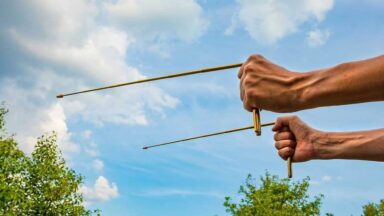
- L-shaped rods: Two metal rods bent at right angles. They are used to explore physical spaces and detect energetic alterations in a location, such as geopathic stress or underground currents.
- Y-shaped rod (or forked stick): Traditionally used to find underground water. The tip lowers when the operator approaches a source or flow.
- Aurameter: A rod with a spiral or sphere at the tip. It is used to measure the energetic field (aura) of people, animals, or objects.
- Biometer or Bovis scale: A numerical scale that measures the “energetic vitality” of something. It helps determine whether an energy is high, low, or neutral.
- Witnesses or energetic samples: Objects or photographs that represent what is being searched for. They help focus the search by acting as a point of connection with the target’s energy.
- Dowsing charts or bases: Templates with symbols or geometric shapes. These are placed under the pendulum to guide and refine responses.
Applications of Dowsing in Everyday Life
Dowsing is not only used in spiritual or therapeutic contexts, but also in practical aspects of daily life. Thanks to its ability to detect energetic imbalances, it is used as a tool for guidance, diagnosis, and harmonization at both a personal and environmental level.
- Energetic health: It can be used to identify blockages or imbalances in a person’s energetic field. This helps guide complementary healing practices.
- Food selection: Dowsing helps evaluate the vibrational charge of foods before consuming them, allowing for choices that are more aligned with physical well-being.
- Space harmonization: It is used to detect areas with dense energy in the home or workplace. Measures can then be applied to restore balance to the environment.
- Searching for objects or water: Traditionally, it has been used to find lost objects or underground water sources. The tool acts as a sensor that responds to energetic traces.
- Decision-making: Some people consult dowsing when choosing between important options. The pendulum, for example, may reflect which alternative is more aligned with the person consulting.
- Evaluation of objects or crystals: Dowsing allows the energy of amulets, crystals, or ancient objects to be measured, helping determine whether their frequency is beneficial or needs cleansing.
Everything Is Energy: Understanding the Basis of Dowsing
The foundation of dowsing lies in a fundamental understanding of the universe: everything is made of energy. Beyond visible matter, every being, object, and place emits a unique frequency that can be perceived by those who refine their sensitivity. This energy is not mystical or exclusive to spirituality; it is part of the invisible fabric that sustains physical reality.
When a person trains their ability to perceive these subtle fields, they can access a deeper dimension of the world around them. Dowsing is a tool that facilitates this access, acting as a translator between the energetic and the tangible. By detecting vibrations, it allows for more conscious decision-making, the harmonization of environments, and a deeper understanding of the connections between body, mind, and surroundings.
In the series Superhuman: The Invisible Made Visible, available on Gaia, cases and experiments are presented that demonstrate the power of the mind to interact with energy. Through scientific research and real-life experiences, the series offers a fascinating look at our perceptual abilities and how they can be trained to expand our understanding of reality.