Have Recent Solar Flares Opened Energy Portals?

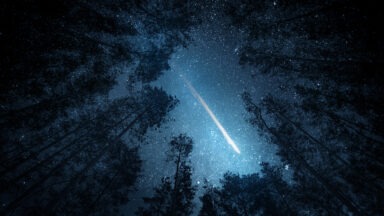
On October 28, 2021, a massive solar flare unleashed a blast of charged particles in Earth’s direction.
This geomagnetic storm resulted in a display of stunning auroras thanks to our planet’s protective magnetosphere. But did this powerful solar event also open temporary energetic portals?
On Oct. 28, a Category 3 geomagnetic storm erupted from the Sun’s surface reaching earth a few days later. This classification comes from the national oceanic and atmospheric administration’s space weather scale.
A level 3 geomagnetic storm is considered strong and can result in minor disturbances to high-frequency radio signals and low-frequency radio navigation. It also leads to auroras visible at much lower latitudes than usual, including as far south as Oregon and even Illinois.
Matias De Stefano, host of the Gaia series Initiation, happened to be in Oregon during this profound solar event.
These storms from the magnetic field of the Sun affect all the planets around, and of course when they hit Earth, they change the pattern of the magnetic field of the planet,” De Stefano said. “So, that opens portals all the time because it moves the energy of the planet and makes the geometrical patterns have to restore and readapt to something new.”
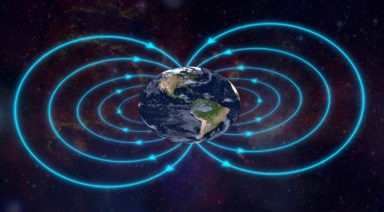
In 2012, NASA published a paper titled, “Hidden Portals in Earth’s Magnetic Field,” in which it explained that a scientist had discovered what the space agency refers to as x-points, or portals where the magnetic field of the Earth connects to the Sun.
According to Jack Scudder, the lead physicist who discovered these portals, this phenomenon creates an uninterrupted connection to the Sun‘s atmosphere 93 million miles away. But what effect does this have for us here on Earth?
“When these solar flares occur, everything is much more sensitive and faster. The best thing to do is to be perfectly aligned with the positive and negative in our body so we can be a channel. And that means to be meditating and discharging all this energy going toward the Earth or the portal we’re working with,” De Stefano said.
Earth typically experiences periods of heightened solar activity in 11-year cycles, and scientists are predicting a ramping up of solar activity in the coming years, leading to the next solar maximum in July 2025. Is this a cause for concern?
“If it goes straight to us, of course it could create many problems in communications, the internet, and technology of the planet— satellites could shut down,” De Stefano said. “Of course we could be concerned about that, but I wouldn’t be really worried, I would just get prepared for that in case, like having food and all the normal things for when something happens that you should take care of. But I wouldn’t really get worried about something terrible happening because this happens every 11 years.”
What else can we learn from these solar flares and the portals they open on Earth?
“These cycles that we are living — that the Sun is living — is something that injects energy into the planet. The solar flares that will arrive in 2025 will be much stronger for us than the previous ones, so [there will be] a lot of new energy that could help us to build new philosophies, new civilizations, new technology — many things could change if we know how to receive them,” De Stefano said.
About the Author

Science Says Wormhole Travel is Real; Can We Use it for Exotic Propulsion?

Once believed to be sci-fi fantasy, new research suggests we may be able to achieve interstellar travel using wormholes as shortcuts through spacetime.
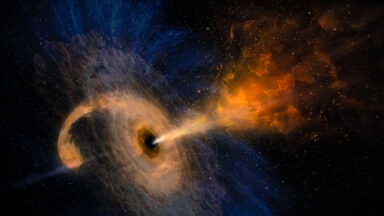
Recently, physicist Pascal Koiran at Ecole Normale Supérieure de Lyon in France published a pre-print study detailing the potential that matter could enter the event horizon of a black hole and pass through a wormhole and exit out the other end intact. Though still highly theoretical, wormholes are believed to be incredibly unstable as they exist as a tunnel between a black hole and a white hole in another part of the universe.
But because nothing, including light, can escape a black hole once it has crossed its event horizon, physicists have believed that matter would need to somehow enter the wormhole outside of the event horizon in order to safely pass through.
Dr. Simeon Hein, director of the Institute for Resonance, explains the mind-bending physics of this theoretical phenomenon.
“So the idea people were beginning to think, ‘well, what happens to the matter and energy that gets condensed and condensed into a black hole?’” Dr. Hein said. “The idea was that it had to be ejected somewhere else beyond that point in space. And that became the idea of a wormhole to another point in spacetime where all the matter and energy would be ejected from the black hole to conserve this idea of symmetry which is the foundation of modern physics — that there’s kind of a basic symmetry to the universe. And so the other side of the wormhole is a white hole.”
If wormholes have been conceptualized by theoretical physics for decades, what is so novel about the mathematics proposed in this recent paper?
“Physicist Pascal Koiran in France, he looked at another way to measure what’s going on in the mathematics of black holes. He used a different metric than Einstein would have used because back in the 1950s, two different physicists, David Finkelstein and Sir Arthur Eddington of the Royal Society in the UK, both proposed that there was this point of no return in the black hole where once you got past a certain point, it was no longer symmetrical, you couldn’t leave anymore, the so-called Schwarzschild radius,” Dr. Hein said.
“Past this point, you would just keep getting more compressed and you would have to go through the wormhole. So, using the so-called Finkelstein-Eddington metric — and a metric, by the way, is kind of the idea of a standard unit of measurement, a standard unit of anything: speed, direction, or position — using this measurement Koiran was able to show that it’s actually more stable than you think; that there is some stability even at the highest level of gravitational compression in a black hole. This would suggest that moving through it, maybe something really would survive.”