Fitness App’s Heatmap Exposes Secret Government Military Bases

The tables have been turned as governments are starting to see how intrusive cellular data collection can be, now that a fitness app has exposed secret military bases around the globe.
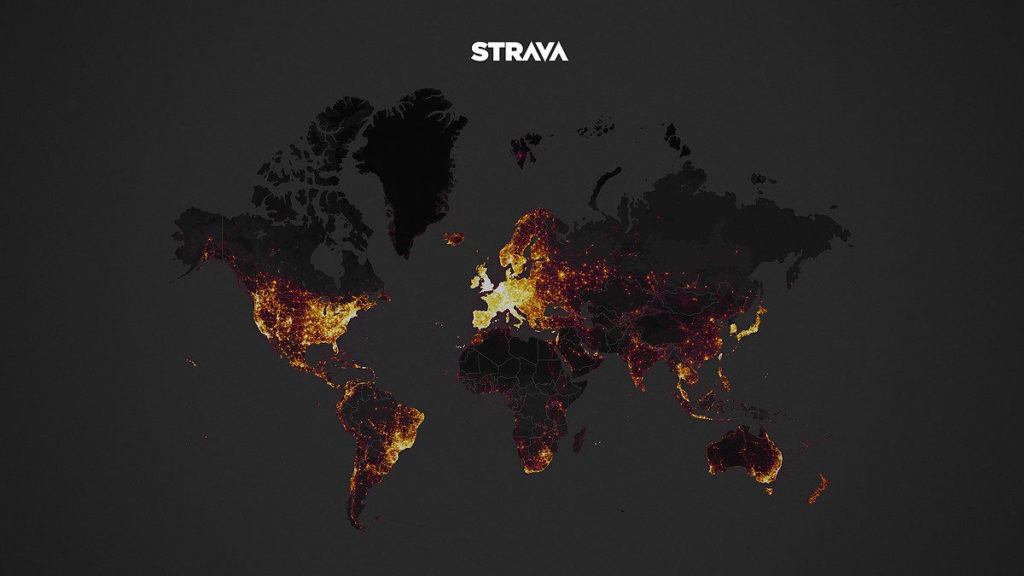
Strava, an app that has set its sights on becoming a fitness social media network, has recently come under fire for uploading a global heatmap of its users’ activity.
The map has exposed patrol routes as well as secret underground tunnels and bases that have been undisclosed to the public or unable to be viewed on satellite imaging from Google Earth.
Conspiracy theorists are scavenging the heatmap in attempts to discover undisclosed bases. Some online sleuths believe they’ve found evidence of potentially secret outposts located in and around Antarctica, Greenland, and the Giza pyramids.
The intention behind Strava’s app is to create an engaged community of athletes who use each other’s training data to learn and improve their own routines. Users can follow professional athletes or peers to discover new training techniques and regimens, while contributing their practices to a communal forum.
But unless you know to turn off the location services on the app after its downloaded, it will automatically track and upload your movements to its server. Strava hasn’t said how many users have downloaded its app, though it has conceded that it gains roughly a million new users every 45 days with 8 million activities uploaded each week.
This is how the massive, global heatmap was compiled, by collecting the data of both users who were aware of its function and, clearly, quite a few who were unaware. Strava doesn’t make it easy to opt-out of the function that uploads your data, either. One must dig somewhat thoroughly and turn off four different settings to disable all tracking.
The app touts its real-time tracking ability as a safety feature for runners and cyclists who want to share their location with up to three contacts in the event of an emergency. But the flip side of this is that strangers are able to see other users running routes, even with stricter privacy settings, unless tracking data is completely turned off.
One of the main purposes of the app, however, is to acquire “kudos” much like Facebook or Instagram likes. This encourages users to upload data of their whereabouts and routes taken during exercise, while also exposing their routines to just about anyone.
While there are certain features to block out the beginning and end-points of a user’s route, this metadata can be just as intrusive, especially if it’s a route that’s run consistently.
It seems that our newest technological advents are becoming more and more intrusive in our obsession with social media and fitness tracking, now for both the state and the individual.
About the Author

TikTok Users Found CIA Remote Viewing 'Gateway Experience,' Made it Go Viral

Why is a younger generation of truth seekers suddenly obsessed with a long declassified military report? “The Gateway Experience” has gone from relative obscurity to a viral hit.
The social media platform TikTok has seen a viral hit from an unlikely source, a 1983 Army Intelligence report called “The Analysis and Assessment of Gateway Process” details the technique to reach higher consciousness by syncing the hemispheres of the brain. Declassified nearly 20 years ago by the CIA the report has suddenly gained interest from TikTokers, with more than a million views and counting. Many young TikTokers are not only sharing news of the Gateway Process but also their experiences trying to use it. So what’s the full story?
Often mistakenly reported as a CIA document, this decades-old report was actually written by an Army Intelligence officer. The Gateway Process, part of the Gateway Program, was run by Bob Monroe at the Monroe Institute, which many remote viewers went through as a part of their training. What was the objective of the Gateway Program and how was it related to remote viewing?