Healing Frequencies of the Ancient Solfeggio Scale

Early in the 11th century, an Italian Benedictine monk, Guido of Arezzo, was looking for ways to teach melodies and harmonies to monastic choirs. One of his methods was a mnemonic tool, called the “Guidonian Hand.” Notes were associated with places on the fingers and palm. Once mastered, a choirmaster could point to his hand to inform singers of the next note. This was a new way to teach music — but Brother Guido continued to innovate.
Finding a way to express a musical scale, he created staff notations to teach chants and hymns. Guido’s original notations were “UT RE MI FA SOL LA,” derived from the first syllable of each half-line of the ancient “Hymn to Saint John the Baptist,” descended from an even more ancient work by Horace, an 8th century BC Roman poet.
This scale of six notes (C, D, E, F, G, A), the ancestor of our “so re mi fa so la ti do,“ evolved into the modern diatonic scale after “UT” became “DO” in the 19th century, and “TI” (B) was added later. “Solfeggio” is based on the word “solfège,” the name for this notation method of teaching pitch and sight singing.
Solfeggio Healing Frequencies
Gregorian chants have a measurable influence on human psychology and physiology. Those who perform the chants experience the lowest heart rates and blood pressure of the day while singing, according to Dr. Alan Watkins, a neuroscience lecturer at Imperial College, London. Other research suggests that singing the ancient compositions relieves fatigue and alleviates depression. Scientists have also observed that monastic singers require much less sleep; as little as two hours a day.
Solfeggio Geometry and Cymatics
Cymatics is the science of observing the effects of sound and frequency on matter usually in the form of liquid or powder. The term was coined by Swiss scientist Hans Jenny, who used specialized equipment that allowed a viewer to observe shapes formed in a medium under the influence of sound wave frequencies.
A cymascope study for SomaEnergetics, a company specializing in education and equipment for sound therapy, recorded cymatic images of each of the Solfeggio frequencies. Each frequency image contained “nodes” and “antinodes,” or the tops and bottoms of visible standing sound waves.
Counting the antinodes, the researchers discovered discovered that most of the Solfeggio frequencies, precisely produced by tuning forks, are “divisible by 3, 6, and/or 9. Any whole number divisor of 72 carries a mathematical relationship between phi and certain frequencies; 12, 9, 8, 6, 3, and 2 all work.” 12, 9, 6 and 3 all have special significance in many number-based esoteric systems. And coincidentally, the hz frequency numbers (396, 417, 528, 639, 741, 852) can all be reduced to one of these numbers (369 = 18 = 9, 417 = 12 = 3, 528 = 15 = 6, 639 = 18 = 9, 741 = 12 = 3, 852 = 15 = 6).
Nikola Tesla said, “If you only knew the magnificence of the 3, 6 and 9, then you would have the key to the universe.” The researchers added that distortions in the images were the product of ambient background noise, but the structure and geometry of each frequency is apparent in the images.
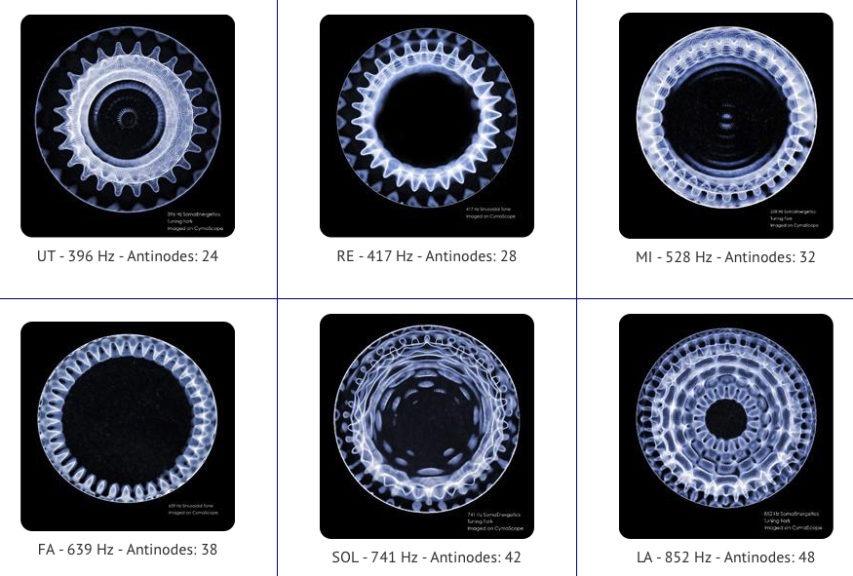
Image courtesy of somaenergetics.com.
Benefits of the Solfeggio Frequencies
Dr. Joseph Puleo, a physician and herbalist, began exploring the Solfeggio in the 1990s. He developed a theory that each of the six frequencies carried precise characteristics, and that the tones could be used therapeutically.
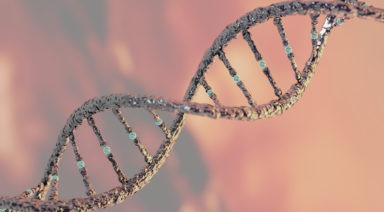
In 1988, Biochemist Glen Rein, Phd, converted and recorded Solfeggio scale Gregorian chants to scalar audio waves. The results were played to test tubes containing DNA. By measuring UV light absorption, Rein could document the effect of the music on DNA. He also compared the chants with other forms of music, including rock. While rock music had little or no influence, the chants caused a marked increase of light absorption, up to nine percent, leading Rein to conclude that Solfeggio scale sound frequencies cause resonance in DNA, and may have healing properties.
Since then, others have explored the healing potential of the Solfeggio frequencies. According to an article in Anti-Aging Medical News (Winter 2006), pulsed frequencies had a positive impact on osteoporosis. In another study, snails exposed to a range of frequencies, including some in the Solfeggio range, became more focused and active compared to a control group. “It was evident that exposure enhanced the creative capacity of the brain in snails,” the author wrote.
A Japanese study published in 2018 examined the stress reducing effect of 528 hz (MI or E) on the endocrine system. The researchers concluded that 528 hz music has “an especially strong stress-reducing effect, even after only five minutes of exposure.”
Using the Frequencies
Youtube has countless Solfeggio meditations that integrate the frequencies with music — over a million pages were returned in a Google search on “Solfeggio meditation.” Some websites offer expensive, specialized equipment — others offer precisely calibrated tuning fork sets. Some health practitioners strike the forks, then place them on specific acupuncture points and meridians while others create “sound baths” with gongs and singing bowls tuned to specific frequencies.
Someone wishing to experience the Solfeggio frequencies can spend a little or a lot, but a Youtube search and a good pair of headphones may be the best entry point for exploring the Solfeggio frequencies.
Solfeggio Frequency Characteristics
396 Hz — Releases Fear
417 Hz — Eases and Initiates Change
528 Hz — Healing and DNA Repair
639 Hz — Heals Relationships
741 Hz — Finding Creative Expression and Solutions
852 Hz — Spiritual Homecoming
About the Author

The 10 Most Used Quartz Crystals: Meaning and Properties
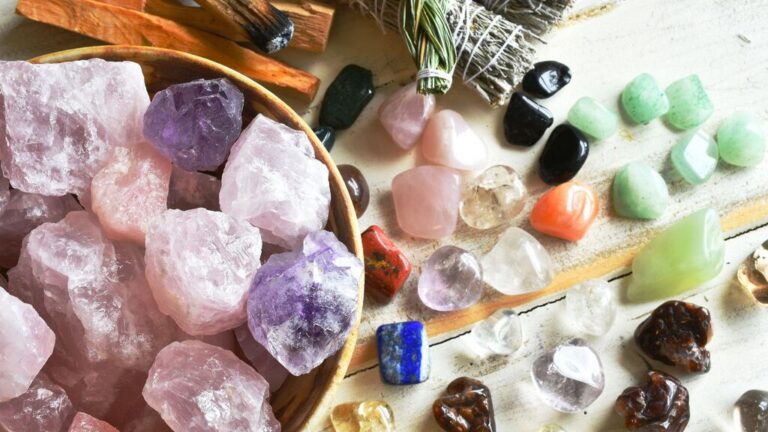
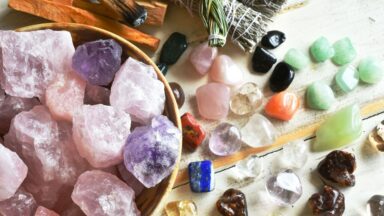
Perhaps quartz crystals have been catching your attention for some time. You see them on social media, in stores, in someone’s home, and you feel like starting to use them, but you do not really know where to begin. It is normal: there are many of them, each one with its name and its reputation, and so much information all at once can overwhelm more than help.
In this article, we explore the ten most used quartz crystals: what each one means, what properties are attributed to it, and what it is usually used for, so that you can take your first steps with clarity.
Table of Contents
- What Quartz Crystals Are and Why They Are Used
- The 10 Most Used Quartz Crystals and Their Meanings
- Clear Quartz: Clarity and Amplification
- Rose Quartz: Love and Tenderness
- Amethyst: Mental Calm and Intuition
- Citrine: Joy and Abundance
- Smoky Quartz: Grounding and Letting Go
- Tiger’s Eye: Courage and Firmness
- Green Aventurine: Prosperity and Serenity
- Carnelian: Vitality and Motivation
- Agate: Balance and Stability
- Rutilated Quartz: Unblocking and Momentum
- How to Choose a Quartz Crystal for Your Intention
- How to Use Quartz Crystals in Everyday Life
- How to Cleanse and Charge Quartz Crystals Before Using Them
- How to Integrate Quartz Crystals into Your Personal Path
What Quartz Crystals Are and Why They Are Used
Quartz crystals are minerals that form in the Earth over a very long period of time, and perhaps that is why they feel so special when you hold them in your hand. They are not just pretty stones: their color, their shine, and their natural shapes made many people perceive them as capable of transmitting something more than a simple visual impression.
Over time, that perception began to be organized into more concrete meanings. Some stones were associated with calm, others with protection, love, clarity, strength, or healing. Thus, from experience, intuition, and repeated observation, the idea gradually formed that each quartz crystal holds its own energy, capable of resonating with different inner states or accompanying different personal processes.
What is curious is that very different cultures, very distant from one another, came to attribute similar meanings to them. In Egypt, among the Indigenous peoples of the Americas, in China, or in India, stones and crystals were used to protect, heal, harmonize, or connect with the sacred. Each tradition developed its own way of understanding them, but many coincided in seeing them as allies for sustaining an intention or strengthening the bond with the spiritual.
This bond between crystals, energy, and intention is also explored in the series Crystals: Healing, Manifestation & Alchemy, available on Gaia. Through different perspectives, the series delves into why these stones have been valued by so many traditions and how they can accompany processes of consciousness, healing, and inner transformation.
The 10 Most Used Quartz Crystals and Their Meanings
Each quartz crystal has its own character and specialty. Knowing its meaning and what it is used for is what allows you to choose with intention, according to what you truly need. These are ten of the most used, ordered from the most essential to the most specific.
1. Clear Quartz: Clarity and Amplification
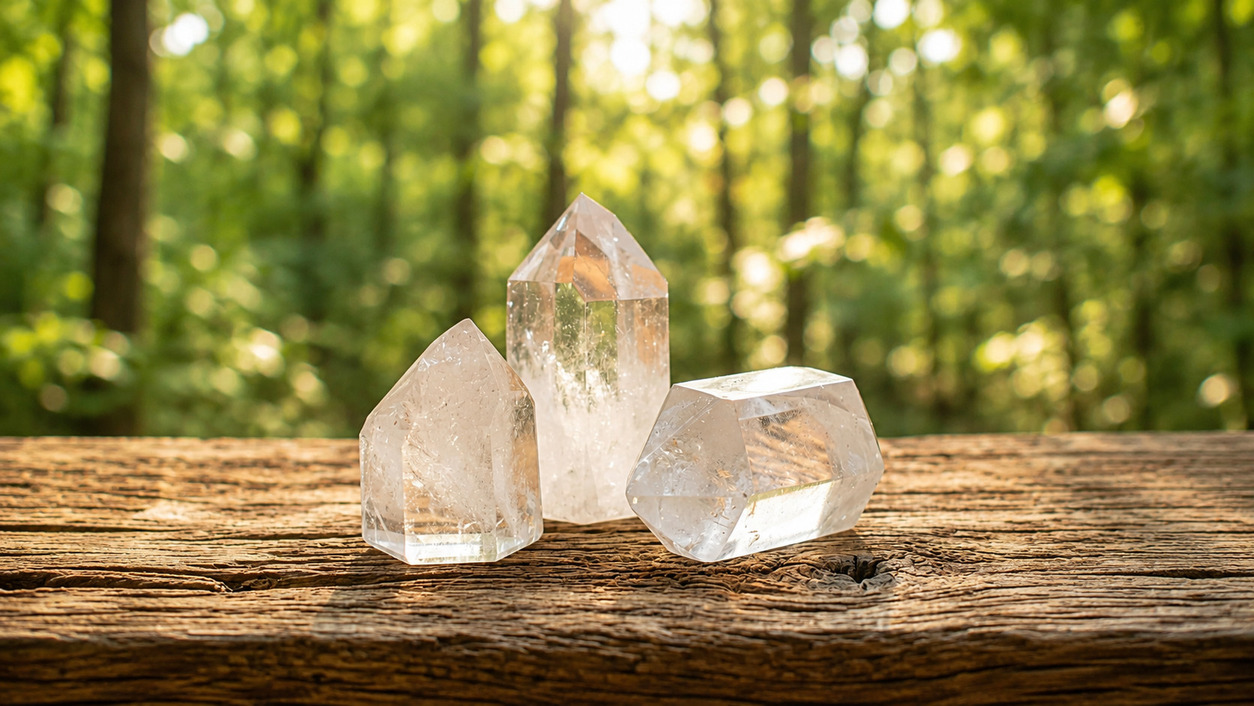
If you had to start with just one quartz crystal, it would be this one. Clear quartz is known as the master crystal because it amplifies and clarifies: it takes the energy of what is near it and strengthens it, like a lens that focuses light. It is associated with mental clarity and with the ability to sort through what you feel when everything seems confusing.
That is why many people use it to accompany meditation, sustain a specific intention, or simply return to their center on a busy day. If you do not know where to enter the world of quartz crystals, it is a safe starting point: it combines well with any other and is never unnecessary.
2. Rose Quartz: Love and Tenderness
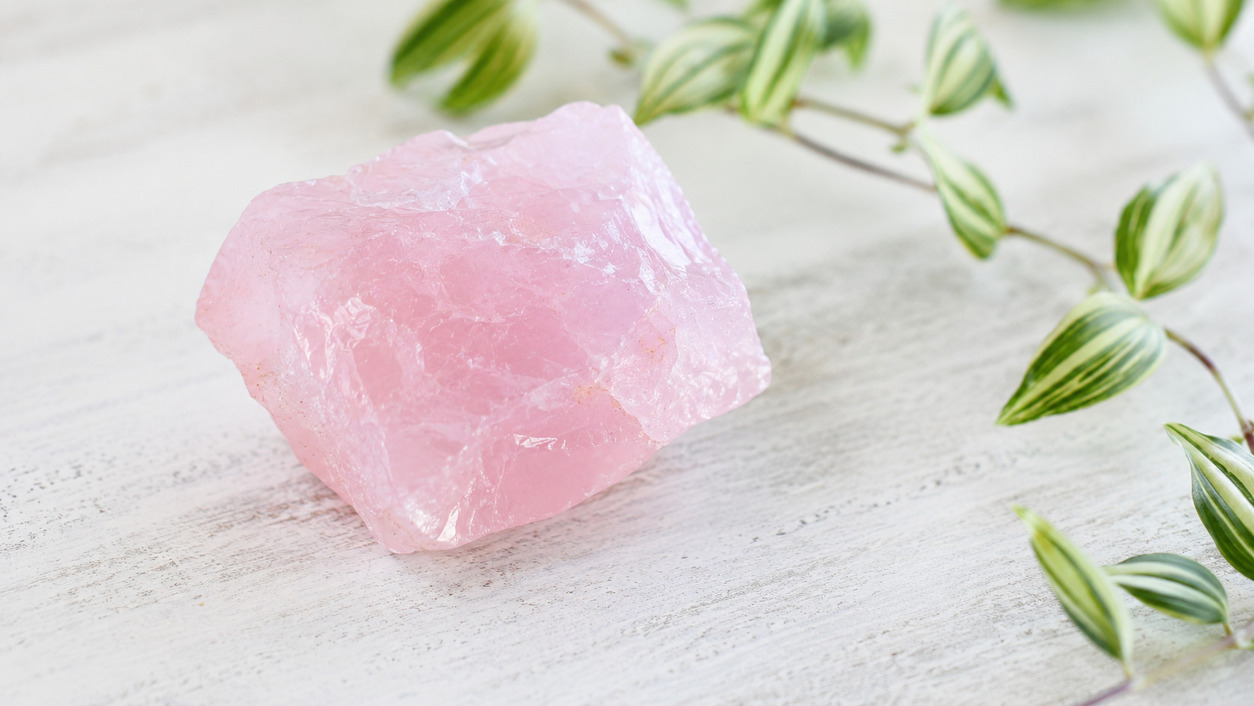
Few stones are associated with love as quickly as rose quartz. Its energy is soft, almost maternal, and it is linked to the heart in all its forms: love toward others, but above all the one that is sometimes most difficult, the love you have for yourself.
It is said to soften emotional pain, calm anxiety, and open space for tenderness. It is often chosen after a breakup, during periods when you are being especially hard on yourself, or when you notice that you are treating yourself more harshly than you deserve. Keeping it close, in the bedroom or on your chest while resting, is a way of reminding yourself that you deserve the same care you give to others.
3. Amethyst: Mental Calm and Intuition
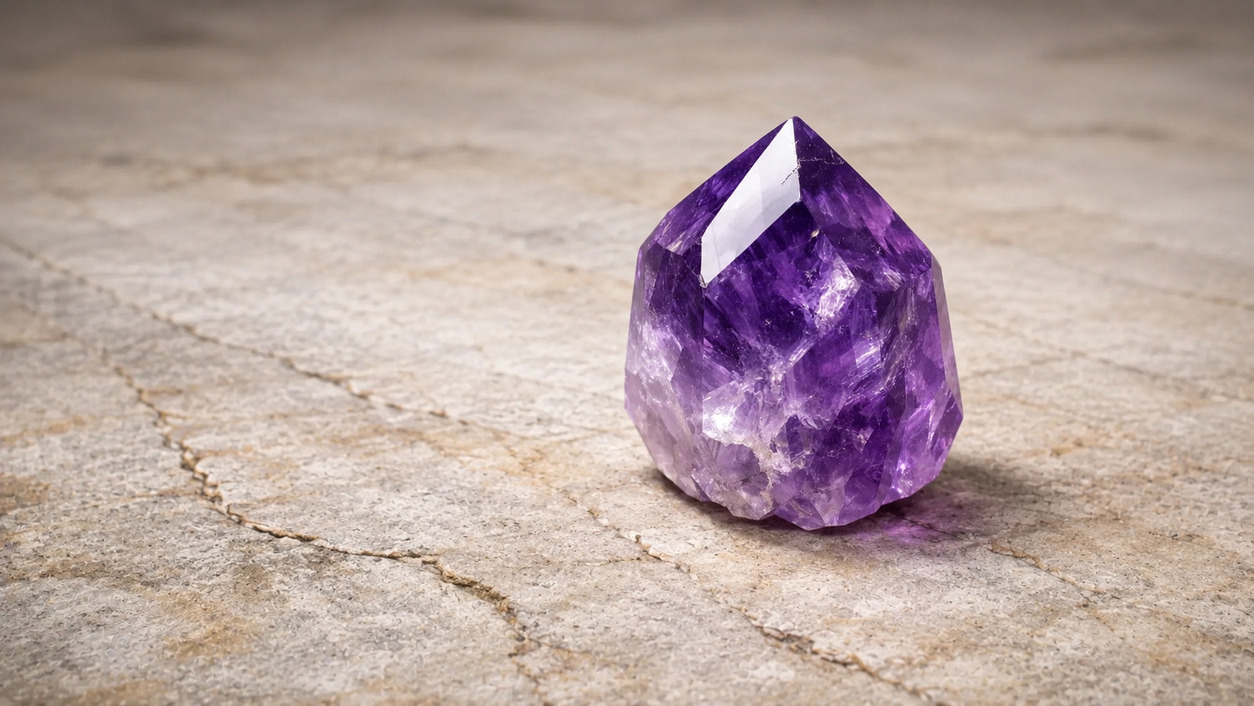
Its violet color already suggests what it is about: it is the tone that many traditions associate with the spiritual and the deep. Amethyst is related to mental calm, intuition, and connection with more subtle planes, and it is said to help quiet the noise in the mind in order to listen to what haste usually covers up.
That is why it is one of the favorites for meditation, for accompanying rest when it is hard to disconnect, and for those moments when the mind cannot stop going in circles. If you feel that you live too much toward the outside and need to reconnect with your inner world, it is a good ally.
4. Citrine: Joy and Abundance
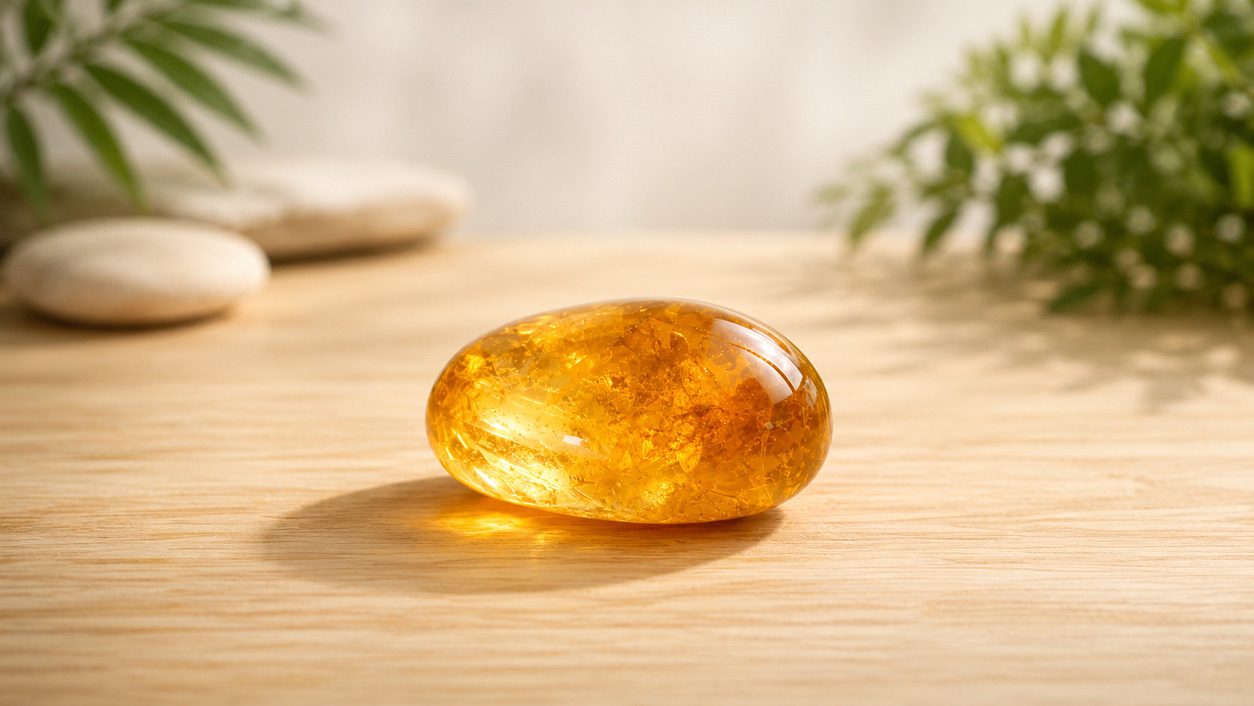
Think of the clarity of the sun coming through the window: that is, more or less, the energy of citrine. Its golden yellow tone connects it with joy, confidence, and abundance, and that is why it is sometimes called the stone of success.
Rather than attracting money by magic, what is attributed to it is the power to awaken optimism and the drive to go after what you want. It is a quartz crystal for times of new projects, for when you start something, or when your mood is low and you need to reconnect with your enthusiasm. Many people carry it with them or place it in their workspace, right where they want that energy to flourish.
5. Smoky Quartz: Grounding and Letting Go
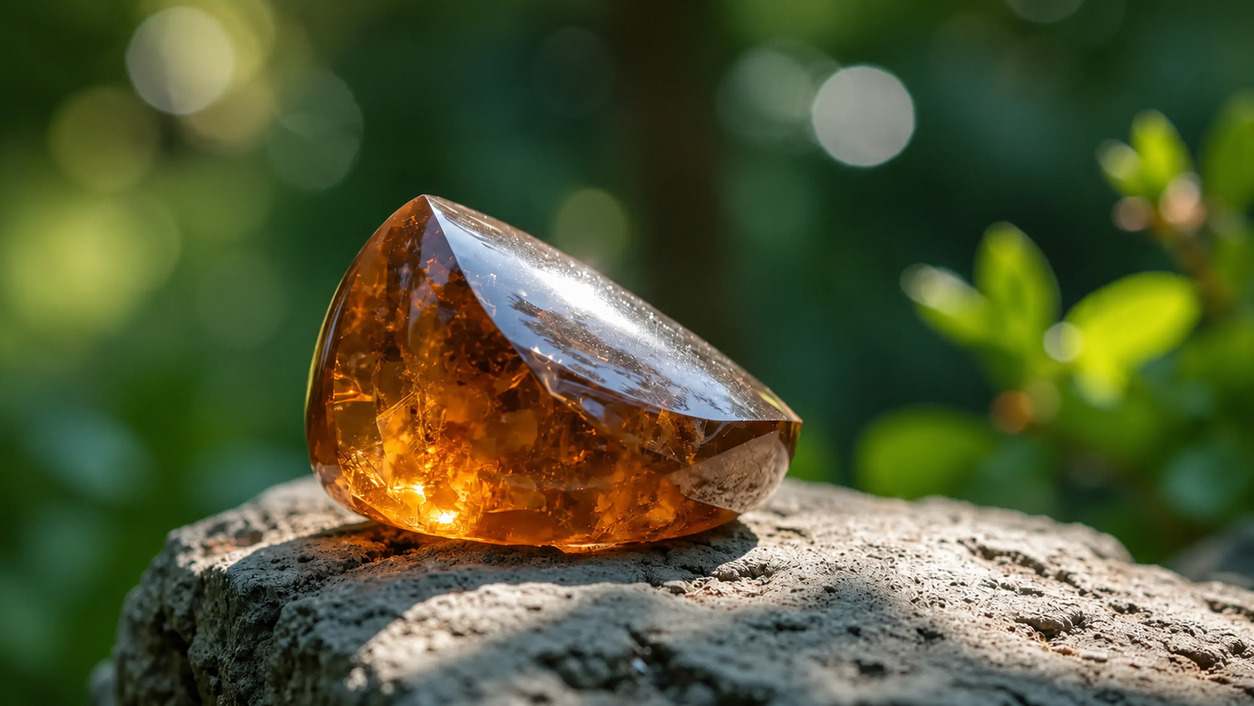
There are days when you come home with a heaviness that is not entirely yours: other people’s arguments, accumulated tension, a charged atmosphere. Smoky quartz, with a translucent gray that recalls smoke, is associated precisely with that: releasing what is heavy and bringing you back down to earth.
It is credited with grounding and protective properties, as if it transformed dense energy into something lighter and helped you let go of what you no longer need to carry. It is often used in moments of stress, grief, or changes that stir things up, when what you are looking for is not to rise above, but quite the opposite: to feel the ground beneath your feet again.
6. Tiger’s Eye: Courage and Firmness
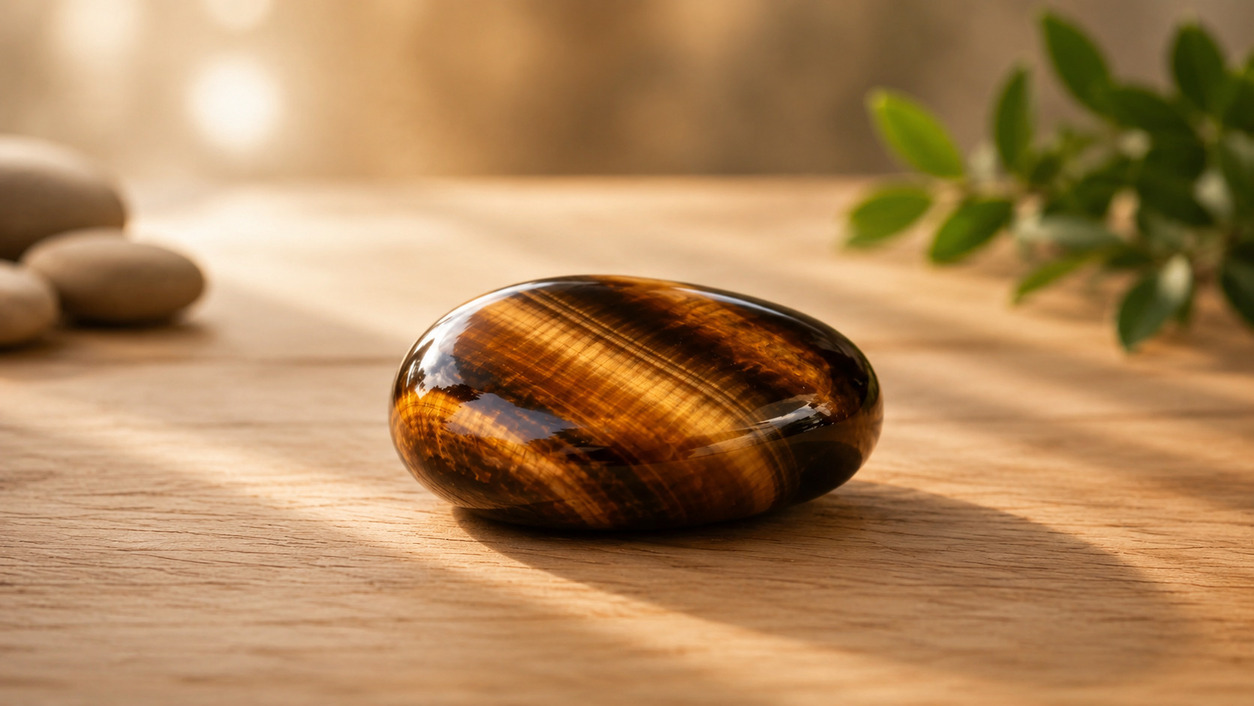
All you have to do is look at it to understand its name: it has golden and brown bands that, when the stone is turned, seem to shine and move like the eye of a feline. Tiger’s eye is associated with courage, willpower, and concentration, that blend of calm and firmness you need so you do not run away from what intimidates you.
It is believed to clarify decisions, steady your self-confidence, and protect against the doubts that hold you back. It is the quartz of challenges: an interview, an exam, a difficult conversation, any situation in which a little more composure would serve you well. Carrying it in your pocket is, for many, a way of feeling capable of facing whatever comes.
7. Green Aventurine: Prosperity and Serenity
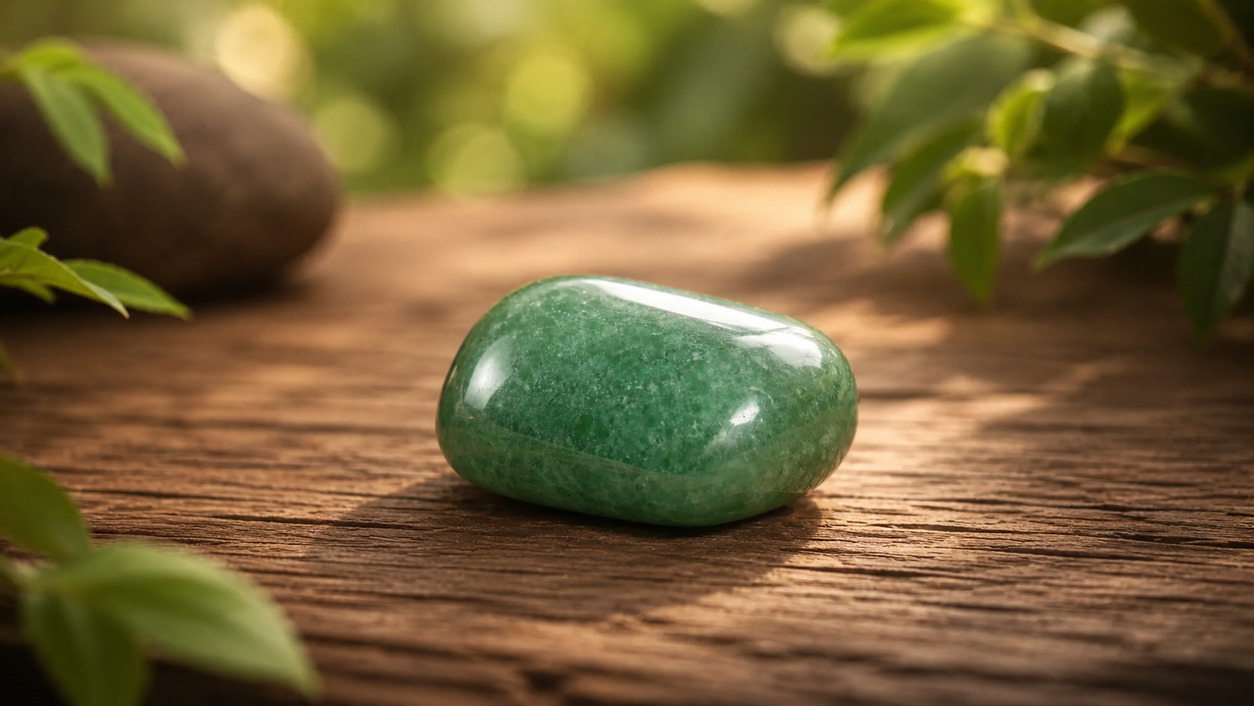
Green aventurine is the stone that many associate with luck and new opportunities. Its energy is that of calm growth: the kind of progress that happens without haste or pressure, like a plant making its way at its own pace.
Linked to the heart, it is thought to open you up to optimism and give you the serenity to try something new without fear holding you back. That is why people often choose it during times of change, before an important decision, or when you are hoping to attract a good streak.
8. Carnelian: Vitality and Motivation
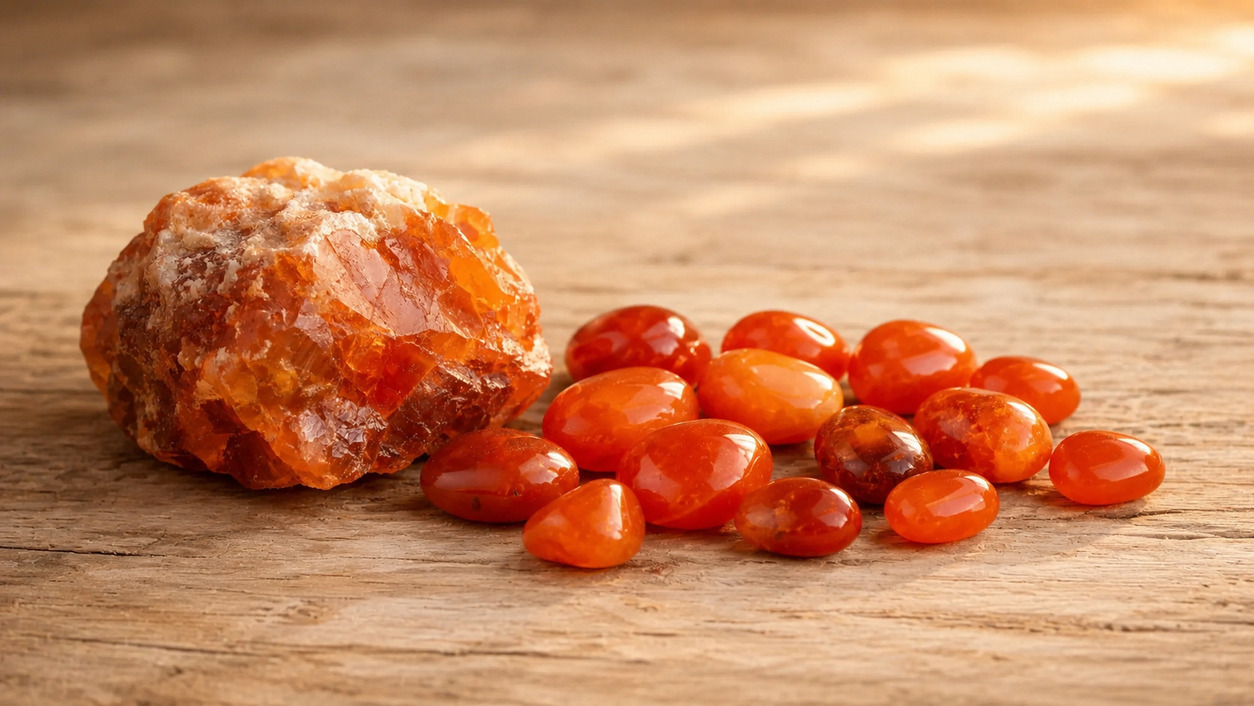
When your mood fades and everything feels twice as hard, there is a quartz crystal associated with turning the engine back on: carnelian. Its orange and reddish tones link it to vitality, creativity, and desire, that spark that moves you to create and dare.
It is said to awaken motivation, push past inertia, and reconnect you with the pleasure of doing things. It is the stone for when you feel stuck, low on drive, or starting something that calls for courage and energy. Keeping it close while you work on a creative project is a way of inviting that strength to stay.
9. Agate: Balance and Stability
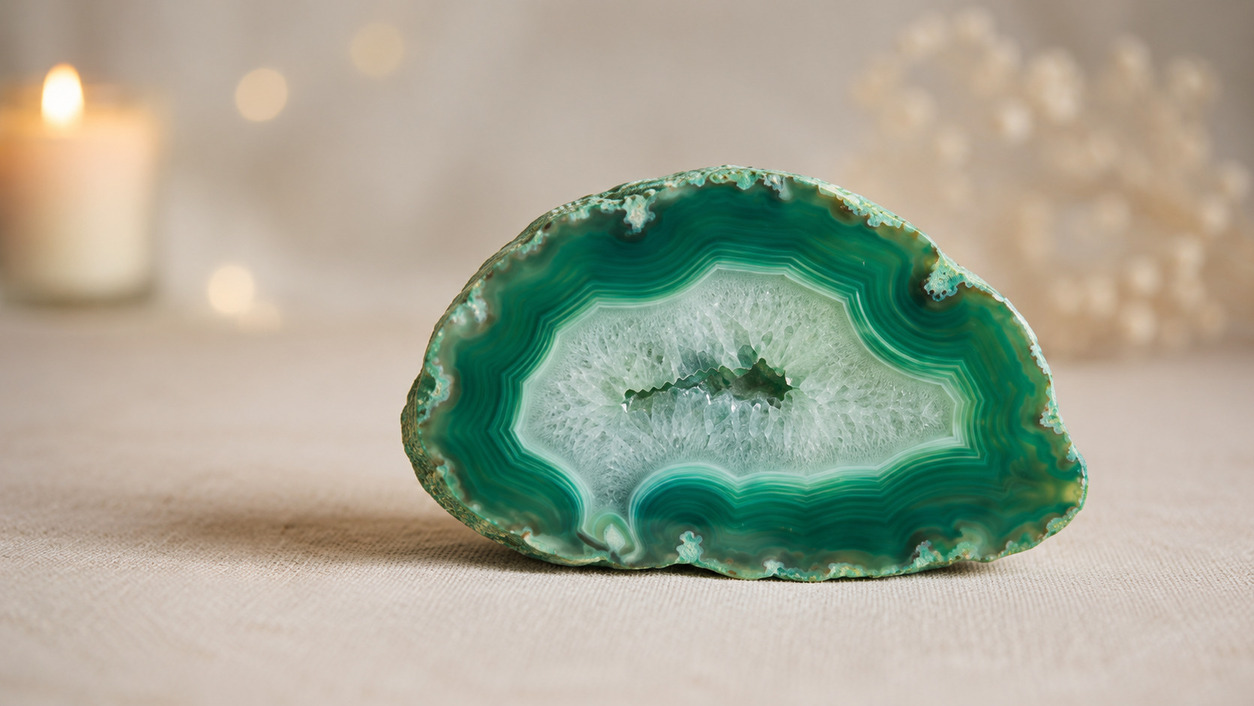
Not every process calls for intensity; some call for consistency. Agate, with its bands of color formed layer by layer, is associated precisely with that: balance, stability, and serene protection, the kind that does not make noise.
It is said to harmonize opposing emotions and lend you a sense of firmness when you feel as though you are standing on shifting ground. It is a good ally for transitions, moves, new chapters, or any moment when you need to feel more anchored. Unlike more active stones, it works slowly and in the background, like a foundation that holds you up without imposing itself.
10. Rutilated Quartz: Unblocking and Momentum
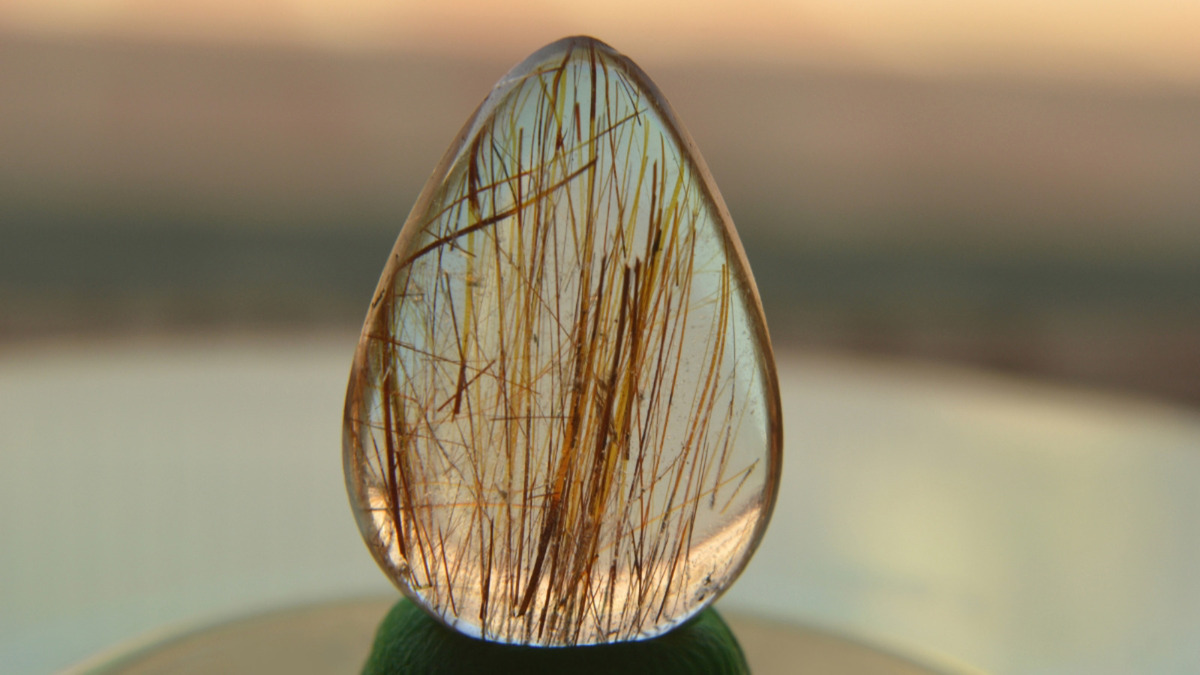
It is hard not to keep looking at it: inside, it is crossed by very fine golden threads of rutile, like rays of light trapped in the crystal. That is why it is credited with the power to illuminate what was blocked and set stagnant energy moving again.
It is associated with clarity, drive, and the strength to sustain intentions and manifest what you set out to do. It is often chosen when you feel that something is not moving forward, when you need to unblock a situation, or when you want to give more momentum to a purpose. Because of its intensity, many people combine it with calmer stones to balance so much energy.
How to Choose a Quartz Crystal for Your Intention
You do not need to know each quartz crystal perfectly, or memorize its properties, in order to choose well. What truly guides the decision is asking yourself what you are going through at this moment: what would you like to heal, release, or strengthen? That question, more than anything else, is the one you need to answer first.
Once your intention is clear, looking at the different stones becomes much simpler, because you already know what you are looking for and you recognize almost immediately which one is speaking to you.
- For self-love and healing the emotional: rose quartz and green aventurine help you open your heart and treat yourself with more kindness after a loss or an emotional blow.
- For calming the mind and anxiety: amethyst helps lower mental noise and find stillness when thoughts will not stop.
- For attracting abundance and recovering enthusiasm: citrine accompanies new projects and the days when you need a little more momentum.
- For protecting yourself and setting boundaries: smoky quartz and tiger’s eye work as a shield against tense environments or decisions that require firmness from you.
- For recovering energy and motivation: carnelian helps you get out of stagnation when your mood is low and everything feels twice as hard.
- For unblocking and giving momentum: rutilated quartz sets in motion what you feel is stopped and helps you sustain a specific purpose.
- For facing changes with more calm: agate provides stability and confidence when you begin an uncertain stage.
- For gaining clarity and focusing an intention: clear quartz organizes ideas and strengthens any purpose you want to sustain.
How to Use Quartz Crystals in Everyday Life
Working with quartz crystals does not require complicated rituals or a special altar. Many times, it is enough to give them a place in your day and let their presence remind you of what you want to cultivate. These are some of the most common ways to do it.
- Carry them with you, in your pocket, your bag, or as jewelry, to keep their energy close as the day unfolds.
- Place them in some corner of your home, such as an amethyst in the bedroom or a citrine on the desk, so that each environment carries its own intention.
- Hold them while meditating, in your hand or resting on your body, to focus your attention and deepen the practice.
- Always accompany them with a clear intention, silently formulating what you want to work on when you take the quartz crystal in your hand.
- Include them in your rest, leaving a stone under your pillow or on your nightstand, to accompany sleep.
How to Cleanse and Charge Quartz Crystals Before Using Them
Many traditions agree on a simple idea: if a quartz crystal absorbs and accumulates energy, it is worth caring for it from time to time, especially when it is new or when you used it in an intense moment. That care usually has two different steps, done one after the other.
- First comes cleansing, which serves to release the energy the stone may have picked up, as if you were resetting it to zero.
- Then comes charging, which seeks to restore its vitality, just as you would recharge a battery.
There are many ways to do it, and you can stay with the one that resonates most with you.
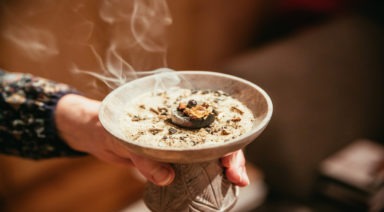
To cleanse them, you can pass the quartz crystal through the smoke of herbs such as palo santo or sage, or use the sound of a bowl, a bell, or some vibrational instrument. The idea is that the smoke or vibration helps release accumulated energy and leave the stone lighter, ready to be used again.
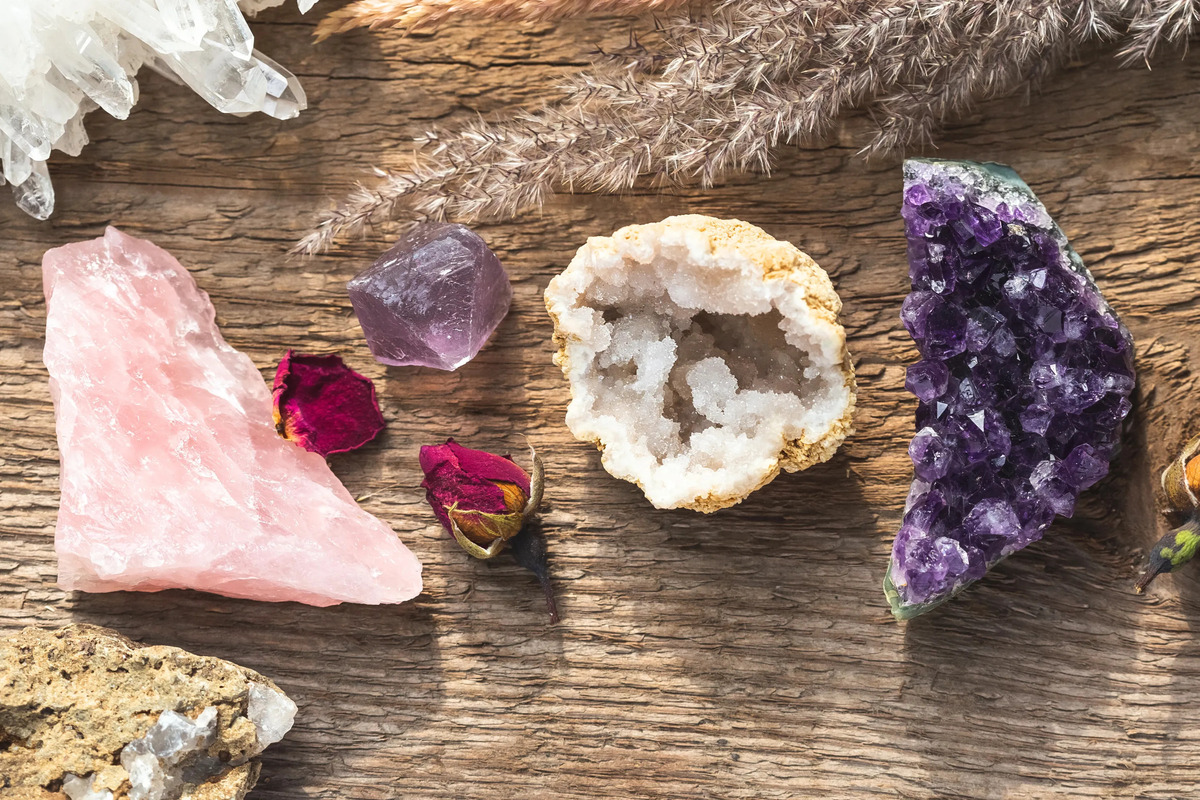
To charge them, one of the most popular methods is to leave them under the light of the moon, especially when it is full. It is enough to place them next to a window overnight. You can also rest them on an amethyst or quartz cluster, which many people use as a kind of natural recharge for other stones.
And then there is the most important thing, which needs nothing material: the intention. Hold the quartz crystal, imagine a light passing through it and carrying away the old, and clearly formulate what you want to use it for. That visualization is not a simple formality: it is what turns a pretty stone into a quartz crystal with a purpose of your own.
How to Integrate Quartz Crystals into Your Personal Path
At this point, it is worth clarifying something: no quartz crystal does the work for you. There is no stone that heals a wound, attracts love, or resolves a blockage while you watch from the outside. What a quartz crystal can do is accompany the process: sustain an intention you have already chosen and remind you, every time you see it or touch it, where you wanted to go.
Seen this way, the quartz crystal is more of a support: a concrete object that reminds you of what you want to pay attention to. When you choose it with an intention, you are not asking it to act in your place, but to help you listen more closely to what is already moving within you: that decision you have been postponing, that emotion asking for space, that desire you still do not dare to recognize. The series Crystals: Healing, Manifestation & Alchemy goes deeper into this perspective and shows how to work with crystals consciously, far from empty formulas.
Perhaps that is the true value of a quartz crystal: not to change you, but to help you be more present on your own path. You choose it, you hold it, you set an intention for it, and the rest still depends on you. It is not a shortcut, but a companion. And on very noisy days, having something at hand that reminds you of what you wanted usually helps more than it seems.