New Dr. Joe Dispenza Study Shows Meditators’ Blood Resists Illness

A cutting-edge, new study by Dr. Joe Dispenza is showing the connection between meditation and our body’s capacity to heal itself.
“Our nervous system tends to be the greatest pharmacy in the world,” Dr. Joe Dispenza said.
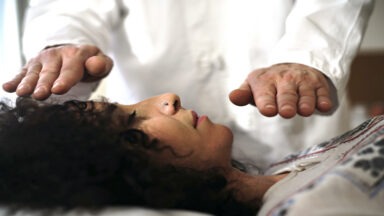
Dr. Joe Dispenza has spent a career, as he puts it, “demystifying the mystical” to that end. After leading week-long meditation retreats for years, he noticed miraculous changes among the participants, with some even claiming to have long-standing afflictions cured, seemingly by meditation alone. So, he decided to put it to scientific testing and partnered with the University of California San Diego biology department.
They tested advanced meditators, novice meditators, and a control group, and the results have been fascinating.
“We started looking closely at cellular function, and we started measuring thousands of cellular metabolites that determine whether a cell is in growth and repair or a cell is in breakdown,” Dr. Joe Dispenza said. “At the end of seven days, I get a call from our senior research analyst and he says ‘We have some really compelling things to show you,’ and we saw dramatic changes in the biology of advanced meditators. So when we started looking at the cellular function, we noticed along with the change in cellular function (for those people that watch Rewired) there was this arousal that was taking place in the person’s brain and in their nervous system. The arousal wasn’t pain, the arousal wasn’t fear, and the arousal wasn’t anger or aggression — which typically causes an arousal from the sympathetic nervous system — the person was reporting an arousal and the only word they could use was ‘ecstasy’ or ‘bliss,’ they had made some connection with something. So when we captured the blood of these people and when they made some type of connection, we noticed some really powerful effects in their blood plasma.”
But when they took the blood samples of these meditators into the lab they were in for a big surprise.
On a cellular level, how could blood from advanced meditators appear to fight off disease?
“Ok, so we knew that there was something in the blood of advanced meditators that caused this kind of immunity. So we went through several different assays and biological tests to actually isolate a protein, a very specific protein that has profound effects on the immune system,” Dr. Joe Dispenza said. “In fact, when we take that protein and we put it in the affected blood of the controls, we notice that all of the infection in the controls was reversed. In other words, it reversed the infection and so we’ve isolated this protein.”
How do these advanced meditators create this disease-fighting protein?
“The person who’s having that inward experience is not having that experience from anything in their environment. Their eyes are closed, there’s music playing in the background, they’re not eating, they’re not smelling, they’re not tasting, they’re not moving around and experiencing and feeling — they’re disconnected from their outer environment. Somehow, when they connect, there’s some type of order that’s taking place in their nervous system that causes a frequency and that frequency in their nervous system must be carrying information that transcends their senses, and there’s only one place where we can name that and that’s the quantum field. So, somehow, there is some type of connection between the biology of the brain and the body, and the physics of the field. Somehow we’re demystifying that process,” Dr. Joe Dispenza said.
Dr. Joe Dispenza has studied this subject for years. What does he hope this discovery will bring people in the future?
“Nothing changes in our life until we change, and giving people the formula on how to do that — it no longer becomes about healing, it really becomes about what stands in the way between you and becoming healed,” he said. “So, we’re demystifying that process and turning it into a solid practical application, so that people have in their reach all the tools to make measurable changes in their life. This is a time in history where it’s not enough to know, this is a time in history to know how.”
On Friday, Jan. 14, at 10:30 am (ET), Dr. Joe Dispenza and his scientific team are holding a live stream event open to the public to provide all the data behind this discovery, and what they say is the future of health and healing.
A Guide to Healing Adrenal Fatigue With Emoting And Herbs

Your adrenals are small glands that sit on top of your kidneys, much like ice cream atop a sugar cone. At first glance, they might look like two old, hump-backed men, their backs to the camera, crouched over a table playing chess. Found within your endocrine system and comprised of two parts, the adrenal cortex, and inner adrenal medulla, these glands look similar to brains, which is probably the best metaphor.
Your adrenals fuel and run your body’s operations by producing then releasing hormones into your bloodstream, without which, you’d soon expire. Here are your body’s essential hormones that your adrenals produce:
- Cortisol: your best buddy in times of stress, and has a host of vital functions that support your entire system.
- Adrenaline: also known as epinephrine, is both a hormone and a medication. In partnership with noradrenaline, it helps you prepare your fight or flight responses.
- Aldosterone: a steroid hormone that helps you conserve sodium in your kidney, salivary glands, sweat glands, and colon.
Without these musketeers, you’d find it difficult to think, move, or breathe. This triune of energy and life are vital to remaining alive. When our adrenal glands are out of balance, they can fall into patterns considered to be adrenal gland disorders. Our bodies find it difficult to break out of these types of patterns.
“Trying to describe a good marriage is like trying to describe your adrenal glands. You know they’re in there functioning, but you don’t really understand how they work.” — Helen Gurley Brown