The Top Five Subtle Body Treatments for Back Pain
Don’t laugh when you see me walking down the street. In my life I have broken my neck in a hard bicycling fall and had rods inserted into my lower spine after plummeting to the ground in a skydiving accident.
I walk a bit funny because they put my leg back together crookedly. It was not the doctor’s fault – he did the best he could. I am not about to get my leg fixed. I’ll wear it crooked, thank you very much. I feel very lucky just to be alive and walking at all. In fact, I am completely functional and pain free, and I’m the one laughing as I consider those two major accidents, countless minor ones and the amount of major metal now in my body.
My life took a very different turn over a decade ago that led me to study and experience my subtle body energy or what some call our chakra system. This has taught me lessons to help address my pain and made obvious what I once would not have believed. In this article I’ll share what I’ve learned through first-hand experience and outline some concrete steps you can take to help tackle your pain.
Our back and other parts of our body have a very specific language or way of communicating with us. Many times the expression can be quite literal, such as painful hands resulting from our holding tight onto something and the fear of letting it go. This happened to me.
A few years back my hands and the inside of the forearms began to hurt for seemingly no reason. Over a few months it became so bad that I could no longer pull my pants up, so I had to wear loose, stretchy shorts. I happened to run into a very wise old soul who I told about the pain. She touched my hand and said, “You are afraid of losing your job. Just let go and do your best.” I worked on letting go of that fear, and the pain went away as mysteriously as it had arrived. A few months later, a friend told me about similar pain and I had the answer. His went away as well.
The underlying premise of the discovery is that our body will express for us the emotion that we cannot process. Interestingly enough, our bodies use of language is amazingly consistent, regardless of race, nationality or gender. Our body communicates without bias, so lessons learned can be applied universally.
These energetic systems run throughout our body but the adverse expression of emotion felt in our bodies is a topic greater than can be covered in just this article. We’ll focus our discussion today on the back, since back pain is so prevalent worldwide and the third most common reason people visit the doctor’s office in the U.S., according to a major study conducted by the Mayo Clinic.
While there are no “silver bullets” and nothing works 100% of the time, I have discovered that simple, specific realizations can relieve back pain. Once I understood the function and location of chakras within the body, I was able to map these energy centers to the cause of the pain. Through trial and error with thousands of people, I’ve identified the most common resolutions for addressing back pain.
It’s not a coincidence that most people’s back pain emanates from the mid- to lower-back. From a chakra point of view, these areas correspond to the more base parts of life – money, sex, pleasure, relationships and power. These are the focus of most of humanity’s fear and doubt.
Finally, in this stage the instructor guides us not to seek the primordial seed outside of us. It is, as Jesus and so many others have taught, within us.
Here are five common areas of back pain and the top five realizations for making that pain go away. Identify one or more areas where you’re feeling pain under “Pain Location” and simply walk through the steps listed under “The Relief” for three to five minutes. See what happens. Hopefully you’ll be laughing with relief soon.
#1 – Pain Location: Very base of the spine. Note that it will often radiate to the sides of the spine, hips and legs.
The Relief:
- Ask yourself how bad is your pain right now? Rate it on a scale of 1 to 10.
- Note how old you are now and recognize that for all of your life you have always had a place to sleep, something to eat and clothing to wear. This is true since birth, right? (For most people, this is true.)
- Note that you focus on fear of financial doom. You tend to focus on your bills and what would happen if you don’t have enough to make it. You don’t see how you are going to make it.
- Look back at your life. You have had this fear many times but the truth is that somehow, some way you made it….month after month, year after year, decade after decade, you made it, right? The truth of your life is that the fear was false. You addressed the issues, adjusted and made it. Right?
- Now apply this to every real financial concern you currently have. Apply it to all of your loved ones.
- You most likely learned this fear from your parents and they from your grandparents. Not true for them too, right? They made it too, right?
- Apply the truth of your entire lifetime of experience to your current fear and frustration around all financial issues. Let go, you are going to make it again. So too will your loved ones. Do this for every financial concern.
- Rate your pain on a scale of 1 to 10 again.
#2 – Pain Location: Lower back – area across from the belly button
The Relief:
- How bad is your pain right now? Rate it on a scale of 1 to 10.
- Think of someone you love non-romantically, it could even be a pet. Allow yourself to fully feel that feeling of love for them.
- Give this feeling very specifically to the person(s) you are related to that irritate you. Do not hold back, give this to them 100% even though they don’t deserve it. Do this for 3 to 5 full minutes.
- Rate your pain on a scale of 1 to 10 again
- Bonus – Let go of the feeling that you are not safe enough to enjoy the physical pleasures of life. Give yourself permission to fully enjoy.
#3 – Pain Location: Mid-back – area across from the solar plexus
The Relief
- How bad is your pain right now? Rate it on a scale of 1 to 10
- Let go of all of your fear of someone controlling you. Do this by letting go of your fear of the worst- case scenario. This is most often work-related but does not have to be. Imagine the worst case scenario as if it has happened, you fully accept it and are moving on to the new phase of life. If you let go of all of your fear no one can really control you. Feel it.
- Let go of your insistence that things have to be done your way. Allow others to be, do and say as they wish. Feel that you are now doing that.
- Rate your pain on a scale of 1 to 10 again

#4 – Pain Location: Upper back – area between shoulder blades, behind heart
The Relief:
- How bad is your pain right now? Rate it on a scale of 1 to 10.
- Let go of your judgements of others, any and all judgements no matter how small.
- Notice that every time you were hurt by love it was when your love went from unconditional to conditional
- Let go and allow yourself to make it now unconditional again, feel it…just for 3 to 5 minutes.
- Rate your pain on a scale of 1 to 10 again
#5 –Pain Location: Neck
The Relief:
- How bad is your pain right now? Rate it on a scale of 1 to 10.
- Let go of being right and making others wrong around you.
- Realize that they simply have a different perspective from you.
- Allow yourself to see the others’ perspective. Do this while making neither one of you right or wrong. Let go, feel it. Do this for 3 to 5 minutes.
- Rate your pain on a scale of 1 to 10 again
Why does this work for so many people?
Your chakras are energy centers that are related to different aspects of life, emotion and even organs and glands. Chakras open and close like flowers, in love and trust they open, in fear and doubt they contract. Meridians in the body are as hoses with energy flowing through them. If you get a kink in the hose then the energy cannot flow. If the energy is not flowing, then you might feel it as pain, or possibly, if it continues long enough, as disease.
Watch a trailer for E-Motion Now
Energy comes into our chakra system in love and trust. We mess it up with fear and doubt. Each chakra performs at its optimum when we apply thoughts and feelings of love and trust to the aspect of life that the chakra controls. All we have done is just un-kink your hoses and open your flowers.
About the Author:
Bill McKenna; Creator and Founder of Cognomovement, has helped countless individuals find relief from physical, emotional, energetic and even spiritual discomforts. He is the author of The Only Lesson and regularly leads seminars on pain relief. Bill has made multiple appearances as a guest on Open Minds with Regina Meredith. Learn more about Bill and where to experience other methods of profound healing. Get in touch with Bill today.
1) Mayo Clinic Proceedings, January 2013, Volume 88, Issue 1, Pages 56-57

About the Author
Clairvoyants Able to 'See' Energy Healing in Action, Study Finds
An important new scientific study shows that energy can be both channeled to produce healing, and “seen” through extended perception, beyond the five senses.
The Institute of Noetic Sciences, or IONS, has been studying the nature of reality through rigorous scientific exploration for nearly 50 years. In their latest study, IONS scientists set out to validate both the practice of reiki and the phenomenon of clairvoyance or “extended seeing.”
Dr. Helanè Wahbeh is the head of research at IONS, and has been studying energy medicine for decades.
“People who are energy medicine practitioners might call energy this system that runs throughout the body that they experience as energetic, magnetic, tingling, etc. around the body,” Wahbeh said.
“One type of energy medicine that is commonly used around the world is called Reiki, and Reiki is a technique that originated in Japan. It’s based on the principle that the therapist can actually channel energy into the patient and activate their natural healing process — their innate ability to heal themselves, often releasing obstacles and allowing an optimal flow throughout the body.”
Reiki is one of the best-studied energy medicine modalities, having been shown in clinical studies to be effective in conditions including pain, anxiety, depression, cancer, and others.
In this IONS experiment, researchers wanted to study the effect of Reiki on people with a variety of physical and mental health conditions to test the principle that the modality uses a universal life force energy and can therefore be applied to anyone for any condition.
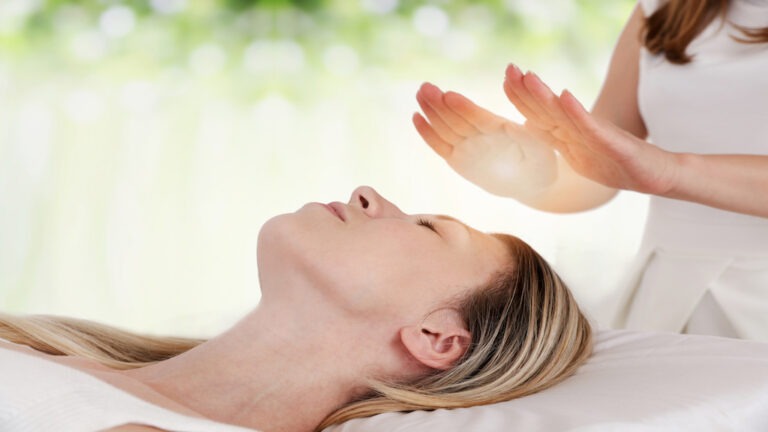
“We had six Reiki masters with extensive experience give 30-minute sessions to 40 participants. The participant would come in, they would lay down in this reclining chair, and the Reiki practitioner would say that they were going to start their session, they would place their hands on different parts of their body and direct the Reiki energy for 30 minutes,” Wahbeh said.
The results were profound.