The Enigma of the Lost Chinese Pyramids of Xi’an
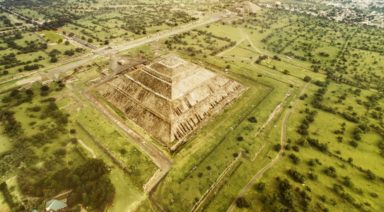
One-hundred kilometers outside of Xi’an, an ancient city in central China, among green grasses, farms, and forests, rise a hundred pyramid-shaped mounds that have been shrouded in mystery for thousands of years.
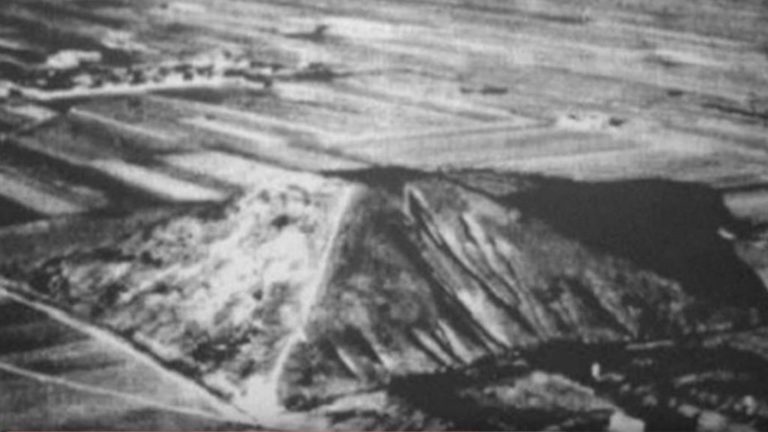
Westerners first learned there were Chinese pyramids relatively recently, when Fred Meyer Schroder, an American travel agent and trader, first discovered them in 1912. At the time, he was traveling through the Shaanxi Province with a guide, where he recorded a thorough description in his diary, noting he’d seen one giant pyramid approximately 1,000 feet tall and nearly twice that size in length, surrounded by a number of smaller pyramids.
Schroder’s guide explained that the pyramids he happened upon were the subject of local legends and that their history could be found in ancient monastic documents. To put things into perspective, the great white pyramid of Xi’an is nearly twice as large as the Great Pyramid of Egypt.
Why Are the Pyramids in China Such a Mystery?
The Pyramids in China have remained largely an enigma to tourists and archaeologists alike — perhaps intentionally.
In the early 1990s, German investigator/travel agent Hartwig Hausdorf searched for the massive pyramid that appeared in Gaussman’s earlier photographs, but he was unsuccessful in finding it. Instead, he found the Chinese military meticulously patrolling the area.
The experience led him to write a book titled “The White Pyramid,” but which only discussed other structures in the area. Western archaeologists still have not been granted entry to these areas, but Hausdorf’s excitement over the pyramids was good for drumming up publicity.
In 2000, Chinese officials declared there were around 400 pyramids north of Xi’an, though that doesn’t include the White Pyramid. Excavation of many of the other sites revealed mausoleums shaped more like Mesoamerican pyramids, differing from those in Egypt, as they are flat topped and covered with vegetation.
In these burial mounds lay ancient members of China’s royal class, who intended to rest for eternity undisturbed. Most of the pyramids are extremely difficult to detect, camouflaged in lush mountains and hills and covered by tall grass and trees. Very few of the structures have been open to tourism.
The Chinese government has given simple explanations as to why no one is allowed to enter, namely that overzealous archaeologists and tourists could potentially damage the artifacts. Officials claim they are waiting until technology advances enough to properly excavate the pyramids and their precious contents. After all, some of the pyramids are believed to date as far back as 8,000 years.
Pyramids of Xi’an Hidden in The Stars
Through modern technology, researchers have been able to chart the locations of dozens of the Xi’an pyramids, and taken particular interest in their spatial relationships. They’ve been particularly struck by how these mausoleums are in precise astrological alignment. While most of the monuments are positioned according to cardinal directions, with about half of them aligned true North, it was found that a few of them were about 14 degrees off. The explanation for this is believed to be astronomical in nature. Computer analysis has revealed that the layout coincides with the Gemini constellation as it would’ve been positioned on the spring equinox in 10,500 B.C.
Suspicions and Theories Chinese Pyramids
Conspiracy theories inevitably erupt wherever there’s secrecy. Westerners have been endlessly guessing about the purpose and energy of the pyramids, as well as their astronomical significance. According to researchers, “to some rulers, the cardinal points of North, South, East, and West were all important. Lining up your tomb with the globe’s axis was a sign that you were still number one.”
The most popular conspiracy theory involves extraterrestrials — asserting that they were perhaps the original architects. Is it possible that the ancient astronaut theory espoused by Erich von Däniken and his ilk may also apply to the Chinese pyramids?
Restoration of the Pyramids
Slowly raised funding equates to sluggish restoration progress in Xi’an. However, the Maoling Mausoleum remains a tremendously popular tourist destination complete with a museum dedicated to the Western Han Dynasty period and featuring more than 4,000 excavated treasures and cultural relics.
Meanwhile, the mystery surrounding the Chinese pyramids and their real origins continues to stimulate the imagination as to who the true builders were — human or otherwise. But if funding isn’t forthcoming, the mystery may never be solved and the structures may collapse into ruins before archaeologists — let alone tourists — have the opportunity to experience the history buried within their walls.
Ancient Complex at Karahan Tepe Older than Gobekli Tepe

New discoveries have been made at the ancient site of Karahan Tepe — this sister site of Göbekli Tepe may have just revealed its hidden origins and proved an ancient civilization is even older than once thought.
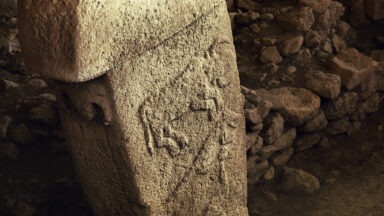
Archeologists working at the ancient site of Karahan Tepe, about 30 miles east of its sister site Göbekli Tepe, have found stunning carved heads, standing stones, buttresses, and what appear to be snakes prominently carved into the earth. The dig is being led by the University of Instanbul and in their official report point out that, not only are these and other neolithic structures the beginning of architecture but also held a symbolic purpose. Writing, “[T]hey also bear traces of the conceptual transformation of the space. It is during this period when the building was instilled to mean something other than a space to live in, whereby the construction of the first shelters was followed by that of ‘special structures.'”
Science and history writer Andrew Collins, has visited and studied Karahan Tepe since 2004 and has seen these special structures up close.
“The main structures were all what they call ‘subterranean,’ they would cut deep down into the bedrock. One was a huge elliptical stone enclosure,” Collins said. “Clearly, this was an amphitheater for ceremonial ritual activity. Yet this connected via a hole that is 70 cm in diameter into a very strange room containing 11 stone pillars, ten of which are actually carved out of the bedrock itself, and sticking out of the wall of this room that I call the Pillar Shrine, is this elongated neck with a head on the end of it — this carved stone head. This confined room is somewhere initiates or people looking for connection or communication with some kind of otherworldly force or influence or diety would come to do their attunement in altered states of consciousness.”