Explore more [topic] on Gaia

3 Yoga Poses for Labor
3 Yoga Poses for Labor

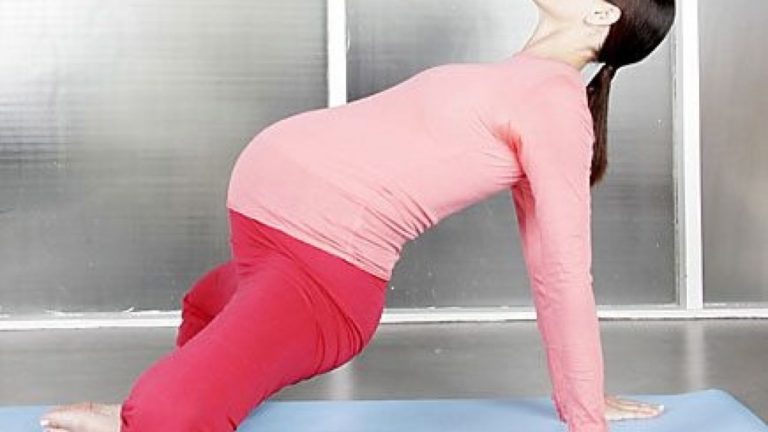
As a birth doula and yoga teacher, I believe that yoga for labor is one of the most rewarding forms of yoga. Your labor could be a breeze or it could be a marathon. Either way, these sure fire hip-openers can help give you the edge.

(Click here for prenatal yoga videos.)

1. Cobbler’s Pose/Butterfly.

Take your Cobbler’s Pose to new heights by not only lengthening and strengthening your upper back, helping to improve your posture, but the lift also allows the hips to fall open towards the sides, going deeper into your groin muscles and stretching the pelvis to open for birth. Place the soles of the feet together in front of your body and walk the hips back an inch to rest in a forward pelvic tilt. Keep the outer edges of the feet pressed to the earth as you roll your shoulders open and back and lift your hips from the floor

  • enjoying a deep stretch in the entire back from crown to tailbone.

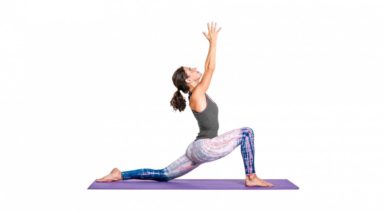
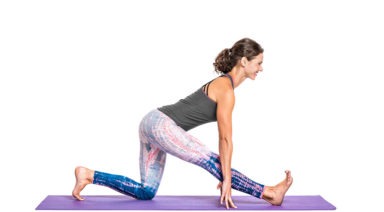
2. Low Lunge Pose.

Lunge is a terrific pelvic floor stretch as well as a strengthener for your thighs. In addition, it stretches the hip flexors which lead into the back and can alleviate some of the tension in your tight lumbar. I often recommend my Doula clients to try this pose while standing in labor, as it may help to open up the pelvic floor on one side more than another, which is useful for babies who like to thumb suck in utero and cannot descend with a little arm in the way!

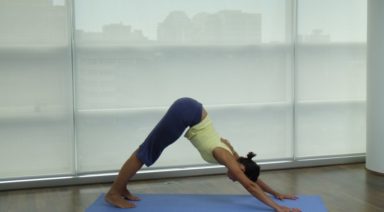
3. Downward Facing Dog.

The Downward Facing Dog is a standard pose in most classes, but done properly with birth in mind, can also become your new best friend. Begin the pose by sitting on the heels with the arms outstretched on the mat as far in front of you as you are comfortable. Keep the fingers soft and the shoulders pulled into the back with a long neck. Shift your weight into your toes and lift the knees slightly from the floor. Keep reaching with your chin as you straighten the legs, letting the heels descend, and the shoulders pulled back into the spine. The head will naturally fall towards the floor as your hips elevate, keeping the length and the strength in the shoulders behind you, where it belongs. As you lift the hips, lift the tailbone and stretch the hamstrings from heels to hips forming a perfect triangle with your body. In this position, the baby can fall out of the hips and low back, offering relief in later weeks as well as encouraging a breech baby to shift with the relaxation of the internal ligament structure.

*Consult with your medical professional before starting any new physical regime during pregnancy or labor.


Discipline & Surrender: The Art of Down Dog

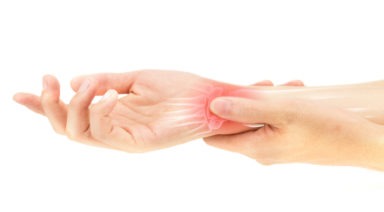
I’m a yoga teacher who’s been teaching for over 20 years and doing down dog every day. So technically I can do the pose, but because of a pinched nerve in my elbow I’ve developed a problem akin to tennis elbow and it hurts like hell.

For years I’ve heard one student after another complain about down dog. They tell me it’s too hard, it’s boring and it sometimes hurts the hands and the feet. I would remind them about limitation, relaxing and letting go. “Breathe,” I would say.

I love down dog. It reminds me to surrender every part of my body to the pose. It requires discipline to first get into the pose and then a sense of surrender to maintain it. I remind my students that such is down dog, such is life. It takes discipline to stick to your goals and surrender to maintain them.

What I love about down dog is that it’s a one-for-all pose, meaning that it requires the integration of the whole body. It stretches the muscles of the back of the legs, shoulders, the belly and the back. It strengthens the arms, relieves neck tension and offers some of the benefits of inverted poses, such as cleaning the internal organs and relieving tension. It can be done for a warm up or a cool down.

Patanjali, who organized the knowledge of yoga into The Yoga Sutras of Patanjali, understood down dog. His book compiles 196 sutras that are essentially a road map for life. The second sutra, if fully understood, is enough to understand yoga. The rest of the sutras only serve to explain. Basically the second sutra is about the modification of the mind or the balance between the two qualities of abhyasa and variragya or “discipline” and “surrender.” This is down dog.

These two qualities form the foundation of yoga. It’s the balancing and the blending of the two opposing forces of discipline (practice) and surrender (letting go) that create harmony. It’s precisely the physical discipline of moving into down dog and the letting go so as to maintain it: that is why I love down dog, and why I was so disappointed when my body would no longer allow me to embrace the pose.


Not to be one to give up, I saw my doctor who sent me to a physical therapist. For six weeks I worked to relieve the pain in my elbow so that I could return to the mat. It also took discipline to faithfully make time to see the physical therapist three times a week. It took a sense of surrender to let go and remain unattached to the outcome of my therapy. My focus was to establish that sense of balance between abhyasa and variragya.

This process of therapy was a discovery that called upon me to transcend my ego. I’ve always prided myself on being able to easily slip in and out of down dog. My body has always been strong, flexible and resilient. Now my body was tired and worn, and I had to let go of my self-imposed boundaries and admit that I too had my limitations. I’m the yoga teacher and I cannot do a down dog?! But like all things in life, this too shall pass. Everything changes. With time and a little rest my elbow improved, and before I knew it, I was back on the mat in down dog with my students.

But something changed. I no longer take for granted that my body will always respond with the discipline I impose. Sometimes we need to pull back and surrender to the flow of life, even if that flow is one that is not so pleasant. As I like to remind my students, everything has an element of good. We just need to surrender to it and quietly learn to accept. In that, we will discover a sense of discipline and the ability to surrender; and if truly understood, this is enough to understand yoga. The resting of my elbow, like the remaining sutras, simply served to instill in me the importance of balance and the modification of the mind.

Read Article

Our unique blend of yoga, meditation, personal transformation, and alternative healing content is designed for those seeking to not just enhance their physical, spiritual, and intellectual capabilities, but to fuse them in the knowledge that the whole is always greater than the sum of its parts.


Use the same account and membership for TV, desktop, and all mobile devices. Plus you can download videos to your device to watch offline later.

devices en image
Monthly
$13 .99 /mo
BILLED MONTHLY
Select
First 7 days FREE
then $13.99 billed monthly, cancel anytime
Gaia+
$24 .92 /mo
BILLED ANNUALLY
$299 /yr
Select
Includes Events & Guides
$299 billed annually, cancel anytime
All prices USD plus applicable tax
Testing message will be here