Exploring the Sacred Four Directions and Medicine Wheel in Native American Culture
The Native American tradition of recognizing the Four Directions—East, South, West, and North—and the central concept of the Medicine Wheel capture profound spiritual significance and cultural values across numerous indigenous communities. This revered system honors not only the physical elements of the world but also the stages of life, sacred directions, and the cycles of life inherent in Mother Earth. This article delves into the symbolism of each direction and the comprehensive meaning of the Medicine Wheel in Native American tradition.
Insights into the Four Directions
Each of the cardinal directions holds a unique symbolic meaning across many Native American traditions. The directions are commonly associated with specific colors, elements, animals, life stages, seasons, sacred plants, and spiritual attributes. While interpretations may vary by tribe, the following reflects widely recognized associations:
East – Air
- Color: Yellow
- Animal: Eagle
- Element: Air
- Season: Spring
- Life Stage: Birth / New Beginnings
- Sacred Plant: Tobacco or Sweetgrass
- Significance: East represents the rising sun, clarity, wisdom, and new beginnings. It is the direction of vision, spiritual insight, and awakening—energizing the day with light and understanding.
South – Water
- Color: Red
- Animal: Buffalo
- Element: Water
- Season: Summer
- Life Stage: Youth
- Sacred Plant: Cedar
- Significance: South symbolizes warmth, trust, and emotional growth. Aligned with water, it reflects fluidity, learning through experience, and the nurturing energy of summer.
West – Earth
- Color: Black
- Animal: Bear
- Element: Earth
- Season: Autumn
- Life Stage: Adulthood / Maturity
- Sacred Plant: Sage
- Significance: West is associated with introspection, grounding, and maturity. As the sun sets, it invites reflection and connection to the natural world, offering wisdom through self-awareness.
North – Fire
- Color: White
- Animal: Moose
- Element: Fire
- Season: Winter
- Life Stage: Elderhood / Wisdom
- Sacred Plant: Sweetgrass or Sage
- Significance: North represents endurance, cleansing, and transformation. It is a place of strength and resilience, where fire symbolizes purification and the wisdom gained through life’s challenges.
The Medicine Wheel as a Guide to Life
The Medicine Wheel is a sacred emblem used by many Indigenous cultures to express the cyclical nature of life and the interconnectedness of all things. While each tribe may have unique interpretations, the wheel is commonly divided into four quadrants that reflect:
- The Circle of Life: A continuous cycle of birth, growth, death, and renewal.
- The Four Life Stages: Birth, youth, adulthood, and elderhood—each aligned with a direction.
- The Four Seasons: Spring, summer, fall, and winter, representing natural rhythms and transitions.
- The Four Aspects of Wellness: Physical, emotional, mental, and spiritual needs—offering a holistic framework for balanced living.
- Interconnectedness: Emphasizes the unity of all beings, nature, and the spiritual world.
- Health and Healing: Serves as a guide for achieving balance and well-being in all areas of life.
- Spiritual Beliefs: Connects to sacred relationships with Father Sky, Mother Earth, and the Great Spirit.
- Tribal Heritage: Reflects the rich teachings, values, and perspectives of various Native American tribes, including the Navajo and Lakota.
By incorporating these themes, the Medicine Wheel becomes more than a symbol—it serves as a living philosophy, teaching respect, balance, and connection with all of creation.
Ritual of Calling in the Four Directions
Engaging in significant life events or seeking spiritual guidance often involves the ritual known as “Calling in the Four Directions.” This ceremony honors each cardinal direction and invites the energies and spirits associated with them into the ritual space. A typical script for this ceremony might include:
- East: “From the East, the land of the rising sun, we invite the spirit of the Eagle, bringing us vision and enlightenment.”
- South: “From the South, the realm of the warming sun, we call upon the spirit of the Buffalo, offering us strength and growth.”
- West: “From the West, where the sun sets, we summon the spirit of the Bear to bring healing and reflection.”
- North: “From the North, the place of the cold winds, we ask the Moose to join us, teaching resilience and wisdom.”
Assignment: Find Your True North
Knowing the cardinal directions and where you stand in relation to them is an essential aspect of connecting to the natural and spirit worlds. Ancient cultures of the world, in tune with the cycles of the seasons and the stars, knew how to orient themselves if lost and likely intuited their location naturally due to practice.
Set a reminder to locate true north intermittently throughout the day; for example, at sunrise, midday, and sunset, use a compass to find north. Stand facing north and notice the angle of the sun and landmarks that may guide you without a compass.
Four Directions Ceremony: Open Sacred Space
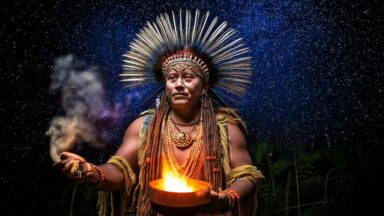
Call upon the four directions in this invocation from the Q’ero shamans of Peru to ask for a blessing from the spirits in your endeavors. Consider creating an altar representing each direction. To begin, take some deep breaths, let go of mental preoccupations, and align with your heart’s intention to create sacred space. As you face each direction, smudge or fan sage, blow scented water, or shake a rattle and say the prayer aloud.
Face the south with one arm up and the other palm open to receive.
To the Winds of the South,
Great Serpent,
Mother of the life-giving waters,
Wrap your coils of light around me.
Remind me of how to let go and shed old ways of being.
Teach me to walk the way of beauty.
Face the west with one arm up and the other palm open to receive.
To the Winds of the West,
Mother Jaguar,
Support me as I see my own fears.
Teach me how to transform my fears into love.
Remind me of how to live with impeccability.
May I have no enemies in this lifetime or the next.
Face the north with one arm up and the other palm open to receive.
To the Winds of the North,
Royal Hummingbird,
Ancient Ones,
Teach me about your endurance and your great joy.
Come to me in the dreamtime.
With honor, I greet you.
Face the east with one arm up and the other palm open to receive.
To the Winds of the East,
Eagle or Condor,
Great Visionary, remind me to lead from my pure heart.
Teach me to soar to new places, to fly wing to wing with Spirit.
Place one palm on the earth and the other arm up.
Mother Earth – Pachamama,
I pray for your healing.
Let me soften into your wisdom.
May I take great care of you, so that my children and my children’s children
may witness the beauty and abundance you offer me today.
Raise both arms to the sky.
Father Sun, Grandmother Moon, to the Star Nations,
Great Spirit – you who are known by a thousand names,
And you who are the Unnamable One,
Thank you for bringing me here at this time.
Close the Ceremony
When you have finished your ceremony, sacred space must be closed. This can be done silently or spoken aloud, but it must be intentional. Thank the serpent, jaguar, hummingbird, and eagle for their wisdom. As you release their energies back to their four directions, take a few deep breaths, acknowledge yourself back in the space you are in, and witness any changes in your being. Take any inspiration gleaned from your sacred space and share it with the earth, your family, and your community.
About the Author

The Origins of Shamanism
Shamanism has a long and storied history, considered by some to have originated in Siberia where members of indigenous tribes would gather the sometimes poisonous and highly psychoactive fly agaric or Amanita muscaria mushroom. But when this practice was recognized and classified as shamanism, it became apparent many cultures around the world conducted similar practices.
Shamanic Mysticism
It might just be the oldest spiritual practice in the world – one that is not necessarily based on faith in a particular god, but rather based on animism, the belief that everything is living and has a spirit.
Shamanism has persisted all over the world since its inception in ancient native cultures, including Siberian, Indian, Native American, and South American Shamans. Shamanism has had to fight oppression from governments and religions worldwide that perceive it to be a manic and primitive tradition. But its mysticism and continued practice remain strong throughout disparate tribal cultures, many of which had little to no contact for centuries, despite their very similar traditions, beliefs, and rituals.
So what is shamanism? Shamanism is thought to be the key to existence — as long as shamanic rituals are practiced we will continue to exist. Shamans are a link between our plane and higher planes of existence. They link to the spirit world in order to heal, contact deceased ancestors, influence the weather, and uplift consciousness.
Shamanism, a practice as ancient as the whispers of the wind, has danced through centuries, weaving its magic into the very fabric of human spirituality. Rooted in a kaleidoscope of various cultures across the globe, shamanism connects the physical and spiritual realms, where shamans act as intermediaries, uncovering profound wisdom and healing. From its beginnings in northern Asia to its modern popularity in South America, the story of shamanism’s emergence reveals why it continues to enchant and inspire seekers today.
Where Did Shamanism Originate?
Shamanism is believed to have originated in the ancient cultures of Siberia and Central Asia, particularly among the indigenous tribes of Siberia and Mongolia. The term “shaman” itself derives from the Tungus word saman, meaning “one who knows.” Anthropologists suggest that shamanic practices date back to the Paleolithic era, as evidenced by ancient cave art depicting shamanistic rituals and symbols.
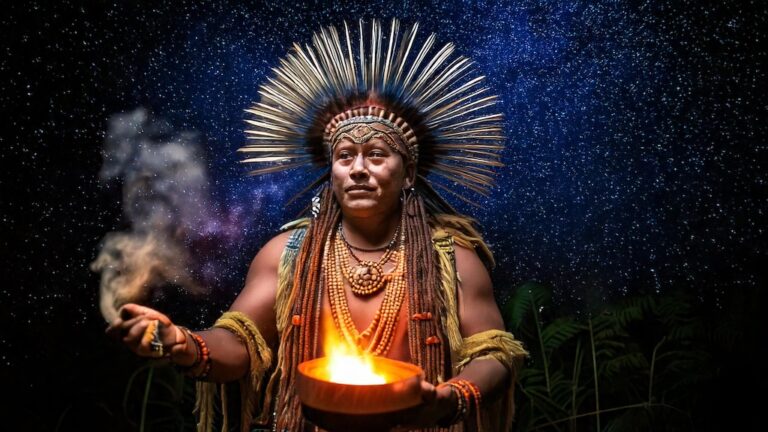
Shamanism’s core belief system is animism—the understanding that every stone, tree, and creature carries a spirit. Shamans, with their unique ability to enter trance states and journey through unseen worlds, seek guidance, perform healing rituals for the sick, and speak with animal spirits and ancestors, weaving the threads of life and afterlife into a spiritual tapestry. These foundational practices reflect humanity’s ancient desire to find harmony with nature and the cosmos.