Friday the 13th Deserves Another Look
Most of us learned that Friday the 13th was unlucky long before we thought to ask who decided that. The date has become so familiar as a warning that its reputation can feel like an ancient fact.
Its history is harder to pin down. Older beliefs about unlucky Fridays and the number thirteen eventually came together, but there is no single established origin for the combined superstition. And fear is only one of the meanings people have attached to thirteen. In tarot and contemporary sacred geometry, the number offers other ways to think about change and our place in the world.
Where Did the Friday the 13th Superstition Come From
Christian tradition supplied some familiar associations: Jesus was crucified on a Friday, and thirteen people attended the Last Supper. These are often suggested as explanations for the separate fears of Friday and thirteen, though tracing a superstition back to a particular event is difficult.
By the nineteenth century, people were already pushing back. According to the Library of Congress, Manhattan’s Thirteen Club held its first dinner on Friday, January 13, 1882, deliberately gathering thirteen guests. Thomas W. Lawson’s 1907 novel, Friday, the Thirteenth, later put the superstition at the center of a Wall Street plot. The book helped circulate an idea that already existed.
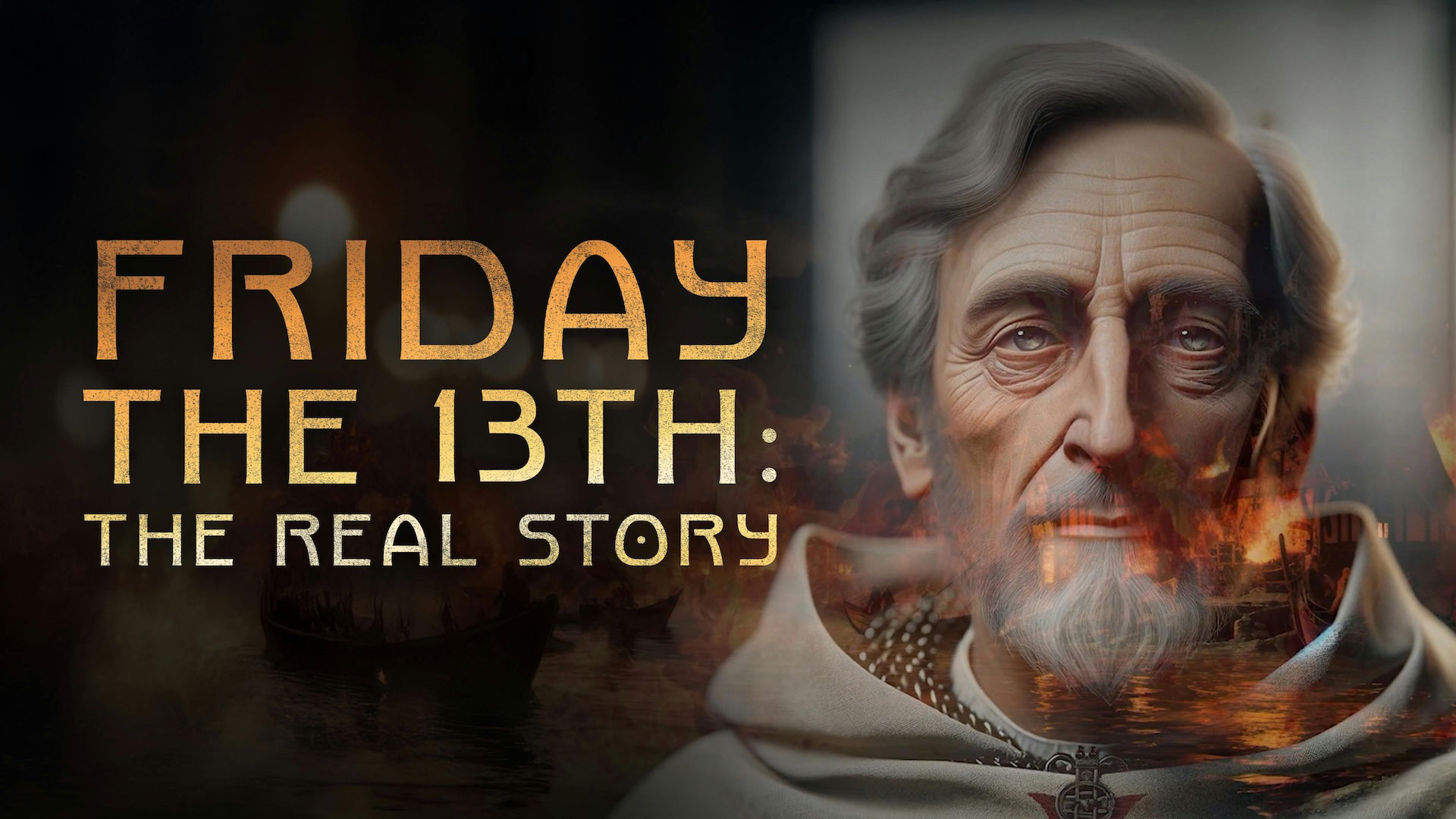
Then there are the Knights Templar. Their arrests in France began on Friday, October 13, 1307. The date is documented; the claim that it started the superstition lacks evidence connecting the two across the intervening centuries. The Library of Congress also cautions against the frequently repeated story of Loki arriving as a thirteenth dinner guest and causing Baldr’s death. The early Norse accounts do not tell that story in that form.
Gaia’s The Real Reason Friday the 13th Became Feared explores the Templar theory. Watch it as one interpretation of the date’s reputation, with that gap in the historical record in mind.
The Spiritual Meaning of Thirteen
Thirteen often appears in discussions of lunar cycles, sometimes with the claim that every year has thirteen moons. The astronomy needs a correction: the Moon’s phases repeat about every 29.5 days. Most calendar years contain twelve full moons; some contain thirteen. A lunar calendar and our January-to-December calendar do not line up neatly.
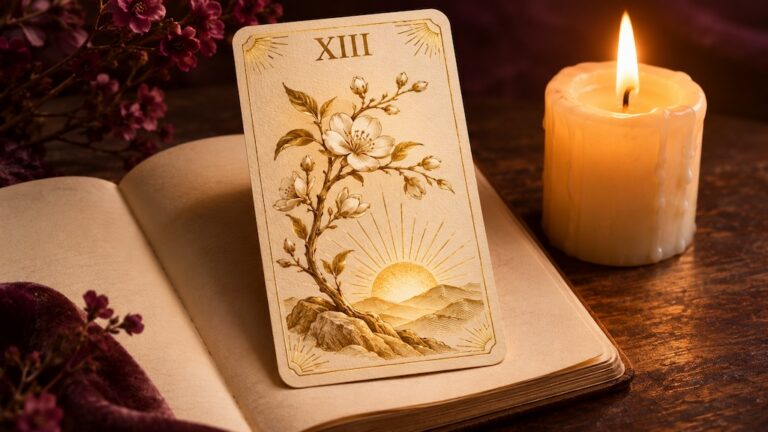
Tarot gives thirteen a different association. The Death card is numbered XIII, and many readers interpret it through endings and transformation. Llewellyn’s tarot reference includes change among its meanings. That symbolism can be uncomfortable without being a forecast of disaster. Leaving a job can be the right decision and still leave you unsure who you are on a Monday morning.
Death & Temperance: Thriving with Change, from Mystery Teachings of the Tarot, explores those cards together. It is a useful place to spend more time with the symbolism if the name of the Death card has always put you off.
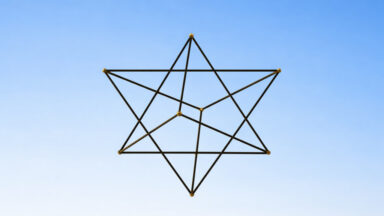
In contemporary sacred geometry, Metatron’s Cube is drawn using thirteen circles connected by straight lines. Practitioners explore the pattern as a representation of spiritual order. You can approach that interpretation through the drawing itself: follow the connections and notice the shapes that emerge as your eye moves across it. Robert Edward Grant explores the pattern and its relationship to perception in Metatron’s Cube: Lens of Perception, from Code X.
For another perspective, Numerology, from The Other Side, explores numbers as a way of examining personal patterns. These symbolic approaches leave room for interpretation. They do not require a number to dictate how your day will go.
Is Friday Freya’s Day
Friday also has a goddess connection, although the names are often tangled together. The Swedish History Museum traces the day’s name to Frigg, associated with marriage and motherhood. Freyja, also spelled Freya, is another Norse goddess with overlapping associations, and the two are frequently confused.
Gaia’s Friday – Freya’s Day meditation draws on Freya and Venus in a practice focused on love and self-worth. This contemporary approach gives those goddess associations a place in a weekly meditation practice.
A Meditation for Friday the 13th
If you would like to mark the day, set aside ten minutes for Friday – Freya’s Day, part of The Daily Wick: 7 Days of Meditation to Spark Magic. Find somewhere comfortable and put your phone out of reach once the practice is playing.
You might bring a question about something you are ready to change, or arrive with no particular intention. When the practice ends, give yourself a moment before opening your messages again.
About the Author

Do We Live in a Holographic Universe?

The Holographic Universe idea suggests that our universe contains a hidden order that connects every point to every other point in the universe. It tells us the whole of the universe is in every gram, thus providing subtle connections between seemingly unconnected events and places. This perspective also relates to the idea of a simulated or virtual universe, whereby our sensory experience is just an illusion produced by an artificial reality.
When you look around your surroundings, you get the feeling you’re living in a three-dimensional world full of visceral shapes, textures, patterns, and objects of all types. You have the feeling that you can interact with these physical objects and get an instantaneous subjective feeling in your body of their depth, size, temperature, texture and weight. This gives you a sense of the physical space around you and your location within it.
But what if this experience of space, location, and depth is all an illusion, a construct of your mind that is beautifully sustained from moment to moment? What if the apparent solidity and shape of the world around you is, in fact, an incredibly well-orchestrated hallucination produced by your brain. Perhaps we live in a purely informational space where matter and energy are not our reality’s fundamental qualities.
Believe it or not, a theory in physics that has been gaining traction recently is the Holographic Universe idea. It suggests to us that our perception of three dimensions is the product of our mind decoding information that arises from a two-dimensional, flat world. This occurs in the same way that a computer constructs a realistic, moving computer game from billions of bits of ones or zeroes embedded in a CD or hard drive. In other words, our senses are only perceiving information and not real physical objects, people, or things. That feeling of physicality is an illusion produced by our brain.