Healing with Sound, Frequency, and Vibration

Many associate illness and disease with prescriptions and interventions such as surgery. Allopathic medicine and science have traveled a narrow path built on chemical substances and sharp instruments rather than energy.
But the ancients recognized sound, vibration, and frequency as powerful forces that influence life all the way down to the cellular level. The gifted Greek philosopher Pythagoras prescribed music as medicine, asserting that the musical intervals he discovered are clear expressions of sacred geometry. He stated that music is the phenomena of numbers in time, reflecting the structures of nature, and has the power to restore balance in an organism.
Sound Healing Research
According to a study published by the National Institute of Health, “Music effectively reduces anxiety for medical and surgical patients and often reduces surgical and chronic pain. [Also,] Providing music to caregivers may be a strategy to improve empathy, compassion, and care.” In other words, music is not only good for patients; it’s good for those who care for them.
A 2010 Finnish study observed that stroke patients who were given access to music as cognitive therapy had improved recovery. Other research has shown that patients suffering from the loss of speech due to brain injury or stroke regain it more quickly by learning to sing before trying to speak. The phenomenon of music facilitating healing in the brain after a stroke is called the “Kenny Rogers Effect.”
For those struggling with addiction and substance dependencies, learning to play an instrument may play an important role in recovery. A study at the University of Wisconsin showed that exposure to the right music, tones, and frequencies produces dopamine, which is in short supply for the nervous system during the withdrawal process.
“If you want to find the secrets of the universe, think in terms of energy, frequency, and vibration.” —Nikola Tesla
Singing bowl bathing is gaining popularity as a method to reduce stress and anxiety and to promote well-being. Laying down with eyes closed, participants listen while different bowls are struck and toned by a practitioner.
Studies show that this practice, called “sound bathing,” directly reduces anxiety and depression; both are related to increases in disease. According to one study, “Sixty-two women and men with an average age of 50 reported significantly less tension, anger, fatigue, and depressed mood after sound sessions. Tibetan singing bowl meditation may be a feasible low-cost low technology intervention for reducing feelings of tension, anxiety, and depression, and increasing spiritual well-being.”
A study published in the Southern Medical Journal (2005) demonstrated the beneficial effects of music in hospital settings. Researchers reported that “For children and adults, music effectively reduces anxiety and improves mood for medical and surgical patients, and for patients in intensive care units.” Researchers also noted that ambient music increased empathy in caregivers without interfering with the technical aspects of treatment.
Can Sound Fight Cancer?
In 1981, biologist Helene Grimal partnered with composer Fabien Maman to study the relationship of sound waves to living cells. Maman was also an acupuncturist and had previously discovered that by using tuning forks and colored light on acupuncture points he could achieve equal and even greater results than he could with needles.
For 18 months, Grimal and Maman worked with the effects of 30-40 decibel sounds on human cells. With a camera mounted on a microscope, the researchers observed uterine cancer cells exposed to different acoustic instruments (guitar, gong, xylophone) as well as the human voice for 20-minute sessions.
Using the nine-note Ionian Scale (C-D-E-F-G-A-B-C-D), Grimal and Maman observed that when exposed to sound, cancer cells lost structural integrity until they exploded at the 14-minute mark. Far more dramatic was the sound of a human voice — the cells were destroyed at the nine-minute mark.
Next, Maman and Grimal worked with two women with breast cancer. For one month, the women devoted three-and-a-half hours a day to “toning,” or singing the scale. One woman’s tumor became undetectable, meaning it simply disappeared. The other woman underwent surgery. Her surgeon reported that her tumor had shrunk dramatically and “dried up.” It was removed and the woman had a complete recovery and remission.
Maman said, “Cancer cells cannot maintain their structure when specific sound wave frequencies attack the cytoplasmic and nuclear membranes. When the vibratory rate increases, the cells cannot adapt or stabilize themselves and die by disintegrating and exploding.”
Sound Healing Technology
According to a paper published on the Institute of Noetic Science website, “Since its development as a therapy in Australia over 40,000 years ago, sound healing has been used to aid in the treatment of mental and physical illnesses and injuries, as well as to assist in the dying process. Though originally performed using only the yidaki, or didgeridoo, sound healing now involves a wide array of instruments (tuning forks, crystal bowls, drums, ultrasonic devices) as well as human and animal vocalizations.”
One elegant piece of sound healing technology was the inspiration of alternative health practitioner Lilly Whitehawk. Combining her observations of the beneficial effects of specific sound frequencies with her knowledge of quantum physics and physiology, Whitehawk envisioned a healing tool combining ancient knowledge and modern technology. Confirming Maman’s findings, Whitehawk observed that the human voice is the most effective for sound healing, followed by singing bowls and tuning forks.
Partnering with a friend and client Larry Doochin, Whitehawk began the process of bringing her vision to life. “Larry had the faith in the project to go all in and help me make it happen,” she said. After working with a studio engineer, software, and hardware developers, the partners created the HUSO — a small box that delivers “uniquely enhanced human toning sounds” to the body via headphones and pads placed on acupuncture meridians.
Whitehawk believes that the body’s fascia, a network of fibrous tissue that wraps around organs and muscles, can carry toned frequencies throughout the body. The partners also discovered that digital recording technology eliminated essential subtle frequency ranges needed for optimal benefits and results, so they recorded in a “lossless” non-digital mode.
Their clients report improved general health and well-being, better sleep and mental focus, and enhanced performance. Parents of children with high sensitivity and ADD say that their children have better sleep and focus as well as enhanced self-regulation skills. “HUSO utilizes the scientific principles of resonance and entrainment to return an out-of-balance body system to health and harmony. It is non-invasive, safe, and effective,” Whitehawk said.
“The effect is similar to what happens when you experience authentic indigenous shamanic healing using sounds of chanting, toning, drums, rattles, whistles, flutes, and bells. You are hearing the sounds, but also feeling the vibrations from those sounds in your body. These are very powerful transformative experiences. I have seen miraculous things occur that modern science would say are impossible. Yet they happen… again and again,” Whitehawk said.
Sound, Frequency, and Pain Management
Medsonix, a publicly held company, manufactures a medical device that delivers low-frequency sound to increase blood flow and decrease inflammation and pain. Non-invasive and drug-free, the technology is used by health care providers for pain management.
Beginning at age 13, Donatella Moltisanti was plagued by excruciating menstrual pain leaving her bedridden for one full week out of each month. Things changed unexpectedly when Moltisanti began studying singing and music in her late teens. She noticed that she had less pain each month. Later she studied vocal techniques that brought additional healing to her body and could be of benefit to others. Over time, Moltisanti learned to combine her vocal gifts with a healing discipline that includes crystal and singing bowls.
Researchers at McGill University have established that music calms children visiting potentially frightening pediatric emergency rooms. Another study notes that patients who listened to soothing music experienced less pain during the insertion of intravenous (IV) tubing.
An article in “The British Journal of General Practice,” notes that music has a direct effect on pain levels. Responses to a questionnaire sent to a group of chronic pain patients showed that “Those who listened to music more frequently had a higher quality of life, suggesting that music can lessen chronic pain.”
The Future of Sound and Medicine
Quoting British physicist Colin McClare, Dr. Bruce Lipton said, “Information can be carried by chemistry, and information can be carried by vibration. The question is whether one is better than the other.” Lipton explains that chemical reactions transfer only about two percent of information — 98 percent dissipates as heat loss. Information transmitted by frequency and vibration (energy) passes nearly 100 percent of the information. Lipton added that chemical signals travel through fluids at a speed of about one foot per second; vibration, resonance, and frequency (sound) travel at 186,000 miles per second.
The visionary Rudolf Steiner said that “Pure tones will be used for healing before the end of the [20th] century.” Indeed, that has happened, but there is much work to be done in identifying how specific sound and energy frequencies affect the body in specific ways. But with the number of studies underway today, it should not be long before sound therapy technology is embraced by mainstream medicine as a powerful complementary therapy.
About the Author

IONS Study Finds Clairvoyants 'See' Reiki Healing in Action
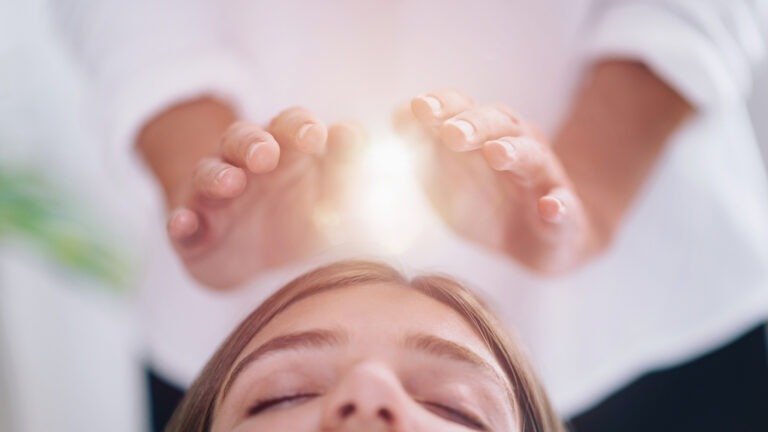
A groundbreaking new study shows that people with clairvoyant abilities can see energy healing take place. The implications for both the understanding of these extra-sensory abilities and the healing field- are profound.
The Institute of Noetic Sciences, or IONS, has just released the results of an important study that shows that energy healing works and that clairvoyants can pick up information about the healing by using their extended perception.
Dr. Helanè Wahbeh is the head of research at IONS and the study lead.
“Clairvoyance essentially is the experience of being able to see things around people — see within their body and around their body — and gain information in a way that is beyond our normal sight,” Wahbeh said.
“Sometimes this shows up as colors, sometimes people can see illness in other’s bodies; what might be called ‘medical intuition.’ Anyone can learn how to be a clairvoyant seer, in fact, there are people who teach medical intuitive classes. I’ve talked to many teachers who say ‘[A]s long as the person believes that they can, they can actually learn how to do this.’ That doesn’t mean that everyone is going to be excellent at it, but that the baseline level skill is learnable by anyone who is willing to try and believes that they can.”
Researchers sought to examine these abilities within the context of a study of Reiki, a popular Japanese energy healing modality. In the study, 40 participants with varying health issues were given half-hour Reiki sessions, which were then shown to improve their wellbeing. While the sessions were taking place, a group of six experienced clairvoyant seers observed.