Platonic Solids: The Language of the Universe

“Philosophy is written in this grand book, the universe, which stands continually open to our gaze.
But the book cannot be understood unless one first learns to comprehend the language and read the letters in which it is composed.
“It is written in the language of mathematics, and its characters are triangles, circles and other geometric figures without which it is humanly impossible to understand a single word of it; without these, one wanders about in a dark labyrinth.”
—Galileo Galilei (1564 – 1642)
And since none of us would consciously choose to wander about in a dark labyrinth for very long, let’s get a little more familiar with the letters that compose the language in which the universe is written.
The Platonic Solids are, at their essence, the basic shapes that underlie observable reality. These five forms govern the structure of everything from atoms to planetary orbits, and if we desire to comprehend “this grand book, the universe,” then we are well-advised to study the characters.
We’ll begin by connecting the five solids to the five-element theory proposed by many ancient healing modalities — in this case, Ayurveda. Having established the relevance of these shapes to the human body, we’ll explore the micro and macro realms as well to see if there are any useful connections to be made.
Five Elements
Sankhya is one of the most ancient natural philosophies still alive on planet Earth today and is the source for Ayurveda’s concept of the body. The Sankhya philosophical system proposes that everything created on this plane of existence is a compound of five essential elements. Planets, people, plants and atmospheric particulate alike are all just a conglomerate of earth, water, fire, and air interacting within the ether.
Earth is the densest element, the stuff of rock and bone, giving solidity and form. Water is the universal solvent and the ruling archetype for all fluids, including rivers and oceans of course, but also plasma and mucous. Fire is the only element that gives heat and is responsible for all transformative processes such as digestion. Air is the element of mobility, carrying ideas, inspiration, and disease around the cosmos and our bodies.
Ether, or Akash, is commonly called “space,” and that is accurate insofar as it is everywhere around and within us. It is the vacuum; the matrix; space through which we move; the three-dimensional field in which we arise, survive, and transform. It is within the ethereal container that the other four elements dance and intertwine.
Elementary Geometry
The interaction of the five elements is well described by the five regular polyhedra known as the Platonic Solids. These are the only three-dimensional shapes that are perfectly symmetrical in every direction, with every internal angle and side length the same. According to Plato, each solid corresponds to a specific element:
The cube corresponds to earth; the icosahedron corresponds to water; the tetrahedron corresponds to fire; the octahedron corresponds to air, and the dodecahedron corresponds to ether.
Looking at the shape of the sides, we notice that three of the five Platonic Solids are composed of equilateral triangles – the icosahedron, tetrahedron and octahedron, representing water, fire, and air, respectively. The two exceptions are the cube and dodecahedron – earth and ether – which are built of squares and pentagons, respectively.
The triangle represents the number three, which in the story of creation according to sacred geometry is truly a magic, catalytic number. Three is the number of proliferation and completion. Triumvirates dominate this dimension in the form of Father, Son, and Holy Ghost; Brahma, Vishnu, and Shiva; beginning, middle and end; Mom, Dad, and child; waking, dreaming and deep sleep; past, present, and future; space, time and observer, and so on.
With that in mind, one way to understand the interaction of elements is to see them as sets of triangles crashing into one another and combining to make different sets of triangles.
Water, fire, and air are in this constant dance, intermingling to make bigger triangles and dissolving into tinier fragments. Is this not a simplified description of what we call chemistry?
Plato himself is said to have given the following example in order to make abstract teaching more real to our experience. It is commonly understood that something spicy must be associated with the fire element, and thus the tetrahedron. The tetrahedron is a very sharp shape, with spiked angles that you can imagine would be very prickly if you had several million of them in your mouth. This points to the burning sharpness of spicy food.
On the other hand, more soothing, creamy foods are associated with the water element, and thus the icosahedron. The icosahedron has twenty sides, with much duller angles, very near to a sphere. Compared to the tetrahedron, you can imagine how the roundness of this shape is far more gentle, sweet, and pleasing to the tongue.
Air, represented by the octahedron, is nothing but two tetrahedrons stacked back to back. Ayurvedically speaking, foods with a predominance of the air element is considered very dry and rough, difficult to digest, like popcorn or crackers. There is a certain intuitive logic to how these shapes connect to our experiential reality if you are willing to tune in and do the experiment.
Somewhat outside this process, although not entirely immune, is the square-based cube, representing earth. As the densest element, it makes sense that each of its sides is made of not one, but two triangles (aka a square). The eight square sides that make up a cube are indicative of the infinite potential of material creation, as well as the power of stability, as the number eight is both an upright infinity symbol and a perfectly balanced shape suggesting, as above, so below.
Outside the triangular paradigm altogether is the five-sided pentagon that makes up the dodecahedron. Given that the ether acts as a container for the other elements, it only makes sense that it is not overly susceptible to entanglement.
That being said, a pentagon can be created by five inwardly-directed triangles (though not equilateral), which is appropriate as well, since even the ether is within the third-dimensional realm and not entirely devoid of physical characteristics.
Generally speaking, though, the dodecahedron is the outlier of the group, and rightfully so since its role is to hold space for the ongoing dance performed primarily by the other four elements.
The Fluidity of Ether
Observing the relationships between the Platonic Solids, one may notice that the icosahedron is the precise inverse of the dodecahedron. This is to say, if you connect the center points of all twelve pentagons that compose the etheric element, you will have created the twelve corners of the watery icosahedron.
This is intriguing because what we have thus far been able to observe of the ether indicates that it does indeed behave like a fluid. Granted, measuring and observing the ether has proven rather difficult to this point, due to its all-encompassing pervasiveness. How can one measure something from which one cannot escape? And if we cannot measure it, how can we be sure that it even exists?
We have little trouble measuring the other elements: the kinetic mass of earth; the chemical reactions made soluble by water; the radiant heat of fire; the volts of electric wind. These are relatively effortlessly observed, standing “continually open to our gaze” as they do. But the super subtle ether evades easy detection.
Einstein’s Theory of Relativity predicts the existence of the ether, requiring that “physical space has physical qualities.” Indeed, this hypothesis has recently been proven by the direct detection of the gravitational waves created when two black holes collide. In February of 2016, scientists at LIGO were able to measure actual ripples in the fabric of space-time.
This is big news! It is the last major piece of Einstein’s famous Theory of General Relativity to be experimentally verified and for our purposes here, demonstrates that massive gravitational forces behave just like water. When the black holes collide, they send waves of gravity rippling out through the very fabric of space-time, just like a still pond disturbed by a stone.
This being the case, we can learn a great deal about the nature of the ether by studying fluid dynamics. Water is far easier to access and observe than ether, so we can take clues from the spiraling of water down a drain, or the path of a hurricane to better understand what is happening at a more subtle level way out in the universe, or way deep within, all the same.
From Micro to Macro
Beginning on page 328 of The Source Field Investigations, David Wilcock describes the work of Dr. Robert Moon in exploring how the Platonic Solids govern the structure of any given atom, accurately predicting the number of protons found therein.
“The cube, with eight protons… corresponds to oxygen, which is highly stable — and makes up 62.55% of all the atoms in the Earth’s crust.” According to Dr. Moon, the eight corners of the cube indicate eight protons. This gives scientific credence to the assertion that the cube shape is associated with the esoteric earth element.
Using this model, we can extrapolate the entire periodic table of elements, stacking several solids together to create the larger, less stable structures. This is a very exciting reimagining of how chemistry functions. Dr. Moon was involved in the Manhattan Project and his model may prove useful in cold fusion experiments as well as many other applications beyond the scope of this author’s current awareness.
Moon’s atomic model was inspired by Johannes Kepler, who suggested a model of the solar system based on the Platonic Solids all nested within one another. This conception of the planetary orbits is not only an elegant wish but a mathematical reality.
On page 337 of Source Field, Wilcock tells us that “the spacing of planetary orbits in our solar system [can] be precisely defined by the Platonic Solids… the planets are apparently being held in place and driven through their orbits by the same geometric forces that very likely create atoms and molecules.”
This is by no means a new idea. Many scientists and philosophers before have suggested that the micro is essentially a reflection of the macrocosm. What is exciting in this case, is the mathematical precision with which we can make this assertion.
Pulling just one of many examples from John Martineau’s magical classic, A Little Book of Coincidence, wherein “the sphere” refers to the orbit of a given planet, Wilcock tells us how “the distance between the sphere of Venus and the sphere of Mars is precisely defined by the dodecahedron… Then, if you flip this dodecahedron inside out to get the icosahedron, you can fit a larger sphere inside of it — and that happens to be the exact distance of Earth’s orbit.”
To use the word “coincidence” in describing such astonishing alignments is clearly tongue-in-cheek. Such elegant arrangements must be the result of a divine architect. Whether we choose to name this Nature or God matters very little. What seems to matter is that by studying the creation, we come to better know ourselves as both created and Creator.
These shapes, the Platonic Solids, are the letters of the alphabet of the third-dimension. Once we have these as a key, we can decode many of the mysteries of the observable universe.
If these patterns govern atomic structures and planetary orbits, they must also influence the human form, which exists in the exact middle of those micro and macro forces.
As an Ayurvedic practitioner, I am extremely excited to continue exploring the potentials for healing offered by this conceptual understanding. Each of the five elements is specifically associated with one of the five senses, with an organ of action, with color and chakras. Now we know that they also have a specific shape.
What are the practical applications of this knowledge? I invite you to explore these potentials in your own mind and body. Meditate on these shapes and see what changes take place. Practice drawing them, or better yet, build models of the solids using construction paper to become acquainted with their physical qualities. I promise you such exercises will reveal valuable insights into your own true nature, and literally reshape the way you see the world around you.
Enjoy the journey!
About the Author

What Are the Platonic Solids, Pillars of Sacred Geometry?
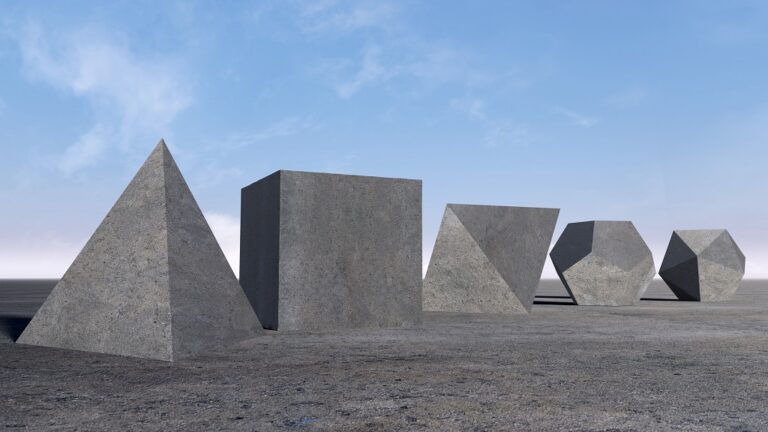
Platonic solids are highly symmetrical three-dimensional geometric figures that have fascinated mathematicians, philosophers and mystics for centuries. They are considered the fundamental building blocks of creation in the universe, representing essential elements and profound spiritual concepts. In this article we explore what Platonic solids are, their origin, their spiritual significance and their connection to sacred geometry.
Table of Contents
- What Are Platonic Solids?
- Where Does the Name of Platonic Solids Come From?
- One by One: The 5 Platonic Solids
- Platonic Solids in Sacred Geometry
- History and Origin of Platonic Solids
What Are Platonic Solids?
Platonic solids are five geometric figures: the tetrahedron, the hexahedron (cube), the octahedron, the dodecahedron and the icosahedron. Each of them has equal faces, edges and angles, which gives them perfect symmetry. These geometric shapes were studied by the Greek philosopher Plato, who associated them with the fundamental elements of nature.
These solids are not only mathematically interesting, but also have deep significance in sacred geometry. They are believed to be the basic patterns that form the structure of the universe, from subatomic particles to galaxies. The symmetry and balance of Platonic solids reflect the inherent harmony of the cosmos.
In the series Sacred Geometry: Spiritual Science available on Gaia, Dr. Robert J. Gilbert explores how Platonic solids are essential to understanding the structure of the universe and our own inner energies. Through his teachings, he reveals how these geometric shapes can be used in spiritual and meditative practices to enhance spiritual awareness and connection.
Where Does the Name of Platonic Solids Come From?
The name “Platonic solids” comes from the Greek philosopher Plato, who described them in his work “Timaeus”. Plato linked each of these solids to the five classical elements: earth, air, fire, water and ether. According to Plato, these elements formed the basis of all matter in the universe, and the Platonic solids represented the perfect structure of each of these elements.
Plato was not the first to discover these forms, but he was the one who popularized them and gave them philosophical and cosmological significance. His association of solids with the fundamental elements influenced philosophy and science for centuries, highlighting the importance of geometry in understanding the physical and spiritual world.
One by One: The 5 Platonic Solids
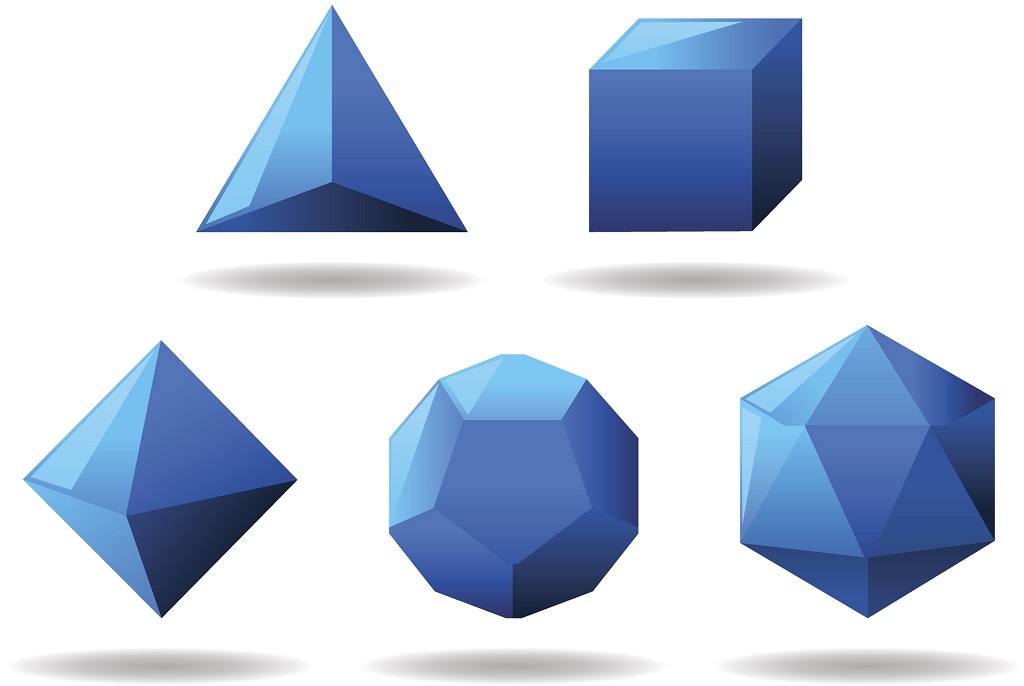
The five Platonic solids are the tetrahedron, hexahedron (cube), octahedron, dodecahedron and icosahedron. Each of these solids has equal faces, edges and angles, which gives them perfect symmetry.
-
The Tetrahedron
The tetrahedron has four triangular faces, six edges and four vertices. It represents the element of fire and is associated with the solar plexus chakra. This solid symbolizes transformation and dynamic energy, and is used in meditative practices to manifest desires and promote mental clarity.
-
The Hexahedron (Cube)
The hexahedron, better known as a cube, has six square faces, twelve edges and eight vertices. It represents the earth element and is related to the root chakra. The cube symbolizes stability and solidity, providing a firm and secure foundation on both the physical and spiritual planes.
-
The Octahedron
The octahedron has eight triangular faces, twelve edges and six vertices. This solid is associated with the air element and the heart chakra. It represents balance and harmony, and is used to improve communication and promote mental and emotional clarity.
-
The Dodecahedron
The dodecahedron has twelve pentagonal faces, thirty edges and twenty vertices. It represents the ether or the universe and is associated with the crown chakra. This solid symbolizes connection with the cosmos and exploration of the mysteries of the universe, encouraging spiritual expansion and higher consciousness.
-
The Icosahedron
The icosahedron has twenty triangular faces, thirty edges and twelve vertices. It represents the water element and is related to the sacral chakra. This solid symbolizes fluidity and adaptability, promoting creativity and emotional expression in spiritual practices.
Platonic Solids in Sacred Geometry
In Sacred Geometry, the Platonic solids are considered the most basic and fundamental forms that make up the structure of the universe. These geometric forms, with their perfect symmetry and proportions, are seen as the building blocks of the cosmos, used at various levels of creation, from microscopic to macroscopic structures. Their symmetry reflects the harmony and order inherent in nature.
Each platonic solid has unique properties that make them powerful tools in meditation and energy practices. For example, the tetrahedron can be used to focus intention and manifest desires, while the cube helps to stabilize and ground energy. The octahedron promotes mental and emotional clarity, the icosahedron enhances fluidity and creativity, and the dodecahedron facilitates connection with the divine and expansion of consciousness.
The application of Platonic solids in sacred geometry is not only limited to spiritual practices; they are also found in art, architecture and science, demonstrating their relevance throughout the ages. These forms serve as bridges between the physical and the spiritual, providing a solid foundation for exploring and understanding the energies that surround us and the structures that make up our universe.
History and Origin of Platonic Solids
The history of Platonic solids dates back to ancient Greece, where they were first studied by the followers of Pythagoras and later described in detail by Plato in his dialogue “Timaeus”. Plato related each of these solids to the fundamental elements of the universe, attributing deep cosmological meanings to them and using them to explain the structure of matter and the cosmos.
In addition to Plato, other Greek mathematicians and philosophers, such as Euclid, also studied and formalized the geometric properties of these solids. Euclid, in his work “Elements”, defined and proved the properties of the Platonic solids, establishing a solid basis for geometry that would influence mathematics for centuries.
During the Renaissance, interest in Platonic solids resurfaced, especially through the work of the astronomer Johannes Kepler. Kepler used these solids to explain planetary orbits in his “Mysterium Cosmographicum”, proposing that the distances between the planets were related to the Platonic solids. Throughout history, these geometric shapes have continued to inspire scientists, artists and mystics, establishing themselves as symbols of harmony and perfection in the structure of the universe.