The 24 Nordic Runes and Their Meanings
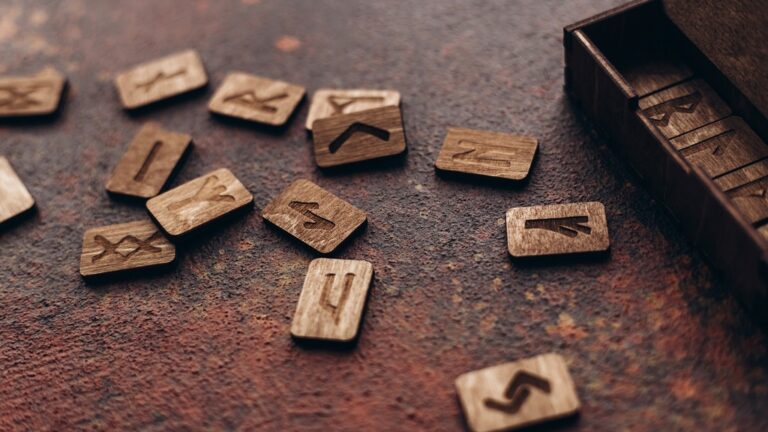
Norse runes are an ancient writing system used by the Germanic and Scandinavian peoples, which also serves a spiritual and symbolic function. This alphabet, known as Futhark, is composed of 24 runes, each with a unique meaning that connects to aspects of life, nature and spirituality. In this article we explore the origin of the Norse runes, their purpose and the meaning behind each of these fascinating symbols.
Table of Contents
- What Are the Nordic Runes?
- Exploring the 24 Norse Runes and Their Meanings
- History and Origin of the Nordic Runes
What Are the Nordic Runes?
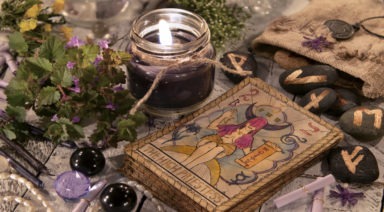
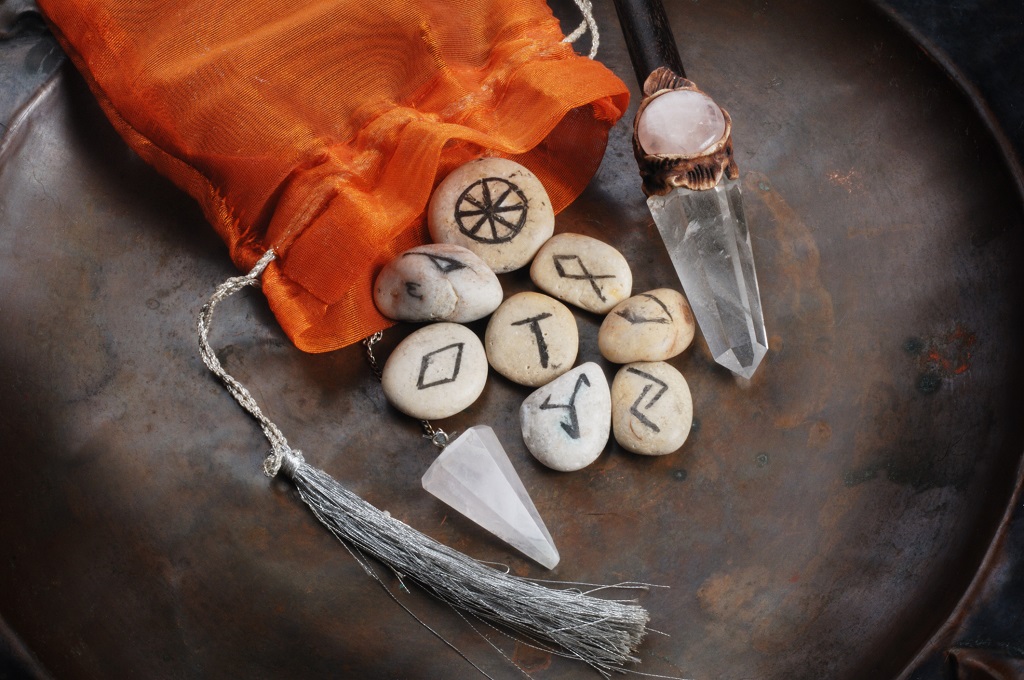
Norse runes represent an ancient writing system dating back to the time of the Germanic and Viking peoples. Beyond their practical use as an alphabet, each rune possessed a deep meaning linked to ideas such as protection, wisdom or the cycles of life. These runes were not only engraved on stones and wood, but also on talismans and ritual objects, reflecting their connection to the mystical.
The best known runic system is the ancient Futhark, composed of 24 symbols, organized into three groups or aettir. These runes were used both as a tool of communication and divination, allowing the ancient Scandinavians to interpret messages of destiny and guide important decisions. This dualism between the practical and the spiritual makes the runes a bridge between the earthly and the divine.
Exploring the 24 Norse Runes and Their Meanings
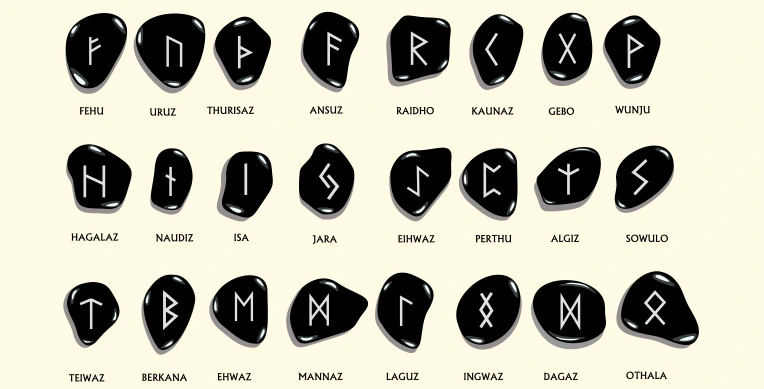
The ancient Futhark, the runic alphabet composed of 24 symbols, is divided into three groups called aettir. Each group covers essential themes of life and reflects aspects related to human existence, from beginnings and prosperity to challenges and transformation.
Runes of the Fehu Group: Beginning and Prosperity
This group brings together symbols that represent the flow of creative energy, wealth and balance at the beginning of a cycle. The runes that compose it stand out for their connection with the materialization of ideas, stability and harmony. Here is a breakdown of their meaning:
- Fehu (wealth): Symbolizes prosperity, abundance and success in projects. It represents the energy of resources in motion, reminding us that sharing and managing well what we have is key to maintaining balance.
- Uruz (strength): Represents vitality and inner power to overcome challenges. This rune is also associated with renewal and personal transformation.
- Thurisaz (the giant): It is a rune of protection and defense against adversity. It also invites us to reflect before making important decisions, helping us to act wisely.
- Ansuz (communication): Related to divine knowledge and clear expression, this rune symbolizes the importance of listening and sharing ideas. It also favors the reception of intuitive and spiritual messages.
- Raidho (the journey): Represents movement, both physical and spiritual, and progress on our life path. It reminds us that each experience is part of a larger journey towards personal growth.
- Kenaz (the torch): Symbolizes enlightenment, creativity and knowledge. It is a rune that guides us in the search for hidden truths and the expression of our passion.
- Gebo (the gift): Associated with generosity and balance in relationships, this rune represents reciprocity and fair exchange. It teaches us the importance of maintaining a harmonious relationship between giving and receiving.
- Wunjo (joy): Represents satisfaction, happiness and harmony. This rune indicates that, after the challenges, comes a period of success and well-being.
Hagalaz Group Runes: Transformation and Challenges
The runes of this group are associated with overcoming trials, profound change and cycles of destruction and renewal. They represent uncontrollable forces of nature and life that push us to adapt and grow. These runes remind us that, although the road may be difficult, challenges prepare us for a stronger rebirth.
- Hagalaz (the hailstorm): Symbolizes the destruction that gives way to renewal. It teaches us that difficulties, although painful, are necessary to eliminate the old and make room for the new.
- Nauthiz (the need): Represents perseverance in the face of obstacles and the importance of facing limitations with patience. It reminds us that, even in times of scarcity, overcoming is possible if we work hard.
- Isa (ice): Symbolizes stagnation and the trials associated with immobility. It invites us to reflect and avoid paralysis due to fear or indecision, while waiting for the right moment to come.
- Jera (the annual cycle): Represents the fruits of our actions, which come at the right time. This rune reminds us that every effort has its reward, but only when the time is propitious.
- Eihwaz (endurance): Symbolizes strength in the face of adversity and the ability to transform fears into personal growth. It is a rune that inspires us to resist even in the most difficult moments.
- Perthro (destiny): Represents the unknown, the mysteries and the acceptance of what we cannot control. It teaches us to adapt to the unexpected and to trust the flow of life.
- Algiz (protection): This is a rune of defense and protection against negative forces. It reminds us that the connection with our intuition and spiritual guidance can protect us in difficult times.
- Sowilo (the sun): Symbolizes the clarity and success that comes after overcoming the shadows. It is a rune that encourages us to seek the light and inner strength to move forward with confidence.
Runes of the Tiwaz Group: Honor and Strength
This group is associated with sacrifice, justice and the courage needed to stand up for what is right. Tiwaz runes represent virtues such as integrity, leadership and determination, reminding us that success often requires perseverance and a deep commitment to our values.
- Tiwaz (justice): Associated with the god Tyr, it symbolizes sacrifice for the common good and the search for truth. It inspires us to act with honor and courage, even in the face of difficult challenges.
- Berkano (rebirth): Represents new beginnings, fertility and personal growth. This rune teaches us that change and regeneration are essential for progress.
- Ehwaz (the horse): Symbolizes mutual trust and collaboration in relationships or projects. It reminds us of the importance of moving forward as a team towards a common goal.
- Mannaz (humanity): Represents connection with others, cooperation and mutual support. This rune reminds us that our strength lies in our relationships and community.
- Laguz (water): Symbolizes intuition, emotions and the power of the unconscious. It teaches us to flow with circumstances and to trust our inner wisdom.
- Ingwaz (fertility): Represents the latent potential and the development of new ideas or projects. It is a rune of incubation that invites us to wait for the right moment to act.
- Dagaz (dawn): Symbolizes enlightenment and transformation that leads to new beginnings. It reminds us that after darkness always comes light.
- Othala (heritage): Represents roots, family and ancestral legacy. It teaches us to honor our traditions while using that knowledge to build our future.
History and Origin of the Nordic Runes
Norse runes emerged in ancient Germanic and Scandinavian cultures around the 2nd century AD. This writing system, known as ancient Futhark, was engraved on stones, weapons and tools, serving both practical and ceremonial functions. Each symbol had a profound meaning and was seen as a bridge between the earthly world and spiritual forces.
The design of the runes was deeply linked to the beliefs of the time, which venerated the forces of nature and the Norse gods. According to mythology, Odin, the god of wisdom, obtained the knowledge of the runes through an extreme sacrifice, hanging himself from the World Tree, Yggdrasil, for nine days and nights. This mythological account highlights the sacredness of the runes and their connection to the divine, giving them an essential role in the spiritual life of these cultures.
-
Runes as a Divination Tool
In ancient times, runes were used to interpret destiny and receive guidance in times of uncertainty. Practitioners would cast them on a surface and analyze their disposition to decipher messages about the present and possible futures. This method was based on the belief that runes could connect those who used them with higher energies, offering clarity and wisdom.
Today, runes continue to be a spiritual resource for many people. They are used in both personal readings and group ceremonies, where the meaning of each rune is interpreted according to the overall context. Their purpose is not limited to foreseeing the future, but also helps to explore inner issues and make decisions in harmony with one’s life purpose.
-
Runes in Rituals and Spiritual Practices
In addition to their divinatory use, runes have a prominent place in spiritual rituals. Each symbol is considered to carry a specific energy, and is used in talismans, amulets or even meditations to channel its strength. These practices seek to harmonize people with the energies represented by the runes, allowing a deeper connection with nature and the cosmos.
Sacred chants, known as Galdr, are also part of runic practices. By chanting specific sounds associated with each rune, practitioners empower their intention and activate the energies they represent. These ceremonies combine tradition and spirituality, inviting you to explore the transformative power of runes and their ability to guide you towards personal balance.
-
The Legacy of the Norse Runes
Over time, the spread of Christianity in Europe displaced the use of runes, which were replaced by Latin alphabets. However, their symbolism and mysticism have endured over the centuries. Today, runes are recognized as a powerful bridge between ancient traditions and modern spiritual practices. Inspiring generations of seekers, these ancient inscriptions continue to be a source of wisdom, spiritual connection and self-discovery, keeping their legacy alive.
About the Author

What Is a Spiritual Quantum Leap and How It Manifests

A spiritual quantum leap is a profound shift in the way we perceive and understand our reality. It doesn’t happen outside of us, but within, when we expand our consciousness and access a broader vision of who we are and why we experience what we experience.
In this article we explore what a spiritual quantum leap is, how it relates to the fifth dimension, and what signs indicate we are going through one.
Table of Contents
- What Is a Quantum Leap on the Spiritual Path?
- The Quantum Leap as a Shift in Consciousness and Perception
- What Is the Relationship Between the Quantum Leap and the Fifth Dimension?
- How to Know if You Are Going Through a Quantum Leap?
- Can a Quantum Leap Be Triggered Consciously?
- Examples of Quantum Leaps in Everyday Life
- The Quantum Leap as the Beginning of a New Stage
What Is a Quantum Leap on the Spiritual Path?
On the spiritual path, a quantum leap does not refer to physically moving from one place to another, but to an internal shift that allows us to see life from a different perspective. It is as if something settles within us and, suddenly, the pieces begin to make sense. That transformation does not depend on what happens outside, but on how we understand it from a new level of consciousness.
This type of shift occurs when we begin to integrate different aspects of our existence. The third dimension is the one we perceive with the physical body, related to space. The fourth dimension is time: our history, our memories, everything that changes. And the fifth dimension appears when we manage to see that entire process together, as if we were standing before a mirror that reflects not only the present, but also the meaning of what has been lived and what is yet to come.
In the series Initiation, available on Gaia, Matías De Stefano shows how this type of transformation is part of the natural process of the soul. Through his connection with the Akashic Records, he reveals how the different dimensions relate to one another and how shifts in consciousness help us remember who we are beyond time and space.
The Quantum Leap as a Shift in Consciousness and Perception
When a person goes through a quantum leap, they stop seeing their life as a succession of separate events. They begin to perceive that each experience has a purpose and that everything lived is part of a greater process. This new consciousness allows one to let go of the idea that things “just happen,” and in its place a deeper understanding of the why and the what-for of what we experience emerges.
This type of perception is not theoretical. It is experienced directly: sometimes as an inner sense of certainty, other times as a deep connection with a wiser version of oneself. In that experience, one may feel guided, not by something external, but by a more conscious aspect of one’s own being. It is a clarity that does not come from the mind, but from the integration of all the dimensions we inhabit.
In this state, time no longer feels like a line running from past to future. Instead, everything is perceived simultaneously: what I was, what I am, and what I will be. That expansion allows us to live with less fear, with more direction, and with a more loving understanding of our own path. The quantum leap, then, is also a way of remembering that we are not lost, but in full process of integration.
What Is the Relationship Between the Quantum Leap and the Fifth Dimension?
The fifth dimension is not a place one travels to, but a level of consciousness from which we can see the complete process of our existence. While in the third dimension we live the physical and in the fourth we experience time, the fifth integrates both: space and time unify. From there, we can observe ourselves as if standing before a mirror that reflects not only who we are now, but also who we have been and who we can become.
A quantum leap occurs when we manage to access that perspective. That is, when we stop identifying only with what happens to us and begin to understand the purpose behind our experiences. In that moment, we project ourselves toward a more expanded version of ourselves. We no longer live only from experience, but also from the observation and awareness of the entire process.
According to Matías De Stefano, the fifth dimension is the dimension of clarity. In that state, we understand that everything we live has a meaning and that we can guide ourselves from a wiser place. That is why quantum leaps are directly related to the activation of this consciousness: they are not random movements, but expansions that connect us with our own inner guidance, that part of us that already knows where we are headed.
How to Know if You Are Going Through a Quantum Leap?
Going through a quantum leap is not always obvious at first. It can feel confusing, challenging, or even destabilizing. However, there are certain signs that indicate something profound is shifting within you:
- Shift in perspective: You begin to see your experiences from a different place. What once seemed like a problem you now understand as an opportunity to grow.
- Greater inner clarity: Even without having all the answers, you feel that something is aligning. A sense of purpose appears that was not there before.
- Emotional detachment: Old wounds or conflicts lose their grip. You can remember what hurt you without getting trapped in that emotion.
- More active intuition: You begin to receive messages, ideas, or sensations that seem to come “from somewhere else.” They are not logical thoughts, but you know they make sense to you.
- Sense of connection: You feel more united with everything around you. A perception of unity arises that goes beyond the mental or emotional.

Can a Quantum Leap Be Triggered Consciously?
A quantum leap can occur spontaneously, but it is also possible to facilitate it consciously. This happens when a person begins to look at their life with a clear intention to understand it, rather than simply reacting to what occurs. It is not about forcing a change, but about opening up to a new way of seeing and feeling what is already present.
Self-awareness is the key to initiating this process. By attentively observing one’s own thoughts, emotions, and patterns, an inner space is created where a deeper understanding can emerge. In that space, it becomes possible to release old structures that no longer make sense and give way to a more coherent version of oneself.
Although there is no single technique, there are practices that can help: meditation, silence, contact with nature, reflective writing, or spiritual study. What matters is not what is done, but from where it is done. When actions arise from a genuine desire to evolve and remember who we are beyond the everyday persona, the quantum leap becomes a real possibility.
Examples of Quantum Leaps in Everyday Life
Quantum leaps are not always accompanied by mystical or extraordinary experiences. Many times they manifest in simple yet profoundly transformative ways:
- Choosing to release control: Instead of insisting that everything go as expected, trust appears. That surrender brings a peace that was previously unknown.
- Seeing a conflict from a different place: What once generated anger or pain begins to be seen with understanding. The way of reacting changes and a repetitive pattern is broken.
- Reconnecting with a purpose: After years of routine, a clarity emerges about what one truly wants to do. That decision marks a before and an after.
- Accepting a loss with love: Instead of remaining trapped in sadness, the value of what was lived is understood. Pain transforms into wisdom.
- Listening to the inner voice: Something within guides an action without logical explanation. Later, that decision proves to have been the right one, even though it made no sense at the time.
The Quantum Leap as the Beginning of a New Stage
Going through a quantum leap does not mean having reached a final destination, but opening the door to a new way of living. Although the process can feel intense or disorderly at first, over time it becomes evident that something has changed in an irreversible way. What once seemed chaotic now has a different order.
In this new stage, decisions are made from a more conscious place. There is greater coherence between what is thought, felt, and done. This does not mean that challenges disappear, but that they are faced from a different perspective, with more clarity and less reactivity.
It is also common that, after a quantum leap, relationships, priorities, and one’s relationship with the surrounding environment shift. Many times a need to simplify, to be more authentic, or to follow paths that once seemed distant is experienced. It is as if something internal begins to align everything else.
This transformation does not happen overnight, but once begun, it makes a profound difference. The quantum leap is not just an event — it is a turning point. And most importantly: it reminds us that we can always change direction, expand our consciousness, and choose to live in a way that is more connected with who we truly are.