What Is Synchronicity: Signs That Guide Your Path

Synchronicity is a phenomenon where seemingly unrelated events coincide in a meaningful way, offering important clues and messages in our lives. These meaningful coincidences not only defy traditional logic, but can also guide us and give us a sense of purpose. In this article we explore what synchronicity is, its relationship to the work of Carl Jung, and how we can interpret and foster these events in our daily lives.
Table of Contents
- What Is the Principle of Synchronicity?
- Jung and Synchronicity
- Examples of Synchronicities in Everyday Life
- How to Interpret Synchronicities?
- Who Sends Us the Signals?
- Can the Occurrence of Synchronicities Be Encouraged?
What Is the Principle of Synchronicity?
Synchronicity refers to the occurrence of two or more events that, although they have no obvious causal relationship, are perceived as meaningfully connected by the observer. This phenomenon defies logical explanation and suggests the existence of a deeper order in the universe. Synchronicities often occur at times of need or major change, offering guidance and confirmation on the path of life.
Many describe synchronicity as a feeling of being in tune with life, where events align in a perfect and meaningful way. These events can manifest in a variety of ways, such as finding a book that answers a crucial question or meeting a person who transforms your life. Synchronicity invites us to become more aware of our surroundings and the messages they send us.
In the series Waking Infinity, available on Gaia, Ben Stewart delves into how synchronicity can influence our daily lives, exploring case studies and interviews with experts that reveal the interconnectedness between significant events.
Jung and Synchronicity
Carl Jung, the renowned Swiss psychiatrist, introduced the concept of synchronicity as part of his work in analytical psychology. For Jung, these synchronous events were evidence of the connection between the individual and the collective unconscious, a deep level of the mind that all human beings share. He considered synchronicity as a bridge between the inner world of the psyche and the outer world of physical reality.
Jung observed that synchronicities often occur during times of intense personal or spiritual transformation. These events function as signals that help us to better understand our circumstances and find meaning in our lives. Jung also believed that synchronicity was an expression of the interconnectedness of all things, reflecting an underlying order in the universe that goes beyond linear causality.
Jung’s interest in synchronicity was reflected in his extensive research and the numerous case studies he documented. Jung argued that paying attention to these significant coincidences could facilitate a greater understanding of oneself and the world, promoting deeper psychological and spiritual development.
Examples of Synchronicities in Everyday Life
Synchronicity can manifest in our lives in many ways, from small details to significant events that change the course of our existence. Here are some examples of synchronicities that many people experience:
- Chance meeting with a key person: Meeting someone by “chance” who turns out to be crucial to an important project or aspect of your life. This encounter may open up new opportunities or provide the solution to a problem you have been trying to solve for some time.
- Book that answers questions: Finding a book that precisely answers a question you’ve been asking yourself. This can happen when you are browsing in a bookstore with no clear direction and suddenly stumble upon the perfect work.
- Premonitory dreams: Dreaming of an event or situation that later occurs in reality. These dreams often provide clarity or warning about important situations.
- Repetitive messages: Repeatedly seeing a number, word or symbol in different contexts. These messages can be seen as signals that are guiding you in a specific direction or confirming a decision.
- Unexpected opportunities: Receiving a job offer, an invitation or an opportunity that comes along just when you need it most. These opportunities often seem to come out of the blue, without warning.
- Meaningful song: Listen to a song in various places that has special meaning for you. This song may appear at critical times, providing comfort or inspiration.
- Lost objects that reappear: Finding a lost object at the exact moment you think of it or need its presence. This can be a reminder that you are on the right track.
How to Interpret Synchronicities?
Interpreting synchronicities requires a combination of open-mindedness and personal reflection. It is critical to recognize these events as they occur and to pay attention to the emotions and thoughts that accompany them. These feelings can offer clues to the underlying message of the synchronicity and its relevance to your life. It’s not just about noticing coincidences, but understanding how they make you feel and what thoughts they provoke in you.
Reflect on the context in which the synchronicity occurred and how it relates to your current circumstances. Ask yourself what was going on in your life at the time and what questions or dilemmas were present in your mind. Consider whether the synchronicity may be responding to a specific need or pointing you in a direction you should take.
Finally, it is helpful to keep a synchronicity journal where you can write down these events and your reflections on them. Over time, you may begin to see patterns or recurring themes that help you better understand the message the universe is trying to send you. This process of ongoing documentation and reflection not only allows you to better interpret synchronicities, but also strengthens your connection with your intuition and helps you make decisions that are more aligned with your personal purpose.
Who Sends Us the Signals?
Signs that we interpret as synchronicities can be seen as messages from our Spirit Guides. These guides may include angels, ancestors or spiritual entities that seek to help us achieve our purpose and well-being. Through various forms of communication, these beings attempt to guide and protect us, offering us signs that guide us at key moments in our lives.
From another perspective, synchronicities can be understood as manifestations of our subconscious. Our subconscious, through dreams, intuitions and synchronistic events, sends us signals to pay attention to certain aspects of our life. These manifestations can arise to give us answers to deep questions and to guide us towards decisions that align us with our true self.
Whether the signals come from spirit guides or from our own subconscious, the objective is the same: to help us move through life with greater clarity and purpose. Recognizing and accepting these synchronicities allows us to open ourselves to a deeper dimension of our existence, where each significant event has the potential to guide us toward personal growth and fulfillment.
Can the Occurrence of Synchronicities Be Encouraged?
An effective way to encourage the appearance of synchronicities in our lives is to ask for them directly. By clearly expressing our desires and needs, we are inviting our spirit guides to send us signals and responses. In doing so, we open a channel of communication with the universe that allows us to be more receptive to synchronicities that manifest as responses to our requests.
Maintaining an attitude of openness and curiosity is also important. Avoiding skepticism and the need to rationalize everything allows us to accept synchronicities as a natural part of life. Trusting that the universe has mysterious ways of communicating with us helps us to be more receptive to these experiences and to allow ourselves to be guided by them. In addition, keeping a journal of synchronicities and reflecting on them can help us identify patterns and better understand their meaning, strengthening our connection to the flow of life and increasing our ability to notice and interpret these significant events.
About the Author

Name Numerology: What Your Name Says About You
Your name has been with you from the beginning: you hear it, sign it, respond to it, and carry it through every stage of your life. Rarely, however, do you stop to look at it closely. Numerology proposes exactly that: observing it not only as a form of identification, but as a key that can reveal aspects of your deeper identity.
In this article, we explore what your name reveals about you, which main numbers arise from it, and how to calculate them step by step.
Table of Contents
- Numerology and Its Relationship With Names
- The Three Main Numbers of Your Name
- How to Calculate the Numbers of Your Name Step by Step
- What Name Numerology Is For
Numerology and Its Relationship With Names
Numerology begins with a very ancient idea: that numbers are not only used to measure or count, but also hold a meaning of their own. Each digit, from 1 to 9, is associated with a set of specific qualities. The name is one of the elements this discipline uses as the basis for its interpretation, because it turns something as everyday as your letters into a symbolic key to who you are.
To arrive at that meaning, it starts from a simple principle: each letter corresponds to a number. In this way, your full name stops being only a set of sounds and becomes a sequence of digits that can be added together and interpreted. That sequence, once deciphered, begins to speak about your way of being.
There is something particular about working with the name: you did not choose it yourself, it was given to you at birth and, over time, became inseparable from who you are. Numerology uses it as a starting point to talk about you. What it offers, ultimately, is one more language for knowing yourself.
In the episode Numerology from the series The Other Side, available on Gaia, numbers are explored as a symbolic language for better understanding personal experience. There, numerology is presented not as a form of divination, but as a tool for observing who you are, how you show up in the world, and what patterns appear on your path.
The Three Main Numbers of Your Name
When working with the full name, there are three numbers that are considered especially important: the Destiny or Expression Number, the Soul Urge Number, and the Personality Number. Each one is calculated using a different part of the name and reveals a specific dimension of your way of being.
It may help to think of them as three levels of interpretation. One speaks of your visible potential, another of your inner motivation, and another of the image you project. They do not compete with each other: they complement one another.
-
The Destiny or Expression Number
The Destiny Number, also called the Expression Number, is calculated by adding all the letters of the full name. It is one of the broadest numbers in the analysis because it takes the entirety of the name into account, not just one part.
It is related to your talents, abilities, and personal resources. It speaks of the way you tend to act, create, solve, build, or communicate when you express your potential with greater clarity.
It does not indicate a fixed destiny or a series of inevitable events. Rather, it points to the tools you have available to move forward on your path and the way you can develop what is already within you.
-
The Soul Urge Number
The Soul Urge Number is calculated only with the vowels of the full name. In numerology, vowels are associated with a person’s innermost dimension: what they desire, value, and need in order to feel aligned.
This number can help you recognize what truly moves you, even when you do not express it in an obvious way. Sometimes it appears in quiet decisions: a choice that may seem illogical from the outside, but feels necessary within.
It can also reveal tensions between what you deeply want and what you do out of habit, obligation, or external expectation. That is why it is often a very useful number for reviewing motivations, relationships, and important decisions.
-
The Personality Number
The Personality Number is obtained from the consonants of the full name. Unlike the Soul Urge Number, it does not focus on what you feel inside, but on the way you show yourself to the outside world.
This number describes the first impression you can create, the type of energy you communicate, and certain traits that others often perceive easily. Depending on the result, it can speak of a more reserved, firm, sensitive, creative, practical, or expansive image.
Knowing it does not mean adjusting your behavior to be more pleasing to others. It helps you observe whether the way you are perceived matches what you feel you are, or whether there is something in the way you express yourself that you could refine in order to relate with greater authenticity.
How to Calculate the Numbers of Your Name Step by Step
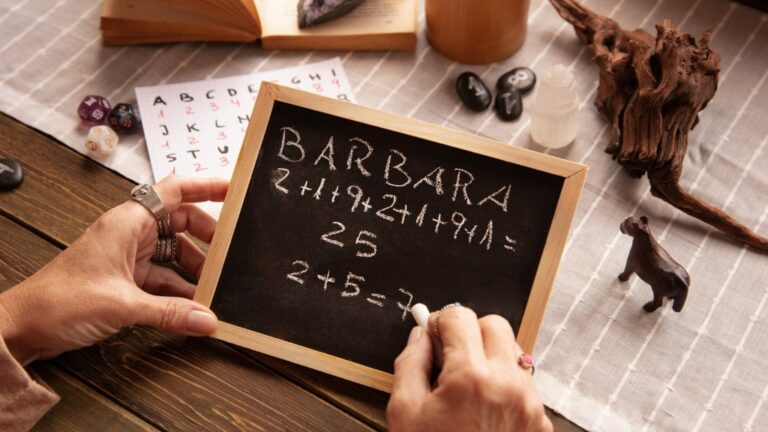
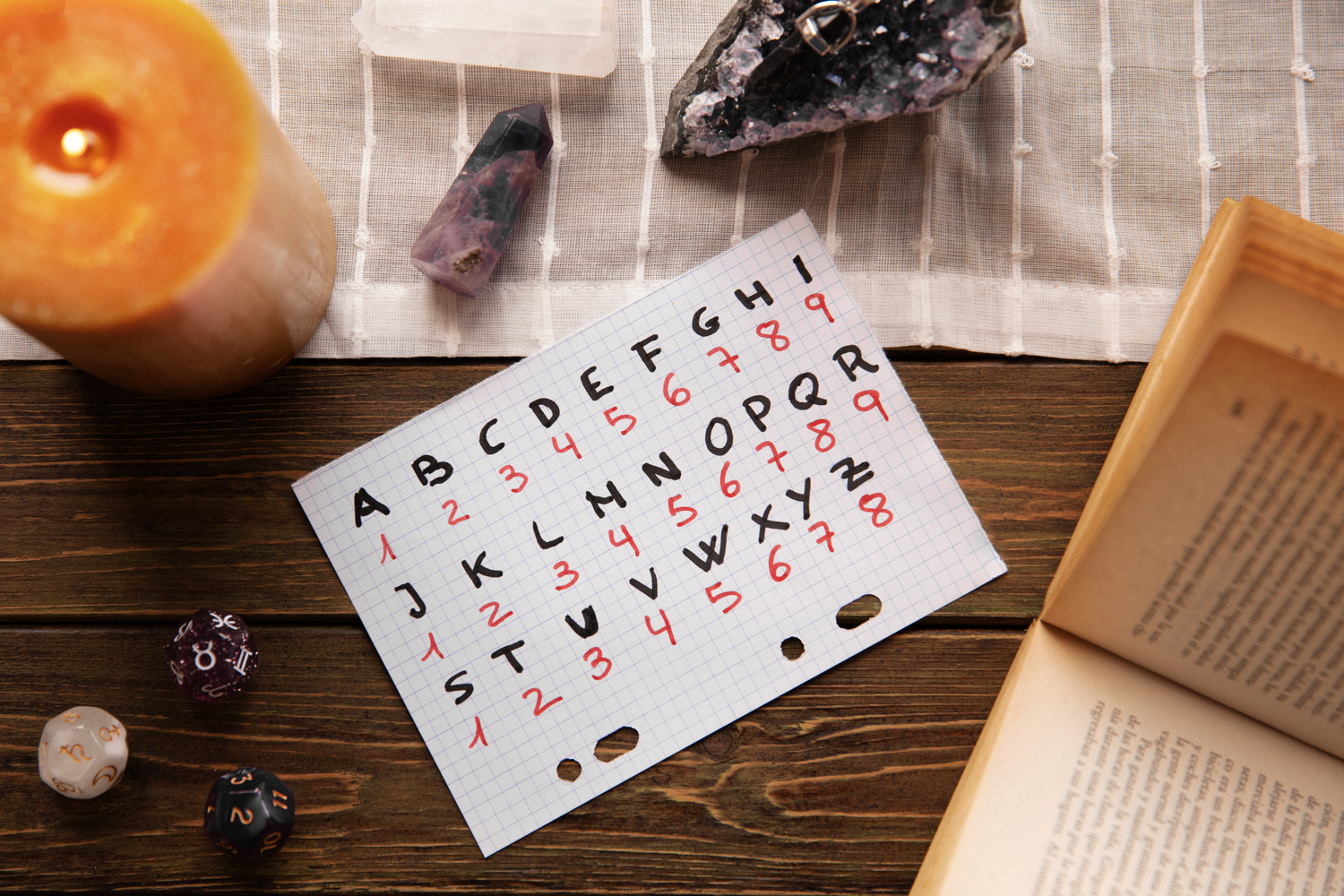
To calculate these numbers, you first need to convert each letter into its corresponding value according to the Pythagorean table. Then you make different sums depending on the number you want to obtain: all the letters for the Destiny or Expression Number, only the vowels for the Soul Urge Number, and only the consonants for the Personality Number.
The process is simple, but it is best to do it calmly. Write your full name, separate vowels and consonants, and check each letter before adding. In names with accents or special characters, the base letter is usually used for numerological calculations.
-
The Pythagorean Table Letter by Letter
The Pythagorean table assigns a number from 1 to 9 to each letter of the alphabet. The full correspondence is as follows:
- 1: A, J, S
- 2: B, K, T
- 3: C, L, U
- 4: D, M, V
- 5: E, N, W
- 6: F, O, X
- 7: G, P, Y
- 8: H, Q, Z
- 9: I, R
With this table, you can convert any name into a numerical sequence. Then, you only have to add and reduce the result until you obtain a number from 1 to 9, unless a master number appears: 11, 22, or 33.
-
Practical Example With a Full Name
Let’s take the name Olivia Carter as an example. First, each letter is replaced by its numerical value:
O (6) + L (3) + I (9) + V (4) + I (9) + A (1) + C (3) + A (1) + R (9) + T (2) + E (5) + R (9)
The total sum is:
6 + 3 + 9 + 4 + 9 + 1 + 3 + 1 + 9 + 2 + 5 + 9 = 61
6 + 1 = 7
In this case, the Destiny or Expression Number is 7.
To calculate the Soul Urge Number, only the vowels are taken:
O (6) + I (9) + I (9) + A (1) + A (1) + E (5) = 31
3 + 1 = 4
The Soul Urge Number is 4.
To calculate the Personality Number, only the consonants are taken:
L (3) + V (4) + C (3) + R (9) + T (2) + R (9) = 30
3 + 0 = 3
The Personality Number is 3. In this way, the same name offers three different readings: one about the potential for expression, another about inner motivation, and another about the image projected toward others.
-
What to Do With Master Numbers (11, 22, and 33)
Master numbers in numerology are 11, 22, and 33. When a sum reaches one of these results, it is not reduced further. That is, if by adding the letters you obtain 11, you do not turn it into 2; if you obtain 22, you do not turn it into 4; and if you obtain 33, you do not turn it into 6.
These numbers are interpreted as vibrations of greater symbolic intensity. This means they may indicate a broader potential, but also more demanding challenges when it comes to integrating that energy into everyday life. They do not indicate that a person is “better” or “more advanced”; they simply require a more careful reading.
It is also useful to remember that each master number contains the base of its reduction: 11 is linked to 2, 22 to 4, and 33 to 6. That is why, when interpreting them, both their elevated qualities and their simpler, everyday expressions are observed.
What Name Numerology Is For
Knowing the numbers that arise from your full name can be a form of self-knowledge. This does not mean that every description will match you exactly, or that you should adjust yourself to a fixed interpretation. It works more like a mirror: it shows you certain tendencies so you can observe them, question them, and understand yourself better.
This reading can help you distinguish between what moves you inside, what you express through your actions, and what others perceive in you. Perhaps you discover that your Soul Urge Number points to a need for stability, while your Personality Number projects a much more changeable or restless image. That difference can give you clues as to why others sometimes expect an energy from you that does not always match what you truly need.
It can also be useful when making decisions. You can ask yourself: Does this respond to what truly moves me? Does it allow me to use my abilities? Does the way I am presenting myself reflect what I want to communicate? The answers do not depend only on a number, but the calculation can give you a concrete reference point from which to look more honestly.
As with the birth chart, numerology does not replace your discernment or fully define who you are. It offers a symbolic language for looking at your experience from another angle. Used with discernment, it can help you recognize patterns, organize inner questions, and make decisions that are more aligned with who you are, not only with what others expect to see in you.