Women’s Circles: A Complete Guide to Getting Started
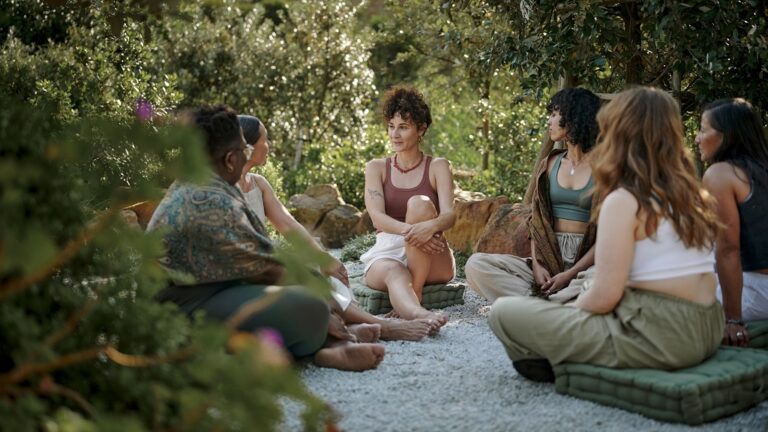
Women’s circles provide a safe environment where women can connect deeply, share their stories and support each other. These spaces facilitate personal and spiritual growth through connection and sharing of experiences. In this article we explore what women’s circles are, their purpose and how they can transform lives.
Table of Contents
- What Are Women's Circles and How Do They Work?
- The Purpose of Women's Circles
- How Women's Circles Are Structured
- Common Topics Shared in Women's Circles
- Who Can Facilitate a Women's Circle?
- The Origin and History of Women's Circles
What Are Women’s Circles and How Do They Work?
A women’s circle is a gathering of women who congregate to support each other, share experiences and work together on their personal and spiritual growth. These circles can take various shapes and sizes, but all share the common goal of providing a safe and supportive space where women can express themselves freely and without judgment.
These gatherings often include practices that foster connection and healing, such as guided meditations, symbolic rituals and creative activities. Women’s circles are based on trust and confidentiality, creating an environment where each participant feels heard and valued.
The Purpose of Women’s Circles
The primary purpose of a women’s circle is to provide a space where women can explore and develop their personal and collective power. These circles foster deep connection and emotional support, helping participants feel more connected to themselves and to each other.
In addition, women’s circles seek to promote healing and empowerment. By sharing their stories and experiences, women can release repressed emotions and find comfort in the solidarity of the group. This process of sharing and listening allows participants to heal emotional wounds and strengthen their resilience.
How Women’s Circles Are Structured
Women’s circles develop through a well-defined structure that allows participants to connect and share effectively. This structure can vary, but generally includes specific stages that facilitate the flow of the meeting and ensure that all participants have the opportunity to express themselves.
- Welcome and Opening: Begin with an introduction and a brief meditation or breathing exercise to center the group. This initial moment sets a tone of calm and connection.
- Sharing in a circle: Each woman has the opportunity to speak while the others listen attentively and without interruption. This is a key moment for personal expression and mutual support.
- Core activity: A specific activity such as a ritual, a guided meditation practice, or a group dynamic can be included. These activities foster connection and personal growth.
- Closing and reflection: The circle ends with a group reflection where participants share their experiences and learning. This closing helps to integrate what was experienced during the meeting and to strengthen the sense of community.
Common Topics Shared in Women’s Circles
The topics of conversation in a women’s circle are deeply intimate and reflect the personal and collective experiences of the participants. These topics allow women to connect at deep levels, sharing and healing together their most significant stories and emotions.
- Life stories and trauma: Women share their life stories, including traumatic events that have shaped who they are today. This exchange promotes empathy and mutual understanding. Talking about these issues in a safe environment helps heal deep emotional wounds.
- Motherhood and Fertility: Experiences related to motherhood are discussed, including the challenges of fertility and loss. Women share their joys and sorrows related to motherhood. This topic creates a supportive space for those seeking or experiencing motherhood.
- Body and sexuality: Conversations revolve around body acceptance and exploration of sexuality. Participants share their experiences and challenges in these areas, promoting a positive and healthy view of sexuality. This topic helps to break taboos and encourage self-acceptance.
- Complex family relationships: Women address difficult family dynamics and how these have influenced their lives. Strategies for managing toxic relationships and finding inner peace are discussed. This topic is vital to understanding and healing the roots of many emotional conflicts.
- Violence and abuse: A safe space is created for women to talk about experiences of violence and abuse they have suffered. Sharing these stories allows them to release their pain and find support and solidarity. This topic is crucial for empowerment and the recovery of personal autonomy.
- Dreams and aspirations: Women discuss their personal and professional dreams and goals. Sharing these aspirations allows them to receive support and motivation from the group. This topic helps participants visualize and work toward a desired future.
Who Can Facilitate a Women’s Circle?
Any woman with a desire to create a safe and supportive space for other women can facilitate a women’s circle. No specific training is necessary, although leadership skills and empathy are beneficial. The facilitator must be able to maintain order, encourage participation and ensure that all voices are heard.
The facilitator should also be aware of the importance of confidentiality and trust within the circle. Creating an environment in which all participants feel comfortable sharing their stories and emotions is crucial to the success of the group. The facilitator should be a supportive figure, guiding the discussions so that everyone feels valued and respected.
The Origin and History of Women’s Circles
Women’s circles have their roots in ancient community traditions that valued the power of the female gathering for healing and shared wisdom. In many indigenous cultures, women gathered regularly to share knowledge, perform rituals and support each other in their roles within the community. These gatherings were essential to the social and spiritual well-being of the group.
Over time, these practices have evolved and adapted to modern contexts. During the feminist movement of the 1970s, women’s circles re-emerged as spaces of empowerment and resistance. Women began to meet to discuss their experiences and fight for their rights, creating a critical support network for the movement.
Today, women’s circles continue to be a vital space for connection and personal growth. They are held all over the world, in both urban and rural settings, and cover a wide range of topics and approaches. From spiritual development to emotional support, these circles offer a haven where women can explore and celebrate their collective identity and strength.
These spaces not only allow us to share stories and experiences, but also to build a supportive community. Women’s circles provide a place where understanding, empathy and healing are fostered, continually adapting to the needs and challenges of women in every era and culture.
About the Author

7 Self-Knowledge Exercises To Truly Discover Who You Are

Self-knowledge is a process of inner exploration that helps us understand how we think, what we feel, and why we act the way we do. It involves looking inward with honesty, acknowledging both our strengths and limitations.
In this article, we explore why it’s important to know ourselves, how to begin that journey, and which practical exercises can help us discover who we really are.
Table of Contents
- The Importance Of Discovering Who We Are
- How To Begin Our Path Toward Self-Knowledge
- Self-Knowledge Activities To Deepen Our Understanding Of Ourselves
- Writing A Personal Journal
- Answering Deep Self-Knowledge Questions
- Taking A Personality Test
- Exploring The Birth Chart
- link text=”Using Cards As A Tool For Symbolic Introspection” url=”#using-cards-as-a-tool-for-symbolic-introspection” target=”_self” /]
- Exploring Our Personality With The Enneagram
- Analyzing Our Wheel Of Life To Detect Imbalances
- Explore More Self-Knowledge Tools On Gaia
- Integrating Self-Knowledge Into Everyday Life
The Importance Of Discovering Who We Are
Many times we go through life following routines, expectations, or obligations without asking ourselves if what we do is actually connected to who we are deep down. We may reach certain goals or meet what’s expected of us, but if we do it from a place of disconnection, it’s common to feel exhausted, empty, or find it hard to see real meaning in what we do. Living without an inner compass can lead us to make decisions that don’t represent us and to maintain relationships or lifestyles that pull us away from our essence.
On the other hand, when we begin to understand what moves us, what we value, and what we need, decisions stop being automatic. A sense of internal order arises, which is reflected in how we live, how we relate, and how we respond to daily challenges. Living from our truth, even if it brings discomfort or uncertainty at first, brings a deeper sense of calm—less dependent on what’s outside.
This process of knowing ourselves isn’t a goal we reach once and for all—it’s a constant practice cultivated in everyday life. It is a way of being in relationship with ourselves: observing ourselves honestly, questioning our beliefs, reviewing what we choose and what we avoid. And in that movement of self-exploration and reconstruction, we gain clarity, depth, and meaning.
How To Begin Our Path Toward Self-Knowledge
Self-knowledge begins with an internal decision: to look at ourselves with more attention. Sometimes, it’s enough to pause for a moment, take a deep breath, and notice what’s happening inside us. That small pause can be the starting point for establishing a more conscious relationship with our inner world.
Over time, that space of observation becomes clearer and more natural. We begin to notice recurring thoughts, emotions that are hard to express, or decisions we make without questioning them. It’s not about correcting everything at once, but about recognizing what’s there so we can act with greater clarity and meaning.
Self-Knowledge Activities To Deepen Our Understanding Of Ourselves
If we feel the urge to know ourselves better but don’t know where to begin, we can rely on certain practices that offer us valuable guidance. Writing in a journal, answering reflective questions, or taking a personality test can help us see more clearly what we think, feel, and do.
These tools don’t offer definitive answers, but they do open inner doors that are worth exploring. What’s essential is to maintain an honest attitude and openness to the process.
-
Writing A Personal Journal
Keeping a journal is a simple yet powerful practice for exploring what we think and feel. By recording our daily experiences, we can detect emotional patterns, recurring reactions, or themes that need attention. You can also practice automatic writing, with no filters or corrections, to connect with deeper parts of your inner world.
-
Answering Deep Self-Knowledge Questions
Asking ourselves deep questions can open up spaces that usually remain hidden. Questions like “What gives us meaning?”, “What are we avoiding?”, or “What do we need to let go of?” activate reflection and allow us to explore motivations, fears, and desires we may not have previously considered. It doesn’t matter if no immediate answer comes—the very act of asking already sets the process in motion.
-
Taking A Personality Test
Taking a personality test can help us put into words certain traits or tendencies that are part of who we are. Tools like MBTI, DISC or the Big Five offer frameworks for understanding how we think, how we relate to others, and what kind of environment supports our development. It’s not about labeling ourselves, but about gaining clarity on how we function internally.
-
Exploring The Birth Chart
The birth chart reflects the configuration of the sky at the moment of our birth. Through its symbols and archetypes, we can identify emotional patterns, relationship styles, talents, and personal challenges. It is a symbolic guide that does not define who we are, but it does allow us to understand ourselves from a broader and deeper perspective.
-
Using Cards As A Tool For Symbolic Introspection
Tarot, oracle, or archetype cards can serve as gateways to our inner world, through images, symbols, and intuitive associations. By asking a question and observing the card that emerges, a dialogue with the unconscious opens. It’s not about predicting the future, but about giving shape and language to what we may not yet be able to see clearly.
-
Exploring Our Personality With The Enneagram
The Enneagram is a system of nine personality types that describes how we perceive the world, how we react to our environment, and what we seek on an emotional level. Recognizing our type allows us to more consciously observe our automatic behaviors, fears, and deep motivations. From there, we can work on our growth with more clarity and direction.
-
Analyzing Our Wheel Of Life To Detect Imbalances
The Wheel of Life is a visual exercise that helps us assess how we feel in different areas: health, relationships, purpose, work, finances, among others. By completing it, we can identify which areas are balanced and which need attention. It is a practical tool to focus our energy more consciously and in alignment.
Explore More Self-Knowledge Tools On Gaia
On Gaia you’ll find a wide variety of content designed to support you in your self-knowledge process. There are series, documentaries, courses, and guided practices that cover all the topics we’ve discussed in this article: astrology, enneagram, meditation, tarot, personal development, and more. These resources are designed to help you go deeper into your inner world with clear, accessible, and high-quality information.
An excellent place to start is with the series Transcendence, which offers a comprehensive view of how mind, body, and consciousness are connected. It’s an introductory program that combines science, spirituality, and practical tools to help you begin to know yourself from a broader and more transformative perspective.
Integrating Self-Knowledge Into Everyday Life
Knowing ourselves doesn’t mean much if we leave it at the level of reflection. True value arises when we begin to bring that understanding into daily life: into how we make decisions, how we set boundaries, and how we respond when something makes us uncomfortable. Self-knowledge becomes alive when it influences our actions—not just our thoughts.
Integrating what we discover takes practice and patience. Sometimes it means making small adjustments, other times holding onto decisions that may not be comfortable. It’s not about getting it perfect, but about staying aware of when we stray from what we know is true for us—and choosing to return.
Over time, this internal work translates into a more honest relationship with ourselves. We learn to listen before reacting, to recognize when we need to pause, and to choose from a more conscious place. That is one possible closure for this journey: not arriving at a final answer, but continuing to inhabit the process with greater clarity and presence.