These Ancient Civilizations Knew About Our Third Eye
The Seat of the Soul
The significance of the pineal gland has been the subject of investigation for centuries, with its first documentation tracing back to a Greek doctor and philosopher known as Galen. Galen’s colleagues believed the pineal regulated the flow of ‘psychic pneuma,’ or an ethereal substance referred to as ‘the first instrument of the soul.’ But Galen refuted this, instead, thinking the pineal was simply a gland that regulated blood flow.
A resurgence of supernatural characteristics associated with the pineal returned when René Descartes took interest in it. He asserted it was ‘the principal seat of the soul,’ and believed it to be the source of all thought. Descartes was essentially credited with reflex theory or the involuntary system of actions carried out in the body’s function.

René Descartes
He thought of this in the sense that the mind could be separated from the body, with the ability to take over the animal instincts, making its entrance through the pineal gland. Descartes believed the pineal was unique because it did not have a matching pair, like most other sensory organs.
“It must necessarily be the case that the impressions which enter by the two eyes or by the two ears, and so on, unite with each other in some part of the body before being considered by the soul. Now it is impossible to find any such place in the whole head except this gland; moreover, it is situated in the most suitable possible place for this purpose, in the middle of all the concavities.” – Réne Descartes
Hinduism’s Third Eye
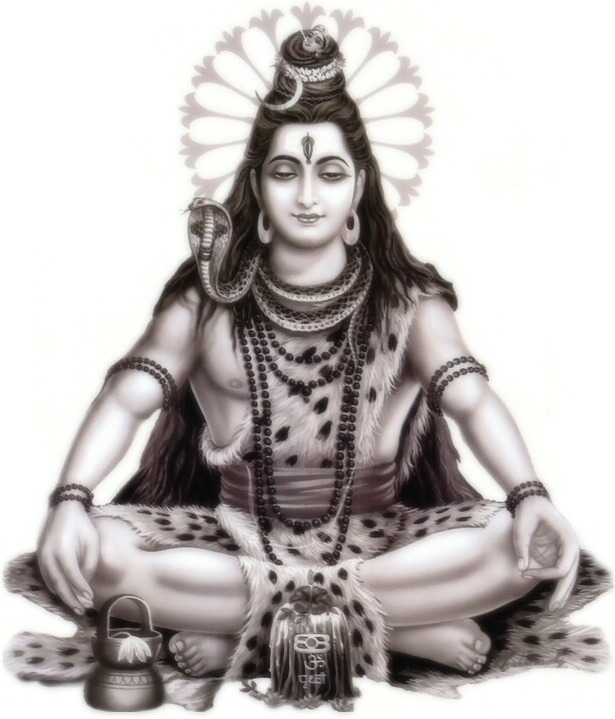
Shiva and other Hindu deities are often depicted with a literal third eye on their forehead. This eye represents an awakening, or enlightenment, as the ability to see into higher realms of existence and consciousness. Many interpret this third eye as the pineal gland.
Shiva’s dreaded hair wrapped in snakes looks strikingly similar to a pinecone, the namesake of the gland itself. Snakes in Hinduism are thought to be auspicious, most notably seen in imagery surrounding Kundalini Yoga. The body’s chakras are often depicted in Kundalini by a winged staff encircled by two snakes, or a Caduceus as it is known in Greek mythology. The snakes meet at the Ajna chakra, where the pineal and pituitary glands are located. This chakra is known as the source of consciousness, with Ajna translating to command or guidance.
Ancient Egypt’s Eye of Horus/Eye of Ra
Many are familiar with the Eye of Ra and the Eye of Horus from ancient Egyptian iconography. Aside from the eye’s striking resemblance to a lateral view of the pineal gland within the brain, these depictions in Egyptian hieroglyphs are always singular. In addition to its lack of a counterpart, it was often drawn on the center of the foreheads on sarcophagi. Another reference to the location of the pineal, mirroring Hindu mythology is that of a snake emerging from the center of the forehead, also seen on pharaohs’ sarcophagi. Egyptians regarded the snake auspiciously as well, associating it with wisdom.

Pinecone Imagery
Many portrayals of Sumerian gods depict a pinecone extended in one hand. These gods are believed to be a representation of the Anunnaki, or an ancient extraterrestrial visitor race and their ability to access the pineal for its consciousness-expanding abilities. Pinecones can be found in ancient Greek mythology on the staff of Dionysus, or his Roman iteration Bacchus.

A pinecone staff with snakes wrapped around it is also carried by Osiris in Egyptian lore. Cambodian temples in Angkor Wat bear a striking resemblance to pinecones and there is even a massive pinecone statue at the Vatican, originally situated next to a temple for the Egyptian god Isis, in ancient Rome.
These ancient ancestors clearly had a healthy awareness of our pineal gland and the mysticism surrounding its connection to a higher level of consciousness. Its pinecone shape adds to the mysterious symbolism seen across cultures. It comes as no surprise that the pinecone also forms in a sacred geometric pattern from Fibonacci’s golden ratio.
What did our ancestors know about the pineal gland that we don’t?
About the Author

Research Confirms Intention Affects Structure of Water Pt. 1

Groundbreaking new studies have been published on the power of the mind to change the structure of water and even help stem cells grow.
Water, the most plentiful substance on Earth, has been shown to have the unique properties of recording and storing information. For this reason, it has recently been used as a target in the scientific study of mind-matter interactions.
Dr. Dean Radin is the Chief Scientist at the Institute of Noetic Sciences, or IONS, which has for the last 50 years been at the forefront of studying the frontiers of consciousness. Since 2006, Radin has led several studies on the effect of mental intention on water, culminating with a groundbreaking just-published experiment.
“We’re interested in mind-matter interactions where water is the target because we are composed mostly of water,” Radin said. “One of the questions then — when it comes to any kind of psychic healing, distance healing, energy medicine — maybe the reason why it works is because the mind can influence properties of water because then it would obviously influence all of us.”
“So, some years ago we did some studies to look at the claims of Dr. (Masaru) Emoto, who had become famous as the result of putting different kinds of mental intentions into water and then making little frozen crystals, and his claim was that if you think beautiful thoughts at the water as you make the crystals, the crystals will look beautiful, and if you think ugly thoughts, then you get ugly looking crystals,” Radin said.
When IONS conducted two rigorous studies to validate Dr. Emoto’s work, the scientists found that the effect held; the quality of the intention placed on the water directly affected the configuration of the crystals.
In another more recent study, Radin and his team explored the effect of intention on water as part of an experiment looking at energy healing.