Gifts From the Divine; Lightning Strike Survivors Gain Abilities
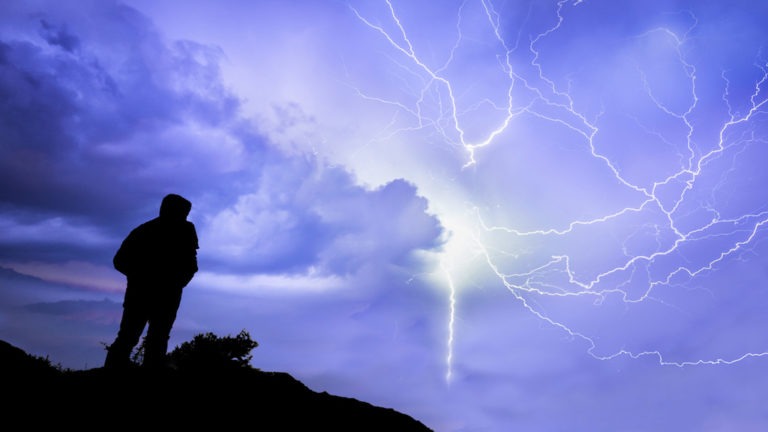
We’re all familiar with this supernatural Hollywood motif: an otherwise normal protagonist gets struck by lightning and develops superpowers. Similar stories are told about comic book heroes who encounter substances or are bitten by creatures that imbue them with superpowers, and a story unravels about their metamorphosis.
As art often imitates life, this idea of lightning strike survivors gaining abilities after being hit isn’t just science fiction. Numerous stories have been recounted by people who have not only been struck by lightning, but who have also been declared dead — only to come back to life forever changed, with talents and abilities they’d never had before. In a sense, these survivors have been reborn, but reborn into the same body.
The Story of Dr. Tony Cicoria
In 1994, Anthony Cicoria, M.D., an orthopedic surgeon in Chenango County, New York, was on a pay phone with his mother when he noticed a storm brewing in the distance. Describing what happened next, he said, “With my left hand I pulled the phone hand-piece away from my face to hang it up. When it was about a foot away from my face, I heard a deafening crack. Simultaneously I saw a brilliant flash of light exit the phone hand-piece I was holding. A powerful bolt of lightning had struck the pavilion, traversed through the phone striking me in the face, as its massive electrical charge raced to ground.”
Cicoria found himself first flying backward, and then forward. After a minute, he took note of his surroundings and saw his lifeless body on the ground with a huddle of people around him — a woman was giving him CPR.
He realized then that he was dead. His life flashed before his eyes, and he reported being surrounded by a bluish-white light that flooded him with bliss. And then he returned to his body, in pain, looking at the woman hovering over and attempting to revive him. According to The New Yorker, “After a minute or two, when he could speak, he said, ‘It’s O.K.— I’m a doctor!’ The woman, who turned out to be an intensive-care-unit nurse, replied, ‘A few minutes ago, you weren’t.’”
Cicoria explained that up until this incident, he’d worked 10- to 12-hour days while raising three children, leaving room for little else. But after this near death experience, he began craving classical music, which was strange to him because he’d never before had an affinity for much beyond classic rock. But he was so moved by his passion that he drove to the closest music store, nearly an hour away, and purchased his first classical album: a CD of Chopin’s piano compositions.
Soon after, Cicoria acquired a piano from his babysitter and then bought some beginner piano books, as well as the sheet music to the songs on the Chopin CD he’d been listening to over and over again.
A few months later, he had a dream in which he says felt like another out of body experience. He entered a concert hall and saw himself on stage, playing haunting compositions that, after a few moments of listening, he realized were his own. It was the crescendo of his own music that awoke him at 3:15 in the morning. Cicoria climbed out of bed, walked to where the piano was stationed, and attempted to play what he’d heard. But he was unable to.
He continued to teach himself piano, and every time he sat down to practice, his own compositions would begin to play. “If I tried to ignore it, it became more insistent. I became obsessed with the piano and came to believe the only reason I survived the lightning was because of the music,” he said.
Eventually, he hired a Julliard-trained teacher to give him piano lessons and began practicing relentlessly. After attending the Sonata Piano Camp, he was introduced to the late Dr. Oliver Sacks, who interviewed him for a book he was writing, Musicophilia: Tales of Music and the Brain. “At the end of that day, as we shook hands in his doorway, he looked into my eyes as if looking through me and said, ‘The music from the dream went through an awful lot of trouble to get here, the least you can do is write it.’ I was so shaken by what he said, I went home and bought a Sibelius music writing program,” Cicoria said.
Cicoria has now performed his highly acclaimed compositions for crowds across the world.
Scientific Phenomenon or a Gift From the Divine?
There is a term for Cicoria and others like him — an “acquired savant” — and it describes a person who exhibits savant skills after a serious brain or central nervous system (CNS) injury or disease. One moment they’re the person they’ve always been, and the next they have acquired a skill or talent that defies explanation.
The more spiritual among us are apt to credit divine intervention for savant status. Scientists, on the other hand, are left scratching their heads to come up with a logical explanation. In any case, it is impossible to deny the newfound talents of these people who have acquired such gifts nearly instantaneously. They have pushed past not only what most people would deem to be prodigal, but in so doing, they have metamorphosed further, becoming mythic — as Phoenixes rising from the ashes to be reinvented as gifted human beings, almost supernaturally so.
As an acquired savant, Cicoria became fanatical, and music became his raison d’etre. He attributes the gifts of composition to the divine, refusing to take any credit for them.
In a sense, such lightning strike survivor stories can function as myths, showing us what we are capable of doing when we feel there’s a higher purpose. But for those who wonder, if you get struck by lighting, will you get superpowers — the safest response is no, whether it’s because such phenomena are rare or because the lightning was divinely sent, there’s no guarantee such an event will have a happy outcome.
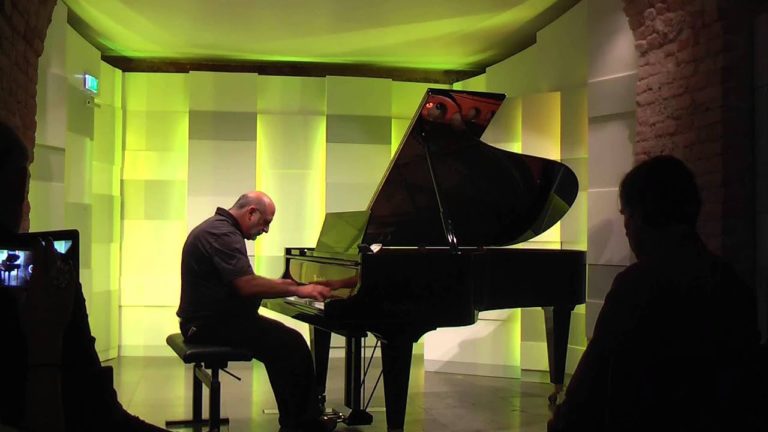
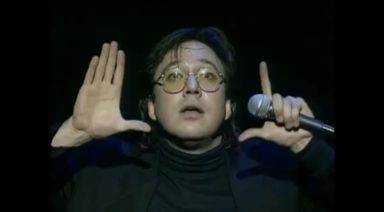
Tony performing one of his compositions
Scientists searching for material answers surmised that lightning strikes damage the anterior temporal and orbitofrontal cortex of the brain, quieting “parts of the brain that normally inhibit or put the brakes on parts of the brain responsible for vision and perception.” Neuroscientists who accept this explanation, though, “suggest that sudden savant syndrome is brought about by damage in parts of the brain that normally act as a kind of check on the way information is filtered into a person’s conscious experience.” However, this point is negated by the sheer fact that anterior temporal and orbitofrontal cortex damage is not true in all cases.
Newsweek writer Joseph Frankel wrote that “many of these ‘sudden savants’ worked extremely hard to improve their skills. The lightning strike left Cicoria with a hunger for piano music that drove him to throw himself into playing, starting practice on the piano at 4:00 a.m. before work and then again well into the night once he got home.” Though this doesn’t explain what sparked the drive in Cicoria, or why he developed such a predilection for a genre of music he never had interest in.
What is known by scientists and laypersons alike is that a sudden brain image can unlock, or perhaps create, a sudden talent or skill. This is all that is known, and at this point all else is speculation. But if we were to take a broader approach to this, perhaps a new picture would arise.
For instance, if we regard the brain as no more than a receiver of information (similar to the way a radio receives waves that are existent and invisible to the senses), then we may understand that an altered brain can begin to receive signals that are existent but have not been accessed.
Science is not completely averse to this idea, especially in cutting edge branches such as quantum physics that recognize consciousness — or the quantum field (that which Einstein called the unified field) — as a singular and all-encompassing complex network of reality. In such a case, the brain affected by a lightning strike or other similar trauma may simply take in information that has always been available to it, yet never before accessible.
Cicoria said of his own experience, “What is clear to me is that my consciousness survived death and I was able to verify details of my near-death and out-of-body experience that I would have no conceivable way of knowing except through conscious travel of my spiritual self outside of my body.”
Scientists often describe near death, out of body experiences as artifacts of the brain, to those who have had such startling experiences there is a reality that cannot be understood by those, including scientists, who have not had them. And, in the cases wherein so-called superpowers or talents arise due to a person’s brush with death, science is left speechless.
Acquired Savant Syndrome Shows Superhuman Skills Latent in Anyone

Everyone has an area in life where they excel, but what if you woke up one day and suddenly had a newfound aptitude for a musical instrument, or intrinsic comprehension of complex mathematical equations? While this might sound like the premise of a science fiction novel, it’s actually a documented phenomenon called “Acquired Savant Syndrome,” and it can give subjects amazing abilities.
How is Savant Syndrome Acquired?
Savants are often associated with autism or the autistic subtype, Asperger’s syndrome. It’s common for those on the autistic spectrum to have incongruous gifts when it comes to music, arts, and mathematics.
The term “idiot savant” was originally coined by John Langdon Down, the discoverer of Down Syndrome. Derived from the French word idiot, and the word savoir, meaning “to know.” It was a non-derogatory word for someone with a low IQ, and unusual gifts or abilities such as in mathematics. This was soon replaced with the term “autistic savant,” but in reality, only about 50 percent of savants are autistic.