Paramhansa Yogananda: A Mahayogi Comes West
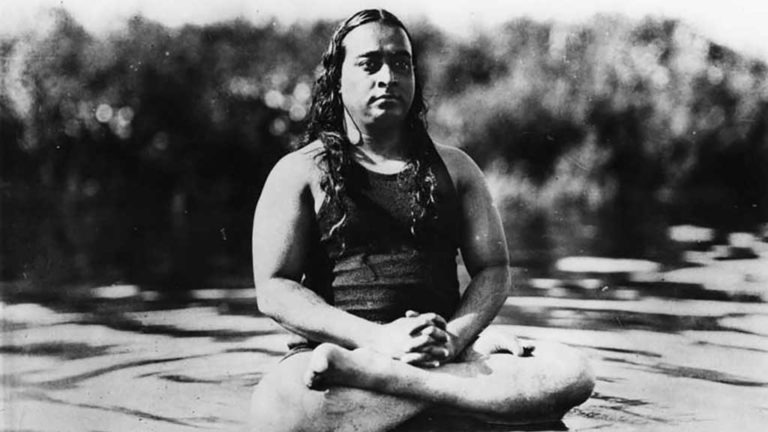
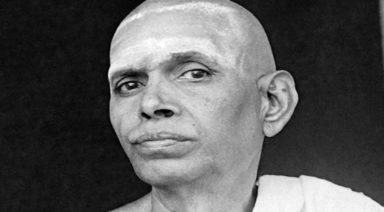
Millions actively practice yoga and meditation with the ultimate goal of achieving self-realization, but few are aware of one of the most influential people who brought these Eastern teachings to the West. Paramahansa Yogananda, an Indian yogi and guru who lived from 1893 to 1952, experienced his own rendition of the famed Hero’s Journey. Yogananda’s legacy lives on, and his seminal work, Autobiography of a Yogi, is still considered among the “100 Best Spiritual Books of the 20th Century,” continuing to grace the bookshelves of philosophers and the spiritually inquisitive.
Yogananda’s Life
Born to a devout, upper-class family in Gorakhpur, India, Yogananda’s spiritual fate was foretold in his infancy. His parents’ guru, Lahiri Mahasaya, blessed the child and told his mother, “Little mother, thy son will be a yogi. As a spiritual engine, he will carry many souls to God’s kingdom.” The prophecy did not take long to begin its manifestation, and at an early age, Yogananda experienced the first signs of spiritual awakening.
When he was eleven years old, Yogananda’s mother was in Calcutta — he had a dream that she was dying. A telegram arrived soon after, confirming this tragedy. From this point onward, Yogananda’s spiritual life escalated, and he began an earnest search for the guru he had seen thousands of times in his dreams. When he was 17-years old, he finally found Swami Yuktweswar Giri, a revered teacher who met him with open arms, and declared that he had been waiting for Yogananda.
It was at their first meeting that Yuktweswar taught Yogananda the meaning of unconditional love. In his autobiography, Yogananda recalls his master’s words, “‘Ordinary love is selfish, darkly rooted in desires and satisfactions. Divine love is without condition, without boundary, without change. The flux of the human heart is gone forever at the transfixing touch of pure love.’” It was also during this first meeting that Yuktweswar told Yogananda that he was destined to teach Kriya Yoga in the United States and throughout the world.
After graduating from Calcutta University in 1915, Yogananda took his vows and became a monk of India’s Swami Order. During that time, he founded what he referred to as a “How to Live” school for boys, which melded modern education with spiritual ideals. It was to be the first of his major accomplishments.
In 1920, Yogananda received a directive from the divine to leave his beloved country and go to America, which he did upon receiving an invitation to serve as India’s delegate to the International Congress of Religious Liberals. He went on to teach the importance of Kriya yoga and meditation throughout the United States, finally settling in Los Angeles, CA, a city that embraced him and his teachings.
Kriya Yoga: The Path to Self-Realization
Yogananda taught that no matter what spiritual tradition a person follows, he or she is capable of reaching the ultimate spiritual state: self-realization. He defined “self-realization” as, “Knowing in all parts of body, mind, and soul that you are now in possession of the kingdom of God; that you do not have to pray that it will come to you; that God’s omnipresence is your omnipresence; and that all you need to do is improve your knowing.” To achieve self-realization, he taught, one should study the ancient science of Kriya Yoga, the “jet-airplane route to God.”
When Yogananda came to the United States, in 1920, he established the Self-Realization Fellowship, and made Los Angeles its headquarters in 1925. There, he taught Kriya Yoga, a method involving breath control, postures, and intentional use of energy. Through these techniques, Yogananda said that disciples can learn to draw energy up and down their spines, achieving control over their own life forces and progress in their spiritual development.
According to Yogananda, one 30-second revolution of this life force, traveling up and down the spine, equates to a year of spiritual growth.
Oneness and Acceptance in a Segregated World
Yogananda had profound respect for Jesus Christ, which resonated with the Western world. He drew a parallel between Christianity and ancient Indian teachings, explaining that not only had the fundamental spiritual basis for both doctrines been lost, but that those fundamentals — as with the fundamentals of all spiritual paths — are one and the same, leading the devout to the experience of universal oneness.
The idea of “oneness” was radical to Western society, which had been structured according to profound prejudice, and Yogananda found himself combatting an institution of bigotry. Upon discovering that only caucasians could attend his lectures, he founded an African-American center. And, in protest of the mistreatment and marginalization of interracial couples, he officiated the marriage of an Indian man and a white woman.
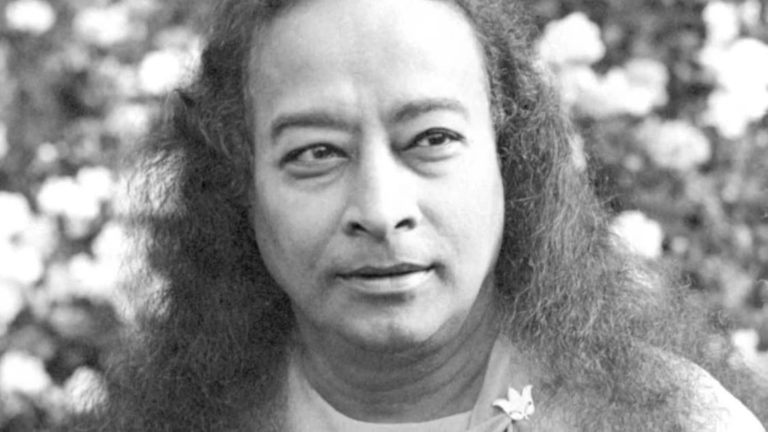
Yogananda
Death of a Saint
Yogananda died during a banquet at the Millennium Biltmore Hotel in Los Angeles, California, in the midst of reading from his poem, “My India.” He was buried in Glendale, California’s Forest Lawn Memorial Park.
A notarized letter written by Harry T. Rowe, the Forest Lawn mortuary director, preserves his observations, depicting more of a saint than a man: Yogananda’s body did not show signs of decay, even 20 days after his death, and a slight smile remained on his lips. “The physical appearance of Paramahamsa Yogananda on March 27th,” Rowe explained in his letter, “just before the bronze cover of the casket was put into position, was the same as it had been on March 7th….For these reasons we state again that the case of Paramahamsa Yogananda is unique in our experience.“
A visionary, a teacher, an activist, a leader — Yogananda was, in no small part, responsible for bridging the enormous gap between the East and the West in the 20th Century. His teachings continue to ripple throughout the world today, and can not only be seen in ever-resurging spiritual yoga and meditation trends, but also in the way many regard the world around themselves and their places within it. In many ways, Yogananda paved the way for the tremendous followings of other Indian spiritual giants teaching self-realization, as well as for the rebirth of spirituality in the 1960s and 1970s.
About the Author

The Five Chinese Zodiac Elements: How To Discover Yours And The Meaning Behind It
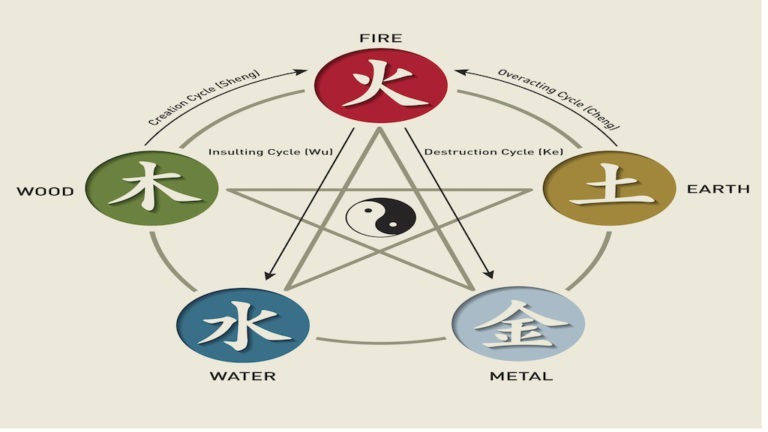
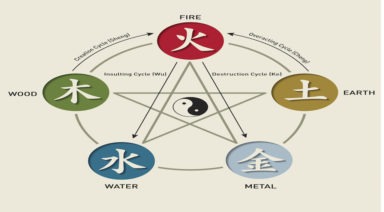
In Chinese culture, balance is a central concept. As energy flows in one direction, it naturally ebbs in another, creating a dynamic equilibrium. This idea is woven into practices like Feng Shui, traditional Chinese medicine, and holistic healing, where harmony in relationships—both internal and external—is essential. The Five Elements Theory, or Wu Xing, emerged during the pre-Qin period (770 BC – 221 BC) and forms the philosophical foundation for many aspects of Chinese thought and practice. The five elements—Wood, Fire, Earth, Metal, and Water—are considered the fundamental building blocks of the universe, constantly interacting in cycles of generation and control.
Similar to how Western astrology uses horoscopes, each element in Wu Xing has its own traits, associations, and symbolic meanings. No element is inherently superior; instead, each possesses distinct strengths and weaknesses and plays a vital role in maintaining universal balance. According to Five Elements Theory, all things originate from and eventually return to the universe through these elemental forces, which is why understanding our personal connection to them is so valuable.
Applications of the Five Elements Theory include:
- Traditional Chinese Medicine
- Feng Shui
- Fortune-Telling and Astrology
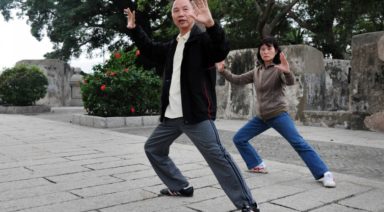
- Martial Arts
- Cosmology and Natural Philosophy
Understanding the Chinese Elements Cycle
Each of the five elements—Wood, Fire, Earth, Metal, and Water—stands independently, yet each influences and shapes the others. The world’s dynamic balance is guided by how the elements generate and control one another. The Generating cycle promotes growth and transformation, while the Controlling cycle maintains balance by regulating excess. Together, they create harmony when in proper alignment.
For example:
Generating Cycle (Shēng Cycle):
- Water feeds Wood.
- Wood fuels Fire.
- Fire makes Earth (i.e. ash).
- Earth produces Metal.
- Metal carries Water.
Controlling Cycle (Kè Cycle):
- Wood separates the Earth (i.e. roots).
- Earth absorbs Water.
- Water smothers Fire.
- Fire melts Metal.
- Metal penetrates Wood.