Quantum Evidence Our Consciousness Persists After Death

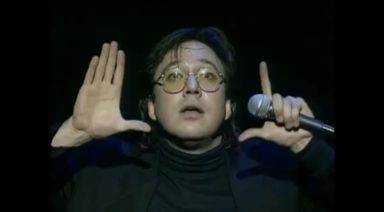
An Oxford-educated trial lawyer, fourth-generation psychic medium, and author of The Evidence of Eternity, Mark Anthony is a multi-faceted man who bridges the scientific and spiritual perspective of what he terms our “electromagnetic soul.”
Anthony shares his unique approach explaining what lies beyond this physical existence, as he fuses science with the world of psychic phenomena. And, while Newtonian physics claims psychic matters are unprovable or untenable, the world of quantum physics may show otherwise.
All discussion of psychic phenomena, and how it fits into our model of existence, hinges on the poorly understood concept of consciousness. Anthony defines consciousness as the energy of who and what we are.
In spiritual circles, it’s called the “soul” or the “spirit,” and as pure energy, consciousness is eternal, he adds. But what’s most remarkable is that consciousness is capable of perception beyond our five well-known senses. And here’s where we step into a whole other reality, because consciousness, not limited to the physical/material world, is our entry-way into other dimensions of existence.
The knowledge that the mind and the brain are separate is fundamental to understanding psychic phenomena, reincarnation, survival of physical death, and much more. Anthony likens the brain to a computer hard drive, and the shortcoming of mainstream science is to believe that consciousness is an artifact of this vital organ.
To further this hard drive analogy, he suggests the brain does not create consciousness, but rather “hosts” it. Unless we can get past this elementary mistake of believing that consciousness is an artifact of the brain, instead of the other way around, we remain stuck in a materialist worldview that fails to recognize what many know to be the “real” reality of tremendous expansion and potential.
In the distinguished journal Scientific American, noted physicist and skeptic Sean Carroll wrote, “Claims that some form of consciousness persists after our bodies die and decay into their constituent atoms face one huge, insuperable obstacle: the laws of physics underlying everyday life are completely understood, and there’s no way within those laws to allow for the information stored in our brains to persist after we die.”
This is the official party line of mainstream, materialist science. However, for psychics such as Anthony, as well as the countless who have experienced reality beyond the physical and what Anthony calls “interdimensional communication,” materialist opinions fall short.
According to Anthony, there is a chain of our electromagnetic consciousness that remains unbroken despite physical death. It seems that more evidence exists on the side of psychics and experiencers of alternate realities than with materialists who entertain nothing but narrowminded logic to espouse an opinion. The act of communicating with spirits, suggests Anthony, is evidence that life goes on in the form of an unbroken chain of consciousness. Bodies may die, but consciousness remains whole and unaffected.
If any discussion on psychic phenomenon can be categorized as “down to earth,” it’s this. Anthony’s answers to hard-put questions are practical, relative, and easy to grasp as he relates psychic powers and insights to the vast network of energy we’re all made of. And his introduction of quantum science is the key to taking the next step in our psychic evolution.
Dowsing: What It Is, How It Works, and What It’s Used For

Dowsing is a technique that allows one to detect vibrations or subtle fields present in people, objects, and places. It relies on the natural human ability to perceive energetic frequencies that escape the physical senses but can influence our well-being and our environment.
In this article, we explore what dowsing is, how it works, and how it can help us understand the relationship between mind, energy, and matter.
Table of Contents
- What Is Dowsing?
- Brief History and Evolution of Dowsing
- How Dowsing Works and What Energy It Detects
- Uri Geller and His Relationship With Dowsing
- Tools Used in Dowsing
- Applications of Dowsing in Everyday Life
- Everything Is Energy: Understanding the Basis of Dowsing
What Is Dowsing?
Dowsing is based on the idea that everything in the universe emits a vibrational frequency that can be perceived by the human body. Using tools like pendulums or rods, it is possible to translate this energetic information into physical movements that reveal data about the state of a person, a space, or a situation. This technique starts from the principle that we are sensitive receivers of subtle fields and that this perception can be trained for practical or introspective purposes.
The body acts as a bridge between the visible and the invisible: when it is in a receptive state, it can register signals that bypass logical reasoning and instead reach us through intuition. The movements generated in dowsing tools—such as spins, oscillations, or vibrations—are not caused by the object itself, but by an interaction between the energetic field of what is being consulted and the sensitivity of the dowser.
In addition to its use in the search for water, minerals, or lost objects, dowsing is also used to explore emotional, physical, or spiritual aspects of a person. It serves as a gateway to a more subtle dimension of reality, where mind, energy, and consciousness intertwine in a deep dialogue.
Brief History and Evolution of Dowsing
The use of dowsing dates back to ancient civilizations that used rods or Y-shaped branches to locate underground water or minerals. In cultures such as the Chinese, Egyptian, or Roman, it was acknowledged that the Earth emitted energetic currents that could influence people’s well-being and the harmony of spaces. Over time, this practice took on different approaches depending on the spiritual and scientific traditions of each era.
During the 19th and 20th centuries, dowsing began to be systematized and studied as an energetic discipline. More precise instruments were developed, such as the dowsing pendulum and vibrational measurement scales, which allowed the technique to be applied in fields as diverse as health, geobiology, and the exploration of natural resources. Today, it continues to be used as a complementary tool to explore the relationship between energy, consciousness, and matter.

How Dowsing Works and What Energy It Detects
Dowsing works through the interaction between the energetic field of the environment and the sensitivity of the dowser. When a person enters a relaxed state of attention and holds a tool such as a pendulum or a rod, their body acts as an amplifier that responds to subtle stimuli. The movements produced in the instruments are not random; they reflect an unconscious response that can be interpreted as “yes,” “no,” or as a direction to follow.
The energy detected in dowsing corresponds to vibrations present in everything that exists. These may be related to a person’s vital state, the geobiological energy of a piece of land, the vibrational quality of food, or even emotional imprints that persist in a space. The technique helps identify variations in these fields, aiding in more balanced and aligned decision-making.
The key to how dowsing works lies in its ability to translate the invisible into observable signals. It is not a form of divination, but rather an energetic reading based on a fundamental principle: everything is made of energy, and it is possible to tune into it by training perception and using the right tools.
Uri Geller and His Relationship With Dowsing
Uri Geller, world-renowned for his psychic abilities and telekinetic phenomena, also explored dowsing as a way to understand the energetic field that surrounds us. In the series Uri Geller’s Legacy of Paranormal Experiences, available on Gaia, his experiences with this practice are explored in depth—from its use in the search for deposits to its role in his spiritual transformation.
In the episode From Dowsing to Spirituality, Geller reveals how this technique was key to opening new dimensions of perception in his life.
Tools Used in Dowsing
Although energetic perception can be developed without instruments, many people use tools that amplify and translate subtle impulses into physical signals. These tools hold no inherent power but function as extensions of the operator’s field of consciousness. Each one serves a specific purpose and can be adapted to different types of energetic inquiry.
- Dowsing pendulum: A small mass suspended by a thread or chain. It moves according to the energetic vibrations of the environment and provides simple answers (yes, no, maybe).
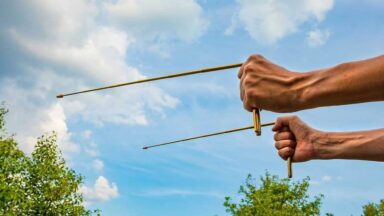
- L-shaped rods: Two metal rods bent at right angles. They are used to explore physical spaces and detect energetic alterations in a location, such as geopathic stress or underground currents.
- Y-shaped rod (or forked stick): Traditionally used to find underground water. The tip lowers when the operator approaches a source or flow.
- Aurameter: A rod with a spiral or sphere at the tip. It is used to measure the energetic field (aura) of people, animals, or objects.
- Biometer or Bovis scale: A numerical scale that measures the “energetic vitality” of something. It helps determine whether an energy is high, low, or neutral.
- Witnesses or energetic samples: Objects or photographs that represent what is being searched for. They help focus the search by acting as a point of connection with the target’s energy.
- Dowsing charts or bases: Templates with symbols or geometric shapes. These are placed under the pendulum to guide and refine responses.
Applications of Dowsing in Everyday Life
Dowsing is not only used in spiritual or therapeutic contexts, but also in practical aspects of daily life. Thanks to its ability to detect energetic imbalances, it is used as a tool for guidance, diagnosis, and harmonization at both a personal and environmental level.
- Energetic health: It can be used to identify blockages or imbalances in a person’s energetic field. This helps guide complementary healing practices.
- Food selection: Dowsing helps evaluate the vibrational charge of foods before consuming them, allowing for choices that are more aligned with physical well-being.
- Space harmonization: It is used to detect areas with dense energy in the home or workplace. Measures can then be applied to restore balance to the environment.
- Searching for objects or water: Traditionally, it has been used to find lost objects or underground water sources. The tool acts as a sensor that responds to energetic traces.
- Decision-making: Some people consult dowsing when choosing between important options. The pendulum, for example, may reflect which alternative is more aligned with the person consulting.
- Evaluation of objects or crystals: Dowsing allows the energy of amulets, crystals, or ancient objects to be measured, helping determine whether their frequency is beneficial or needs cleansing.
Everything Is Energy: Understanding the Basis of Dowsing
The foundation of dowsing lies in a fundamental understanding of the universe: everything is made of energy. Beyond visible matter, every being, object, and place emits a unique frequency that can be perceived by those who refine their sensitivity. This energy is not mystical or exclusive to spirituality; it is part of the invisible fabric that sustains physical reality.
When a person trains their ability to perceive these subtle fields, they can access a deeper dimension of the world around them. Dowsing is a tool that facilitates this access, acting as a translator between the energetic and the tangible. By detecting vibrations, it allows for more conscious decision-making, the harmonization of environments, and a deeper understanding of the connections between body, mind, and surroundings.
In the series Superhuman: The Invisible Made Visible, available on Gaia, cases and experiments are presented that demonstrate the power of the mind to interact with energy. Through scientific research and real-life experiences, the series offers a fascinating look at our perceptual abilities and how they can be trained to expand our understanding of reality.