The 7 Hermetic Principles of the Kybalion Explained
Hermetic philosophy, based on the teachings attributed to Hermes Trismegistus, has influenced numerous systems of thought throughout history. In the book “The Kybalion,” seven principles are presented that summarize this ancient wisdom. These principles, ranging from universal mentality to the law of causality, provide a guide to understanding and navigating the universe. In this article, we explore each of these principles in detail, unraveling their meaning and practical application.
Table of Contents
- The Kybalion and the Hermetic Principles
- The 7 Hermetic Laws
- The Principle of Mentalism: The Universal Mind
- The Principle of Correspondence: The Law of Analogy
- The Principle of Vibration: Constant Motion
- The Principle of Polarity: Duality and Opposites
- The Principle of Rhythm: Cycles and Tides
- The Principle of Cause and Effect: The Law of Causality
- The Principle of Gender: Masculine and Feminine Energies
- Hermetic Laws and Quantum Physics
- Hermes Trismegistus and Hermetic Philosophy
The Kybalion and the Hermetic Principles
“The Kybalion” is a text that compiles the Hermetic teachings into seven fundamental principles, offering a comprehensible and accessible vision of this ancient philosophy. First published in 1908, its authors, known as the Three Initiates, aimed to reveal these esoteric concepts to the Western public. Through its pages, the book explores the relationship between the universe, the mind, and the laws that govern existence.
The Hermetic principles of the Kybalion encompass various areas of human and cosmic experience, providing a coherent structure for understanding how the world works. This holistic approach allows readers to apply these principles to their daily lives, fostering a deeper understanding of reality and facilitating spiritual and personal growth.
The 7 Hermetic Laws
The seven Hermetic principles are the pillars of the philosophy of the Kybalion: mentalism, correspondence, vibration, polarity, rhythm, cause and effect, and gender. Each of these principles offers a unique perspective on the nature of the universe and human experience, providing tools for self-understanding and spiritual growth.
The Principle of Mentalism: The Universal Mind
“The All is Mind; the Universe is Mental.”
The principle of mentalism holds that reality is a creation of the universal mind. Everything that exists is a manifestation of the infinite mind, and our thoughts are fundamental in shaping our life experience. This concept implies that consciousness is the source of everything we perceive and experience, suggesting that the universe is essentially mental in nature.
This principle also reminds us of personal responsibility in the creation of our experiences. By understanding that our thoughts act as creative forces in the universe, we are encouraged to cultivate positive and constructive thinking. In this way, we can consciously influence our reality, promoting not only our personal well-being but also collective well-being by recognizing the interconnectedness of all minds in the universe.
The Principle of Correspondence: The Law of Analogy
“As above, so below; as below, so above.”
The principle of correspondence establishes that there is a direct relationship between the different planes of existence: the physical, the mental, and the spiritual. The patterns and laws that operate in the macrocosm are reflected in the microcosm, allowing us to better understand the universe by studying its manifestations on various levels. This connection helps us recognize that universal laws apply both on a grand scale and in our daily lives.
This principle invites us to see harmony in all things, from atoms to galaxies, and to recognize how our internal actions and thoughts reflect and affect the external world. By understanding this relationship, we can live in a more balanced way and in tune with the universe. This understanding promotes both personal and collective well-being, as it allows us to adjust our perceptions and behaviors to create a more coherent and harmonious reality.
The Principle of Vibration: Constant Motion
“Nothing rests; everything moves; everything vibrates.”
The principle of vibration holds that everything in the universe is in constant motion and change. From the smallest particles to the largest galaxies, everything vibrates at different frequencies. This understanding reveals to us that absolute stability is an illusion and that change is a universal constant, allowing us to better adapt to shifts and flow with life.
Every object, thought, and emotion has its own vibrational frequency, meaning that our personal vibrations can influence our reality. By maintaining a high and positive frequency, we can attract more harmonious and fulfilling experiences, creating a balanced and healthy life. This principle teaches us to be aware of the energies we emit and receive, fostering a more conscious and aligned existence.
The Principle of Polarity: Duality and Opposites
“Everything is dual; everything has poles; everything has its pair of opposites; like and unlike are the same; opposites are identical in nature but different in degree; extremes meet; all truths are but half-truths; all paradoxes may be reconciled.”
The principle of polarity states that everything has its pair of opposites and that these opposites are, in reality, two extremes of the same thing. This concept helps us understand that duality is essential for balance and that contrasts exist to complement and enrich each other.
This principle provides tools for personal transformation by shifting our perception of opposing poles. By recognizing that extremes are part of the same continuum, we can transcend internal and external conflicts, balance our emotions, and view paradoxes from a broader and more reconciling perspective.
The Principle of Rhythm: Cycles and Tides
“Everything flows, out and in; everything has its tides; all things rise and fall; the pendulum-swing manifests in everything; the measure of the swing to the right is the measure of the swing to the left; rhythm compensates.”
The principle of rhythm states that everything in the universe moves in cycles and phases, like the tides of the ocean. This axiom teaches us that life is a series of ebbs and flows and that constant change is a natural part of the process. Recognizing these rhythms allows us to understand that phases of expansion and contraction are inevitable and necessary for growth.
This understanding helps us better navigate life’s ups and downs, providing comfort and patience during moments of adversity. By accepting and aligning ourselves with natural cycles, we can maintain a healthy balance and optimize our energy, living in harmony with the rhythms of the universe.
The Principle of Cause and Effect: The Law of Causality
“Every cause has its effect; every effect has its cause; everything happens according to law; chance is but a name for law not recognized; there are many planes of causation, but nothing escapes the law.”
The principle of cause and effect states that every action has a corresponding consequence and that nothing happens by chance. This axiom teaches us that everything that occurs results from previous causes and that our current actions will determine our future. Understanding this law empowers us to make conscious and responsible decisions.
This awareness motivates us to act ethically and thoughtfully, knowing that our actions affect not only ourselves but also others. By exploring the different planes of causality, we can align our intentions and thoughts with our goals, creating a positive flow of energy in our lives.
The Principle of Gender: Masculine and Feminine Energies
“Gender is in everything; everything has its masculine and feminine principles; gender manifests on all planes.”
The principle of gender holds that all things contain two fundamental energies: the masculine and the feminine. These energies do not refer exclusively to physical sex but to complementary qualities present in all forms of life and at all levels of reality. The masculine energy is associated with action and logic, while the feminine is related to receptivity and intuition.
This principle invites us to seek balance between these two energies in our daily lives. By cultivating both masculine and feminine energy, we can develop greater internal and external harmony, making more complete and effective decisions. This balance allows us to live more integrally and in tune with the universe.
Hermetic Laws and Quantum Physics
Hermetic laws and quantum physics share striking similarities in their understanding of reality. Both perspectives hold that consciousness plays a fundamental role in the formation of the universe. In quantum physics, the wave-particle duality principle and the observer effect suggest that the mind can influence matter, resonating with the principle of mentalism, which states that the universe is mental.
The principle of vibration, which maintains that everything is in constant motion, is reflected in quantum physics through concepts such as quantum fluctuations and ever-moving subatomic particles. These connections suggest that, at a fundamental level, everything in the universe is interconnected and in a state of constant change, which also aligns with the Hermetic idea of correspondence and the rhythmic cycles of the principle of rhythm.
In the first season of Mystery Teachings, available on Gaia, Theresa Bullard explores these intersections between quantum physics and Hermetic wisdom. Bullard explains how the Hermetic principles can offer a deeper understanding of quantum phenomena, providing a spiritual framework for the complexities of modern physics.
Hermes Trismegistus and Hermetic Philosophy
Hermes Trismegistus, a legendary figure who combines the Egyptian god Thoth and the Greek god Hermes, is the pillar of Hermetic philosophy. Known as “the thrice-great” for his mastery of alchemy, astrology, and magic, he is credited with fundamental texts such as the Corpus Hermeticum and the Emerald Tablet. These works offer a profound understanding of the universe and its laws, establishing a foundation for the Hermetic tradition that has influenced various esoteric and philosophical currents throughout history.
Hermetic philosophy, derived from the teachings of Hermes Trismegistus, seeks to understand the connection between the universe and humanity. This tradition has influenced various esoteric and philosophical movements, highlighting the interrelation between the divine and the human. His writings provide a deep and unified vision of the cosmos, promoting self-knowledge and spiritual evolution.
Hermes Trismegistus is also known for his focus on spiritual transmutation, a process that goes beyond physical alchemy to include the purification and elevation of the soul. This perspective has resonated through the centuries, influencing alchemists and philosophers who see inner transformation as a key to true wisdom.
The influence of Hermes Trismegistus extends from antiquity to the Renaissance, when his texts were rediscovered and studied by prominent figures in science and philosophy. His thought has permeated multiple disciplines, offering a foundation for spiritual exploration and personal development across various cultures.
Today, Hermetic philosophy remains relevant, guiding those who seek a deeper understanding of the universe and themselves. The work of Hermes Trismegistus continues to inspire scholars and esoteric practitioners, providing a rich source of wisdom and a coherent structure for spiritual growth.
About the Author

What Is the Personal Year in Numerology and How to Calculate It
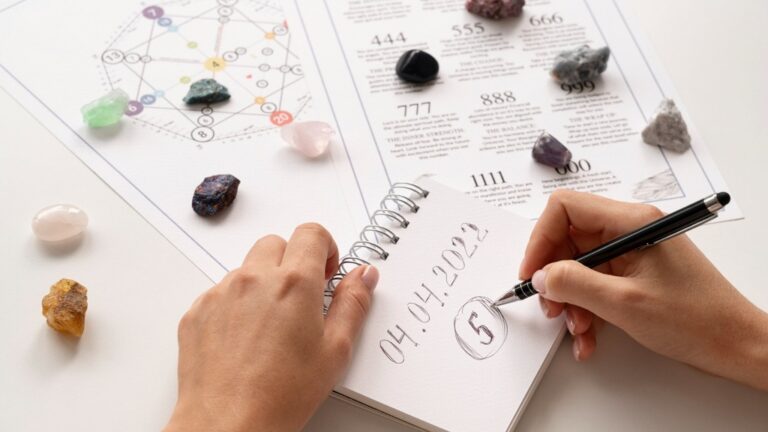
Numerology proposes that each person goes through nine-year cycles, where each year has a specific purpose and energy. These cycles, known as personal years, reflect different stages of personal evolution and help us understand what kind of experiences, challenges, and opportunities will be most present during certain periods.
In this article, we explore what the personal year means, how to calculate it correctly, and how to use it as a guide for personal and spiritual growth.
Table of Contents
- What Is the Personal Year in Numerology?
- How to Calculate Your Personal Year Step by Step
- Characteristics of Personal Years From 1 to 9
- The 9-Year Cycle and Its Influence on Your Life Path
- How to Use Your Personal Year to Grow Spiritually
What Is the Personal Year in Numerology?
The personal year in numerology is a number that indicates which energy predominates between one birthday and the next. Each personal year is associated with specific themes such as beginnings, growth, changes, or closures. Through this tool, it’s possible to understand what kind of experiences will be most present and how to respond to them more consciously.
These years are organized into a cycle of nine stages numbered from 1 to 9. Each number reflects a different phase of personal evolution, and knowing your personal year allows you to identify where you are in the cycle and what types of decisions are most favorable. Some years encourage you to start new projects, others to strengthen relationships, and others to let go of what has already served its purpose.
It is important to know that the personal year does not begin on January 1st, but on the day of each person’s birthday. From that moment, a new energy is activated that accompanies you during the following twelve months, setting the tone for the experiences that will unfold during that period.
In the episode dedicated to numerology in the series The Other Side, available on Gaia, there is an in-depth exploration of how numbers, and particularly the date of birth, can offer insights into who we are and how we navigate each stage of life. This perspective allows for a deeper understanding of the meaning of numerological cycles and their impact on our personal journey.
How to Calculate Your Personal Year Step by Step
The calculation of the personal year is based on adding the day and month of birth with the year you want to analyze. Unlike the life path number, which considers the complete date of birth, here you only use the day, the month, and the current year. Everything is added together and then reduced to a single digit between 1 and 9.
Let’s look at an example:
If you were born on June 7 and want to know your personal year for 2026:
7 (day) + 6 (month) + 2 + 0 + 2 + 6 (year) = 23
2 + 3 = 5
Your personal year would be 5.
Another example:
Date of birth: November 15
You want to know your personal year for 2026:
1 + 5 + 1 + 1 + 2 + 0 + 2 + 6 = 18
1 + 8 = 9
Your personal year would be 9.
Remember that this number begins to influence you from your birthday, and not from January first. So if you were born in November, you will remain in your previous personal year until your birthday.
Characteristics of Personal Years From 1 to 9
Each personal year is part of a nine-year cycle that reflects different phases of personal evolution. Each number represents a specific energy that sets the tone of the year, indicating what kind of experiences, challenges, and opportunities will be most present. Knowing this information allows you to make more conscious decisions and live more in tune with the moment you are going through.
-
Personal Year 1
It is a year of beginnings, independence, and renewal. It encourages you to make firm decisions, start new projects, and leave behind what no longer fits in this new stage. The energy is focused on the self: who you are, what you want, and where you want to go. It’s a time to act with determination and plant the seeds that will bear fruit in the coming years.
-
Personal Year 2
This year requires sensitivity, patience, and openness to dialogue. It’s a stage for strengthening bonds, cooperating with others, and resolving conflicts harmoniously. It’s not about moving forward quickly, but about observing, listening, and building from emotional connection. Intuition and empathy will be great allies during this period.
-
Personal Year 3
It is a year to express yourself, communicate, and enjoy life with lightness. The energy supports creativity, art, social relationships, and anything that allows you to share what you carry inside. It’s a time to release accumulated tension and recover your enthusiasm. It’s also a good stage for developing new talents.
-
Personal Year 4
The energy of this year is focused on consistent work, organization, and building solid foundations. It’s a time to set priorities, take on responsibilities, and give concrete form to your plans. Although it may feel slower or more demanding, what you do now will be key for your future stability. The effort will yield lasting results.
-
Personal Year 5
It is a stage of changes, surprises, and expansion. This year brings movement, new opportunities, and the chance to break away from routines that no longer make sense. The key is to stay open to change without losing focus. Travel, unexpected learning experiences, and important decisions may arise suddenly.
-
Personal Year 6
This year invites you to care for your immediate environment, your loved ones, and your emotional responsibilities. It may involve important commitments at home, with family, or in close relationships. It’s a time to cultivate balance between giving and receiving. It may also be a stage of healing, whether personal or relational.
-
Personal Year 7
The energy of 7 is introspective, reflective, and spiritual. It’s not a time for impulsive action, but for pausing, questioning, and seeking deeper answers. You may feel the need for solitude, silence, or inner connection. Studying, meditating, or reviewing your purpose may be especially valuable during this period.
-
Personal Year 8
This year focuses on the material, the professional, and the exercise of personal power. It’s a stage of results, achievements, and important decisions that may impact your financial stability or long-term projection. The key is to act with responsibility and balance. If you use your energy wisely, this year can bring significant progress.
-
Personal Year 9
The 9 represents the closing of a cycle. It’s a time to let go, forgive, and release what has already fulfilled its purpose. This energy supports introspection, gratitude, and preparation for what’s to come. You may feel emotions more intensely, but also gain greater clarity about what you no longer wish to carry forward.
The 9-Year Cycle and Its Influence on Your Life Path
Numerology teaches that life unfolds in nine-year cycles, each with a specific purpose. Throughout this journey, we go through stages of beginning, development, transformation, and closure. Understanding where you are within this cycle helps you align your decisions with the moment you are currently experiencing.
These cycles do not repeat in exactly the same way, but they do share an energetic structure that sets certain rhythms. For example, a year 1 is ideal for planting seeds, while a year 9 invites you to let go. Recognizing these patterns doesn’t mean predicting the future, but rather understanding the ground on which your experiences will unfold.
The nine-year cycle is not separate from your life path. On the contrary, the two complement and enhance each other. Your life path number reflects your essence, and the personal year indicates how that essence expresses itself in a particular stage. Observing both numbers gives you a more complete view of your growth process.
How to Use Your Personal Year to Grow Spiritually
The personal year is not only useful for making practical decisions; it can also be a tool for your spiritual evolution. Each number proposes a kind of learning that invites you to grow inwardly, release repetitive patterns, and connect with your life’s purpose. When you align with that energy, spiritual development flows more easily.
For example, in a year 7 you might dedicate more time to meditation or reflection; in a year 6, to working on self-love and service; in a year 1, to cultivating the confidence to move forward without fear. Each stage is an opportunity to look within and discover which part of yourself needs to be strengthened or transformed.
The key is to live each year with awareness. Instead of resisting what happens, you can observe what the energy of the personal year is showing you and use it as a guide. In this way, your spiritual path becomes more coherent, and each experience, no matter how simple it may seem, can become a step toward greater clarity and inner connection.