How to Access Your Subconscious Mind in 4 Steps

“Logic can take you from point A to point B, but imagination can take you anywhere.” – Albert Einstein
How to Access your Subconscious Mind?
Exercise: Access your Subconscious Mind in 4 Steps
- Relax
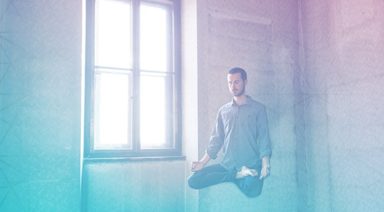
Relaxation is challenging for many of us, but it’s the gateway to opening and moving deeper within ourselves. Find a place where you won’t be disturbed. Sit or lie down in a comfortable place. If you’re sitting, use a cushion or a folded blanket underneath to help your sitz bones relax the hip flexors and knees. If you’re lying down, roll your shoulder blades down your back to support the heart. Place the hands at your sides palms up, and let the legs and ankles splay out. Relax the eyes with a soft gaze or close them, whatever feels most comfortable for you.
- Listen
Listen to the sound of your breath. If your breath is fast and choppy, slow it down by taking long, slow breaths. This calms the mind. Listen to the sound of your heart beating in sync with the natural rhythms of your body. The more you listen and focus on the breath, the more you’ll arrive in the moment, at ease, letting go of thoughts.
- Find Guidance
Using a guided meditation or a yoga nidra recording can be a powerful way to encourage visualization and deeper meditation. Better yet, seek out a teacher. Guided meditations will help you set your intention for what you want to work on, from dealing with trauma to fulfilling dreams, getting rid of bad habits, etc.
Guided meditations can often be found free through many different apps. Another option is brain wave music, which moves the hemispheres of the brain into alpha, delta and theta states, which help to de-program old thought patterns.
- Be Consistent
The more frequent you practice, the better. Find the time of day that resonates with you most and stick to it. Want to complement your practice even more? Restorative yoga is incredibly beneficial for relaxation.
Accessing your subconscious can help change your harmful thought patterns and take you out of feeling like you’re living life on autopilot. With a regular practice, you’ll enjoy a new sense of well-being, passion and purpose.
Learn how to access the subconscious mind with this E-motion toolkit full-length video
In our day-to-day lives, we’re constantly in an alert, conscious state of mind. In the beta state, our brains are very active as we navigate through the day, sometimes feeling like we are on autopilot as we form our experiences. In this active beta state, our brain is over-stimulated, which in yoga is often referred to as “the monkey mind.” Here, everything comes to us as doubts, fears, to-dos, emotions, and it can really cloud our minds and trains of thought.
Studies have shown that in our conscious state, we’re only using between 1 and 5 percent of our brain’s resources. So if we’re only functioning at 1 to 5 percent, how are we really living our lives with true purpose? Where’s the other 95 to 99 percent?
The answer is found in our powerful subconscious, where the alpha, delta and theta states provide us with calm, deep relaxation and dreamlike states. The subconscious is where the magic happens, and where the imagination is stored. This state is where we can de-program our thought processes of doubt and fear, and where we tap into our authentic self without the judgment and criticism of our conscious state interfering.
Dr. Bruce Lipton of Stanford University says that the subconscious mind “ultimately casts the deciding vote” on how much abundance, happiness and success you will experience. He also claims that the subconscious is “one million times more powerful” than your conscious mind.
About the Author

The Pineal Gland’s Spiritual Connection With the Third Eye Chakra

The third eye is our greatest gift to connect us to source and remind us of a universe much more mystical than we can perceive with our physical senses. It’s through the awakening of the third eye and its corresponding pineal gland that we’re able to attain supernatural feats of telepathy, psychic vision, and an intimate connection with God.
Rare is a conversation on higher consciousness without a mention of the pineal gland. Its prevalence is more than a fad; it’s an imperative first step to attaining our full human potential.
What is the Pineal Gland?
The pineal gland, often referred to as the “third eye” in Eastern esoteric religions (Hinduism, Buddhism, and Taoism), is a pea-sized endocrine gland located deep in the center of the brain, between the two hemispheres. In Western medicine, it is an organ primarily recognized for its role in regulating the body’s circadian rhythms and melatonin production, which helps regulate sleep-wake cycles. The pineal gland also plays a part in the body’s response to light and darkness, influencing mood, energy levels, and overall well-being. While it holds significant physiological importance, some spiritual practices also attribute metaphysical qualities to the pineal gland, linking it to intuition, perception, and spiritual enlightenment.
The Pineal Gland and Third Eye Chakra
The chakra system is the way the spirit moves within the physical body—how the spirit animates form. The chakras can be imagined as wheels of energy to remain balanced and open for optimal human function. If stagnation appears within the chakra system, the physical body will be affected by unease, depression, and even illness.
Chakras are energy centers, whereas organs have defined locations. The chakras are ruled by the organs but are not confined to a specific location. The heart chakra, for instance, is in the center of the chest, while the physical heart is on the left side. Similarly, the third eye chakra is located in the center of the forehead near the pineal gland.
The pineal gland is known as the third eye chakra or ajna chakra in the Hindu system. A closed ajna (i.e. mind) is said to lead to confusion, uncertainty, cynicism, and pessimism.
Every esoteric tradition heralded the third eye as our connection to spirit. It’s the space between humans and God, moving us from the isolation experienced in the human condition—through an open and vibrant third eye, we find our highest source of ethereal energy. A return path to God is offered when one works to expand third-eye awareness.