What Dharma Is And How It Differs From Karma

Dharma and karma are essential concepts in the spiritual traditions of India that help us understand our purpose in life and the law of cause and effect. While karma explains how our actions generate consequences, dharma reveals our true nature and mission in the world.
In this article, we will explore these concepts from the perspective of Simon Chokoisky, who has studied Vedic wisdom in depth to help us find our true mission.
Table of Contents
- What Is Dharma And What Is Its Essential Purpose?
- What Is The Difference Between Dharma And Karma?
- The Five Types Of Dharma: Keys To Discovering Your Mission
- How To Identify Your Type Of Dharma
- Living In Harmony With Your Dharma In Daily Life
What Is Dharma And What Is Its Essential Purpose?
Dharma is a concept of Sanskrit origin that means “that which sustains.” It refers to the unique purpose each person has in life, that which makes us feel fulfilled and gives meaning to our existence. Following dharma means living according to who we are and our abilities. It is not something imposed from outside, but an inner guide.
The essential purpose of dharma is to achieve balance between our needs and those of our environment. When we discover our dharma, we begin making more conscious decisions that are connected with our essence. This not only improves our personal life but also contributes something valuable to others. Living our dharma means living with coherence and purpose.
Unlike goals we pursue out of habit, dharma arises from the deepest part of ourselves. It is a force that drives us to express the best within us. This force is present in every aspect of our lives, from work to relationships. Recognizing our dharma is key to living authentically.
During an interview on Open Minds, available on Gaia, Simon Chokoisky explores these concepts in depth. He explains how dharma offers a clear path to living more authentically and aligned with our true nature. His practical and direct approach helps us understand how to integrate these principles into everyday life to find greater purpose and balance.
What Is The Difference Between Dharma And Karma?
Dharma and karma are different concepts, although they are related. Karma is based on the law of cause and effect: every action we take has a consequence. These consequences may be immediate or may manifest later. For this reason, karma teaches us how our choices affect our lives.
Dharma, on the other hand, does not refer to the consequences of our actions, but to the purpose we have. It is the inner guide that tells us which actions are in harmony with our nature. If karma is the result of what we do, dharma is the path we choose to walk. This distinction helps us act with greater awareness.
When we act according to our dharma, the karma we generate tends to be positive. Although this does not eliminate challenges, it allows us to face them with greater clarity and determination. In this way, dharma and karma work together: one shows us the consequences, while the other helps us choose the best path. Living with purpose transforms every action into growth and learning.
The Five Types Of Dharma: Keys To Discovering Your Mission
According to the perspective of Simon Chokoisky, each person has a main type of dharma that defines how they can contribute to the world and grow authentically. Below, we explore these five types of dharma, which function as a practical map for understanding our talents and strengths. These archetypes help us see how our actions contribute to collective well-being and personal meaning. Identifying your type of dharma is the first step toward living with coherence and purpose.
-
Warrior: The Protector And Natural Leader
The warrior is the one who feels a strong calling to protect others and lead with courage. Their strength lies not only in their physical presence but also in their ability to act decisively when others cannot. Warriors possess a deep sense of justice and responsibility, which makes them agents of change in any environment. They are people who seek just causes to which they can dedicate their energy.
However, this type of dharma also faces the challenge of balancing intensity with compassion. When warriors learn to use their power wisely, they can inspire others to do the same. Their path involves learning to listen and act with integrity so that their strength becomes a tool for transformation rather than imposition. In this way, they lead with a higher purpose.
-
Educator: The Guide Who Inspires And Teaches
The educator finds their purpose in sharing knowledge and awakening the curiosity of others. Their dharma is to guide, teach, and help others discover their own potential. Educators enjoy learning and exploring ideas, and they have the ability to make complex topics clear and accessible. Their passion for knowledge is reflected in every aspect of their lives.
However, the educator’s challenge is avoiding remaining only in theory. To fully fulfill their mission, they must balance reflection with action. When they are able to put into practice what they teach, they become true role models. Their dharma is to spark the flame of learning and to be a living example of what they teach.
-
Merchant: The Creator Of Value And Happiness
The merchant has the natural ability to generate well-being around them. Their dharma is to create value and share it with others, whether through business, art, or activities that inspire joy. These individuals know how to recognize opportunities and turn them into something positive for everyone. Their enthusiasm and optimism are contagious and bring lightness to any situation.
Although they may be motivated by success and results, their true strength emerges when they use these gifts to benefit the community. The merchant must remember that their purpose is not only to win, but to generate happiness and abundance. When they balance the pursuit of success with generosity, they become powerful agents of change. In this way, their mission becomes as enriching for others as it is for themselves.
-
Industrious: The Builder Of Community And Family
The industrious one finds meaning in caring for others and building strong relationships. Their dharma is linked to consistent work and dedication to keeping family or community united. These individuals are the heart of any group, as their presence brings stability and trust. They are always willing to collaborate and provide support when it is most needed.
However, the challenge for the industrious person is remembering that they also deserve care and attention. At times they may lose themselves in responsibilities and forget their own well-being. Their path involves balancing giving and receiving while recognizing their unique value. In this way, they can continue strengthening the community without neglecting their own inner peace.
-
Outsider: The Rebel Who Transforms The World
The outsider is the nonconformist who breaks patterns and proposes new ways of seeing life. Their dharma lies in questioning what is established and bringing freshness to every space they touch. This type of person sees beyond social norms and dares to open new paths. Their renewed perspective can inspire others to step outside their comfort zones.
The outsider’s challenge is maintaining balance between freedom and commitment. Although their strength lies in innovation, they need to find stability so their ideas can materialize. When they manage to combine creativity with consistency, the outsider becomes a true engine of change. In this way, they fulfill their mission of transforming the world through authenticity and courage.
How To Identify Your Type Of Dharma
Recognizing your type of dharma involves observing how you act, what motivates you, and what brings you joy when serving others. Here are some key points to help you identify it and begin living more authentically:
- Observe your inclinations: Ask yourself in which activities you feel most comfortable and fulfilled. Your natural talents and passions are signs of your dharma.
- Notice your challenges: Pay attention to the obstacles that appear most frequently in your life. They are often related to your main mission.
- Review your behavioral patterns: Think about how you respond in different situations. Your instinctive reactions can give you clues about your type of dharma.
- Examine your relationships: The way you interact with others reveals aspects of your dharma. Observe how you contribute to your environment and what types of connections enrich you.
- Take time to reflect: Meditation and self-observation help you see internal patterns. Sometimes the answer is closer than you think—you simply need to quiet the mind.
Living In Harmony With Your Dharma In Daily Life
Living in harmony with your dharma is not something reserved for special moments; it is reflected in every daily decision. This means acting in alignment with your nature and recognizing that every small gesture is part of your greater purpose. When you become aware of this, each day becomes an opportunity to grow and share the best of yourself.
Practicing inner listening is essential to remain connected with your dharma. When doubt or confusion arises, take a moment to pause and breathe. By focusing on your intuition, you find the strength to make decisions that bring you closer to your true path.
Finally, remember that your dharma is not static. It evolves with you and manifests in different ways throughout your life. Stay open to change and willing to learn, and in doing so you ensure that you live with authenticity while contributing to the well-being of others.
About the Author

Name Numerology: What Your Name Says About You
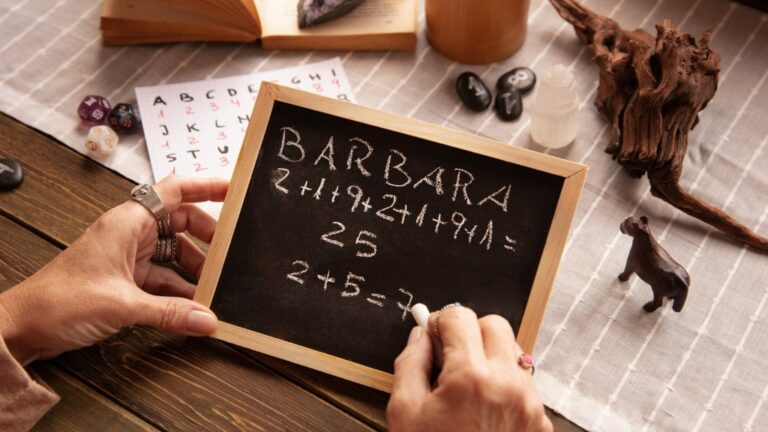
Your name has been with you from the beginning: you hear it, sign it, respond to it, and carry it through every stage of your life. Rarely, however, do you stop to look at it closely. Numerology proposes exactly that: observing it not only as a form of identification, but as a key that can reveal aspects of your deeper identity.
In this article, we explore what your name reveals about you, which main numbers arise from it, and how to calculate them step by step.
Table of Contents
- Numerology and Its Relationship With Names
- The Three Main Numbers of Your Name
- How to Calculate the Numbers of Your Name Step by Step
- What Name Numerology Is For
Numerology and Its Relationship With Names
Numerology begins with a very ancient idea: that numbers are not only used to measure or count, but also hold a meaning of their own. Each digit, from 1 to 9, is associated with a set of specific qualities. The name is one of the elements this discipline uses as the basis for its interpretation, because it turns something as everyday as your letters into a symbolic key to who you are.
To arrive at that meaning, it starts from a simple principle: each letter corresponds to a number. In this way, your full name stops being only a set of sounds and becomes a sequence of digits that can be added together and interpreted. That sequence, once deciphered, begins to speak about your way of being.
There is something particular about working with the name: you did not choose it yourself, it was given to you at birth and, over time, became inseparable from who you are. Numerology uses it as a starting point to talk about you. What it offers, ultimately, is one more language for knowing yourself.
In the episode Numerology from the series The Other Side, available on Gaia, numbers are explored as a symbolic language for better understanding personal experience. There, numerology is presented not as a form of divination, but as a tool for observing who you are, how you show up in the world, and what patterns appear on your path.
The Three Main Numbers of Your Name
When working with the full name, there are three numbers that are considered especially important: the Destiny or Expression Number, the Soul Urge Number, and the Personality Number. Each one is calculated using a different part of the name and reveals a specific dimension of your way of being.
It may help to think of them as three levels of interpretation. One speaks of your visible potential, another of your inner motivation, and another of the image you project. They do not compete with each other: they complement one another.
-
The Destiny or Expression Number
The Destiny Number, also called the Expression Number, is calculated by adding all the letters of the full name. It is one of the broadest numbers in the analysis because it takes the entirety of the name into account, not just one part.
It is related to your talents, abilities, and personal resources. It speaks of the way you tend to act, create, solve, build, or communicate when you express your potential with greater clarity.
It does not indicate a fixed destiny or a series of inevitable events. Rather, it points to the tools you have available to move forward on your path and the way you can develop what is already within you.
-
The Soul Urge Number
The Soul Urge Number is calculated only with the vowels of the full name. In numerology, vowels are associated with a person’s innermost dimension: what they desire, value, and need in order to feel aligned.
This number can help you recognize what truly moves you, even when you do not express it in an obvious way. Sometimes it appears in quiet decisions: a choice that may seem illogical from the outside, but feels necessary within.
It can also reveal tensions between what you deeply want and what you do out of habit, obligation, or external expectation. That is why it is often a very useful number for reviewing motivations, relationships, and important decisions.
-
The Personality Number
The Personality Number is obtained from the consonants of the full name. Unlike the Soul Urge Number, it does not focus on what you feel inside, but on the way you show yourself to the outside world.
This number describes the first impression you can create, the type of energy you communicate, and certain traits that others often perceive easily. Depending on the result, it can speak of a more reserved, firm, sensitive, creative, practical, or expansive image.
Knowing it does not mean adjusting your behavior to be more pleasing to others. It helps you observe whether the way you are perceived matches what you feel you are, or whether there is something in the way you express yourself that you could refine in order to relate with greater authenticity.
How to Calculate the Numbers of Your Name Step by Step
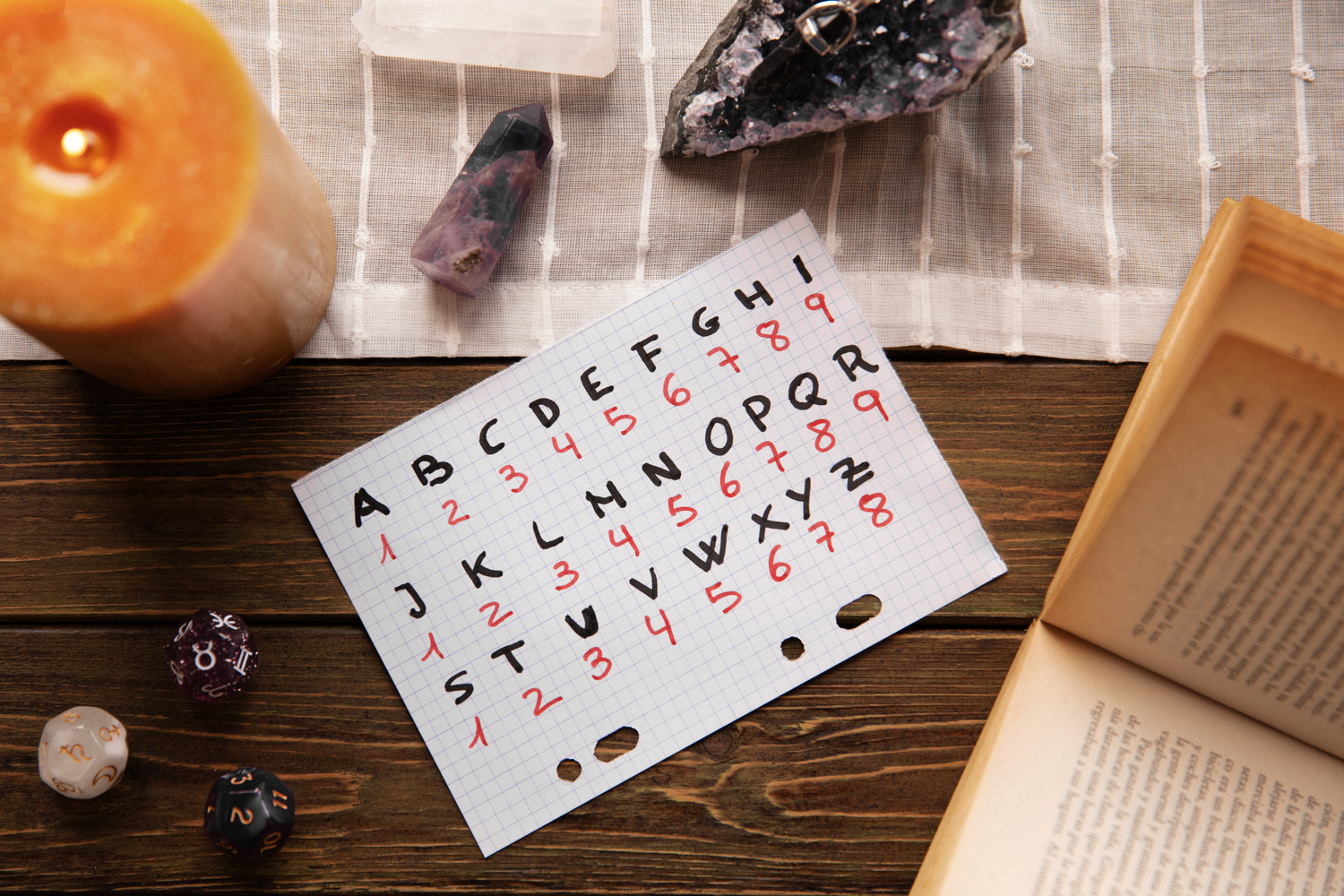
To calculate these numbers, you first need to convert each letter into its corresponding value according to the Pythagorean table. Then you make different sums depending on the number you want to obtain: all the letters for the Destiny or Expression Number, only the vowels for the Soul Urge Number, and only the consonants for the Personality Number.
The process is simple, but it is best to do it calmly. Write your full name, separate vowels and consonants, and check each letter before adding. In names with accents or special characters, the base letter is usually used for numerological calculations.
-
The Pythagorean Table Letter by Letter
The Pythagorean table assigns a number from 1 to 9 to each letter of the alphabet. The full correspondence is as follows:
- 1: A, J, S
- 2: B, K, T
- 3: C, L, U
- 4: D, M, V
- 5: E, N, W
- 6: F, O, X
- 7: G, P, Y
- 8: H, Q, Z
- 9: I, R
With this table, you can convert any name into a numerical sequence. Then, you only have to add and reduce the result until you obtain a number from 1 to 9, unless a master number appears: 11, 22, or 33.
-
Practical Example With a Full Name
Let’s take the name Olivia Carter as an example. First, each letter is replaced by its numerical value:
O (6) + L (3) + I (9) + V (4) + I (9) + A (1) + C (3) + A (1) + R (9) + T (2) + E (5) + R (9)
The total sum is:
6 + 3 + 9 + 4 + 9 + 1 + 3 + 1 + 9 + 2 + 5 + 9 = 61
6 + 1 = 7
In this case, the Destiny or Expression Number is 7.
To calculate the Soul Urge Number, only the vowels are taken:
O (6) + I (9) + I (9) + A (1) + A (1) + E (5) = 31
3 + 1 = 4
The Soul Urge Number is 4.
To calculate the Personality Number, only the consonants are taken:
L (3) + V (4) + C (3) + R (9) + T (2) + R (9) = 30
3 + 0 = 3
The Personality Number is 3. In this way, the same name offers three different readings: one about the potential for expression, another about inner motivation, and another about the image projected toward others.
-
What to Do With Master Numbers (11, 22, and 33)
Master numbers in numerology are 11, 22, and 33. When a sum reaches one of these results, it is not reduced further. That is, if by adding the letters you obtain 11, you do not turn it into 2; if you obtain 22, you do not turn it into 4; and if you obtain 33, you do not turn it into 6.
These numbers are interpreted as vibrations of greater symbolic intensity. This means they may indicate a broader potential, but also more demanding challenges when it comes to integrating that energy into everyday life. They do not indicate that a person is “better” or “more advanced”; they simply require a more careful reading.
It is also useful to remember that each master number contains the base of its reduction: 11 is linked to 2, 22 to 4, and 33 to 6. That is why, when interpreting them, both their elevated qualities and their simpler, everyday expressions are observed.
What Name Numerology Is For
Knowing the numbers that arise from your full name can be a form of self-knowledge. This does not mean that every description will match you exactly, or that you should adjust yourself to a fixed interpretation. It works more like a mirror: it shows you certain tendencies so you can observe them, question them, and understand yourself better.
This reading can help you distinguish between what moves you inside, what you express through your actions, and what others perceive in you. Perhaps you discover that your Soul Urge Number points to a need for stability, while your Personality Number projects a much more changeable or restless image. That difference can give you clues as to why others sometimes expect an energy from you that does not always match what you truly need.
It can also be useful when making decisions. You can ask yourself: Does this respond to what truly moves me? Does it allow me to use my abilities? Does the way I am presenting myself reflect what I want to communicate? The answers do not depend only on a number, but the calculation can give you a concrete reference point from which to look more honestly.
As with the birth chart, numerology does not replace your discernment or fully define who you are. It offers a symbolic language for looking at your experience from another angle. Used with discernment, it can help you recognize patterns, organize inner questions, and make decisions that are more aligned with who you are, not only with what others expect to see in you.