Oldest Evidence of Ayahuasca Use Found in Ancient Shaman’s Stash

Bolivian archeologists found what appears to be the world’s oldest evidence for the use of the psychedelic brew ayahuasca, in a shaman’s stash alongside a slew of other psychoactive substances. The ancient drugs were found in a 1,000-year-old pouch made of fox snouts in a cave in Cueva del Chileno in the highlands of the Andes.
The shaman’s pouch was originally thought to be a leather shoe when it was discovered back in 2010, but upon further inspection proved to contain a bundle with a headband, llama bone utensils, and various devices meant for crushing and inhaling psychoactive powders – a toolkit of primitive paraphernalia.
1000-Year Old Ancient Drugs
In addition, the shaman’s pouch contained a pharmacopeia of psychotropic herbs and plants containing DMT, such as chacruna, harmine (an ayahuasca compound), bufotenine (a DMT analogue found in toad venom), cocaine and a cocaine metabolite, and possibly psilocyn a psychoactive component of magic mushrooms.
According to Jose Capriles, an archeologist at Penn State University and one of the authors on the discovery’s paper, the array of psychotropic herbs found in the shaman’s pouch would have had to be sourced from very disparate areas of the Amazon, meaning this DMT shaman would have travelled many miles or had access to extensive trade routes to acquire his stash.
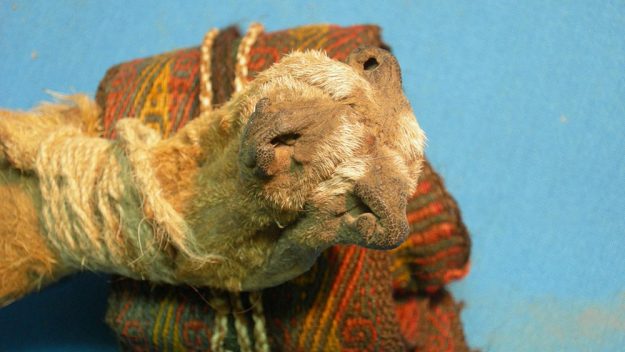
Shaman’s pouch made of fox snouts stitched together courtesy natgeo.com
The history of ayahuasca in the Amazon is believed to have been passed down over centuries –about 5,000 years— according to indigenous cultures, despite debate by western archeologists studying its history. But when it comes to western studies of ayahuasca, western academia is often stumped by the many inexplicable facets of the brew.
Such as how, out of 40 thousand plant species in the Amazon, did indigenous people know to combine specific vines and plants containing DMT and a substance that negates a very specific enzyme in the gut, to produce the most potent hallucinogen known to man. Not to mention the vast troves of medicinal combinations of those plants, which indigenous shamans and doctors say were revealed to them under the influence of ayahuasca.
In Jeremy Narby’s 1998 book The Cosmic Serpent, documenting his time spent among the indigenous Ashaninka tribe of Brazil, he concludes that the discovery of the DNA double helix strand was influenced by visions seen under the influence of ayahuasca. Narby says he believes the brew allows shamans to shrink their consciousness to the molecular level to “gain access to DNA-related information, which they call animate essences or spirits.”
Now with this recent discovery, it has become apparent that the use of these psychedelic substances was widespread and likely considered extremely valuable as tools of knowledge and spiritual sacrament. And as these substances slowly become more popular tools of healing and medicine in the western world, it seems we may be on the verge of discovering what indigenous cultures have held sacred for so many years.
For more on the shamanic rituals involved with ayahuasca and other psychedelics check out our series Psychedelica:
About the Author

Bicycle Day 2022 – 79 Years Since Albert Hofmann's LSD Discovery
Eight years before Albert Hofmann first synthesized LSD in 1938, Harry J. Anslinger was appointed the founding commissioner of the U.S. Treasury’s Federal Bureau of Narcotics. While both men were of Swiss descent and their life’s work centered around public drug use, their paths couldn’t have been more divergent. And now for this year’s Bicycle Day, as the tides of drug policy are shifting quicker than ever, their stories are increasingly relevant.
While most consider the United States’ war on drugs to have started with the Nixon or Reagan administrations, author Johann Hari in his book Chasing the Scream: The First and Last Days of the War on Drugs, urges our reconsideration of the country’s infamously failed attempt at drug prohibition to an earlier date.
Hari argues that based on racism, classism, and other prejudices, Anslinger was largely responsible for creating a zeitgeist of public misconception about nearly every drug, without regard to therapeutic applications or larger societal implications.
And though Anslinger’s tenure ended just before the criminalization of LSD, it was the foundation he set in place that widely villainized the chemical for decades.
But with the recent relaxation around psychedelic substances and the recognition of their potential as powerful healing modalities, Hofmann’s radical discovery may finally be realized for what he envisioned it could be.