The Eight Stages to Immortality and Contentment
The word Tao literally means “The Way,” and is pronounced “dow” (rhymes with how). Taoism began about 600 B.C., but its formal origins are generally attributed to the philosopher Lao-tzu and his book The Way of Power. In this text, he presents the concepts of inaction and spiritual harmony.
But Taoism has gone through many changes over the past 2,600 years. Taoism can be divided into two branches: one seeks a way to physical and social health and well being, and the other seeks a way to eternal reality and immortality. They work together, because a healthy physical self makes an excellent temple for an enlightened mind and immortal Spirit. One sect of Taoism was devoted to conforming to the Law of cause and effect (karma) while transcending the bonds of illusion and confusion. Much of this transcendence was realized through contemplative meditation, breathing exercises, and reversing the flow of energy in the body and thoughts in the mind.
Let’s explore The Way.
8 Stages to Immortality & Contentment
In The Book of Consciousness and Life, written in 1794 by Liu Hua-yang and later published in the popular Secret of the Golden Flower, there are eight stages to immortality and ultimate contentment. Liu Hua-yang begins each stage with a poetic instruction. Each contains attitudinal instructions for the mind and physical activities for the body. The overarching teaching for all of these stages is that all activity should lead to non-activity, all thought to non-thought, and in this still state one will reconnect with one’s true self, the primordial heaven from which we have all come, and rebalance the energy for eternal life.
1. Cessation of Outflowing
If thou would complete the diamond body with no outflowing,
Diligently heat the roots of consciousness and life.
Kindle light in the blessed country ever close at hand,
And there hidden, let thy true self always dwell.
“Heat the roots of consciousness and life” is both a physical and mental practice. Physically, it refers to awakening our root chakra and reversing its energy flow. Mentally, it refers to contemplation upon the genesis of our existence and our original nature. Who am I? What is my true “I am”? And How does my little “I am” correlate to the great “I AM”? As Plato posted above the entrance to his school: Know Thyself.
This Taoist poet and teacher is guiding us to “kindle light in the blessed country ever close at hand,” meaning our inner consciousness and inner body’s spiritual centers (chakras, sushumna, ida, and pingala). He instructs us that this is a hidden place where our “true self always dwells.” Fundamental to this first stage is completing our “diamond body,” by turning within to the original source of life. The diamond body is analogous to Jesus’ teaching that we must be born again. We’ve been born physically — now we must conceive, gestate, and give birth to our spiritual, eternal, true self.
2. Circulation in Conformity with the Law
If one discerns the beginning of the Enlightened One’s path,
There will be the blessed place of the West.
After the circulation in conformity with the Law,
There is a turn upward towards Heaven when the breath is drawn in.
When the breath flows out, energy is directed towards the Earth.
One cycle consists of six intervals.
In two intervals one gathers Sacred Energy.
The great Way comes forth from the center.
Do not seek the primordial seed outside!
The “blessed place of the West” is a poetic way of saying what we Westerners would call the Latter Days, the place of the setting sun, the end of an era. In other words, if we discern our enlightened soul’s path, we will see where it is ultimately headed: back to Heaven, back to the Father, as Jesus taught at the Last Supper. We’ll also see that the bodily path of the Enlightened One is along the kundalini channel, which Edgar Cayce encouraged us to awaken to and use.
“The circulation in conformity with the Law” is both physical and mental. It is a physical technique for raising the energy of our body through the kundalini pathway. This practice does not seek to simply raise the kundalini energy or life force in our body, but to circulate it. The teacher points out that when we inhale “there is a turn toward Heaven.” When we exhale “energy is directed toward Earth.” He states that it only takes two intentional cycles of inhalation and exhalation to gather the Sacred Energy latent in our body. Try this. Sit still … sense your deeper, true self and its eternal destiny. Then as you inhale, draw the energy upward from the root chakra to the top of your head. Hold your breath there for a moment; then, as you exhale, feel the energy flowing throughout your body, bathing it in raised energy, sacred energy. Pause with the lungs empty and your focus on the root chakra. Feel the stillness. Then repeat the breathing exercise again.
Finally, in this stage the instructor guides us not to seek the primordial seed outside of us. It is, as Jesus and so many others have taught, within us.
3. Two Paths of Function & Control
There appears the way of the in-breathing and out-breathing of the primordial path.
Do not forget the white path below the circulation in conformity with the Law!
Always let the cave of eternal life be nourished by the spirit-fire.
Ah! Test the immortal place of the gleaming pearl.
In this metaphorical stanza, the teacher is continuing the breathing exercise while encouraging us not to forget the deeper “white path below the circulation in conformity with the Law” (as you sow, you reap; as you think, so you become). The white path is consciousness. Edgar Cayce often pointed out to highly advanced souls the need to be careful not to forget the difference between the “channel” and the “Creative Forces.” Anyone can move the energy, because the body is arranged for this, but what impelling force is behind this energy? Is it the pure white light of the Creator? Or is it self’s ego? Self, especially righteous self, is a very subtle darkness.
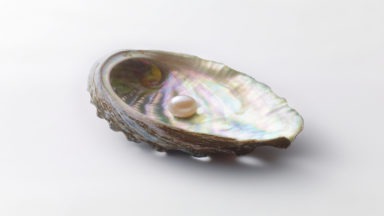
The “cave of eternal life” is the deeper consciousness, beyond the conscious mind and the outer self’s influence. Ezekiel told us that he could not find God in the lightning, the earthquake, or the thunder, but when he backed up to the mouth of the cave, he heard a still, small voice; and there was God. This Taoist teacher is saying the same thing. Nourish the cave of deeper consciousness with the fire of the Spirit, both physically and mentally. Then, just as Jesus encouraged us to test the spirits, the Taoist teacher tells us to test the immortal place. See that it is the pure place, white light, true Creator of all. He compares this to a “gleaming pearl,” which is a good metaphor. It is circular, as is the Sun disk, whole, the beginning and the end being one. And dealing with the irritation of life’s challenges makes this gleaming pearl in the same way that the pearl is formed around an irritating grain of sand in the oyster’s life. And it gleams when the light shines on it.
4. The Embryo of the Way
According to the Law, without exertion, one must diligently fill oneself with light.
Forgetting appearance, look within and help the true spiritual power.
Ten months the embryo is under spirit-fire.
After a year the washings and bathings become warm.
Here the teacher is giving us the gestation period for our rebirth of the true self. He encourages us to help the inner development by budgeting time for the breathing exercises (“washings and bathings” are the intentional inhalations and exhalations, circulating the energy through the body) and by filling ourselves with light. In Egyptian mysticism, Hermes guides us to experience the inner mystical illumination through meditation, and the outer through reading and studying of inspirational writings. Cayce adds that outer-life application of inner experiences brings the fuller understanding.
5. The Birth of the Fruit
Beyond the body there is a body called the Enlightened image.
The thought that is powerful, the absence of thoughts, is Light.
The thousand-pedaled lotus flower opens, transformed through breath-energy.
Because of the crystallization of the spirit, a hundredfold splendor shines forth.
Stage 4 states that after one year the embryo is ready for birth. Stage 5 is that birth. The breathing exercises and the raising of consciousness have opened the lotus flower and crystallized the spirit. Within the physical body and conscious mind are a new body and a new mind.
6. Retaining the Transformed Body
Every separate thought takes shape and becomes visible in color and form.
The total spiritual power unfolds its traces and transforms itself into emptiness.
Going out into being and going into non-being, one completes the miraculous Way.
In this stanza the teacher gives insights into how to maintain the new body, the new mind. Just as the Psalmists of Western biblical thought, he addresses the “going out” and the “coming in” as our daily cycle. This cycle is “the miraculous Way.” Day and night; wakefulness and sleep; activity and non-activity; thought and non-thought; form and formlessness; being and non-being are the rhythms that lead to reunion with a true source. Too much outer life, and we lose the Light to guide us. Too much inner life, and we cannot make enlightenment a living part of us. Budget time for both inner and outer life. Oneness will eventually encompass both.
7. Face Turned to the Wall
The shapes formed by the spirit-fire are only empty colors and forms.
The light of human nature shines back on the primordial, the true.
The imprint of the heart floats among the clouds; untarnished, the moonlight shines.
The boat of life has reached the shore; bright shines the sunlight.
Waxing transcendental, the teacher takes us into the upper reaches of infinite consciousness and life. His imagery is a poetic rendering of his personal experience with reunion to the true, the primordial, the shore of paradise.
In the final stage, he attempts to describe what cannot be described. It is the ineffable, transcending state of pure at-onement with the infinite, the universal, from out of which all life came and in which all life has its existence.
Watch a trailer for The Immortal Path: The Tao of Tai Chi Chuan
About the Author
Water Rituals to Spiritually Connect with the Sacred Element
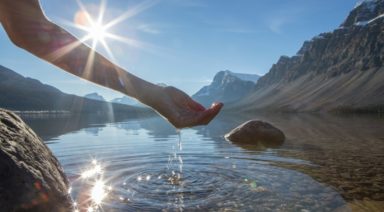
Water is a life-giving element with profound importance, recognized and celebrated across cultures. It’s not only essential for survival but also revered for its spiritual significance, offering renewal, purification, and connection to the divine. When we connect deeply with the element of water, we honor its role as a giver of life and develop a greater sense of well-being and appreciation. This connection can help us foster respect for this sacred element while enhancing our personal sense of balance and vitality.
Spiritual Meaning of Water Across Traditions
Water’s symbolism—representing renewal, fertility, purification, and transformation—holds significant spiritual meaning across religions. In Christianity, for instance, baptism with water signifies purification and acceptance into the faith, echoing stories of Jesus and the cleansing power of holy water. Similarly, in Greek traditions, water is seen as a bridge to the divine, used in offerings to gods of the sea and rivers.
Religious practices worldwide incorporate water as a tool for blessing, connection, and spiritual awakening. In Islam, daily ablutions (wudu) cleanse the body in preparation for prayer, aligning one’s spirit with sacred intentions. Hinduism reveres sacred rivers like the Ganges, believed to have powerful spiritual properties that cleanse impurities and aid in liberation from the cycle of rebirth, or Moksha. These rituals underscore water’s spiritual role in supporting life and guiding transformation.
Purification through Water
Ritual cleansing practices, or ablutions, are foundational in many faiths. In Judaism, the mikveh—a bath used for full-body immersion—restores ritual purity, while netilat yadayim involves washing hands upon rising and before meals. In Christianity, baptism serves as a purification act, welcoming individuals into the church through holy water. Similarly, Hindu rituals encourage bathing in sacred waters, which cleanse spiritual impurities and connect devotees to the divine.
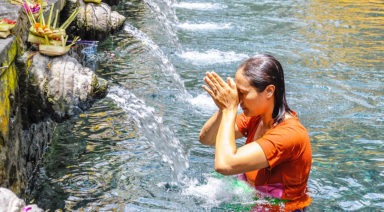
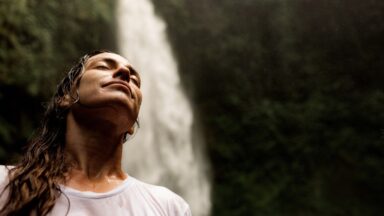
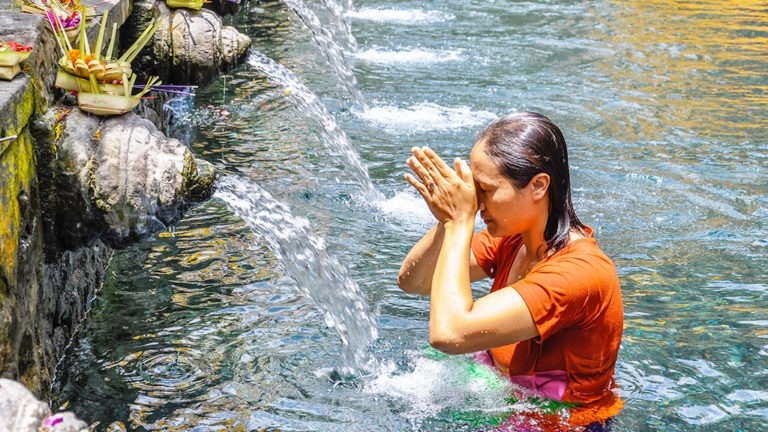
Across cultures, holy sites near rivers, springs, and other water sources invite pilgrims to partake in this purifying element. In Bali’s Agama Tirtha, or “religion of the holy water,” devotees seek purification and blessings at temples with flowing holy water, such as Tirta Empul. Here, worshippers immerse themselves to wash away impurities and connect with the sacred.
Infusion of Blessings
The idea that water holds “memory” has resonated in spiritual traditions. The Japanese researcher Masaru Emoto suggested that positive thoughts and blessings could alter the molecular structure of water, enhancing its vitality. This notion aligns with practices in Bali, where priests bless water through mudra (sacred gestures) and mantra (sacred sound) to imbue it with divine energy. Similarly, Christian ministers may sanctify water for sacramental and protective purposes, showing how different faiths infuse water with blessings.