Name Numerology: What Your Name Says About You
Your name has been with you from the beginning: you hear it, sign it, respond to it, and carry it through every stage of your life. Rarely, however, do you stop to look at it closely. Numerology proposes exactly that: observing it not only as a form of identification, but as a key that can reveal aspects of your deeper identity.
In this article, we explore what your name reveals about you, which main numbers arise from it, and how to calculate them step by step.
Table of Contents
- Numerology and Its Relationship With Names
- The Three Main Numbers of Your Name
- How to Calculate the Numbers of Your Name Step by Step
- What Name Numerology Is For
Numerology and Its Relationship With Names
Numerology begins with a very ancient idea: that numbers are not only used to measure or count, but also hold a meaning of their own. Each digit, from 1 to 9, is associated with a set of specific qualities. The name is one of the elements this discipline uses as the basis for its interpretation, because it turns something as everyday as your letters into a symbolic key to who you are.
To arrive at that meaning, it starts from a simple principle: each letter corresponds to a number. In this way, your full name stops being only a set of sounds and becomes a sequence of digits that can be added together and interpreted. That sequence, once deciphered, begins to speak about your way of being.
There is something particular about working with the name: you did not choose it yourself, it was given to you at birth and, over time, became inseparable from who you are. Numerology uses it as a starting point to talk about you. What it offers, ultimately, is one more language for knowing yourself.
In the episode Numerology from the series The Other Side, available on Gaia, numbers are explored as a symbolic language for better understanding personal experience. There, numerology is presented not as a form of divination, but as a tool for observing who you are, how you show up in the world, and what patterns appear on your path.
The Three Main Numbers of Your Name
When working with the full name, there are three numbers that are considered especially important: the Destiny or Expression Number, the Soul Urge Number, and the Personality Number. Each one is calculated using a different part of the name and reveals a specific dimension of your way of being.
It may help to think of them as three levels of interpretation. One speaks of your visible potential, another of your inner motivation, and another of the image you project. They do not compete with each other: they complement one another.
-
The Destiny or Expression Number
The Destiny Number, also called the Expression Number, is calculated by adding all the letters of the full name. It is one of the broadest numbers in the analysis because it takes the entirety of the name into account, not just one part.
It is related to your talents, abilities, and personal resources. It speaks of the way you tend to act, create, solve, build, or communicate when you express your potential with greater clarity.
It does not indicate a fixed destiny or a series of inevitable events. Rather, it points to the tools you have available to move forward on your path and the way you can develop what is already within you.
-
The Soul Urge Number
The Soul Urge Number is calculated only with the vowels of the full name. In numerology, vowels are associated with a person’s innermost dimension: what they desire, value, and need in order to feel aligned.
This number can help you recognize what truly moves you, even when you do not express it in an obvious way. Sometimes it appears in quiet decisions: a choice that may seem illogical from the outside, but feels necessary within.
It can also reveal tensions between what you deeply want and what you do out of habit, obligation, or external expectation. That is why it is often a very useful number for reviewing motivations, relationships, and important decisions.
-
The Personality Number
The Personality Number is obtained from the consonants of the full name. Unlike the Soul Urge Number, it does not focus on what you feel inside, but on the way you show yourself to the outside world.
This number describes the first impression you can create, the type of energy you communicate, and certain traits that others often perceive easily. Depending on the result, it can speak of a more reserved, firm, sensitive, creative, practical, or expansive image.
Knowing it does not mean adjusting your behavior to be more pleasing to others. It helps you observe whether the way you are perceived matches what you feel you are, or whether there is something in the way you express yourself that you could refine in order to relate with greater authenticity.

How to Calculate the Numbers of Your Name Step by Step
To calculate these numbers, you first need to convert each letter into its corresponding value according to the Pythagorean table. Then you make different sums depending on the number you want to obtain: all the letters for the Destiny or Expression Number, only the vowels for the Soul Urge Number, and only the consonants for the Personality Number.
The process is simple, but it is best to do it calmly. Write your full name, separate vowels and consonants, and check each letter before adding. In names with accents or special characters, the base letter is usually used for numerological calculations.
-
The Pythagorean Table Letter by Letter
The Pythagorean table assigns a number from 1 to 9 to each letter of the alphabet. The full correspondence is as follows:
- 1: A, J, S
- 2: B, K, T
- 3: C, L, U
- 4: D, M, V
- 5: E, N, W
- 6: F, O, X
- 7: G, P, Y
- 8: H, Q, Z
- 9: I, R
With this table, you can convert any name into a numerical sequence. Then, you only have to add and reduce the result until you obtain a number from 1 to 9, unless a master number appears: 11, 22, or 33.
-
Practical Example With a Full Name
Let’s take the name Olivia Carter as an example. First, each letter is replaced by its numerical value:
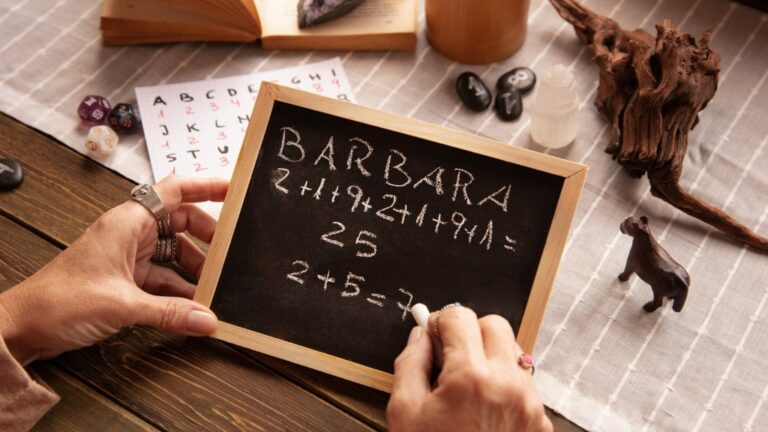
O (6) + L (3) + I (9) + V (4) + I (9) + A (1) + C (3) + A (1) + R (9) + T (2) + E (5) + R (9)
The total sum is:
6 + 3 + 9 + 4 + 9 + 1 + 3 + 1 + 9 + 2 + 5 + 9 = 61
6 + 1 = 7
In this case, the Destiny or Expression Number is 7.
To calculate the Soul Urge Number, only the vowels are taken:
O (6) + I (9) + I (9) + A (1) + A (1) + E (5) = 31
3 + 1 = 4
The Soul Urge Number is 4.
To calculate the Personality Number, only the consonants are taken:
L (3) + V (4) + C (3) + R (9) + T (2) + R (9) = 30
3 + 0 = 3
The Personality Number is 3. In this way, the same name offers three different readings: one about the potential for expression, another about inner motivation, and another about the image projected toward others.
-
What to Do With Master Numbers (11, 22, and 33)
Master numbers in numerology are 11, 22, and 33. When a sum reaches one of these results, it is not reduced further. That is, if by adding the letters you obtain 11, you do not turn it into 2; if you obtain 22, you do not turn it into 4; and if you obtain 33, you do not turn it into 6.
These numbers are interpreted as vibrations of greater symbolic intensity. This means they may indicate a broader potential, but also more demanding challenges when it comes to integrating that energy into everyday life. They do not indicate that a person is “better” or “more advanced”; they simply require a more careful reading.
It is also useful to remember that each master number contains the base of its reduction: 11 is linked to 2, 22 to 4, and 33 to 6. That is why, when interpreting them, both their elevated qualities and their simpler, everyday expressions are observed.
What Name Numerology Is For
Knowing the numbers that arise from your full name can be a form of self-knowledge. This does not mean that every description will match you exactly, or that you should adjust yourself to a fixed interpretation. It works more like a mirror: it shows you certain tendencies so you can observe them, question them, and understand yourself better.
This reading can help you distinguish between what moves you inside, what you express through your actions, and what others perceive in you. Perhaps you discover that your Soul Urge Number points to a need for stability, while your Personality Number projects a much more changeable or restless image. That difference can give you clues as to why others sometimes expect an energy from you that does not always match what you truly need.
It can also be useful when making decisions. You can ask yourself: Does this respond to what truly moves me? Does it allow me to use my abilities? Does the way I am presenting myself reflect what I want to communicate? The answers do not depend only on a number, but the calculation can give you a concrete reference point from which to look more honestly.
As with the birth chart, numerology does not replace your discernment or fully define who you are. It offers a symbolic language for looking at your experience from another angle. Used with discernment, it can help you recognize patterns, organize inner questions, and make decisions that are more aligned with who you are, not only with what others expect to see in you.
About the Author

What Is the Fourth Dimension and Why You’re Already In It

The spiritual fourth dimension is a plane of existence that allows us to understand the internal processes behind everything we experience. Unlike the third dimension, where the physical predominates, the 4th dimension organizes time, dreams, emotions, and subtle energies. In this article, we explore what the spiritual 4th dimension is from the perspective of Matías De Stefano, as explained in the series Initiation, available on Gaia.
Table of Contents
- What Is the Spiritual Fourth Dimension?
- Differences Between the Third, Fourth, and Fifth Dimensions
- Time as a Structure in 4D
- Energetic Characteristics of the Fourth Dimension
- The Astral Planes in the 4th Dimension and Their Levels
- The 4th Dimension After Death
- Beings That Inhabit the Fourth Dimension
- Dreams, Time, and Manifestation in 4D
- The Fourth Dimension as a Bridge to the Fifth
What Is the Spiritual Fourth Dimension?
The spiritual fourth dimension is one of the nine dimensions of the universe and is part of the energetic structure that composes all reality. It is not a place one reaches, but a plane that coexists with physical reality. While in the third dimension we perceive shapes, objects, and limits, in the fourth, the focus is on the processes that pass through those forms: movement, change, and constant transformation. This level of consciousness allows us to observe what lies behind the visible and better understand how events are organized from the subtle.
In this dimension, time is not perceived as a continuous line, but as a network of simultaneous possibilities. It is the space where our emotions, thoughts, memories, and future projections are stored. Everything we feel and think leaves a trace on this plane, which acts as an energetic matrix from which material reality is later organized.
In the series Initiation, available on Gaia, it is shown how this intermediate level between the physical and the spiritual allows us to understand the patterns we repeat, the emotions that condition us, and the relationships that transform us. Through this understanding, real transformation from within becomes possible, recognizing that every change in matter begins first in the energetic field.
Differences Between the Third, Fourth, and Fifth Dimensions
Each dimension represents a different way of experiencing life. Although all are present at the same time, how we relate to each one depends on the level of consciousness from which we inhabit reality. Understanding these differences allows us to integrate experience from a broader perspective.
- Third dimension: This is the physical and concrete plane. Here, consciousness identifies with the body, time is experienced as a line, and reality is interpreted through separation and rational logic.
- Fourth dimension: This is the plane of time, emotions, and energy in motion. Here, invisible connections between events, dreams, and intentions begin to be perceived.
- Fifth dimension: This is a state of expanded consciousness where everything is experienced as part of a greater unity. Time and space integrate, and a complete vision of the soul’s purpose is accessed.
Time as a Structure in 4D
In the fourth dimension, time is not a straight line from past to future, but a living structure that contains all processes of change. What we understand as “past,” “present,” and “future” coexists within the same field, where everything can be perceived as simultaneous. It’s as if all life stages—from childhood to old age—were happening at the same time from another perspective.
This dimension does not focus so much on events themselves, but on how they transform over time. Here, what matters is not what happens, but the process that generates it: the emotion that accompanies it, the intention that drives it, the lesson it leaves behind. This is why accessing the fourth dimension means coming into contact with the dynamism of existence— with the invisible aspect that organizes the visible.
When one lives from this perspective, time ceases to be a limitation. It becomes a tool to understand cycles, review memories, transform repeating patterns, and open up to new possibilities. The fourth dimension doesn’t eliminate time—it expands it.
Energetic Characteristics of the Fourth Dimension
The fourth dimension is characterized by a type of energy subtler than that of physical matter, but denser than that of higher planes. Here, everything emotional and symbolic gains strength, and forms are molded by the frequency emitted from within. Personal vibration plays a fundamental role in how this plane is perceived and experienced.
- Active emotional field: Emotions are the dominant energy at this level. Everything you feel directly influences what you experience.
- Malleable reality: Forms are not fixed. They change according to your vibrational state and internal perception.
- Presence of symbols: Symbols, archetypes, and dreams play a central role. They act as a language of communication between planes.
- Echoes of thought: What is thought creates resonances. Ideas manifest more quickly and with greater clarity.
- Direct energetic interaction: There are no material filters. One being’s energy can immediately affect another if there’s no balance or conscious protection.
The Astral Planes in the 4th Dimension and Their Levels
Within the fourth dimension, there are different levels known as astral planes. These planes are not fixed places but vibrational states that correspond to the frequency of the one who inhabits or travels through them. Each plane reflects a particular type of experience and perception of reality.
- Lower astral: This is a dense level, where fear, unresolved emotions, and material attachments predominate. Here, energetic forms related to conflict, confusion, or suffering are manifested.
- Middle astral: This is a space of emotional and symbolic transition. At this level, consciousness begins to free itself from density, and processes of understanding and transformation become possible.
- Higher astral: This corresponds to higher frequencies, linked to clarity, harmony, and spiritual expansion. Here, perception is more luminous, and the soul prepares to access more subtle planes.
The 4th Dimension After Death
From the perspective of Matías De Stefano, when the physical body completes its cycle in the third dimension, consciousness does not disappear, but projects itself into the fourth dimension. This energetic projection is not random: it takes shape according to what the person has cultivated internally throughout their life. Emotions, beliefs, and mental patterns determine how this new reality is experienced, which is no longer limited by matter.
In this dimension, experience is entirely subjective and is constructed from within. Those who have lived with fear or attachment may generate chaotic or dense scenarios. On the other hand, those who have gone through life with greater balance access more harmonious planes. The fourth dimension neither judges nor rewards—it simply reflects and amplifies what consciousness already contains.
This transition does not imply a definitive separation but a continuous transformation. Energy remains in motion, and the soul retains the possibility to learn, release burdens, or prepare for new experiences. The 4th dimension functions as a reorganization field, where what has been lived is understood and the path is redefined before moving on to subtler levels of existence.
Beings That Inhabit the Fourth Dimension
In the fourth dimension, there are multiple life forms that do not have physical bodies but actively interact with the energetic field of human beings. Some of these presences offer guidance, others serve as teachers, and some feed on dense emotions. The relationship with these beings does not depend on chance but on the vibration from which one accesses this plane.
- Spiritual guides: They accompany processes of consciousness without imposing paths. Their presence is subtle and often manifests as intuitions, dreams, or synchronicities.
- Symbolic beings: They appear in archetypal forms in the dream or meditative world. They function as mirrors of the unconscious and help integrate internal aspects.
- Energetic parasites: They feed on fear, guilt, or anger. They often approach people with energetic cracks or emotional imbalance.
- Time beings: They are not tied to physical forms but to processes. They perceive reality as a web of simultaneous moments and can manifest according to the observer’s perception.
- Ancestral presences: They represent family, cultural, or planetary memories. They usually appear when it is necessary to recognize, heal, or integrate stories that still impact the present.
Dreams, Time, and Manifestation in 4D
In the fourth dimension, dreams are real experiences within an energetic plane that does not follow the laws of the physical world. Here, time does not follow a linear sequence but appears as a space of multiple possibilities. While sleeping, part of our consciousness detaches from the physical body and accesses this structure, where it can explore memories, anticipate situations, or encounter symbols that represent internal processes.
This level functions as a testing ground where thoughts and emotions take shape. Ideas that are repeated with clarity and coherence can solidify and begin to organize the reality that later manifests in the third dimension. That’s why dreams often anticipate events or offer insights to understand what’s happening in everyday life. They are not meaningless illusions—they are energetic movements within a plane of creation.
When one accesses the fourth dimension consciously, it becomes possible to recognize how events are generated before they happen. This awareness allows for the transformation of limiting beliefs, the release of trapped emotions, or the redirection of intentions more precisely. It is a way to actively participate in the manifestation process, using time not as a limitation, but as a tool for creation.
The Fourth Dimension as a Bridge to the Fifth
The fourth dimension plays an essential role as a space of transition between the density of matter and expanded consciousness. Here, the old is dismantled, internal energy is reorganized, and processes that were previously unconscious become clear. This plane is not a final destination but a stage that prepares the ground for accessing higher states of understanding and unity. Integrating this dimension is fundamental to evolving toward higher levels of consciousness.
To reach the fifth dimension, one must first go through and integrate the experiences of the third and fourth. It is not about “skipping” stages, but about recognizing how each one offers unique tools for the soul’s journey. In the fourth dimension, distortions are cleared, emotions are aligned, and the creative power of thought is acknowledged. Only then can one sustain the subtler and more coherent frequency that the consciousness of unity requires.
From this perspective, the fourth dimension is a plane of conscious transformation. It not only reveals what needs to be understood but also offers the means to do so. By inhabiting this level with presence and openness, one builds the bridge that enables the shift from a fragmented perception of reality to a broader, more integrated view aligned with the soul’s purpose.