Cymatic Science Explains the Benefits of Mantra
Physicists know that energy is in eternal motion. According to the Vedas, everything we perceive is the manifestation of oscillating energy. Modern science recognizes electromagnetic frequencies, what the Vedics call “shakti,” as the primal energy source of form. It is vibration and frequency that organizes “this” into “this” and “that” into “that” — including each of us.
While this is an oversimplification of the Vedic view of creation and existence, as well as energy science, quantum physics now agrees, since discovering that atoms, and their components, are in perpetual states of vibration. Both systems assert that it is this endless dynamic energy that becomes sound, light, heat, and ultimately form, when reduced to the most basic state, causing creation to pulse with the rhythms of energy moving in waves.
Bijas and Mantra Benefits
The Sanskrit word “mantra” translates into two words; “man,” meaning “mind,” and “to think,” and “tra,” meaning “tool” or “instrument.” Mantra is an instrument of the mind, or a tool for thought. Frits Staal, founder of the department of South Asian Studies at U.C. Berkeley and a Vedic scholar, believed mantras pre-date language and words.
Mantra “bijas,” or “seeds” are single-syllable words that carry the essence of a principle. OM is a bija that is used alone or combined with other bijas to make mantric phrases, i.e. “Om Mani Padme Hum.” The bija “OM” is rich with meaning — learn more here.
All mantra, whether spoken or silent, oscillates as subtle frequencies within the body. Karmic habits (how we react the same way over and over again) are imprinted on our energetic being — mantra can subtly change energetic karmic patterns and tendencies. Mantra raises or shifts our subtle frequency, and can “upgrade” our karmic address by helping us change old, unconscious patterns.
Along with invoking specific qualities, spoken or silent mantra recitation protects the mind from reactivity, and can “tame” the wild horse of discursive thought. The untamed mind is the source of karma, in that it draws conclusions and judgements that trigger reactivity of all kinds — for better or worse. Discursive mind has a habit of believing itself to be “right;” always correct in its limited perceptions — often conclusions based on ignorance. By training the mind with mantra, we begin to break out of karmic tendencies and ignorance and open to the world as it is.
Forms of mantra can be found in many traditions. Early Christians chanted single verses from scripture in the same way the Vedics chant mantra. An ancient instruction from a Christian mystic to his student was, “whatever work you are doing, or office you are holding, or journey you are making, do not cease to chant your verse. We must ceaselessly and continuously pour forth the prayer of this verse if we seek holiness.”
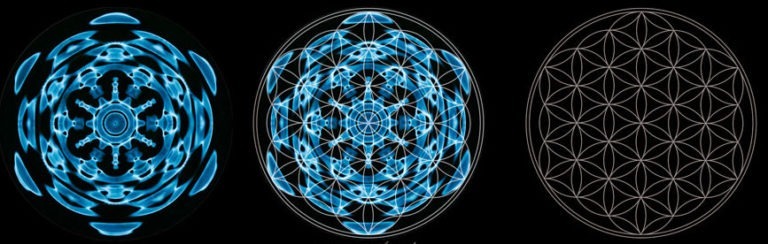
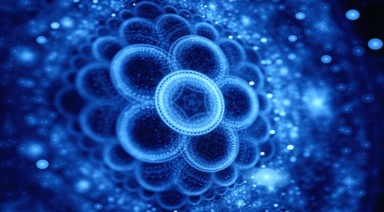
A cymatic image displaying attributes of the universal flower of life geometry
Cymatics
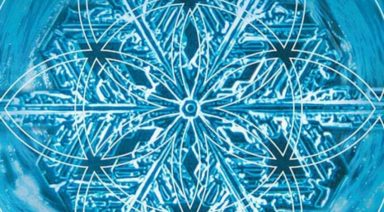
Derived from the Greek word for “wave,” cymatics is essentially the study of how sound waves and frequencies influence matter. This is illustrated by a substance (salt, sand) suspended in water or on a surface sensitive to vibration. When exposed to sound, substances flow into visible patterns and shapes. Cymatic experiments have documented the ever-changing forms and designs that reflect principles of sacred geometry and biology.
Some researchers theorize that cymatic action on matter created life, using deep-sea hydrothermal vents to illustrate the theory.
“The hydrothermal vents spewed mineral-rich gases from earth’s core into the seawater and made contact with molten lava in the vicinity of the vent, causing bubbles to form that ranged in size from melons to microbes.
“The elements that poured out of the vents emerged into highly turbulent water in an ocean of rich bubbling sounds. The watery membrane surfaces of the microscopic bubbles offered the perfect places for sound structures to be imprinted with cymatic patterns of energy,” according to the cymascope.com website.
Researcher John Stewart Reid has hypothesized that cymatic action is responsible for Saturn’s visible atmospheric hexagon, caused by a constant stream of ELF, or “extremely low frequency” energy.
By observing cymatic action, we realize that sonics and sound waves impact the body, which is 65 to 70 percent water. Since the body directly influences the mind, by changing the body, we change the mind the same way soundwaves change water and sand. Conversely, when the mind changes, so does the body.
Sonic Science and Wisdom
Science has begun mapping the deep, intricate influences of sound and frequency on the human brain and nervous system. Exploration of sound as a healing modality has exploded in recent decades — sonics are being used for pain management, enhanced learning, performance, immune system health, depression, and many more physical and mental health issues. While science has discovered some of the ways the brain and nervous system respond to sound, sonic and acoustic mysteries are still waiting to be cracked — science is still catching up with ancient wisdom.
To a fetus, the mother’s heartbeat is the entire world. The instinctual human affinity for rhythm is hardwired by our first perception of sound as heartbeat — and not just “heard” sound; the mother’s heartbeat pulses through the entire fetus. Studies have determined that infants who could hear recordings of their mothers’ heartbeat were calmer and cried less. The heartbeat is the matrix of life from womb to tomb — when it stops, we stop.
Jung believed that sound and rhythm were means to access the collective unconscious. Perhaps he was aware that shamanic and indigenous traditions recognize the power of drumming as a potent tool for healing. The shaman or medicine man uses drumming to enter a trance state and travel to other realms to learn of a patient’s illness or dis-ease. Tribes of all times and places enact ritual and ceremony with drumming and dancing.
Whether dancing at an EDM party or festival, or waltzing in a ballroom, those who join together in music and movement are “tribe,” even if just for that moment. Imagine a flamenco dancer with staccato heels whirling to a singer’s lament while the clan claps rhythms in ecstatic trance; a marching band with staccato drums and bright brass instruments rousing a crowd to blood-stirring support for its team at a high school football game; or the woeful wail of bagpipes moving funeral mourners to tears.
Spanda: The Sound of Shakti and the Word
According to ancient tantric sutras, we live and die within the vast, primal heartbeat that the Vedics referred to as the “Spanda.” Derived from the Sanskrit root “spadi,” meaning “to move a little,” the word reflects the yogic perception of the subtle, creative pulse of the universe.
These principles are reflected in Judeo-Christian literature when, in Genesis, God speaks formlessness into form with the words “let there be light;” it was the ‘word’ that brought forth light. The famous passage in John 1:1 in the New Testament says, “In the beginning there was the Word; the Word was with God, and the Word was God.”
One argument is that since light travels faster than sound, wouldn’t light preceed sound in creation stories? In 2017, a research team at Middle Tennessee State University conducted an experiment that demonstrated that “sound pulses can travel at velocities faster than the speed of light.” Other experiments have had the same result. Sound can be prior to light.
As humans, our perceptual window is microscopic relative to all there is in space and time. We stumble across puzzle pieces and iceberg tips as we struggle to bring the infinite into focus. Our year of 365 days is a fraction of Saturn’s 29 year trip around the sun. If we can imagine cosmic cymatic activity on a vast scale over (what would be for us) oceans of time, we could conceptualize the universe as the cymatic expression of the spanda. As above, so below; perhaps the key to unlocking vast, cosmic mysteries may be observing energy’s influence on matter on our human scale.

The great hexagon on Saturn’s North Pole. Source: NASA
About the Author

Biorhythms: A Comprehensive Guide to Balancing Biological Rhythms
Seasons have cycles, from amber fall days to verdant spring mornings covered in dew; day and night cycle between light and dark; the oceans swell and recede; the moon swells and thins to a crescent. If all other forms of life have inherent rhythmic cycles, are humans any different? The simple answer is no. Whether we’re aware of it or not, humans operate on a delicate biorhythm of various biological cycles, from the physical, intellectual, intuitive, and spiritual to even the aesthetic.
In this article, we’ll go over what biorhythms are, how to read yours, how they impact life, and more.
What are Biorhythms?
Derived from the Greek root words, bios (life) and rhythmos (regularly occurring movement or motion), biorhythm can be thought of as the body’s holistic mathematical system that can predict, or when studied, consciously control certain aspects of one’s life such as high performance, creativity, and emotional receptivity.
Biorhythms are “invisible waves of energy within the human body that are constantly in flux.” Considered unique to each person, these energy levels are thought to begin the moment we are born. But how and when did biorhythm theory begin?